English Archive

  • ICU dyspnoea assessment tools: Norwegian translation and inter-rater reliability

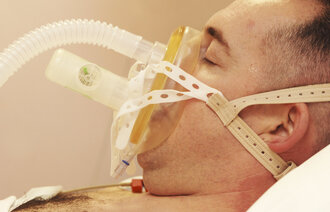
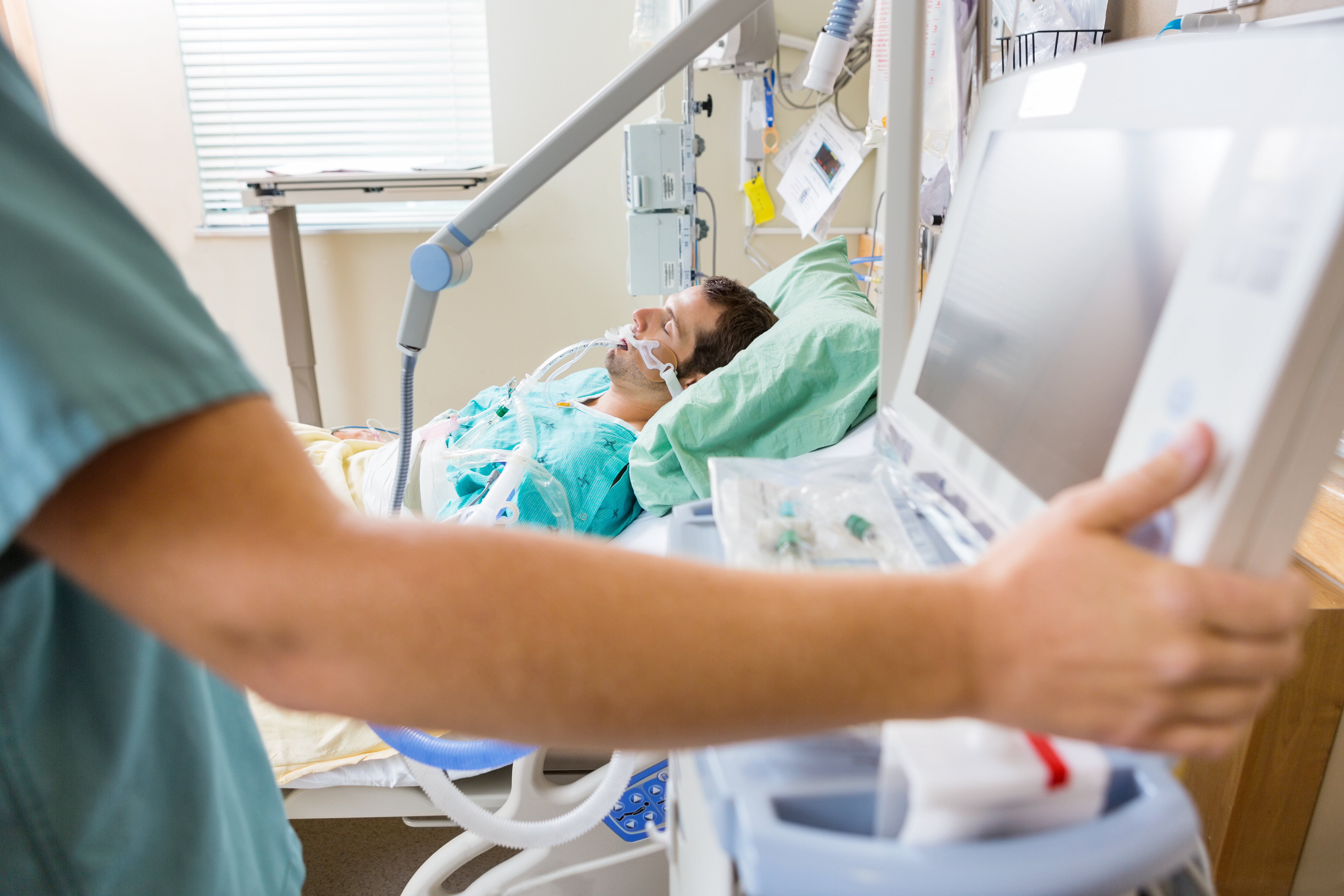
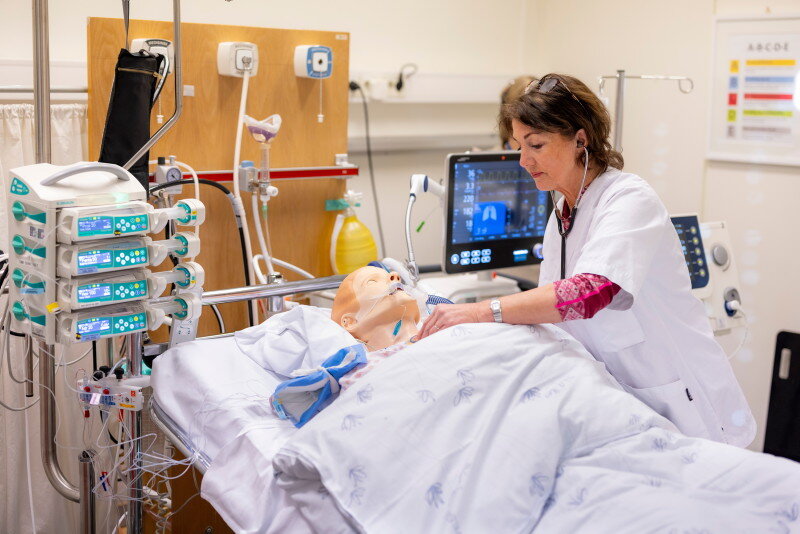
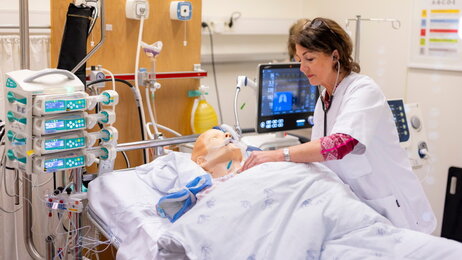
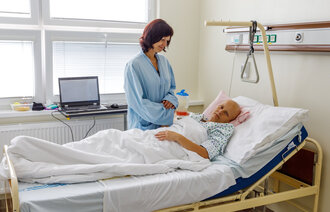
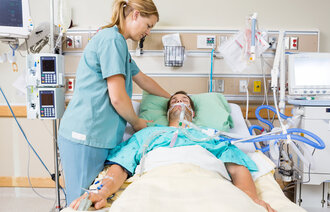
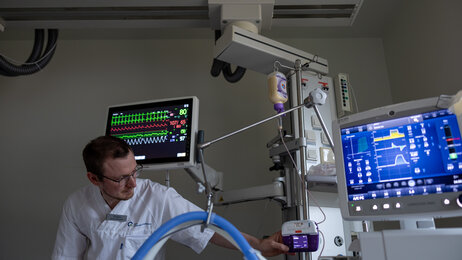
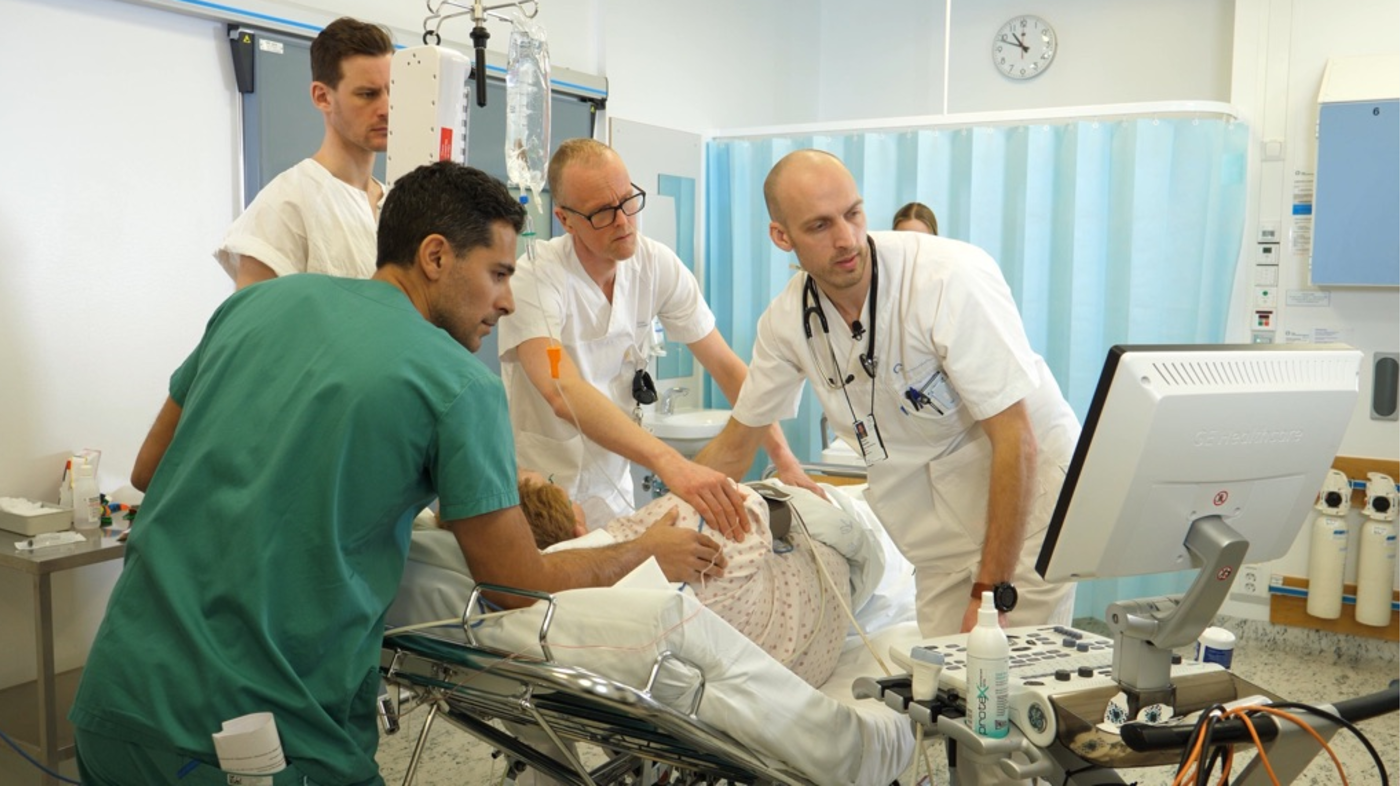
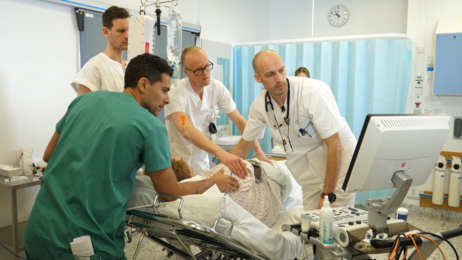
    The photo shows nurse pressing monitor's button with male patient lying on bed in hospital

    Introduction

    In Norway, approximately 18,000 people need intensive care treatment annually (1)Critically ill patients are exposed to several sources of discomfort in the intensive care unit (ICU) (2). Pain, thirst, anxiety, dyspnoea and inadequate sleep are the five most common and stressful symptoms ICU patients can experience (3). 

    While pain has traditionally been the primary focus of symptom research, dyspnoea has received increasing attention in recent years (2, 4). Like pain, dyspnoea can be experienced by the patient despite analgosedation and should be evaluated daily (3). Dyspnoea is defined as ‘a subjective experience of breathing discomfort that consists of qualitatively distinct sensations that vary in intensity‘ (5, p. 436).

    Studies report that 34–55% of adult ICU patients reported significant dyspnoea (6–8). A recent multi-centre study that also included patients from our site found that one in three patients self-reported difficulty breathing during the first seven days of their ICU stay (9). Being a stressful symptom for the ICU patient, dyspnoea can also negatively impact treatment and result in failed or delayed weaning from mechanical ventilation (10, 11). Furthermore, ICU-related dyspnoea is associated with post-traumatic stress disorder (8). 

    The trend in recent decades has been for patients to remain more awake in the ICU, be mobilised earlier and receive lower doses of sedatives. The prevalence of dyspnoea may increase when patients receive less sedation or are ventilated with lower tidal volumes; however, many ICU patients are unable to communicate their symptoms (11–13). 

    Patients unable to communicate due to factors such as delirium, use of sedatives and endotracheal tubes make dyspnoea evaluation challenging (12). These factors, combined with the feeling of not being able to breathe as much as the body requires, may lead to anxiety for patients (4, 7, 14). Despite its impact, dyspnoea is often underestimated and underreported by healthcare professionals (6, 14, 15). 

    Haugdahl et al. enrolled 100 ICU patients and found that nurses and physicians underestimated dyspnoea in 56% and 48% of patients, respectively (15). These findings highlight the need for validated tools to identify dyspnoea in non-communicative ICU patients (16).

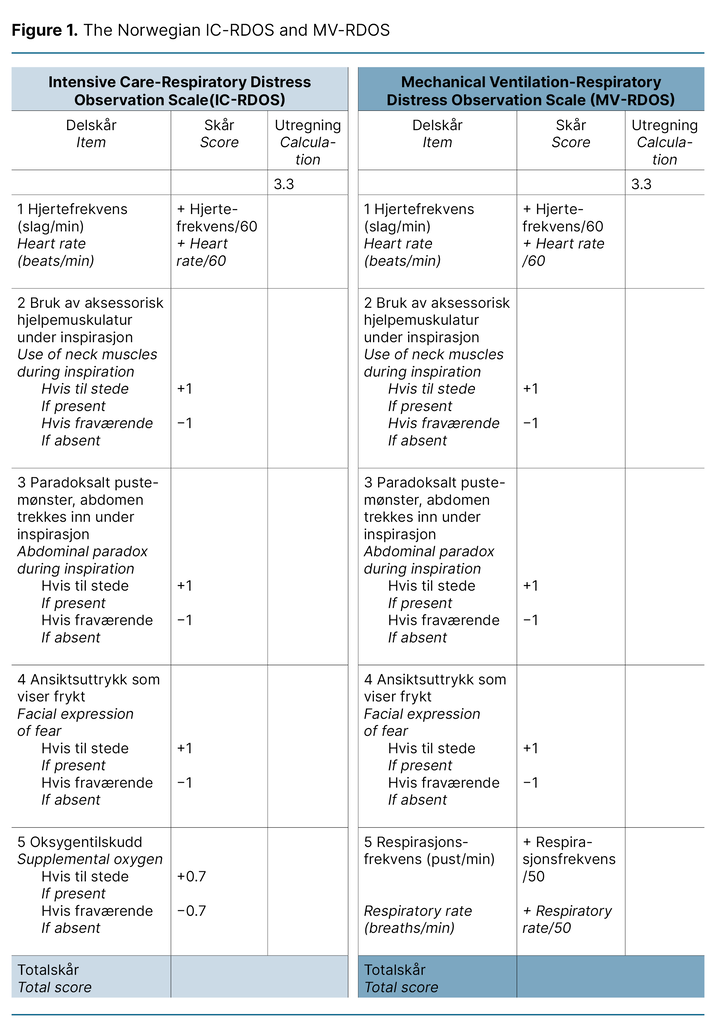
    The Intensive Care-Respiratory Distress Observation Scale (IC-RDOS) and the Mechanical Ventilation-Respiratory Distress Observation Scale (MV-RDOS) are two hetero-evaluation symptom assessment scales intended to aid healthcare professionals in identifying dyspnoea in non-communicative critically ill patients (17, 18). 

    Both scales are meant to be used with ICU patients who are unable to self-report, IC-RDOS for patients not receiving MV and MV-RDOS for patients receiving MV. IC-RDOS and MV-RDOS are based on Campbell’s work with the original RDOS to identify dyspnoea in palliative patients (17, 19). 

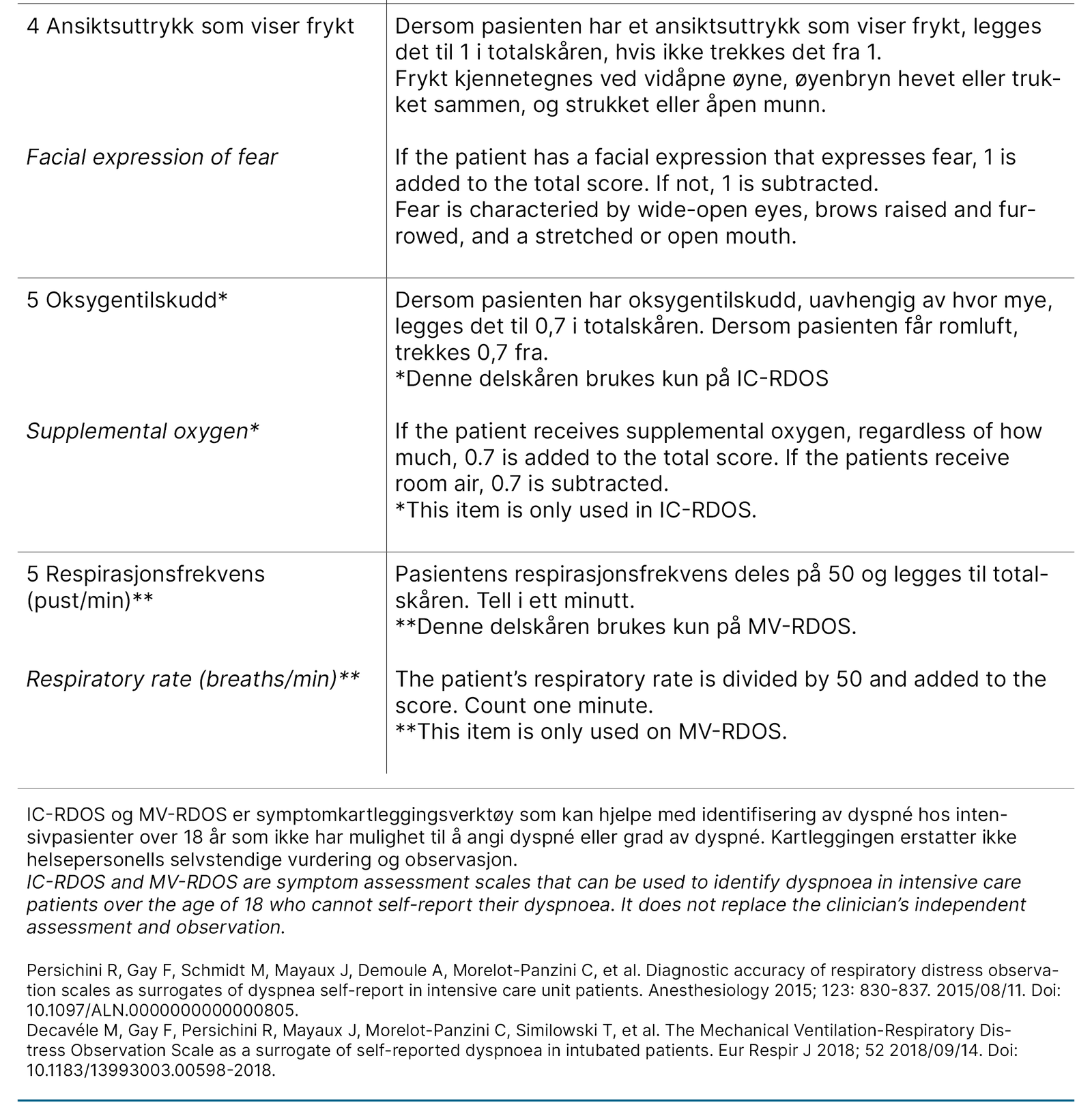
    Both scales consist of five items: heart rate, use of neck muscles during inspiration, abdominal paradox during inspiration, and facial expression of fear. Use of supplemental oxygen only applies for IC-RDOS, and respiratory rate only applies for MV-RDOS. Together, these items constitute a total score to assess dyspnoea. Patient self-report using a visual analogue scale (D-VAS), an alternative to a numeric rating scale (NRS) for alert and verbal patients, is the gold standard for assessing dyspnoea in the ICU (11). 

    Both IC-RDOS and MV-RDOS demonstrate acceptable to excellent predictive value for identifying dyspnoea on a visual analogue scale (D-VAS ≥ 4) with area under the curve values of 0.83 and 0.78, respectively (16, 17). IC-RDOS is recommended to identify dyspnoea in spontaneously breathing patients, and a score ≥ 2.4 predicts D-VAS ≥ 4 with a sensitivity and specificity of 72% (17). 

    MV-RDOS is designed for mechanically ventilated patients, and a score of ≥ 2.6 predicts dyspnoea with D-VAS ≥ 4 with a specificity of 57% and a sensitivity of 94% (16). Comparable metrics have been shown in a recent study (20). The scales have been used in recent studies, including to predict weaning outcomes and to investigate an association with mortality (10, 20). 

    Like other symptom assessment scales, both instruments are used as surrogates for self-reporting and should only be used when patients are unable to communicate (12). This is justified by dyspnoea being a subjective symptom, and self-reporting is the gold standard (5, 11). 

    Currently, there is no validated method to evaluate the dyspnoea of ICU patients without the ability to self-report in Norwegian ICUs. The need for a more systematic approach to identifying and managing dyspnoea in our ICUs has become evident. We believe that a Norwegian adaptation of IC-RDOS and MV-RDOS could support healthcare professionals in making an evidenced based evaluation of dyspnoea in ICU patients without the ability to self-report.

    Aim of the project

    The overall aim of the project was to translate both IC-RDOS and MV-RDOS into Norwegian and evaluate the inter-rater reliability (IRR) of the Norwegian versions.

    Method 

    To ensure the correct method and design, the study design checklist for patient-reported outcome measurement instruments from COnsensus‐based Standards for the selection of health Measurement INstruments (COSMIN) was chosen as a guideline for the IRR testing (22). STrengthening the Reporting of OBservational studies in Epidemiology (STROBE) was applied to ensure appropriate reporting (23).

    The project was conducted as a quality improvement project involving two phases. First, the translation process of IC-RDOS and MV-RDOS was performed (24). We then applied a prospective observational design to evaluate the IRR and measurement errors of the scales. A quality improvement project was chosen to provide a more systematic approach to evaluating dyspnoea in ICU patients who are unable to self-report in our ICUs (25). 

    To translate IC-RDOS and MV-RDOS, we used an international recognised guideline that emphasises the importance of linguistically and culturally adapted translation related to the setting in which the scale is supposed to be used (24).

    Setting and population

    Data for the reliability analysis were collected in four ICUs in a referral university hospital in Norway including both medical and surgical patients. Two of the units have ten beds, and the other two have six beds; both are categorised as level three units (1). Level three units have the capacity to manage advanced organ-supportive therapy for multiple organ systems including invasive mechanical ventilation (26). 

    The inclusion criteria for this project were patients over the age of 18 years, admitted to the ICU, and defined as ICU patients (ICU stay > 24 hours, use of vasoactive medication, or in need of mechanical ventilation) (1). Patients receiving muscle relaxants, declared brain dead, or able to self-report dyspnoea were excluded. We chose to include patients with various scores on the Richmond Agitation Sedation Scale (RASS) to ensure representation of all non-communicative ICU patients. 

    Prior to the data collection, we set a maximum threshold of 10% of mechanically ventilated patients (five patients) to be unresponsive, defined as RASS of −5, to ensure the instrument was tested on heavily sedated patients, despite it being likely that these patients have physical signs of dyspnoea. Some patients were assessed twice with a minimum of 48 hours between assessments to ensure independence.

    Data collection

    Patient ratings were performed using the Norwegian versions of IC-RDOS and MV-RDOS by two ICU nurses with six and eight years of ICU experience. This approach was chosen to minimise external factors influencing measurement errors. Dyspnoea assessment was performed simultaneously and independently, with no discussion or access to view each other’s results until the project was completed. 

    Both raters participated in the translation of the scales. Descriptive clinical characteristics (i.e. Simplified Acute Physiology Score (SAPS) and RASS) of the patients were collected from the electronic health record. We included patients from November 2021 to March 2022.

    Sample size

    We estimated the sample size using power analysis, a priori, to be 50 assessments per scale with two raters. The sample size for Cohen’s kappa was estimated using the Cicchetti and Fleiss (27) formula n = 2k2, where n is the sample size and k is the number of items in the scale. 

    A parallel power analysis for intraclass correlation coefficient (ICC) indicated a smaller required sample. Consequently, we chose the power analysis of Cohen’s kappa to increase the strength of the project. The intention was to use Cohen’s kappa in the analysis, but after the data collection was completed, we changed this analysis to Gwet’s agreement coefficient 1 (AC1) due to a better fit for the data collected. Therefore, the sample size was based on Cohen’s kappa instead of Gwet’s AC1

    A sample size of 50 assessments per scale is, however, in accordance with the recommendations of COSMIN (22). During the project, we increased the sample size of MV-RDOS to 60 due to the low frequency of some of the dichotomous traits.

    Statistical analysis

    Descriptive statistics were used to summarise the patients’ characteristics: continuous variables are reported as median with interquartile range (IQR) and categorical variables as frequencies (%) and counts. The IRR was analysed separately for each scale. For the total score and continuous items, we used a two-way random, average score, absolute agreement ICC (2, k) (28, 29). Normality of the residuals was assessed with Q-Q plots. Gwet’s ACwas chosen for the dichotomous item due to robustness against trait prevalence (30). 

    We used Altman’s scale to benchmark both Gwet’s AC1 and the ICC. A Gwet’s AC1/ICC below 0.2 is considered ‘poor‘, 0.21–0.4 as ‘fair‘, 0.41–0.60 as ‘moderate‘, 0.61–0.8 as ‘good‘, and above 0.81 as ‘very good‘ (31). The measurement errors are presented with 95% upper and lower limits of agreement (LoA) with confidence intervals for the total score and the continuous items (32). 

    In addition to total percentage agreement, we also calculated positive and negative agreement of the dichotomous items (33). Systematic differences between raters were tested using the paired t-test and McNemar’s test (30).

    The data were analysed using R version 4.1 (R Foundation for Statistical Computing, Austria, 2021), with a significance level at 0.05 and a 95% confidence interval (CI) where applicable. 

    Ethical considerations

    This quality improvement project was first presented to the Regional Committees for Medical Research Ethics in Southeast Norway (reference number 2021/325676) but fell outside their mandate. The data protection office at the hospital approved the project, and the need for consent was waived (reference number 21/19413).

    Results

    Translation of IC-RDOS and MV-RDOS

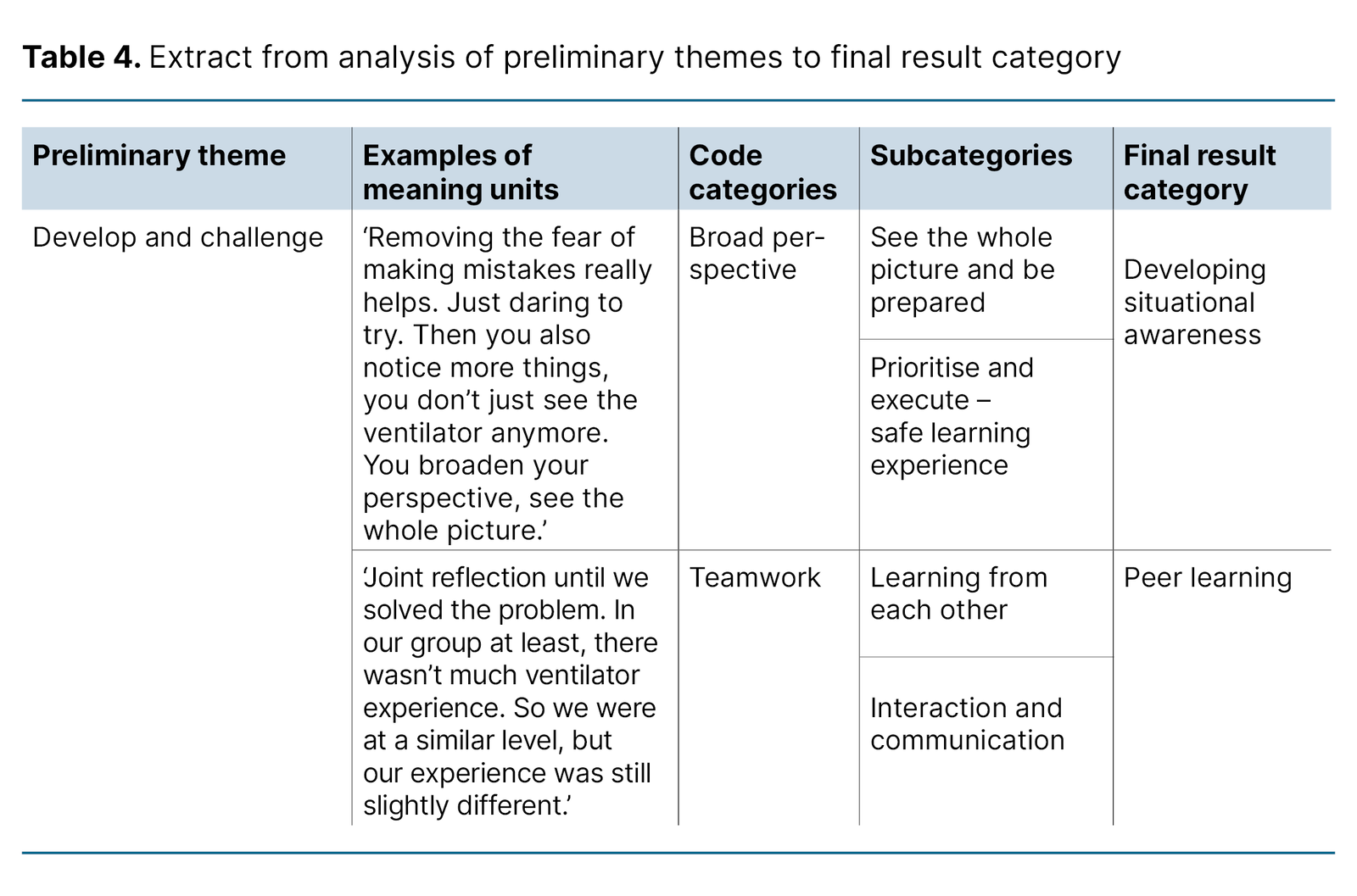
    We describe each step of the translation process in Table 1, which constitutes the final report of the process. We want to emphasise the choice to use medical terminology over layman’s terms to describe the items in the present project as a cultural adaption. For example, ‘Use of neck muscles during inspiration‘ was translated to ‘Use of accessory muscles during inspiration‘, as the instrument will be used by health care professionals. 

    Furthermore, it is standard practice in Norway not to translate the name or abbreviation of scales used in the ICU. The translated versions of the IC-RDOS and MV-RDOS are presented in Figure 1. The back-translated version was accepted by the developer of the scales without disagreement.
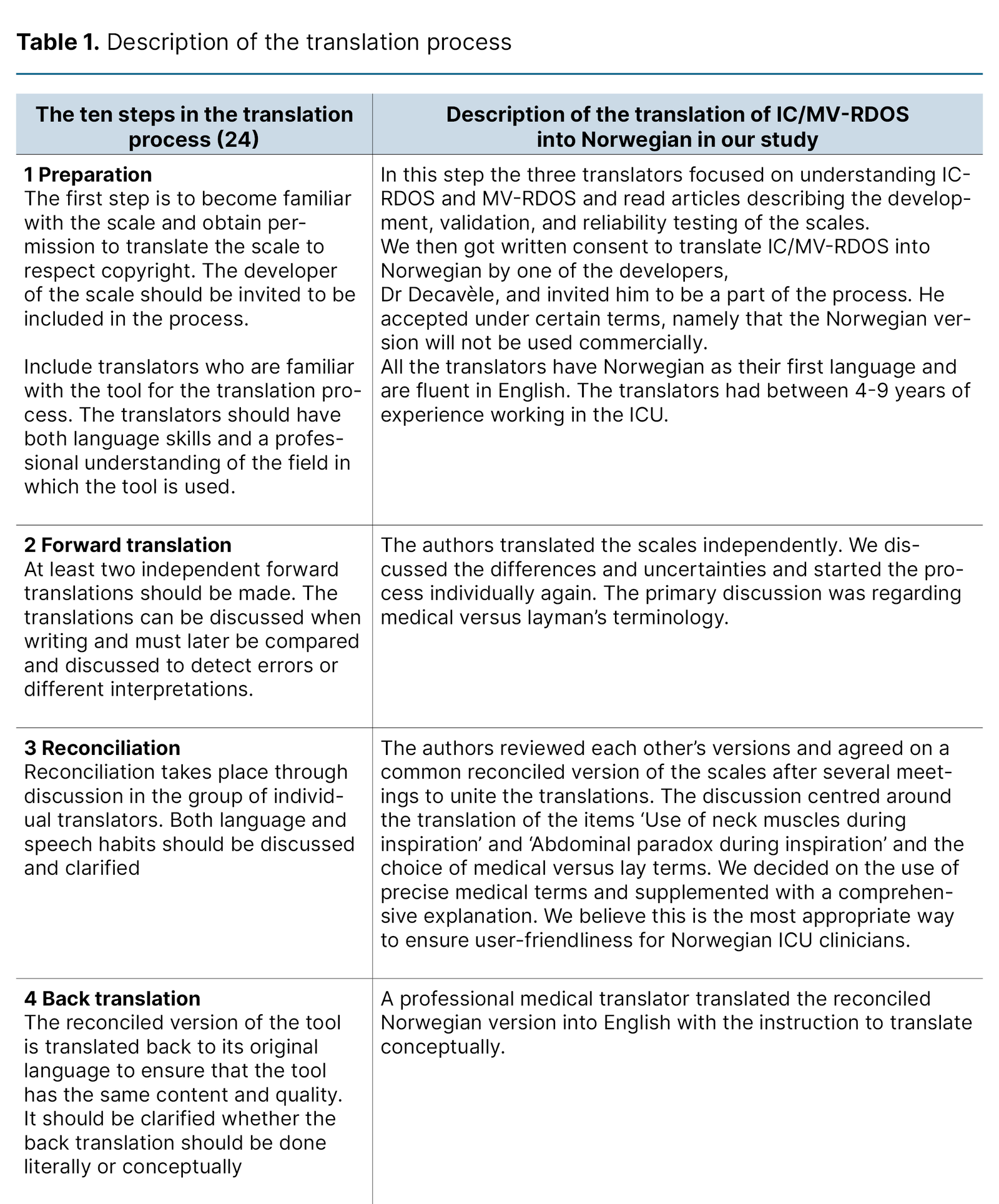
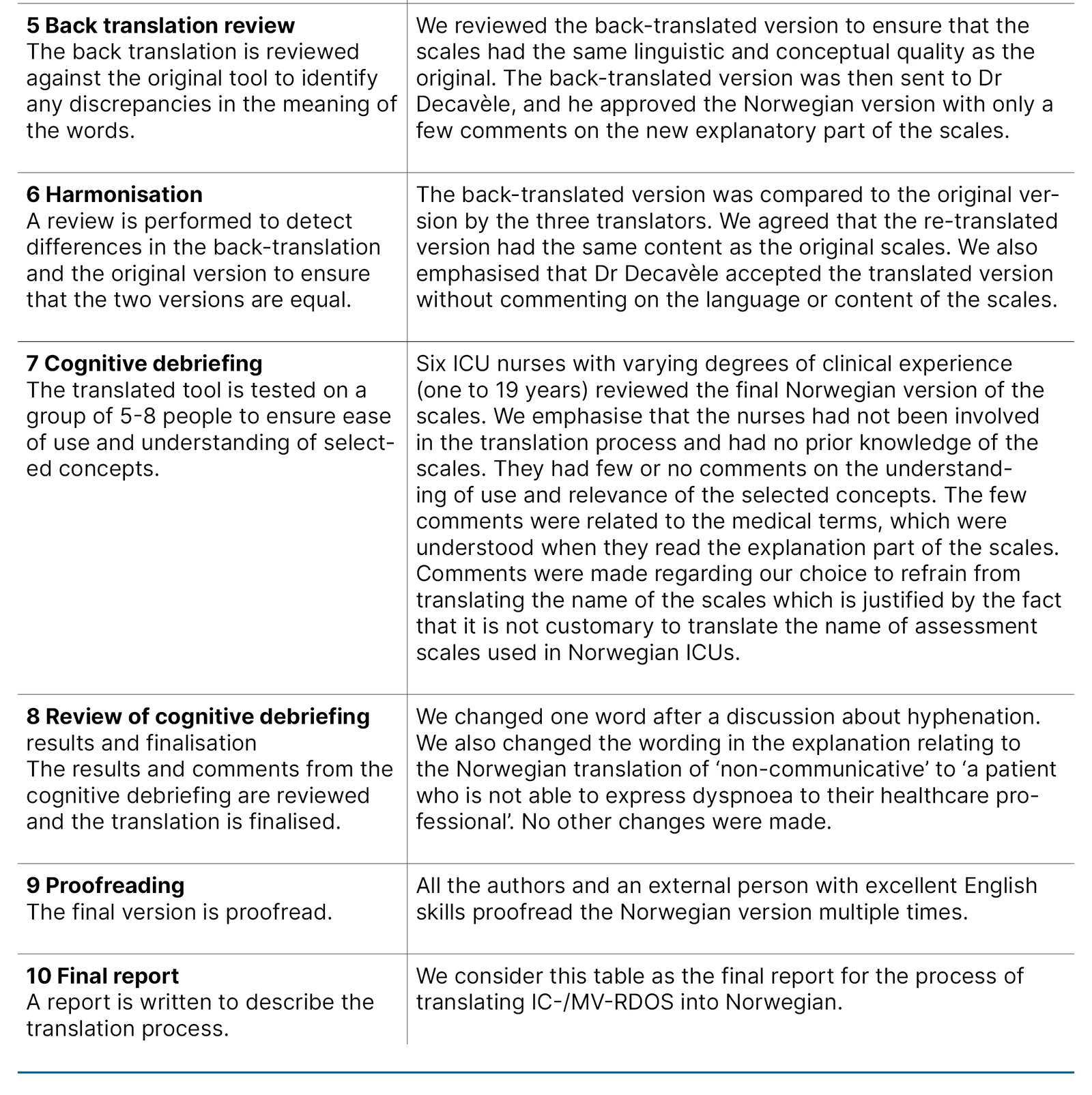
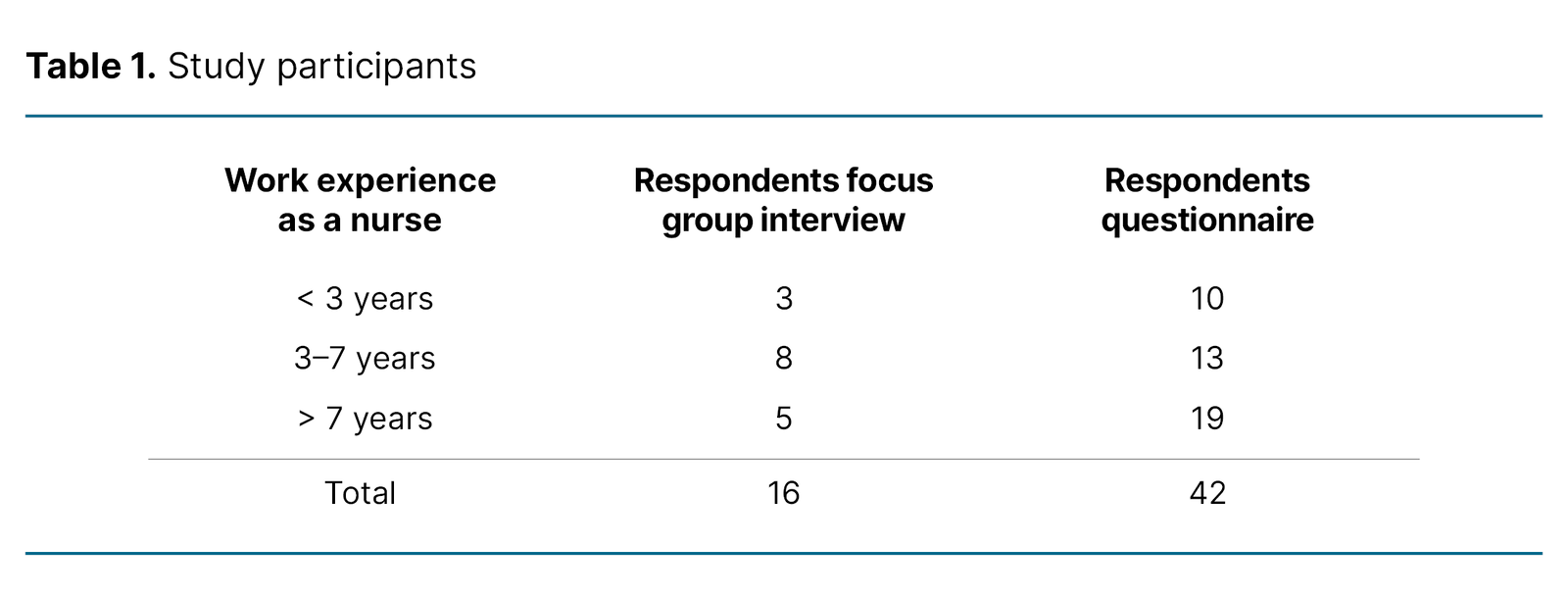
    Table 1. Description of the translation process

    Table 1. Description of the translation process
    Figure 1. The Norwegian IC-RDOS and MV-RDOS
    Explanation of the different items in IC-RDOS and MV-RDOS
    Explanation of the different items in IC-RDOS and MV-RDOS

    Patient characteristics 

    This project enrolled 81 ICU patients. The median patient age was 60 (IQR 51, 69), and 64% were male. Most of the included patients were acute surgical cases (42%). The most frequent reason for admission was ‘respiratory‘ (24%). 

    We performed 50 and 60 pairs of assessments for IC-RDOS and MV-RDOS, respectively. The median RASS at the time of the assessment was −1 (IQR −2, 0) for the non-mechanically ventilated patients and −3 (IQR −4, −2) for the mechanically ventilated patients, indicating drowsy and moderately sedated, respectively. The patient characteristics are summarised in Table 2.
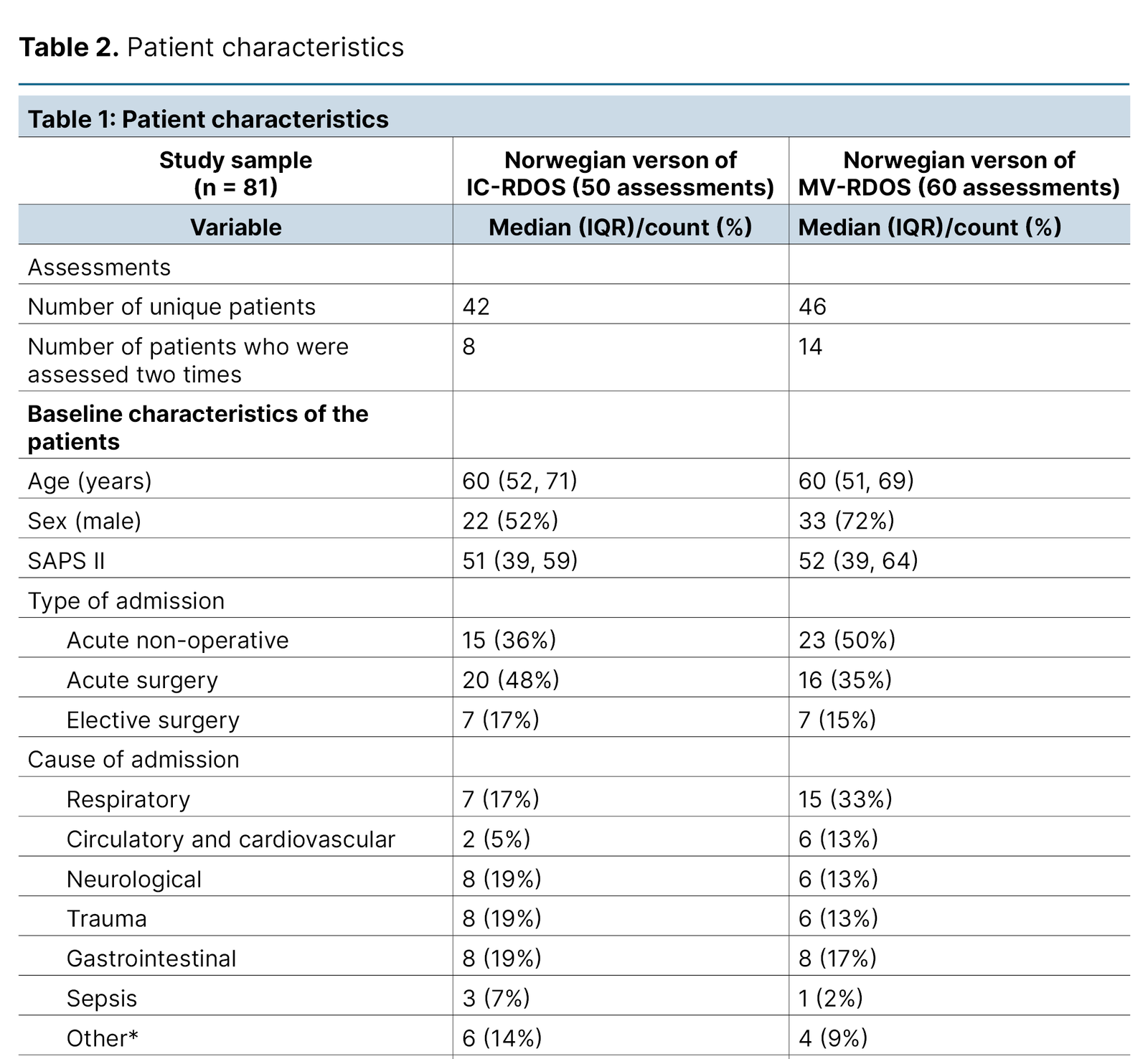
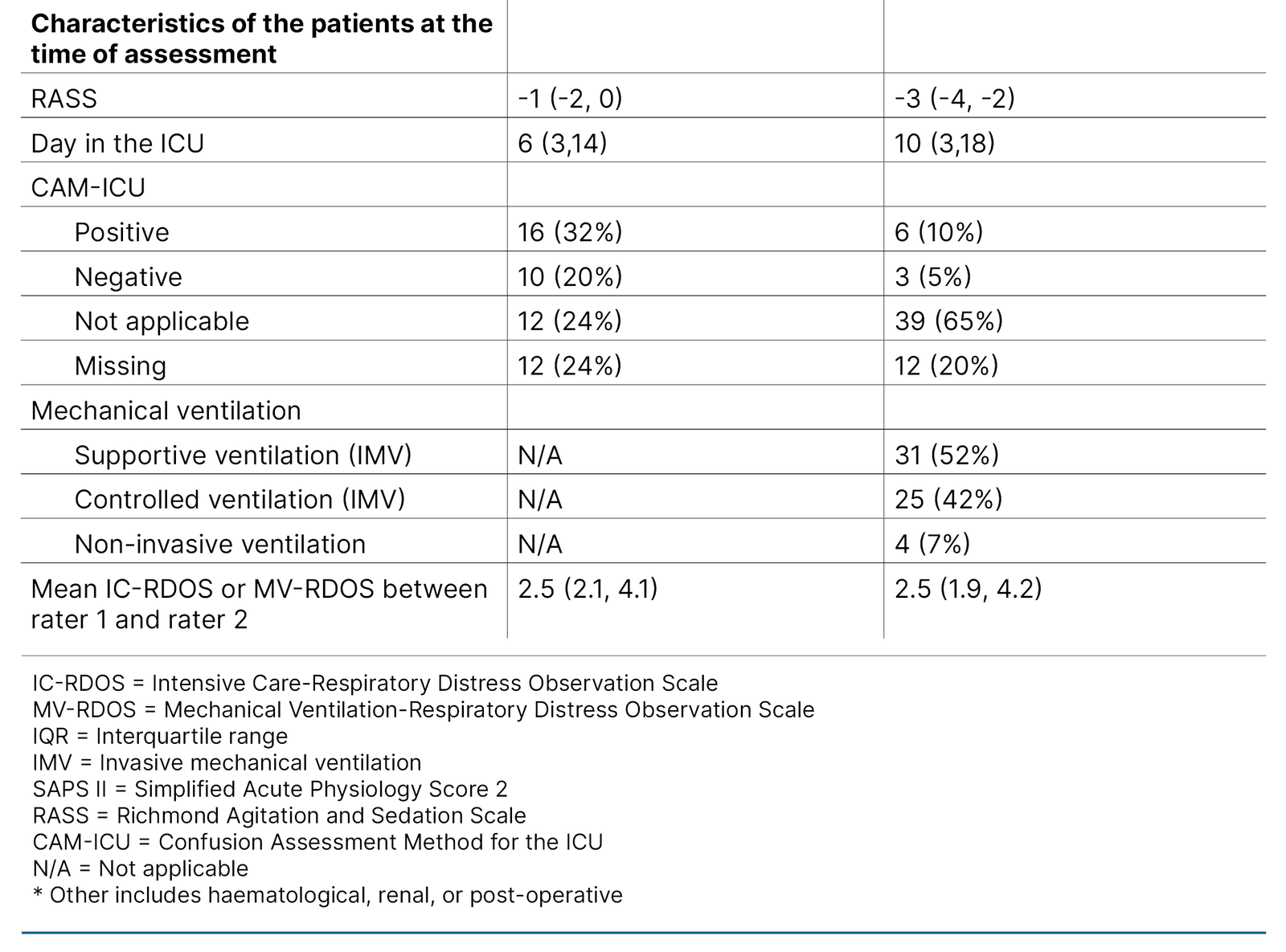
    Table 2. Patient characteristics
    Table 2. Patient characteristics

    Reliability of IC-RDOS

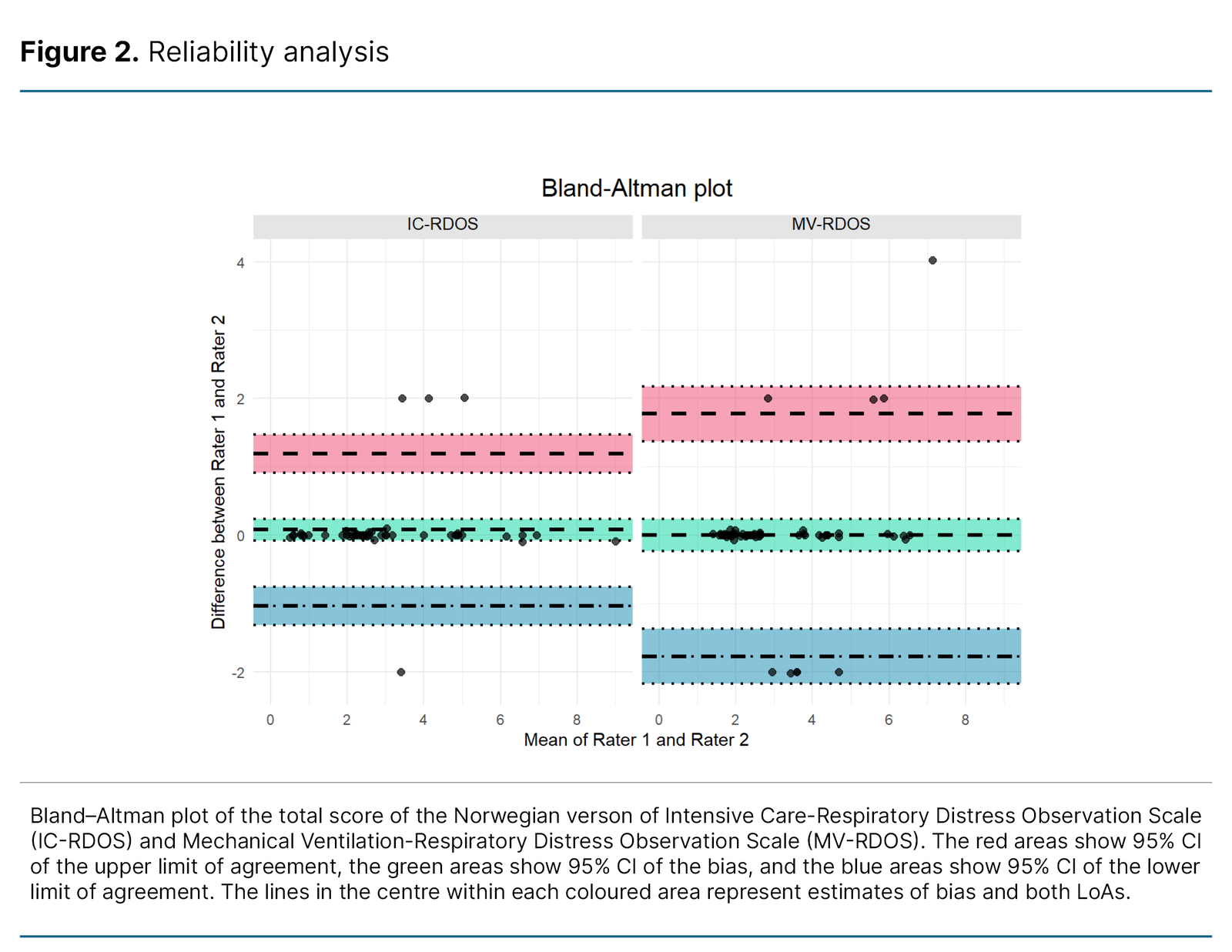
    The total score of IC-RDOS had an ICC of 0.98 (CI 95% 0.96 to 0.99), indicating ‘very good‘ IRR. The mean difference between the raters for IC-RDOS was 0.08 (t = 0.21, df = 49, p = 0.98), with LoA ranging from 1.19 to −1.03.

    Reliability of MV-RDOS

    The total score of MV-RDOS had an ICC of 0.92 (CI 95% 0.86 to 0.95), indicating ‘very good‘ IRR. The mean difference between the raters for MV-RDOS was 0.003 (t = 0.01, df = 59, p = 0.99), with LoA ranging from 1.77 to −1.77. 

    For both scales, the item with the lowest degree of IRR was ‘use of neck muscles during inspiration‘ with an AC1 of 0.87 (CI 95% 0.74 to 1) for IC-RDOS and 0.77 for MV-RDOS (CI 95% 0.61 to 0.93). All ICC and Gwet’s AC1-values, LoAs, and percentage agreements are presented in Table 3. Measurement errors for the total scores are illustrated in Figure 2. 
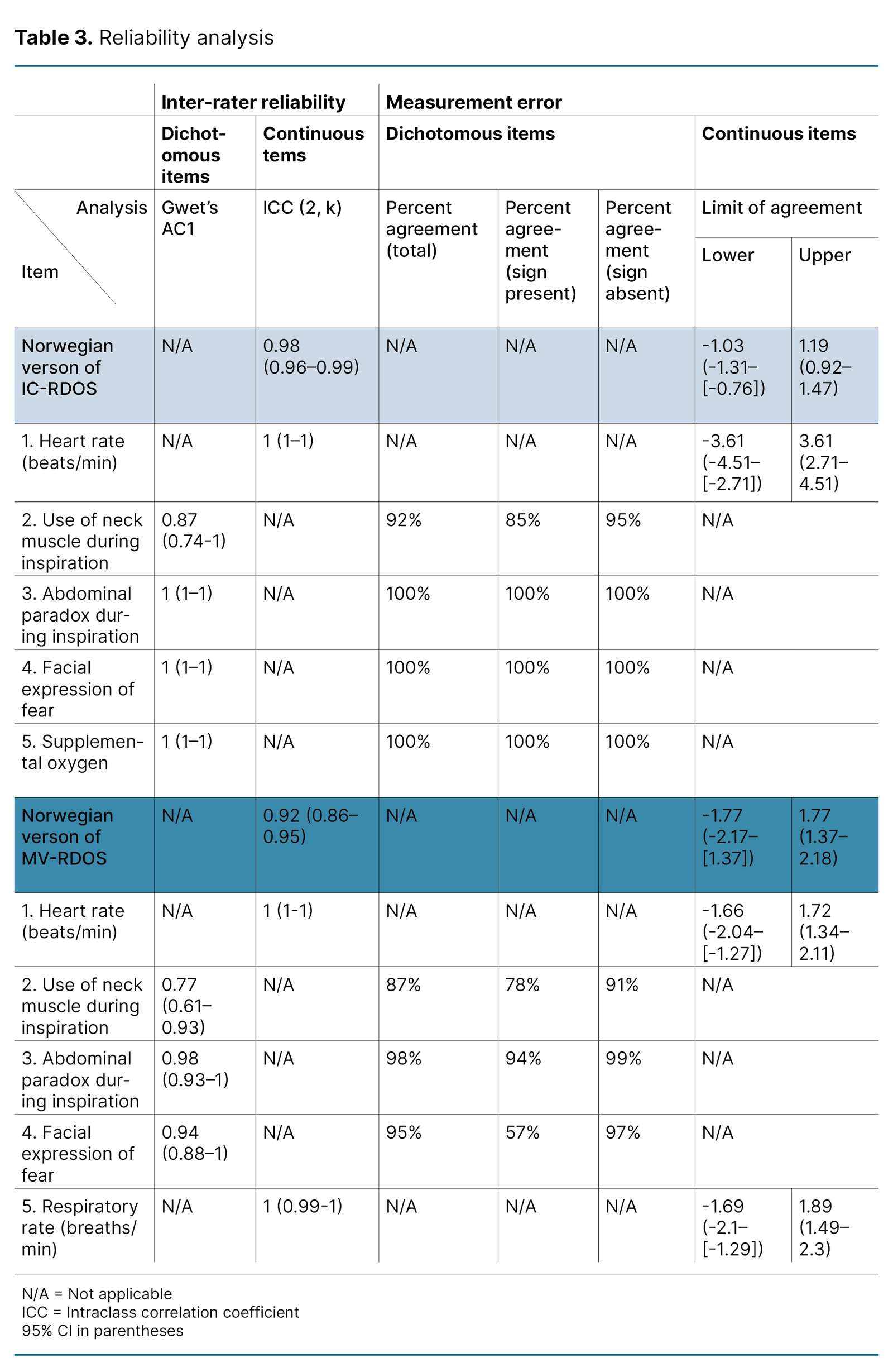
    Table 3. Reliability analysis

    Figure 2. Bland–Altman plot of total score IC/MV-RDOS

    Discussion 

    In this project, we translated IC-RDOS and MV-RDOS (Figure 1) and evaluated the Norwegian versions’ inter-rater reliability. The main findings of this project are that the total scores of both instruments demonstrated ‘very good‘ IRR. All the dichotomous items, except ‘use of neck muscles during inspiration‘ had total agreement for the non-mechanically ventilated patients with the use of IC-RDOS. The total score of IC-RDOS had higher ICC values than MV-RDOS. All dichotomous items without complete agreement had greater negative than positive agreement.

    To our knowledge, only one project has investigated IRR in IC-RDOS (17). Persichini et al. (17) found moderate consistency for the total score and variable IRR across the individual items. However, their study included multiple raters, which may have contributed to lower agreement than in our project, which had only two raters. 

    In our project, we found that the total score had a ‘very good‘ IRR for both scales, but IC-RDOS had a slightly higher ICC than MV-RDOS. The differences in the ICC for the total scores of the two scales may be explained by an increase in subjectivity in the interpretation of the items. It is also possible that these behavioural signs are more subtle in mechanically ventilated patients than in non-mechanically ventilated patients due to a lower RASS or use of sedation. While this project did not explore the underlying differences in ICC, it is a known challenge to identify behavioural signs in mechanically ventilated patients (34). 

    The item with the lowest degree of agreement on both scales was ‘use of neck muscles during inspiration‘. Nevertheless, the item still had ‘good‘ and ‘very good‘ agreement. The raters may have slightly different perceptions of what the item characterises. Alternatively, the item may be inherently more difficult to interpret than the other items on the scales. It is important to consider these findings in the further implementation of the scales as extra focus may be needed for this item. 

    Previous studies have found varying degrees of agreement for this item (17, 35). To address this, we designed a user guide to aid clinicians in using the scales correctly and thus minimise these events during future use. However, this item does not affect the total score in such a way as to make the scales less reliable.

    A facial expression of fear is characterised by wide-open eyes with visible irises (36). We observed a lower IRR for this item for mechanically ventilated patients Thus, these patients may not have had the ability or may have shown it more subtly because they were more sedated than non-mechanically ventilated patients (34). The subtle display of the sign may have led to a greater variation between the raters in this project. 

    Facial expressions can be a powerful predictor of dyspnoea (17) but they were uncommon in our sample. In mechanically ventilated patients, ‘facial expression of fear‘ had the highest discrepancy between positive and negative agreement. This discrepancy may be influenced by the low prevalence of the sign in mechanically ventilated patients and was the reason we applied Gwet’s AC1, which is resilient to trait prevalence (30). Gwet’s AC1 favours the overall agreement, but the low agreement in the actual presence of ‘facial expression of fear‘ must, therefore, be taken into consideration in future implementation processes.

    The measurement errors of IC-RDOS and MV-RDOS have not been examined in previous studies. To clarify, if both raters are in complete agreement except for on one dichotomous item, the total score will deviate by as much as two points. In this project, the LoAs of the total score of IC-RDOS and MV-RDOS are below two, which indicates most of the differences in the total score can be explained by the difference in only one dichotomous item or less. 

    In fact, the raters disagreed on two dichotomous items in only one assessment. We were not able to follow the recommendation to set a desired LoA prior to data analysis as our project is the first to describe the measurement error (37). Our findings offer a base for future studies to compare the measurement errors of the scales.

    Following data collection, we observed clear differences between total percent agreement and Cohen’s kappa, explained by the kappa paradox (33). This prompted a search for alternative methods. Cohen’s kappa assumes that the raters evaluate all observations independently from the other evaluations, which was not the case in our population. The dichotomous items would have been falsely deemed to have low IRR explained by low prevalence (38). In such cases, Gwet’s AC1 provides a more stable estimate (30). 

    We chose to use Gwet’s AC1 in the evaluation of the dichotomous items, which is an advantage of this project due to a more precise presentation of the results (38). If we had solely relied on Cohen’s kappa, it might have led to delayed or failed implementation of a validated method for evaluating dyspnoea in ICU patients without the ability to self-report in Norway. 

    The patients included in this project do not fully represent the general ICU population. The first consideration relates to our inclusion of only patients from a referral hospital. This could have resulted in the inclusion of more severely ill patients or patients with rare conditions. A recent review demonstrated patients receiving non-invasive ventilation (NIV) self-reported both high prevalence and intensity of dyspnoea (39). 

    In addition, out of the 60 assessments performed on mechanically ventilated patients, only 4 (7%) used NIV. As a result of this we cannot say the Norwegian version of the scale has been fully tested on patients receiving NIV. A final consideration is that the assessments were done on median day 6 and 10 in the ICU for IC-RDOS and MV-RDOS respectively. This differs from our ICUs in general with a median length of stay of 3 days, indicating that the instruments have been tested in patients with a prolonged ICU length of stay (1). 

    The median SAPS II score of 51 indicates that the included patients were severely ill, reflecting the patient population at the hospital. Less severely ill ICU patients are more likely to be able to self-report their symptoms and consequently were excluded from the project. These factors combined point out that our sample of patients were severely ill ICU patients, but we argue that the scales still can be applicable to less severely ill ICU patients. Still, we have demonstrated the possible use of the translated version of IC-RDOS and MV-RDOS in Norwegian ICUs. 

    A recent statement from the European society of intensive medicine recommends the use of IC-RDOS and MV-RDOS in the evaluation of dyspnoea in ICU patients who cannot self-report (10). 

    Providing a Norwegian version of the scales will make it easier for clinicians to assess dyspnoea in ICU patients unable to self-report. Introducing these scales into clinical practise may promote a common language in the assessment of dyspnoea, hopefully resulting in improved patient care and reduced symptom burden. Further, being able to measure dyspnoea in a valid and reliable manner can facilitate future research on the associated factors related to dyspnoea in ICU patients.

    Limitations 

    We chose not to perform dyspnoea evaluations on all non-communicative patients to ensure validity for a wider patient selection. Including all non-communicative patients may have biased the results in favour of deeply sedated patients, resulting in items such as ‘facial expressions of fear‘ having a lower prevalence. The raters gathered background information before every assessment. 

    In retrospect, knowing the background information before the assessment may have introduced confirmation bias, and this information therefore should have been collected after the assessments. The sample size was based on Cohen’s kappa instead of Gwet’s AC1. However, the sample sizes of 50 and 60 assessments are more than the recommended threshold (24). 

    Both raters were involved in the translation process. However, we believe the behavioural signs would have shown a higher prevalence or a systematic difference between the raters if confirmation bias was introduced. In future clinical use, a lower IRR must be expected due to a greater diversity of raters.

    Further research

    Regarding the validity and reliability of the Norwegian version of IC-RDOS and MV-RDOS in a larger population of ICU patients, further research is warranted after implementation with a greater diversity of raters. Power analysis should be based on Gwet’s AC1 due to the expected low prevalence in the dichotomous items. 

    Conclusion

    In this article, we presented a Norwegian version of the IC-RDOS and MV-RDOS and evaluated the scales’ IRR. The primary result indicates the total score of the scales demonstrated ‘very good‘ IRR. Further research regarding the Norwegian version of IC-RDOS and MV-RDOS should focus on a wider range of psychometric properties. 

    Dyspnoea is a subjective experience and is often underestimated by clinicians. We believe that IC-RDOS and MV-RDOS can contribute to both increased awareness and evidence-based assessment of dyspnoea experienced by ICU patients. 

    Based on the findings of this project, the scales may be suitable for implementation in Norwegian ICUs. Using the IC-RDOS and MV-RDOS in clinical practice is likely to increase awareness and improve symptom management.

    *Peder Sebastian Martinsen and Runa Austad Haug share first authorship.

    The authors declare no conflicts of interest.

    Open access CC BY 4.0

    Peer-reviewed article
    Publication type
    Publication Year
    2026
    Edition Year
    21
    Publication Number
    105043
    Page Number
    e-105043

    The scales IC-RDOS and MV-RDOS had ‘very good‘ inter-rater reliability.

    Article is Peer Reviewed
    1
    Innsendte kommentarer kvalitetssikres før publisering. Kvalitetssikringen skjer i vanlig arbeidstid.
    Research
    English

    Background: Dyspnoea is a common and stressful symptom in critically ill patients, and healthcare professionals tend to underestimate both the incidence and degree of this symptom. Currently, there is no Norwegian symptom assessment scale to aid in evaluating dyspnoea in intensive care unit (ICU) patients without the ability to self-report. The Intensive Care Observation Scale (IC-RDOS) and Mechanical Ventilation-Respiratory Distress Observation Scale (MV-RDOS) are symptom assessment scales for identifying dyspnoea in non-mechanically ventilated and mechanically ventilated patients.  

    Objective: To translate the IC-RDOS and MV-RDOS into Norwegian and evaluate the inter-rater reliability of the two scales.

    Method: We applied a prospective observational design to evaluate the inter-rater reliability and measurement errors of IC-RDOS and MV-RDOS. The translation process focused on linguistic and cultural adaption following international guidelines. Data for the inter-rater reliability analysis were collected in four ICUs in Norway. Two ICU nurses performed 110 assessments, and inter-rater reliability was evaluated using the intraclass correlation coefficient (ICC) for the total score and continuous items, while Gwet’s agreement coefficient 1 was applied for the dichotomous items.

    Results: IC-RDOS and MV-RDOS were translated into Norwegian. The total score of the scales, used in the evaluation of dyspnoea, showed a high ICC for both scales: ICC = 0.98 for IC-RDOS and ICC = 0.92 for MV-RDOS.

    Conclusion: IC-RDOS and MV-RDOS had ‘very good‘ inter-rater reliability. Based on the findings in this project, the scales may be ready for implementation in Norwegian ICUs.
    Exclude images in ZIP export?
    Off
    The photo shows nurse pressing monitor's button with male patient lying on bed in hospital
    0
    • A Norwegian version of the Intensive Care Observation Scale and the Mechanical Ventilation-Respiratory Distress Observation Scale is now available.
    • The Norwegian version of the scales demonstrated high inter-rater reliability between two ICU nurses.
    • This article presents a method to assess dyspnoea in critically ill patients who cannot self-report in Norwegian ICUs.

    1.         Sjursæther EA, Vatnan A, Helland KF. Buanes EA. Årsrapport for 2023 med plan for forbetringstiltak (Annual report of 2023) [Internet]. Bergen: Norsk intensiv- og pandemiregister (Norwegian Intensive Care and Pandemic Registry); 2024 [cited 16 May 2025]. Available from: https://www.helse-bergen.no/4a53e5/siteassets/seksjon/intensivregister/documents/arsrapporter/arsrapporter-nipar/nipar-arsrapport-2023.pdf 

    2.         Schmidt M, Banzett RB, Raux M, Morélot-Panzini C, Dangers L, Similowski T, et al. Unrecognized suffering in the ICU: addressing dyspnea in mechanically ventilated patients. Intensive Care Med. 2014;40(1): 1–10. DOI: 10.1007/s00134-013-3117-3

    3.         Chanques G, Nelson J, Puntillo K. Five patient symptoms that you should evaluate every day. Intensive Care Med. 2015;41(7):1347–50. DOI: 10.1007/s00134-015-3729-x

    4.         Demoule A, Similowski T. Respiratory suffering in the ICU: time for our next great cause. Am J Respir Crit Care Med. 2019;199(11):1302–4. DOI: 10.1164/rccm.201812-2248ED

    5.         Parshall MB, Schwartzstein RM, Adams L, Banzett RB, Manning HL, Bourbeau J, et al. An official American Thoracic Society statement: update on the mechanisms, assessment, and management of dyspnea. Am J Respir Crit Care Med. 2012;185(4):435–52. DOI: 10.1164/rccm.201111-2042ST

    6.         Gentzler ER, Derry H, Ouyang DJ, Lief L, Berlin DA, Xu CJ, et al. Underdetection and undertreatment of dyspnea in critically ill patients. Am J Respir Crit Care Med. 2019;199(11):1377–84. DOI: 10.1164/rccm.201805-0996OC

    7.         Schmidt M, Demoule A, Polito A, Porchet R, Aboab J, Siami S, et al. Dyspnea in mechanically ventilated critically ill patients. Crit Care Med. 2011;39(9):2059–65. DOI: 10.1097/CCM.0b013e31821e8779

    8.         Demoule A, Hajage D, Messika J, Jaber S, Diallo H, Coutrot M, et al. Prevalence, intensity, and clinical impact of dyspnea in critically ill patients receiving invasive ventilation. Am J Respir Crit Care Med. 2022;205(8):917–26. DOI: 10.1164/rccm.202108-1857OC

    9.         Saltnes-Lillegård C, Rustøen T, Beitland S, Puntillo K, Hagen M, Lerdal A, et al. Self-reported symptoms experienced by intensive care unit patients: a prospective observational multicenter study. Intensive Care Med. 2023;49(11):1370–82. DOI: 10.1007/s00134-023-07219-0

    10.       Decavèle M, Rozenberg E, Niérat MC, Mayaux J, Morawiec E, Morélot-Panzini C, et al. Respiratory distress observation scales to predict weaning outcome. Crit Care. 2022;26(1):162. DOI: 10.1186/s13054-022-04028-7

    11.       Demoule A, Decavele M, Antonelli M, Camporota L, Abroug F, Adler D, et al. Dyspnoea in acutely ill mechanically ventilated adult patients: an ERS/ESICM statement. Intensive Care Med. 2024;50(2):159–80. DOI: 10.1007/s00134-023-07246-x

    12.       Decavèle M, Similowski T, Demoule A. Detection and management of dyspnea in mechanically ventilated patients. Curr Opin Crit Care. 2019;25(1):86–94. DOI: 10.1097/mcc.0000000000000574

    13.       Karlsen MW, Ølnes MA, Heyn LG. Communication with patients in intensive care units: a scoping review. Nurs Crit Care. 2019;24(3):115–31. DOI: 10.1111/nicc.12377

    14.       Binks AP, Desjardin S, Riker R. ICU clinicians underestimate breathing discomfort in ventilated subjects. Respir Care. 2017;62(2):150–5.DOI: 10.4187/respcare.04927

    15.       Haugdahl HS, Storli SL, Meland B, Dybwik K, Romild U, Klepstad P. Underestimation of patient breathlessness by nurses and physicians during a spontaneous breathing trial. Am J Respir Crit Care Med. 2015;192(12):1440–8. DOI: 10.1164/rccm.201503-0419OC

    16.       Decavèle M, Campbell ML, Persichini R, Morélot-Panzini C, Similowski T, Demoule A, et al. Management of dyspnea in the noncommunicative patients: consider hetero-evaluation scales. Chest. 2018;154(4): 991–2. DOI: 10.1016/j.chest.2018.05.046

    17.       Persichini R, Gay F, Schmidt M, Mayaux J, Demoule A, Morélot-Panzini C, et al. Diagnostic accuracy of respiratory distress observation scales as surrogates of dyspnea self-report in Intensive Care Unit patients. Anesthesiology. 2015;123(4):830–7. DOI: 10.1097/aln.0000000000000805

    18.       Decavèle M, Gay F, Persichini R, Mayaux J, Morélot-Panzini C, Similowski T, et al. The mechanical ventilation-respiratory distress observation scale as a surrogate of self-reported dyspnoea in intubated patients. Eur Respir J. 2018;52(4):1800598. DOI: 10.1183/13993003.00598-2018

    19.       Campbell ML, Templin T, Walch J. A respiratory distress observation scale for patients unable to self-report dyspnea. J Palliat Med. 2010;13(4):285–90. DOI: 10.1089/jpm.2009.0229

    20.       Aikawa G, Imanaka R, Sakuramoto H, Hatozaki C, Unoki T, Okamoto S. Assessment of dyspnea in critically ill patients: a comparative analysis of evaluation scales. Cureus. 2024;16(1):e52751. DOI: 10.7759/cureus.52751

    21.       Decavèle M, Rivals I, Persichini R, Mayaux J, Serresse L, Morélot-Panzini C, et al. Prognostic value of the Intensive Care Respiratory Distress Observation Scale on ICU admission. Respir Care. 2022;67(7):823–32. DOI: 10.4187/respcare.09601

    22.       Mokkink LB, Prinsen CA, Patrick DL, Alonso J, Bouter LM, Vet HCd, et al. COSMIN study design checklist for patient-reported outcome measurement instruments: Amsterdam University Medical Centers; 2019 [cited 10 May 2025]. Available from: https://www.cosmin.nl/wp-content/uploads/COSMIN-study-designing-checklist_final.pdf 

    23.       Von Elm E, Altman DG, Egger M, Pocock SJ, Gøtzsche PC, Vandenbroucke JP. Strengthening the reporting of observational studies in epidemiology (STROBE) statement: guidelines for reporting observational studies. BMJ. 2007;335(9596):806–8. DOI: 10.1136/bmj.39335.541782.AD

    24.       Wild D, Grove A, Martin M, Eremenco S, McElroy S, Verjee-Lorenz A, et al. Principles of good practice for the translation and cultural adaptation process for patient-reported outcomes (PRO) measures: report of the ISPOR task force for translation and cultural adaptation. Value in Health. 2005;8(2):94–104. DOI: https://doi.org/10.1111/j.1524-4733.2005.04054.x

    25.       Batalden PB, Davidoff F. What is ‘quality improvement‘ and how can it transform healthcare? Qual Saf Health Care. 2007;16(1):2. DOI: 10.1136/qshc.2006.022046 

    26.       Ministry of Health and Care Services [Helse- og omsorgsdepartementet]. Report from the interregional working group on intensive care capacity [Rapport fra interregional arbeidsgruppe for intensivkapasitet]. Helse Midt-Norge, Helse Nord, Helse Sør-Øst, Helse Vest; 2022 [cited 13 November 2025]. Available from: https://www.regjeringen.no/contentassets/859ef0b02c3248568fa820e4bcced1ab/vedlegg-1-rapport-interregional-arbeidsgruppe-for-intensivkapasitet-mai-2022.pdf

    27.       Cicchetti DV, Fleiss JL. Comparison of the null distributions of weighted kappa and the C ordinal statistic. Appl Psychol Meas. 1977;1(2):195–201. DOI: 10.1177/014662167700100206

    28.       Gwet KL. Handbook of inter-rater reliability: analysis of quantitative ratings. 5th ed. Gaithersburg, MD: AgreeStat Analytics; 2021.

    29.       Koo TK, Li MY. A guideline of selecting and reporting intraclass correlation coefficients for reliability research. J Chiropr Med. 2016;15(2):155–63. DOI: 10.1016/j.jcm.2016.02.012

    30.       Gwet KL. Handbook of inter-rater reliability: analysis of categorical ratings. 5th ed. Gaithersburg, MD: AgreeStat Analytics; 2021.

    31.       Altman DG. Practical statistics for medical research. London: Chapman & Hall/CRC; 1991.

    32.       Carkeet A. Exact parametric confidence intervals for Bland-Altman limits of agreement. Optom Vis Sci. 2015; 92(3):e71–80. DOI: 10.1097/opx.0000000000000513

    33.       De Vet HC, Mokkink LB, Terwee CB, Hoekstra OS, Knol DL. Clinicians are right not to like Cohen's κ. BMJ. 2013;346:f2125. DOI: 10.1136/bmj.f2125

    34.       Gélinas C, Arbour C. Behavioral and physiologic indicators during a nociceptive procedure in conscious and unconscious mechanically ventilated adults: similar or different? J Crit Care2009;24(4):628:e7–17. DOI: 10.1016/j.jcrc.2009.01.013

    35.       Tinti S, Destrebecq A, Terzoni S, De Maria B, Falcone G, Da Col D, et al. Respiratory distress observation scale Italian version: cultural-linguistic validation and psychometric properties. J Hosp Palliat Nurs. 2021;23(2):187–94. DOI: 10.1097/njh.0000000000000736

    36.       Campbell ML. Fear and pulmonary stress behaviors to an asphyxial threat across cognitive states. Res Nurs Health. 2007;30(6):572–83. DOI: 10.1002/nur.20212

    37.       Giavarina D. Understanding bland Altman analysis. Biochem Med (Zagreb). 2015;25(2):141–51. DOI: 10.11613/bm.2015.015

    38.       Zec S, Soriani N, Comoretto R, Baldi I. High agreement and high prevalence: the paradox of Cohen's kappa. Open Nurs J. 2017;11(Suppl-1, M5):211–8. DOI: 10.2174/1874434601711010211

    39.       Richardson BR, Decavèle M, Demoule A, Murtagh FEM, Johnson MJ. Breathlessness assessment, management and impact in the intensive care unit: a rapid review and narrative synthesis. Ann Intensive Care. 2024;14(1):107. DOI: 10.1186/s13613-024-01338-7

    Disable PDF autogeneration
    Off
  • Digital parenting: parents’ experiences of screen use in children under school age

    A smiling young girl looking down at a tablet on the table

    Introduction

    In recent decades, the parental role has changed. There is greater focus on the child’s self-development – physically, mentally and emotionally (1). The term ‘intensive parenting’ describes these changes, with the child as the centre of attention and the parents expected to be available for the child in all areas (2, 3). 

    Intensive parenting is based on accepting that an infant’s experiences will have lifelong consequences. The parents’ caring abilities are linked to improved well-being for the child later in life (4). The role of the child has changed, and children are seen as competent actors in the family democracy (5). Parents are affected negatively by the social pressure to master working life while being the ‘perfect parent’ (6). 

    Access to various screen media devices has increased markedly in recent decades. Children are exposed to screens from infancy, and in Norway almost 50% of children under the age of five watch television every day (7). Research on screen use shows that the family’s socioeconomic situation, the parents’ educational level and screen habits are factors affecting children’s screen use (8). 

    Parents’ strategies for child-rearing in the encounter with electronic devices are referred to as ‘digital parenting’ (9). These strategies range from fully embracing screen use to imposing strict restrictions. Norwegian parents often have an active strategy whereby they provide explanations for their children and prepare them for the digital world. 

    Parents and those working with young children are concerned about the consequences of children’s screen use (9–11). Several review articles link excessive screen use to negative health impacts on children such as sleep problems, overweight and increased risk of depression (12–14). However, some studies also show that playing computer games together can have a positive effect on the interaction of parent and child (15–17). 

    The recommendations of the Norwegian Directorate of Health on children’s screen time state that children under the age of two years should have no screen time, while children under the age of five should have no more than one hour’s screen time per day (18). Several studies suggest that the mothers’ lack of knowledge may result in an earlier introduction of screens and significantly more screen time (19, 20). Some studies show that screens are often introduced to children under the age recommended by the World Health Organization (WHO) (21, 22).

    Objective of the study

    In Norway, we currently know little about the youngest children’s screen use and parents’ motivation for allowing them to use a screen (20). As public health nurses, we note how screen use is increasing in parent-child interaction at the child health centre. The objective of the study is to shed light on parents’ experiences of screen use in children under school age. 

    In this study, ‘screen use’ refers to digital devices that the child uses or is exposed to via their parents’ use. The term ‘screen’ includes television, tablet and mobile telephone.

    Method

    The study has a qualitative design and uses a hermeneutic approach based on the interpretation of empirical data (23). The aim was to obtain greater knowledge of how parents perceive children’s screen access, and their experiences when regulating this. Better understanding of the parental perspective is important for public health nurses in their guidance of parents with young children at child health centres. 

    Data collection was carried out via focus group interviews in order to promote an exchange of experiences and elicit variations and nuances in attitudes towards screen use (24). 

    Recruitment and sample

    The participants were recruited via formal communication with various rural municipalities and one urban municipality. Those who gave their consent received written information prior to the focus group meeting or when they attended. 

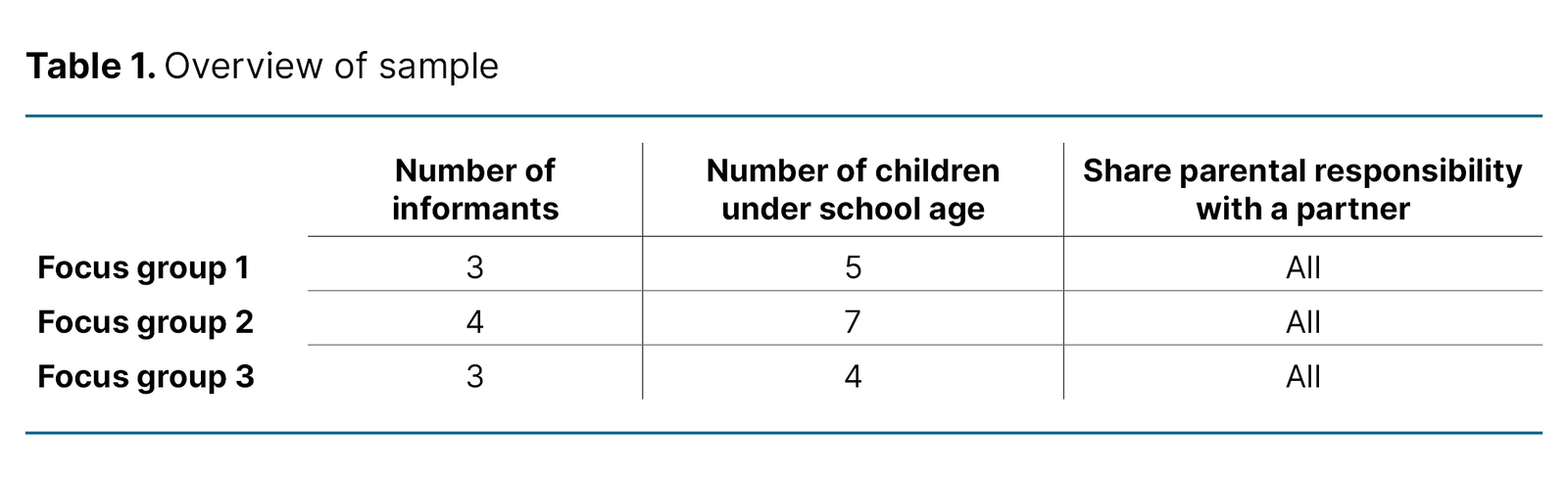
    The inclusion criteria were having at least one child under school age and the ability to participate in a group discussion in Norwegian. A total of ten informants were recruited, distributed across three focus groups. Seven women and three men participated in the study. They all had a partner with whom they shared parental responsibility, and the majority had two children under school age in the family (Table 1). The sample was homogenous in terms of socioeconomic background and ethnicity. 

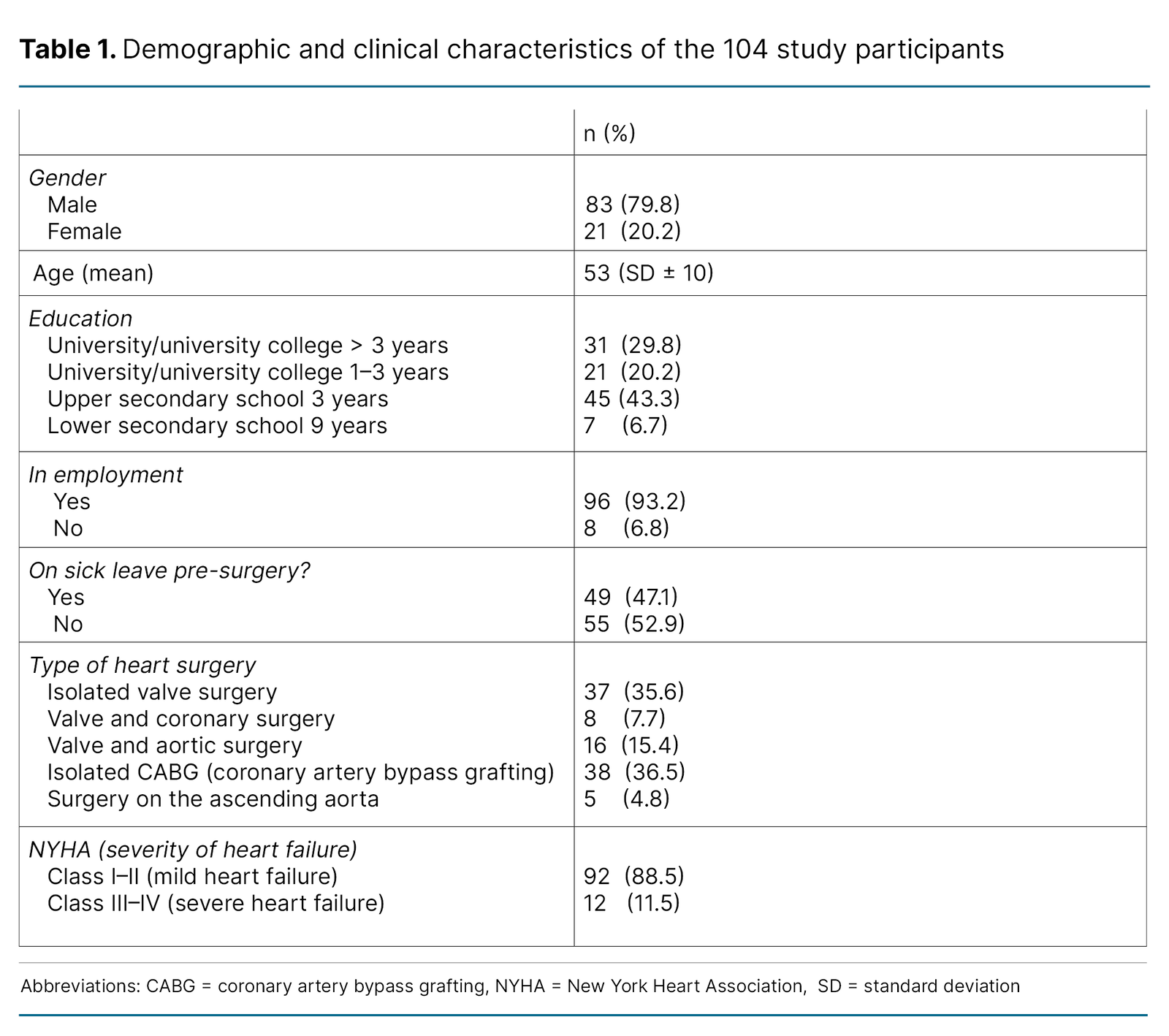
    Table 1. Overview of sample

    Data collection

    Three focus group interviews were conducted using a semi-structured interview guide. Two of the groups had three participants and the third had four. Some of the participants came from small municipalities where they may have already known each other.

    We carried out the interviews, which lasted from 50 to 60 minutes, in autumn 2023. The first and second authors took it turns to be moderator and co-moderator. We audiotaped the interviews, which were transcribed verbatim afterwards. 

    Analysis

    The data were coded and analysed using Aksel Tjoras’ stepwise deductive-inductive method (SDI) (25). This is a structured analysis method that precludes reaching hasty conclusions. Both authors carried out the empirical coding individually, and this was then converted into a joint set of codes that were refined to code groups. Subsequently, we worked in partnership to generate themes and subthemes in light of the theoretical framework on changes in the parental role and the child’s role in the family (Table 2) 

    Table 2. Analysis examples

    Ethical considerations

    The study was reported to the Norwegian Agency for Shared Services in Education and Research (Sikt) (reference number 615343). In line with national research ethics guidelines, all informants received information about the study and gave their written consent to participating (26). The interviews were audiotaped and stored in Nettskjema. The data material was anonymised during transcription. During the analysis, we kept in mind our own bias regarding the subject.

    Results

    The parents’ thoughts about screen use were generally emotional. The findings were divided into two main themes: 1) ‘The screen as something positive’, and 2) ‘The screen as something negative’. 

    The screen as something positive

    The screen was described as a positive and necessary contributor to the family, with screen time together with the child providing an opportunity for shared time. The parents highlighted their pleasure in observing the child’s enthusiasm or finding out what games the child mastered: 

    ‘It’s great fun seeing how involved he is in it. I think it’s an enjoyable activity we do together’ (Informant 10).

    The parents found the quiet time together with their children enjoyable in their otherwise busy daily life. They believed that the children noticed that their parents were also having a good time relaxing in front of the television, so that it was a positive experience for the child. 

    However, the parents made it clear that they were not willing to watch just any programme. They wanted to have a say in deciding what the child should watch, as the quality of different children’s programmes vary. 

    If both adults and children were watching something in which they were both interested, the informants felt that shared screen time could allow them to talk about what was happening in the programme. One of the informants said the following: 

    ‘It’s easy to join in, talk to them, there’s something in that. You can learn something about some feelings, reactions, that kind of thing’ (Informant 6).

    In addition to shared time, the parents used the screen to cope with a hectic workday. They could make a meal without being disturbed, or do other tasks without having the children in tow. The child’s screen time was described as ‘sacred’, and the parents said that it gave them a break from the parental role without the child feeling they were being excluded. 

    When the parents did not have the capacity to play with the child, they regarded the screen as an opportunity to have personal time. Several informants believed that personal time was essential for them to be the best version of themselves. Some described it as a break they could use to reset and find new energy for better interaction with the child.

    The screen was also described as a useful diversion, for example when the family had to drive long distances, or when brushing teeth or when there was general unrest. Meanwhile, several parents emphasised that using the screen as a diversion during meals or as a consolation or reward was not good for the child. 

    The screen as something negative

    The screen was described as a necessary evil, and the parents worried about how screen use affected their children. The parents often had a bad conscience when reflecting on how they regulated their children’s screen time and how the screen made their children passive. One informant described how their daughter said nothing about her basic needs: 

    ‘If she has a wet nappy, the TV can make her ignore it’ (Informant 2). 

    The parents found that their children were engrossed by the screen and that it was difficult to achieve contact with them. They described some programmes as particularly provocative, and a few described such programmes as ‘toxic TV’. 

    They pointed out that it was particularly challenging to end screen use and it resulted in an emotional explosion. One parent said that if their child got angry when they turned off the TV, they often had to allow the child to use their mobile for a while to calm down. Many of the parents had found that switching off led to conflict with the child even when another fun activity was planned: 

    ‘It’s often negative, trying to do something else that might have been fun to start off with. The screen wins every time’ (Informant 6). 

    Concerns about screen use were also linked to possible long-term consequences. Parents vacillated between thinking that ‘everyone knows too much screen time is not recommended’, and ‘is it really that bad?’. They wanted to limit screen time so that their children were not sitting inside and ‘missing out on the world outside’. 

    The findings depict parents who deal with their children’s screen time with uncertainty and ambivalence. Doubt and feelings of guilt dominate. The recommendation of no screen time for children under two years of age appears impossible to achieve. Parents spend a lot of energy thinking about their children’s screen use: 

    ‘I sort of notice that I’m really stressed by it and actually think a lot about it in my daily life’ (Informant 3). 

    Another informant said, ‘Just today, an alert popped up saying, ‟When children under the age of five watch TV more than two hours a day,” – that’s quite a lot actually – ‟they have eight times more chance of getting ADHD and becoming overweight and having anxiety and depression.” So I just thought, ‟Oh my goodness, yes, that’s true”’ (Participant 10).

    Our findings indicate that parents regard themselves as the ones to blame for the child’s screen use. They use expressions like ‘resort to’ the screen, or that it is difficult to refrain from using the screen ‘in a pinch’:

    ‘And it’s kind of like, when everything is hopeless, and everything is kind of wrong, and they don’t want to take part in baby gym, don’t want to do anything, you know that the screen will work. So it’s kind of sad, really’ (Informant 10). ‘It’s really sad. But it’s also great’ (Informant 9).

    Several parents felt guilty because they allowed more screen time than they had planned. Even though they had clear opinions on regulating screen time before they had children, several acknowledged that they had had to compromise in the child’s very first year.

    The conversations between the parents about their children’s screen use are affected by the media. Several asked whether what is published is research-based, or if it is fearmongering without scientific evidence. One informant reflected:

    ‘So I think it’s important to give guidance on what’s good enough, what are the consequences of failing to follow the advice, how bad is it, what can you compare it with, kind of. Like, how bad can it be? Say that you, you’re falling apart, and you just … there isn’t a minute of the day you don’t stick a screen in the kid’s face. What happens then? But I think it’s important to minimize the danger, as long as there’s evidence. Minimize the danger and reduce the shame’. (Informant 8)

    Discussion

    This study sheds light on parents’ experiences of screen use in young children. The findings are discussed in light of parental role theory and views of the child’s role in the family. Parents’ experiences alternate between enthusiasm for the opportunities offered by screen use and difficult emotions linked to how it affects the child. 

    Digital parenting is a struggle between good and evil 

    The screen is well integrated into family life (27). Our study and previous studies find that parents are concerned about their children’s screen use (9). Nevertheless, they frequently do not live up to their own ideals regarding how much screen time children should be allowed (16). 

    To legitimise screen use, they highlight the positive aspects, for example the child’s enjoyment and learning opportunities. Meanwhile, as other studies confirm, parents spend considerable energy worrying about the possible consequences of the screen use that they themselves permit (6, 28).

    Studies show that the screen can have a positive impact on parent-child interaction when used as an educational tool and shared experience (15–17). The findings in our study confirm this, but the parents emphasised that what they watch together with the child must have some educational quality. 

    The parents’ discussion of screen use is morally charged. The clash between what the parents describe as ideal screen use regulation and the child’s actual practice creates considerable stress. They acknowledge that they are unable to stay plugged into the parental role the whole time as the ideology of intensive parenting requires (2, 3), but that they allow their children to use the screen in order to get a longed-for break. 

    They appear to be paying for this through a bad conscience and greater stress, a finding supported by other research (29). In contrast to other studies, our findings indicate that parents are aware of strategies for screen use regulation but lack the energy to apply them. 

    When the children attend kindergarten and the parents are at work, this limits interaction between them to afternoons and weekends. We found that afternoons are particularly hectic for families with young children. Making dinner and doing housework are among the activities the parents must cover. Meanwhile they want quality time with the children to promote physical, mental and emotional development in line with ‘intensive parenting’. They are often exhausted and struggle to find personal time. It is well documented that children are often placed in front of the screen at this time (28, 30). 

    Some studies point out that the screen solves the stress and time squeeze parents experience in their daily lives (11, 31), while others show that the child’s screen use can lead to greater stress for the parents (32). 

    We found that the parents are keen to be good parents. They want to take part in interaction with the child, and the limited amount of time they spend together should be positive. The screen is an effective tool for distracting their children when it comes to brushing teeth, long drives or using a baby changing unit, and enables them to manage everything. The screen is both a childminder and pacifier – it is used as a reward, a distraction and a comfort. In a society where demands on the parents of young children seem almost unmanageable, it allows them to cope. 

    The public debate on screen use is a heavy burden on parents 

    Our study reveals that it is a common perception that screens are bad for children. The public debate in the media is the source of this perception. The discourse affects parents by making them uncertain of their own choices as regards regulating the child’s screen use. They believe that society’s discussion of screen use is one-sided and focuses only on concerns. Navigating a society where access to screens is so widespread becomes more difficult when there is a lack of nuance in the debate. 

    Previous research indicates that parents’ knowledge of screen recommendations is relevant for the amount of screen time they allow their child (8, 19, 20). However, parents think it is difficult to know what to believe, and find current screen recommendations difficult to uphold (30). 

    Our findings suggest that parents may know about the recommendations but nevertheless permit their children to use the screen at an earlier age than recommended or planned. We find the same phenomenon in other studies (21, 22, 30). 

    We may wonder why regulating screen use turns out to be much more difficult than the parents envisaged. Could the fact that they knowingly end up compromising with their ambitions for digital parenting be attributed to the demands that are placed on them? 

    Our findings indicate that the parents do not really want to change their own practice but dream of finding evidence that screen use is not so harmful so that they can continue with less guilt and shame. 

    Strengths and limitations of the study

    As public health nurses, we are interested in the wellbeing of parents and children. When we talk about screen use in one-to-one consultations at the child health centre, we find that parents are fairly unwilling to share their thoughts about this. Therefore we wanted to explore how parents would talk to each other in a group and share their experiences.

    A weakness of focus groups can be that participants have limited time to speak and group dynamics may affect their opportunity to speak freely (23). However, the choice of focus groups proved to be a strength as parents discussed freely, identified with what was being said and were glad to share their experiences with others. 

    It is recommended to have a minimum of four participants in a focus group. Nevertheless we chose to have three participants in two of the groups due to last-minute absence. Despite our efforts to recruit broadly, the sample consisted only of ethnic Norwegians because two participants with a different ethnic background chose to withdraw at short notice. 

    In addition, most of the participants had higher education and they had a partner with whom they shared parental responsibility. Studies suggest that the children of parents without higher education use the screen more (27). 

    The study would undoubtedly have benefitted from the recruitment of informants with a more varied social background. Consequently, our sample is not representative of the parent population in Norway today, which affects the transferability of the findings. However, the study provides valuable knowledge of how the informants in this study deal with children’s screen use in everyday life. The problems we elucidate presumably apply to other parent groups as well. 

    Our bias and involvement as public health nurses have influenced the choice of topic and our approach. As mothers, we have something in common with the informants and can recognise ourselves in the parents’ description, while also noting that the screen is used more than before in the interaction between parents and children at the child health centre. 

    We have attempted to be aware of our bias. The interview guide was based on open questions that were neither positive nor negative, and we did not guide the informants’ conversation to any degree. 

    Conclusion

    The study shows that the screen is well integrated in family life, and is used in many situations, both by the child and the parents. The parents find that both they and the child gain benefit from the opportunities it offers. Meanwhile the constant evaluation of how to use the screen is taxing. The parents think a lot about how the screen affects the child, in both the short-term and long-term. 

    The screen recommendations issued by the health authorities aim to reduce the child’s screen time. The parents find the recommendations impossible to follow and know little about the grounds on which they are based. They cannot imagine daily life without screens and would all like screen use as they currently practice it to be legitimised. Moreover, they would like guidance on how best to use the screen. 

    Recommendations that seek to limit children’s screen time should differentiate between interactive activities together with others and passive activities where the child is left on its own. 

    The authors declare no conflicts of interest.

    Open access CC BY 4.0

    Peer-reviewed article
    Publication type
    Publication Year
    2025
    Edition Year
    20
    Publication Number
    102800
    Page Number
    e-102800

    Parents find current screen use recommendations difficult to follow, and struggle to balance screen use.

    Article is Peer Reviewed
    1
    Innsendte kommentarer kvalitetssikres før publisering. Kvalitetssikringen skjer i vanlig arbeidstid.
    Research
    English

    Background: Today children are exposed to screens from infancy. Parents and those working with children are concerned about the consequences. In 2022, the Norwegian Directorate of Health published recommendations on children’s screen use. The Screen Use Committee has pointed out that we do not know enough about parents’ thoughts and motivation regarding allowing children under school age to use screens. 

    Objective: Greater insight into parents’ experiences of screen use in children under school age.

    Method: The study has a qualitative design. We conducted three focus group interviews with ten parents of children under school age. The dataset was analysed using the Tjoras SDI-model (stepwise-deductive induction).

    Results: The results are presented under two main themes, with the parents perceiving screens as both positive and negative. They enjoyed screen time together with their child and were happy to get a break from the parental role when the child used the screen on its own. They described the screen as a tool that enabled them to cope with a hectic workday and also promoted learning. Meanwhile the parents were concerned about the consequences of screen use, and mentioned emotional challenges in regulating it. Primarily, the parents expressed uncertainty and guilt in relation to the extent to which the screen dominated family life. The findings are discussed in light of a theoretical framework with different perspectives on the parental role.

    Conclusion: The findings show that the parents use the screen to organise their time in a hectic workday. The screen is well integrated into family life and gives the parents the opportunity to combine family life, work life and personal time. The parents are focused on making good choices when it comes to screen use, and experience an emotion-driven inner dialogue that is energy-consuming. The screen is here to stay, and the parents regard it as a necessary evil in their daily lives. They want advice on how to best use screens.

    Exclude images in ZIP export?
    Off
    A smiling young girl looking down at a tablet on the table
    0
    • The parents’ motivation for giving children under school age screen time is that it enables them to spend time together enjoyably, and gives parents valuable personal time and a more flexible daily routine.
    • Parents struggle with a bad conscience when balancing screen use in children under school age.
    • Parents know about screen use recommendations for children under school age but are little motivated to change their established routines. 

    1.        NOU 2020: 14. Ny barnelov – til barnets beste. Oslo: Departementenes servicesenter, Informasjonsforvaltning; 2020.

    2.        Hays S. The cultural contradictions of motherhood. New Haven, London: Yale University Press; 1996.

    3.        Novoa C, Cova F, Nazar G, Oliva K, Vergara-Barra P. Intensive parenting: the risks of overdemanding. Trends Psychol. 2022;33:53–66. DOI: 10.1007/s43076-022-00229-9

    4.        Yerkes MA, Hopman M, Stok FM, Wit JD. In the best interests of children? The paradox of intensive parenting and children's health. Crit Public Health. 2021;31(3):349–60. DOI: 10.1080/09581596.2019.1690632

    5.        Askeland L, Sataøen SO. Utviklingspsykologiske perspektiv på barns oppvekst. 3rd ed. Oslo: Gyldendal Akademisk; 2013.

    6.        Sikorska M. ‘Addictive’ for children and ‘helpful’ to parents: electronic devices as a non-human actor in family relations. J Fam Stud. 2022;28(3):841–57. DOI: 10.1080/13229400.2020.1759446

    7.        Medietilsynet. Undersøkelser om barn og medier [Internet]. Fredrikstad: Medietilsynet; n.d. [cited 27 April 2025]. Available from: https://www.medietilsynet.no/fakta/rapporter/barn-og-medier/ 

    8.        McGough K. Pediatric screen time. J Am Assoc Nurse Pract. 2022;34(4):631–8. DOI: 10.1097/JXX.0000000000000682

    9.        Elvestad E, Staksrud E, Ólafsson K. Digitalt foreldreskap i Norge [Internet]. EU kids online, Universitetet i Oslo, Universitetet i Sør-Øst Norge; 2021 [cited 27 April 2025]. Available from: https://www.hf.uio.no/imk/forskning/senter/barn-unge-medier/publikasjoner/rapporter/digitalt-foreldreskap/2018-digitalt-foreldreskap-i-norge.pdf

    10.      Kutrovátz K. Parental time from the perspective of time pressure: the idea of intensive parenting. Rev Sociol. 2017;27(4):20–39. 

    11.      Wolfers LN, Nabic RL, Walter N. Too much screen time or too much guilt? How child screen time and parental screen guilt affect parental stress and relationship satisfaction. Media Psychol. 2024;28(1):102–33. DOI: 10.1080/15213269.2024.2310839

    12.      Stiglic N, Viner RM. Effects of screentime on the health and well-being of children and adolescents: a systematic review of reviews. BMJ Open. 2019;9:e023191. DOI: 10.1136/bmjopen-2018-023191

    13.      Poitras VJ, Gray CE, Janssen X, Aubert S, Carson V, Faulkner G, et al. Systematic review of the relationships between sedentary behaviour and health indicators in the early years (0–4 years). BMC Public Health. 2017;17:868. DOI: 10.1186/s12889-017-4849-8

    14.      Li C, Cheng G, Sha T, Cheng W, Yan Y. The relationships between screen use and health indicators among infants, toddlers, and preschoolers: a meta-analysis and systematic review. Int J Environ Res Public Health. 2020;17(19):7324. DOI: 10.3390/ijerph17197324

    15.      Stokke SS. The effects of traditional and interactive media use on the quality and quantity of parent-child interactions [doctoral thesis]. Trondheim: Norges teknisk-vitenskapelige universitet; 2020.

    16.      Kaya I. Perceptions of parents having children in preschool level regarding their children’s screen use. Educational Policy Analysis and Strategic Research. 2020;15(4):253–69. DOI: 10.29329/epasr.2020.323.14

    17.      Wood E, Petkovski M, Pasquale DD, Gottardo A, Evans MA, Savage RS. Parent scaffolding of young children when engaged with mobile technology. Front Psychol. 2016;7. DOI: 10.3389/fpsyg.2016.00690 

    18.      Helsedirektoratet. Skjermråd for barn og unge [Internet]. Oslo: Helsedirektoratet; n.d. [updated 5 June 2025; cited 12 November 2025]. Available from: https://www.helsedirektoratet.no/faglige-rad/skjermbruk-blant-barn-unge-og-foresatte/barn-og-unge#barn-under-2-ar-bor-unnga-skjerm 

    19.      Lammers SM, Woods RJ, Brotherson SE, Deal JE, Platt CA. Explaining adherence to American Academy of Pediatrics screen time recommendations with caregiver awareness and parental motivation factors: mixed methods study. JMIR Pediatr Parent. 2022;5(2):e29102. DOI: 10.2196/29102

    20.      Wentz EE, Hoose DL, Holliday K, McDonald T, Silsby K, Podvin S, et al. Knowledge is power: relationship between professional recommendations, maternal attitudes, and screen time exposure of infants. J Pediatr Nurs. 2023;73:213–9. DOI: 10.1016/j.pedn.2023.09.012

    21.      Durham K, Wethmar D, Brandstetter S, Seelbach-Göbel B, Apfelbacher C, Melter M, et al. Digital media exposure and predictors for screen time in 12-month-old children: a cross-sectional analysis of data from a German birth cohort. Front Psychiatry. 2021;12. DOI: 10.3389/fpsyt.2021.737178

    22.      Levine LE, Waite BM, Bowman LL, Kachinsky K. Mobile media use by infants and toddlers. Comput Human Behav. 2019;94:92–9. DOI: 10.1016/j.chb.2018.12.045

    23.      Malterud K. Kvalitative metoder i medisinsk forskning – en innføring. 3rd ed. Oslo: Universitetsforlaget; 2011.

    24.      Johannessen A, Tufte PA, Christoffersen L. Introduksjon til samfunnsvitenskapelig metode. 6th ed. Oslo: Abstrakt forlag; 2021.

    25.      Tjora A. Kvalitative forskningsmetoder i praksis. 4th ed. Oslo: Gyldendal Norsk Forlag; 2021.

    26.      Den nasjonale forskningsetiske komité for samfunnsvitenskap og humaniora (NESH). Forskningsetiske retningslinjer for samfunnsvitenskap og humaniora. Oslo: De nasjonale forskningsetiske komiteene; 16 December 2021 [updated 2023; cited 27 April 2025]. Available from: https://www.forskningsetikk.no/retningslinjer/hum-sam/forskningsetiske-retningslinjer-for-samfunnsvitenskap-og-humaniora/ 

    27.      Elias N, Sulkin I. Screen-assisted parenting: the relationship between toddlers' screen time and parents' use of media as a parenting tool. J Fam Stud. 2019;40(18):2801–22. DOI: 10.1177/0192513X19864983

    28.      Chong SC, Teo WZ, Shorey S. Exploring the perception of parents on children’s screentime: a systematic review and meta-synthesis of qualitative studies. Pediatr Res. 2023;94:915–27. DOI: 10.1038/s41390-023-02555-9

    29.      Blum-Ross A, Livingstone S. The trouble with «screen time» rules. In: Mascheroni G, Ponte C, Jorge A, eds. Digital parenting. The challenges for families in the digital age. Göteborg: Nordicom; 2018. p. 179–87.

    30.      Brown A, Smolenaers E. Parents’ interpretations of screen time recommendations for children younger than 2 years. J Fam Issues. 2018;39(2):406–29. DOI: 10.1177/0192513X16646595

    31.      Brauchli V, Sticca F, Edelsbrunner P, Wyl AV, Lannen P. Are screen media the new pacifiers? The role of parenting stress and parental attitudes for children's screen time in early childhood. Comput Human Behav. 2023;152(108057):1–14. DOI: 10.1016/j.chb.2023.108057

    32.      Egeland C, Pedersen E, Nordberg TH, Ballo JG. Barnefamilienes hverdagsliv i Norge 2021. Oslo: Arbeidsforskningsinstituttet, Oslomet – storbyuniversitetet; 2021. Report: FoU-resultat 2021:06.

    Disable PDF autogeneration
    Off
  • Antibiotic-resistant gut bacteria on patients’ hands – a scoping review

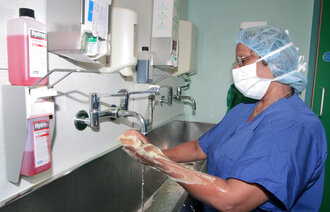
    The image shows a patient washing their hands at the sink

    Introduction

    Although good hand hygiene among healthcare personnel is recognised as the most important infection prevention measure in healthcare settings all over the world (1), patient hand hygiene has received little attention. The Norwegian Institute of Public Health recommends patient hand hygiene compliance as an infection prevention measure in all healthcare settings (2). This is in line with recommendations issued by Centers for Disease Control and Prevention (CDC) in the USA (3). 

    However, neither the World Health Organization (WHO) (1) nor the European Centre for Disease Prevention and Control (ECDC) have issued their own recommendations on patient hand hygiene (4). Inpatients’ hands are carriers of pathogens (5) and they come into contact with healthcare personnel as well as the surfaces of objects and areas that are frequently touched. This can lead to indirect transmission of pathogens. 

    Direct transmission between patients can also occur (6). Three percent of in-patients in Norwegian hospitals pick up a healthcare-associated infection (HAI) (7). In Europe, the expected annual incidence of HAI is 3.5 million (8). It is therefore important that we investigate whether patient hand hygiene should be given greater attention as an infection prevention measure. 

    HAI is an infection that patients acquire while in hospital or in other healthcare settings (8). HAI is a dreaded complication that increases patients’ suffering, and that impacts significantly on the level of resources required to run a hospital. Even a small reduction in the number of infections will produce savings in the health service, less suffering for those affected by the infections, and fewer deaths (7).

    Resistance to antibiotics is a growing problem, nationally and globally. Antibiotic-resistant bacteria will often settle in a person’s normal microbiota, for example in the intestines. This makes the affected individual a carrier of antibiotic-resistant bacteria in the gut. These carriers of antibiotic-resistant gut bacteria will not necessarily be taken ill themselves, but they may well contribute to the spread of antibiotic resistance (9), for instance via their hands after a visit to the toilet. 

    Antibiotic-resistant gut bacteria are bacteria that exist naturally in the gut, but that have developed resistance to one or multiple types of antibiotics. Gram-negative rod bacteria can develop a range of different resistance mechanisms. Extended-spectrum beta-lactamases (ESBL) make up a group of major clinical significance, and they can occur in many types of bacteria (9). 

    The prevalence of resistant enterobacteria and enterococci has been growing in recent years. Particularly Escherichia coli, Klebsiella pneumoniae and vancomycin-resistant enterococci (VRE) represent major challenges for patient treatment and infection control in the health service (10, 11). VRE can survive for more than an hour on hands and for up to four months in the environment (12). In Europe, the increase in antibiotic-resistant gut bacteria represents a significant threat to health services (13).

    When antibiotic-resistant bacteria cause disease, these infections are more difficult to treat than other infections. The risk of complications will be greater, the disease pathway will be longer and there will be increased patient mortality among those infected (9). 

    Despite the existence of well-established guidelines for the hand hygiene of healthcare personnel, patient hand hygiene appears to be under-researched, thus representing a gap in the knowledge on which measures to prevent infections with antibiotic-resistant bacteria in hospitals are based. 

    Objective of the study

    The objective of this study was to chart and summarise research literature on hospital patients’ hand hygiene behaviours, particularly their role in spreading antibiotic-resistant gut bacteria. 

    In order to shed light on this matter, we formulated the following research question: ‘What knowledge does existing research convey about hospital patients’ hand hygiene behaviours and their potential impact on the spread of antibiotic-resistant gut bacteria?’

    Method

    We chose to undertake a scoping review based on the framework developed by Arksey and O’Malley to research literature on the link between hospital patients’ hand hygiene and antibiotic-resistant gut bacteria. 

    The framework involves five stages: identifying the research questions, identifying relevant studies, selecting studies, charting the data and summarising the results (14). Furthermore, we based our literature list on the PRISMA checklist for scoping reviews (15).

    Identifying the research question and searching for relevant studies

    At the first stage, we formulated our research question and established our search terms and search strategy. To answer the research question, our main selection criteria were research literature that studied patient hand hygiene and included antibiotic-resistant gut bacteria. PCC is recommended as a guide to formulating clear and meaningful titles for scoping reviews. PCC is short for populationconcept and context

    The title, research question and inclusion criteria must be congruent. There is no need for explicit outcomes, interventions or phenomena in a scoping review, but elements of each of these can be implicit in the concept being investigated (16). 

    The scoping review’s population was adult, alert patients. The concept was patient hand hygiene and antibiotic-resistant gut bacteria, studied in the context of inpatient hospital wards. On 15 November 2022, we conducted a literature search in the MEDLINE, Embase, Global Health, AMED and Cinahl databases (Appendix 1 – partly in Norwegian). 

    The literature search was conducted using the following search words without truncation: patient, inpatient, hospitalized, institutionalized, hand hygiene, hand hygienic, handwash, hand-wash, hand disinfect, hand wash, hand sanitize, hand sanitise, hand antiseptic, hand contaminate, hand decontaminate, hands disinfect, hands wash, hands sanitize, hands sanitise, hands antiseptic, hands contaminate, hands decontaminate, alcohol hand sanitizer, alcohol hand sanitiser, alcohol hand rub. 

    The search words were combined with Boolean operators and proximity operators to secure relevant hits, and the searches were adjusted to the individual databases. We conducted the search without any date restrictions and in collaboration with a librarian.

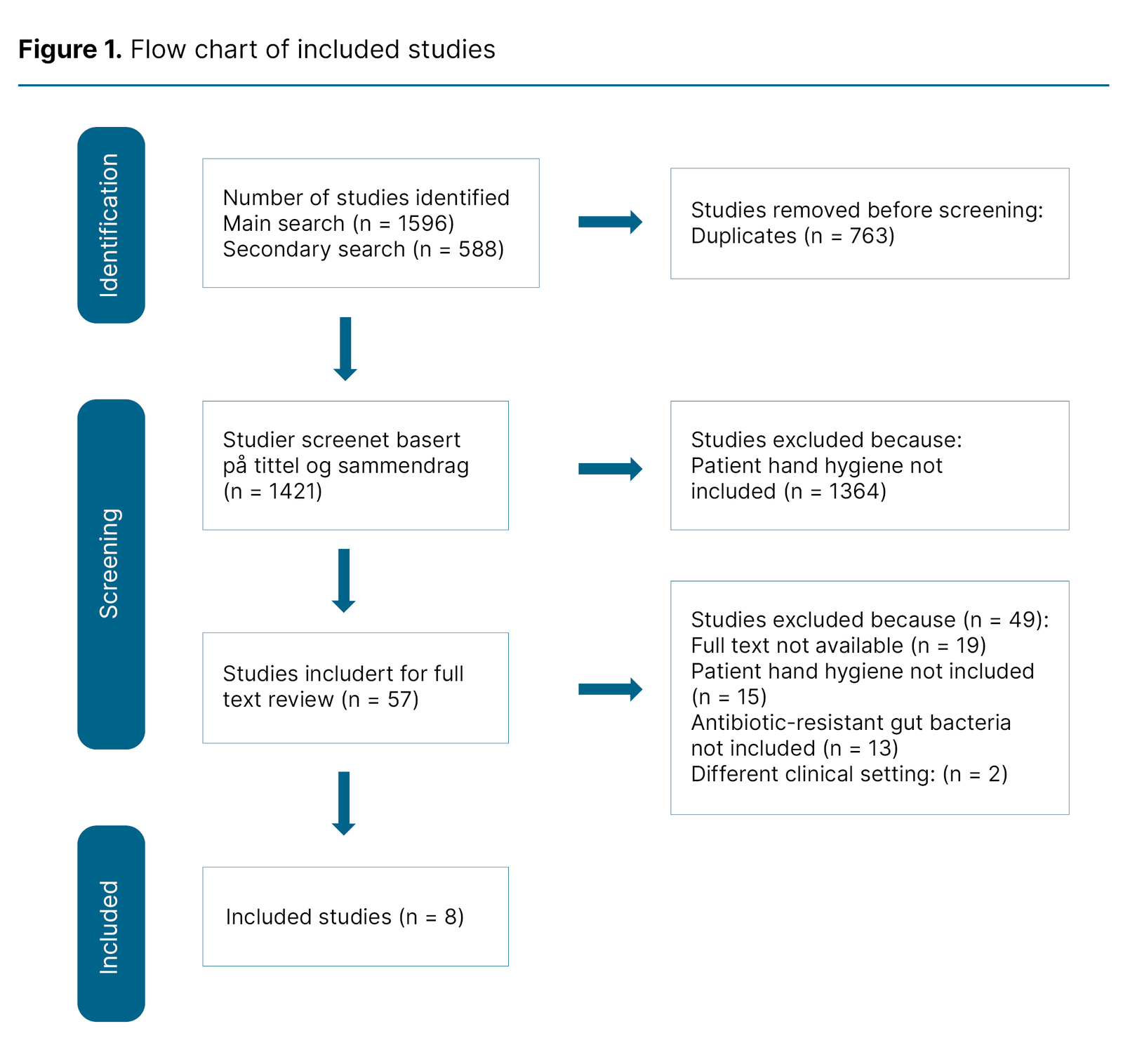
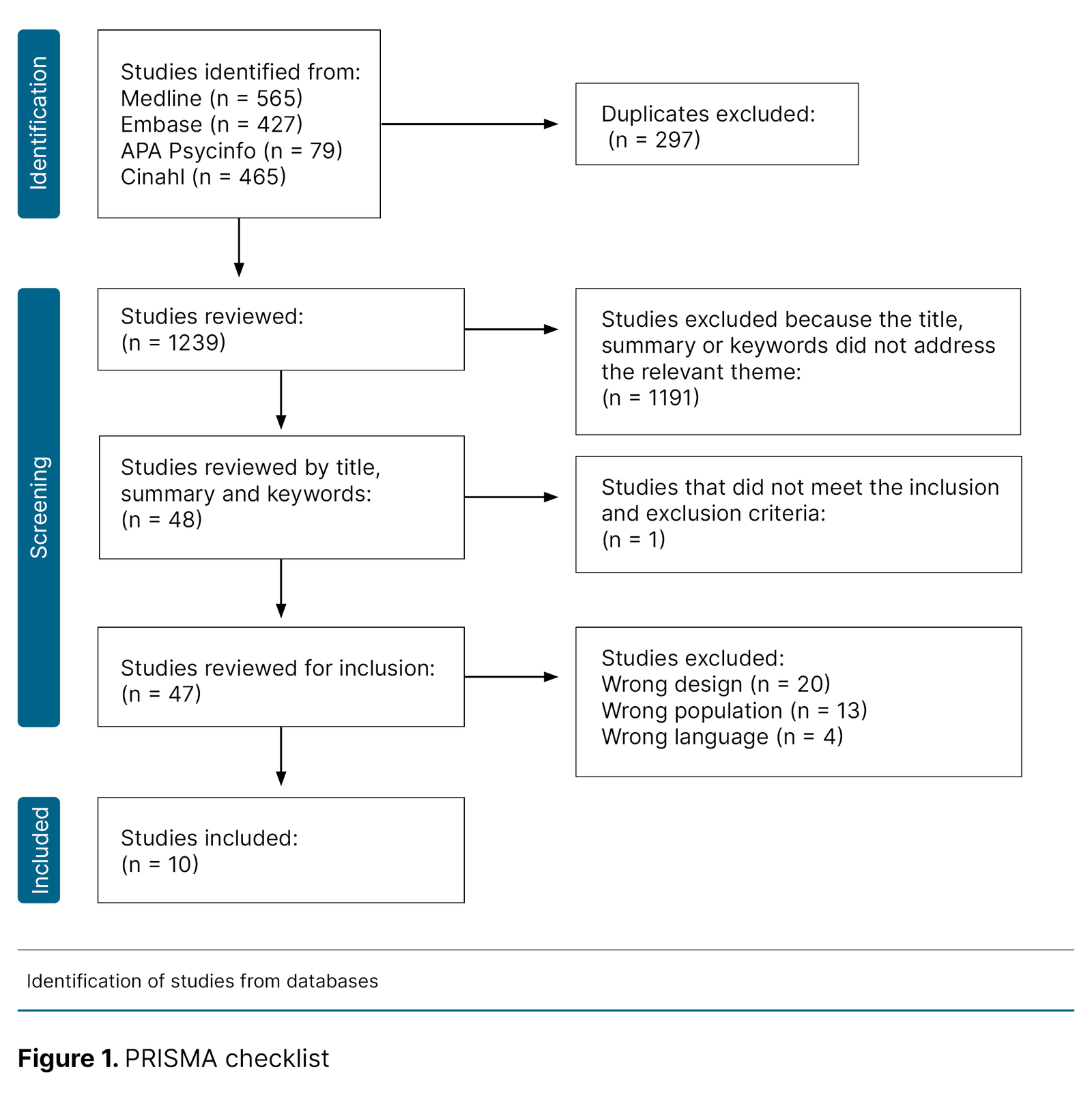
    We conducted another identical search on 13 September 2024, but this was limited to the period 16 November 2022 to 13 September 2024. This search identified a further 144 hits, all of which were excluded (Figure 1). We searched for grey literature in Google Scholar, but this produced an unmanageable number of hits. Consequently, we have not included any grey literature in our scoping review. 

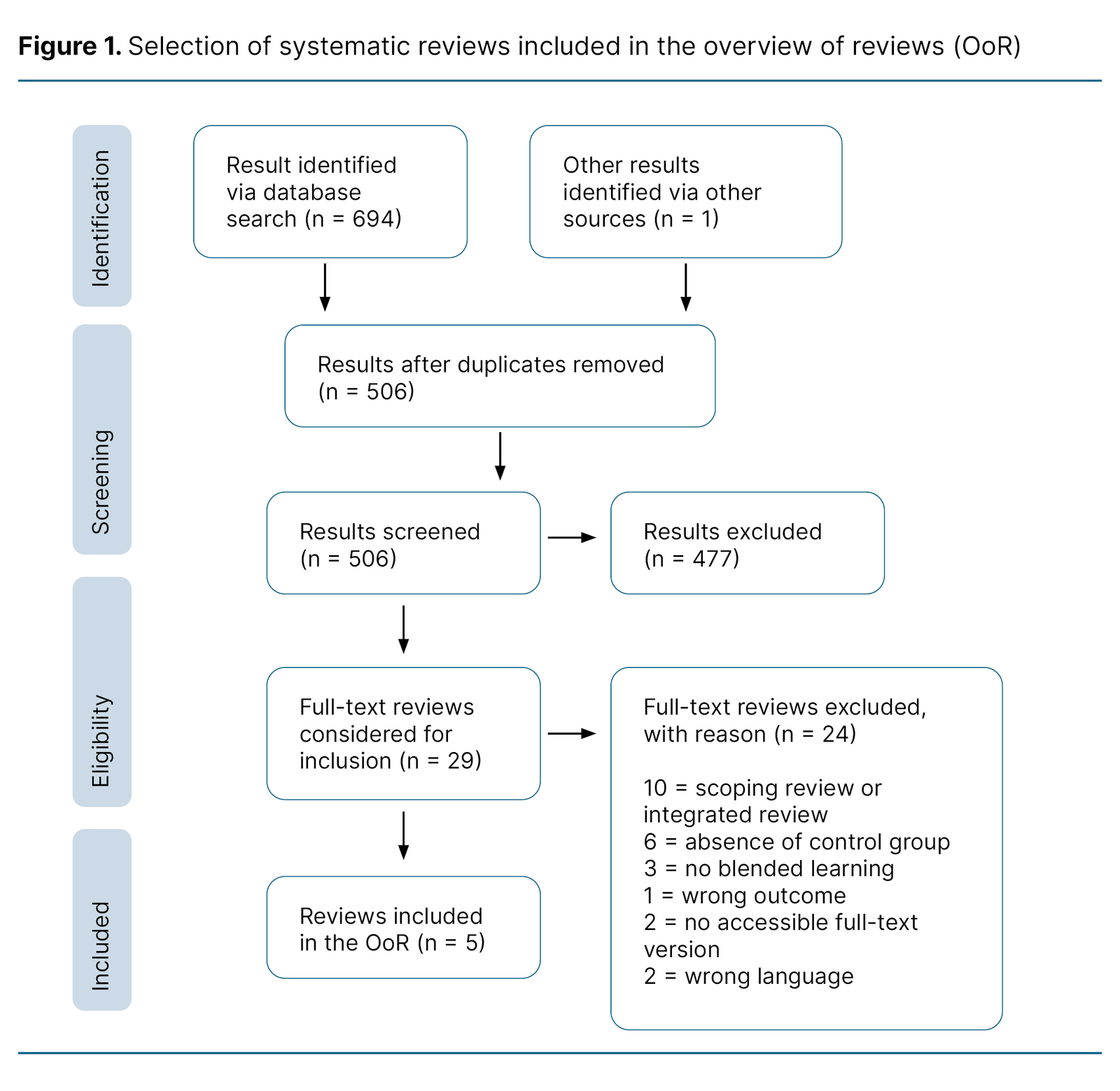
    Figure 1. Flow chart of included studies

    Selecting studies

    At the second stage, we selected articles based on our inclusion criteria: a) patient hand hygiene, b) adult patients, c) hospital, d) inpatient ward, e) antibiotic-resistant gut bacteria, and f) full text available. In the main search of all the databases we identified 1569 articles, in the secondary search 588. After removing 763 duplicates, 1421 studies remained for review of title and abstract. 

    To test our inclusion criteria, both authors conducted a blind test of ten percent of the studies (n = 128) in the main search. This showed congruence between the included and excluded articles. We proceeded to review the remaining articles. Of the 57 studies for which the full text was reviewed, 49 (86 percent) were excluded, and eight included articles remained. 

    The flow chart of included studies was updated after the secondary search. We used Covidence (17) to ensure that a blind and objective selection of articles was made, and the entire screening process was conducted by both authors.

    Charting the data and summarising the results

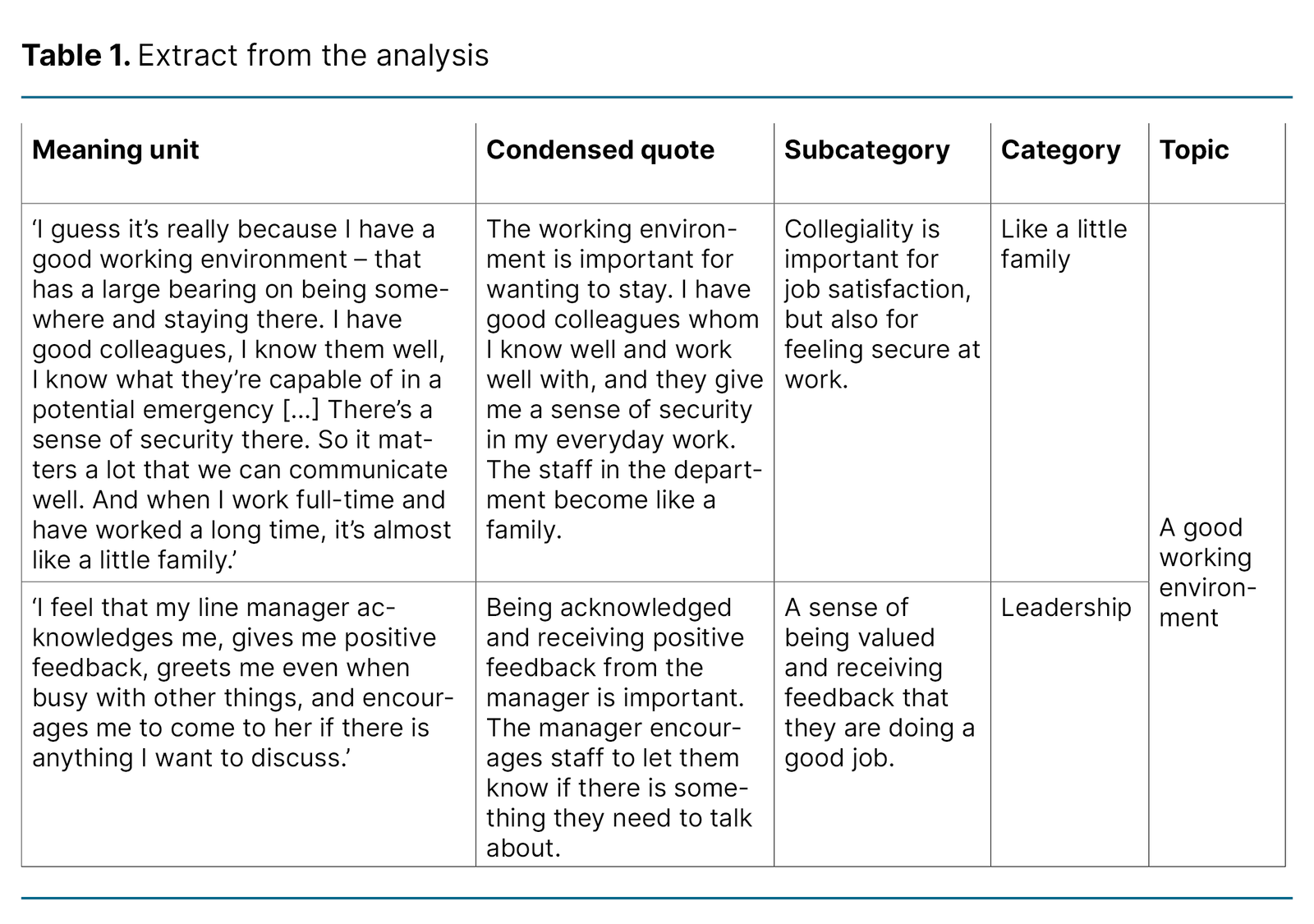
    The first author extracted data from the included articles. The results were summarised in a literature matrix (Table 1). We have not assessed the quality of the included articles, as this is not standard practice in scoping reviews (14).

    Ethical considerations

    We have used neither informants nor health information. The study has therefore not been submitted for assessment by the Regional committees for medical and health research ethics (REK) or Sikt – the Norwegian Agency for Shared Services in Education and Research. 

    Table 1. Literature matrix
    Table 1. Literature matrix

    Results

    Description of the included articles

    Four studies (50 percent) were conducted in the USA (18–21), two (25 percent) in Hongkong (12, 22), one (12.5 percent) in Switzerland (23) and one (12.5 percent) in Sweden (24). The study population of the included studies varied considerably, ranging from one single individual to 42 included hospitals. 

    There was also a range of study designs: one observational study, one quality improvement project, one cohort study, one cross-sectional study, one pre–post intervention study, one case study, one randomised controlled study (RCT) and one case–control study. 

    Two studies involved an intervention (20, 22), and two studies charted the prevalence of antibiotic-resistant gut bacteria on patient hands or on surfaces (18, 21). Four studies conducted an intervention as well as charting the prevalence (12, 19, 23, 24).

    Main categories identified

    We identified areas associated with patient hand hygiene and antibiotic-resistant gut bacteria and grouped the articles’ content in two categories: 1) ‘Prevalence of antibiotic-resistant gut bacteria on patient hands or on surfaces’, and 2) ‘Interventions that targeted patient hand hygiene’.

    Prevalence of antibiotic-resistant gut bacteria on patient hands or on surfaces

    Four studies investigated the prevalence of antibiotic-resistant gut bacteria on the hands of hospital patients (18, 19, 21, 23). All four studies found antibiotic-resistant gut bacteria as well as other bacteria. Two of these studies examined patients’ hands 48 hours after hospitalisation (21, 25). 

    Istenes et al. (21) examined the dominant hand of 100 patients. Of antibiotic-resistant gut bacteria, they found VRE in nine patients (9 percent). 

    Mody et al. (18) examined patients’ hands for antibiotic-resistant bacteria on admission and at regular intervals during their stay in hospital. They found that 28 patients of a total of 399 (7 percent) were colonised with antibiotic-resistant gut bacteria on their hands on admission. Of these, 20 patients (5 percent) had resistant gram-negative bacteria (RGNB), and eight (2 percent) had VRE. 

    Ullrich et al. (23) used nano particles comparable to VRE in their study. They planted nano particles on a patient’s glutes before a visit to the toilet to illustrate how VRE can spread in a hospital environment when only one patient is the unknown carrier. 

    Over the next eight hours, the prevalence of these particles was studied in 73 pre-defined locations, including on patients’ hands, on surfaces and shared contact points in the hospital ward. They carried out three tests and found nano particles on the contaminated patient’s hands in all three tests, while the neighbouring patient had no nano particles on their hands in any of the tests. The neighbouring patient complied with hand hygiene recommendations, often in the form of handwashing and hand disinfection. 

    These findings match those of Sunkesula et al. (19), whose study saw a lower prevalence of microbes on the hands of patients who complied with a hand hygiene intervention . 

    Three studies described surfaces or areas that were frequently touched by both healthcare personnel and patients (18, 19, 23). The patients’ surroundings – the patient zone – is such an area. Both Mody et al. (18) and Sunkesula et al. (19) wanted to investigate the link between microbes found on patient hands and microbes found on surfaces. 

    Mody et al. (18) established that when VRE and RGNB were found on hands, the same microbes were found on surfaces in the patient rooms. Sunkesula et al. (19), however, found no fluoroquinolone-resistant gram-negative bacteria on surfaces in the rooms of patients who carried these bacteria on their hands. 

    Ullrich et al. (23) studied the spread in the patient’s room and elsewhere on the ward. They found the particles on 80.8 percent of the surfaces they tested. Nevertheless, while they found particles on the hands of the neighbouring patient in only one of six tests (16.7 percent), they found nanoparticles on the remote control by their bed, their intravenous pump and on various objects, like mobile phones. 

    Interventions that targeted patient hand hygiene

    In three studies, education was included among the interventions that targeted patients’ hand hygiene (19, 20, 24). Ransjö et al. (24) introduced written and oral reminders, in addition to patient education in hand hygiene. The measures were adopted after an ESBL-producing Klebsiella pneumoniae outbreak had lasted for 20 months. They gained control of the outbreak eight months after measures had been introduced to improve patient hand hygiene. 

    In the other two studies (19, 20) alcohol-based hand disinfectants were handed out to patients, and education initiatives were based on the patient-centred model, supported by healthcare personnel, to improve patient hand hygiene: ‘Four moments for patient hand hygiene’. The model recommends handwashing in the following situations: 1) before and after touching wounds or medical equipment hooked up to the body, 2) before eating, 3) after a visit to the toilet, and 4) when entering or leaving the patient room (25). 

    In the study conducted by Haverstick et al. (20), VRE was reduced by 70 percent over the 19 months that the intervention lasted. All the three studies of interventions that targeted patient hand hygiene showed that the measures had an impact. 

    Sunkesula et al. (19) investigated whether a hand hygiene intervention could influence the prevalence of bacteria on hands. They had an intervention group (n = 44) and a control group (n = 47). 

    This study also identified antibiotic-resistant gut bacteria, but only of the fluoroquinolone-resistant gram-negative bacteria type and no VRE. They found fluoroquinolone-resistant gram-negative bacteria on the hands of two patients (4.3 percent) in the control group and none (zero) in the intervention group. 

    Other measures included direct observation of hand hygiene behaviours, with healthcare personnel observing patients to ensure hand hygiene compliance. This measure was used in two studies from Hongkong (12, 22) and was found to be effective in both cases. 

    In one of these studies, Cheng et al. (12) conducted direct observations of hand hygiene behaviours as a preventive measure, specifically before meals, before intake of medicines and after the use of bedpans. Additionally, patients were encouraged to attend to their hand hygiene after toilet visits. 

    Hongkong’s 42 public hospitals are grouped into seven health trusts. During the period of the interventions, the rate of outbreaks was rising in all of Hongkong’s other health trusts, totalling 78 VRE outbreaks. However, there was only one outbreak in the health trust included in the study. 

    In the second study from Hongkong by Cheng et al. (22) they conducted direct observations of hand hygiene behaviours before the intake of medicines and meals. This was a measure introduced in connection with a VRE outbreak that lasted for four years and ten months. Patients were also regularly reminded of the intervention through posters. 

    After introducing the intervention, they found that the outbreak rate for VRE was reversed from an increase of 10.5 percent per month to a reduction of 13.3 percent per month. Patient hand hygiene compliance before the intake of meals and medication was at 97.3 percent.

    Discussion

    Summary of main findings

    In summary, the studies show that hospitalised patients who comply with hand hygiene recommendations, have a lower prevalence of antibiotic-resistant bacteria on their hands. Additionally, inpatients who comply with hand hygiene recommendations in specific situations, such as after visiting the toilet or before meals, can potentially help to stop the outbreak or the spread of antibiotic-resistant gut bacteria to surfaces.

    Prevalence of antibiotic-resistant gut bacteria on patients’ hands and on surfaces

    Several studies found antibiotic-resistant gut bacteria on the hands of patients, both on admission and during their stay in hospital (18, 19, 21). Some microbes, such as Klebsiella pneumoniae, survive well on skin, which means that good hand hygiene is essential for gaining control of such microbes (24). 

    However, Ullrich et al. (23), who used a VRE surrogate, found that the patient zone was contaminated even if the patient’s hand hygiene was good and only one of six tests found traces on the patients’ hands. The explanation may be that VRE survives for only one hour on hands but can survive for up to four months on inanimate objects in the surroundings (12). 

    The study carried out by Ullrich et al. (23) included only a single patient, which makes it difficult to draw conclusions. Nevertheless, their findings raise interesting questions about the significance of patient hand hygiene, because the study shows how fast VRE can spread on a hospital ward even if only a single patient is a carrier of VRE. Particles from this one patient caused contamination of 80.8 percent of pre-defined locations on a hospital ward, including the toilet seat, the wash-hand basin in the toilet, the toilet door handle and patients’ hands (23). 

    If the patient had washed their hands after visiting the toilet, only some of the contaminated locations would have received the particles. The study highlights the importance of cleanliness, and of isolating VRE-positive patients. It also highlights the importance of hand hygiene compliance among all healthcare personnel who touch patients, and all users of communal spaces, whether visitors, fellow patients or healthcare personnel. The study is also important in that it supports the assertion that focusing on healthcare personnel’s hand hygiene is the most important infection prevention measure in any healthcare setting.

    In recent years, hospitals have changed their practices in that patients are encouraged to be active and contribute to their own convalescence (26). This leads to frequent touching of shared contact points, as well as much movement in and out of patient rooms. According to ‘Four moments for patient hand hygiene’ (25), entering and leaving the patient room present an opportunity for handwashing. 

    Patients are encouraged to play an active part by collecting their own food. A master’s thesis that investigated hand hygiene in connection with buffet meals in a Norwegian hospital, concluded that buffets can involve a risk of transmission of pathogenic microbes (27).

    As mentioned above, microbes have different survival times on surfaces. The studies that sought to match the prevalence of microbes on hands to the prevalence of microbes on surfaces (18, 19, 23), reported conflicting findings. While these were small-scale studies of dissimilar designs, they do raise interesting questions about the role played by healthcare personnel in contaminating surfaces in patient areas, and whether the type of microbe may be significant. 

    Patients who are infected with VRE and multi-resistant gram-negative rod bacteria are all potentially at risk of contaminating the hospital environment. These bacteria, which are highly common in healthcare settings, can persist on different surfaces for different lengths of time and are difficult to eliminate by cleaning or disinfection (28). 

    Two of the studies (18, 19) established multi-resistant gram-negative rod bacteria on the hands of patients. Although these pathogens were found on the hands of patients in both studies, they were not identified on the surfaces of either of the patient rooms. This may be due to differences in surface materials, temperatures and cleaning routines.

    Interventions that target patient hand hygiene

    Two of the studies showed that systematic hand hygiene education, combined with easy access to hand disinfectant, had significant impact on VRE-infections and the presence of fluoroquinolone-resistant gram-negative bacteria on patients’ hands (19, 20). 

    Increased knowledge about hand hygiene among patients, combined with easy access to hand disinfectant, appear to be effective measures for reducing infection rates. Access to hand disinfectant leads to better compliance among healthcare personnel (29), and it seems likely that the same will apply for patients. 

    Both studies made use of the model ‘Four moments for patient hand hygiene’ (25), which recommends hand hygiene compliance in particular situations. The model is clear and specific for those involved, such as patients and healthcare personnel, and there is no scope for individual discretion in deciding on the appropriate situation for hand hygiene compliance. 

    An evidence-based system of routines assures the quality of the work carried out in hospitals. Health and care services have a statutory duty to work systematically on quality improvement and patient safety (30), and in this context, ‘Four moments for patient hand hygiene’ is useful. 

    An outbreak of ESBL-producing Klebsiella pneumoniae in a Swedish hospital was curbed by hand hygiene knowledge combined with various types of reminders. The outbreak had been going on for 20 months, and 247 patients had been identified as carriers of the microbe (24). 

    There is reason to believe that after such a long time and so many infected patients, staff were highly motivated to reverse the outbreak. Large numbers of patients held in isolation lead to much extra work for hospital staff, and infections with antibiotic-resistant bacteria involve higher patient risks. 

    Today we see a growing volume of outbreaks, which in turn means that more patients will have to be isolated due to infections. This situation represents a major challenge for the healthcare personnel involved (31). 

    In Norway, hospitals have a duty to organise and establish routines that will ensure the delivery of appropriate health services. This duty also means that hospital owners and managers are responsible for facilitating each individual healthcare worker’s safe performance of their duties (32). Effective infection prevention depends on management establishing strong routines that provide staff with the necessary knowledge and resources to proactively prevent the spread of infections on hospital wards. 

    Two studies showed that direct observations of hand hygiene practices are useful measures for preventing infection and stopping infection outbreaks (12, 22). It is worth noting that Cheng et al. (12) conducted a study in which all patients were screened for VRE on admission. If VRE was identified, the patient was put in isolation. It is likely that this also had an impact on the spread of VRE at the hospital. 

    Nevertheless, they achieved a high level of hand hygiene compliance among the patients in their study by directly observing their behaviours in specific situations. We do not know how often patients in Norway wash their hands, but an English 24-hour observational study shows an inpatient hand hygiene compliance rate of 56 percent (n = 164) (33). 

    Among patients, knowledge levels about the importance of hand hygiene vary, but this has not been researched. Direct observations of hand hygiene behaviours before meals can be difficult to follow up in Norwegian hospitals, one of the reasons being the way that meals are organised.

    Hand hygiene interventions aimed at patients can also influence healthcare personnel’s hand hygiene compliance. Other studies show that hand hygiene interventions aimed at patients brought a 30 percent rise in compliance among healthcare personnel (34). In the included studies, the hand hygiene interventions aimed at patients may therefore have influenced compliance levels among healthcare personnel, and in turn, the results. 

    Method, strengths and limitations

    A scoping review is an appropriate method whenever the literature available describes different research designs and there is no intention to assess the quality of the included literature. Conducting a scoping review has allowed us to undertake a literature study to identify areas that need further research. 

    It is a strength of this study that a librarian was involved throughout the entire search process, and that the literature review and inclusion of articles was carried out by two independent individuals. The included studies have different research designs, which may be a strength because the topic is approached from different angles.

    The manual screening process that was used to identify articles about patient hand hygiene and gut bacteria may have caused articles to be overlooked. Patient hand hygiene is not a single search word, and if patient and hand hygiene are combined in a literature search, a great many unwanted hits will be included that deal with hand hygiene in general or the hand hygiene of healthcare personnel. 

    The terminology and many abbreviations that are used to describe antibiotic-resistant gut bacteria, such as VRE, RGNB and ESBL, represent another challenge. Familiarity with these words and acronyms is essential to enable identification of relevant studies. 

    The data extraction was conducted by one person, which may have caused relevant data to be overlooked. Additionally, the included studies involved bacteria other than those present in the intestines, which meant that we included only parts of the articles’ content. This may have led to incomplete data extraction, and certain connections may have gone unnoticed. 

    Conclusion

    The research literature lists better hand hygiene among patients, combined with other infection control measures, as a potentially important factor in reducing hospital infection rates and managing outbreaks of antibiotic-resistant gut bacteria.

    It is assumed that patient hand hygiene can influence the prevalence of antibiotic-resistant gut bacteria, and that good hand hygiene may potentially reduce the spread to other patients’ immediate surroundings and to the hospital environment in general. However, hand hygiene interventions among patients should be seen as a supplement to well-established and evidence-based infection prevention measures.

    Further research should investigate what measures are associated with high patient hand hygiene compliance rates in specific situations, so that efforts can be targeted and produce the desired results without unnecessary use of resources. We also need more knowledge about the durability and scalability of hand hygiene measures among patients, across different hospital wards and patient groups.

    The authors declare no conflicts of interest.

    Open access CC BY 4.0

    Peer-reviewed article
    Publication type
    Publication Year
    2025
    Edition Year
    20
    Publication Number
    102648
    Page Number
    e-102648

    Interventions such as reminders, direct observations and hand hygiene facilitation lead to fewer outbreaks.

    Article is Peer Reviewed
    1
    Innsendte kommentarer kvalitetssikres før publisering. Kvalitetssikringen skjer i vanlig arbeidstid.
    Research
    English

    Background: Because patients can cause cross contamination, the Norwegian Institute of Public Health recommends hand hygiene interventions as infection prevention measures in healthcare settings. Healthcare-associated infections are dreaded inpatient complications, and infections with antibiotic-resistant bacteria carry an increased risk of complications and death. Antibiotic-resistant bacteria often establish themselves in the normal microbiota of the intestines, which involves carriership of antibiotic-resistant gut bacteria.

    Objective: To chart and summarise research literature about patient hand hygiene in hospital settings, particularly its impact on the spread of antibiotic-resistant gut bacteria.

    Method: We conducted a scoping review based on Arksey and O’Malley’s methodological framework. We selected literature from MEDLINE, Embase, Global Health, AMED and Cinahl.

    Results: We identified 2184 articles and included eight studies from the USA, Switzerland, Sweden and Hongkong that matched our inclusion criteria. All eight articles focus on either the prevalence of infection, on interventions, or both. We studied the prevalence of antibiotic-resistant gut bacteria on patients’ hands and on surfaces, and we identified interventions that targeted patient hand hygiene. The prevalence of some antibiotic-resistant gut bacteria on patient hands matched the prevalence of surface contamination. We identified the following interventions aimed at patient hand hygiene: education, direct observation of hand hygiene behaviours, reminders, hand hygiene facilitation and easy access to hand disinfection products. These measures, combined with other infection prevention interventions, led to fewer antibiotic-resistant gut bacteria on patients’ hands and less frequent outbreaks of antibiotic-resistant gut bacteria. 

    Conclusion: Greater attention to patients’ hand hygiene compliance in hospital settings can influence infection rates and the management of outbreaks of antibiotic-resistant gut bacteria. Research literature lists patient hand hygiene as a potential factor of relevance to the spread of contamination to other patients’ immediate surroundings or on hospital wards. They recommend that hand hygiene facilities are made more easily accessible to patients, and that patients receive information and guidance about hand hygiene.

    Exclude images in ZIP export?
    Off
    The image shows a patient washing their hands at the sink
    0
    • Interventions such as education, direct observation of hand hygiene behaviours, reminders, hand hygiene facilitation and accessible hand disinfection facilities lead to fewer antibiotic-resistant gut bacteria on patients’ hands and less frequent outbreaks of antibiotic-resistant gut bacteria.
    • It is recommended that hand hygiene facilities are made easily available to patients, and that patients receive information and guidance about hand hygiene.
    • The prevalence of antibiotic-resistant bacteria on patients’ hands does not necessarily match the prevalence on surfaces in the patient room, which suggests that there perhaps is no correlation between these findings.

    1.         World Health Organization (WHO). WHO guidelines on hand hygiene in health care [Internet]. Geneva: WHO; 2009. Available from: https://www.who.int/publications/i/item/9789241597906 

    2.         Folkehelseinstituttet. Håndhygiene blant pasienter og besøkende [Internet]. Oslo: Folkehelseinstituttet; 2017 [updated 11 December 2024; cited 3 June 2025]. Available from: https://www.fhi.no/nettpub/handhygiene/i-praksis/handhygiene-blant-pasienter-og-besokende/%20?term=pasient%20&h=1

    3.         U.S. Centers for Disease Control and Prevention (CDC). About hand hygiene for patients in healthcare settings [Internet]. Atlanta, GA: CDC; 2024 [updated 27 February 2024; cited 3 June 2025]. Available from: https://www.cdc.gov/clean-hands/about/hand-hygiene-for-healthcare.html

    4.         European Centre for Disease Prevention and Control (ECDC). Hand hygiene [Internet]. Solna: ECDC; n.d. [updated 25 May 2015; cited 7 February 2025]. Available from: https://www.ecdc.europa.eu/en/publications-data/directory-guidance-prevention-and-control/core-requirements-healthcare-settings-0 

    5.         Folkehelseinstituttet (FHI). Generelt om håndhygiene og huden på hendene [Internet]. Oslo: FHI; 2017 [cited 21 December 2022]. Available from: https://www.fhi.no/nettpub/handhygiene/om-handhygiene/temakapitler/?term=&h=1 

    6.         Folkehelseinstituttet (FHI). ESBL-produserende gramnegative bakterier, herunder karbapenemaseproduserende bakterier (CPO) – håndbok for helsepersonell [Internet]. Oslo: FHI; 2010 [updated 17 November 2023; cited 3 June 2025]. Available from: https://www.fhi.no/nettpub/smittevernveilederen/sykdommer-a-a/esbl-betalaktamaser-med-utvidet-spe/ 

    7.         Helsedirektoratet. Sykehus – forekomst av helsetjenesteassosierte infeksjoner [Internet]. Oslo: Helsedirektoratet; 2019 [updated 28 November 2022; cited 3 June 2025]. Available from: https://www.helsedirektoratet.no/statistikk/kvalitetsindikatorer/infeksjoner/forekomst-av-helsetjenesteassosierte-infeksjoner-i-sykehus 

    8.         European Centre for Disease Prevention and Control (ECDC). Healthcare-associated infections [Internet]. Solna: ECDC; n.d. [cited 3 June 2025]. Available from: https://www.ecdc.europa.eu/en/healthcare-associated-infections

    9.         Folkehelseinstituttet (FHI). Antibiotikaresistens i Norge [Internet]. Oslo: FHI; 2014 [updated 26 November 2021; cited 21 December 2022]. Available from: https://www.fhi.no/nettpub/hin/smitte/resistens/

    10.       Folkehelseinstituttet (FHI). ESBL-holdige gramnegative stavbakterier – smitteverntiltak i helseinstitusjoner [Internet]. Oslo: FHI; 2015 [updated 8 January 2025; cited 3 June 2025]. Available from: https://www.fhi.no/sv/forebygging-i-helsetjenesten/smittevern-i-institusjoner/tiltak/esbl-holdige-gramnegative-stavbakte/

    11.       Sare M, Langlete P, Raastad R, Handal N, Eriksen-Volle H-M. Årsrapport 2024: forekomst av resistente bakterier og sopp med spesiell betydning for smittevern i helsetjenesten i Norge [Internet]. Oslo: Folkehelseinstituttet; 2025 [cited 3 June 2025]. Available from: https://www.fhi.no/contentassets/126debe38f6e4f4a823ecf34d67c6028/forekomst-av-resistente-bakterier-og-sopp-med-spesiell-betydning-for-smittevern-i-helsetjenesten-i-norge-arsrapport-2024.pdf

    12.       Cheng VC, Tai JW, Chen JH, So SY, Ng WC, Hung IF, et al. Proactive infection control measures to prevent nosocomial transmission of vancomycin-resistant enterococci in Hongkong. J Formos Med Assoc. 2014;113(10):734–41. DOI: 10.1016/j.jfma.2014.04.001

    13.       European Centre for Disease Prevention and Control (ECDC). Increase in carbapenem-resistant Enterobacterales (CRE) poses a significant threat to patients and healthcare systems in the EU/EEA [Internet]. Solna: ECDC; 2025. Available from: https://www.ecdc.europa.eu/en/news-events/increase-carbapenem-resistant-enterobacterales-cre-poses-significant-threat-patients 

    14.       Arksey H, O'Malley L. Scoping studies: towards a methodological framework. Int J Soc Res Methodol. 2005;8(1):19–32. DOI: 10.1080/1364557032000119616

    15.       Joanna Briggs Institute. Appendix 10.2: PRISMA-ScR extension fillable checklist [Internet]. JBI Manual for Evidence Synthesis; 2020 [cited 27 October 2025]. Available from: https://jbi-global-wiki.refined.site/space/MANUAL/355863360/Appendix+10.2+PRISMA+ScR+Extension+Fillable+Checklist 

    16.        Peters MDJ, Godfrey C, McInerney P, Munn Z, Tricco AC, Khalil H. Scoping reviews. In: Aromataris E, Lockwood C, Porritt K, Pilla B, Jordan Z, eds. JBI Manual for Evidence Synthesis [Internet]. Adelaide: JBI; 2024 [cited 27 October 2025]. DOI: 10.46658/JBIMES-24-09 

    17.       Covidence. The world's #1 systematic review tool [Internet]. Melbourne: Covidence; n.d. [cited 31 October 2025]. Available from: www.covidence.org

    18.       Mody L, Washer LL, Kaye KS, Gibson K, Saint S, Reyes K, et al. Multidrug-resistant organisms in hospitals: What is on patient hands and in their rooms? Clin Infect Dis. 2019;69(11):1837–44. DOI: 10.1093/cid/ciz092

    19.       Sunkesula VCK, Kundrapu S, Knighton S, Cadnum JL, Donskey CJ. A randomized trial to determine the impact of an educational patient hand-hygiene intervention on contamination of hospitalized patient's hands with healthcare-associated pathogens. Infect Control Hosp Epidemiol. 2017;38(5):595–7. DOI: 10.1017/ice.2016.323

    20.       Haverstick S, Goodrich C, Freeman R, James S, Kullar R, Ahrens M. Patients' hand washing and reducing hospital-acquired infection. Crit Care Nurse. 2017;37(3):e1–8. DOI: 10.4037/ccn2017694

    21.       Istenes N, Bingham J, Hazelett S, Fleming E, Kirk J. Patients’ potential role in the transmission of health care-associated infections: prevalence of contamination with bacterial pathogens and patient attitudes toward hand hygiene. Am J Infect Control. 2013;41(9):793–8. DOI: 10.1016/j.ajic.2012.11.012

    22.       Cheng VC, Tai JW, Chau PH, Lai CK, Chuang VW, So SY, et al. Successful control of emerging vancomycin-resistant enterococci by territory-wide implementation of directly observed hand hygiene in patients in Hong Kong. Am J Infect Control. 2016;44(10):1168–71. DOI: 10.1016/j.ajic.2016.03.050

    23.       Ullrich C, Luescher AM, Koch J, Grass RN, Sax H. Silica nanoparticles with encapsulated DNA (SPED) to trace the spread of pathogens in healthcare. Antimicrob Resist Infect Control. 2022;11(1):4. DOI: 10.1186/s13756-021-01041-3

    24.       Ransjö U, Lytsy B, Melhus A, Aspevall O, Artinger C, Eriksson BM, et al. Hospital outbreak control requires joint efforts from hospital management, microbiology and infection control. J Hosp Infect. 2010;76(1):26–31. DOI: 10.1016/j.jhin.2010.01.018

    25.       Sunkesula VC, Knighton S, Zabarsky TF, Kundrapu S, Higgins PA, Donskey CJ. Four moments for patient hand hygiene: a patient-centered, provider-facilitated model to improve patient hand hygiene. Infect Control Hosp Epidemiol. 2015;36(8):986–9. DOI: 10.1017/ice.2015.78

    26.       Tazreean R, Nelson G, Twomey R. Early mobilization in enhanced recovery after surgery pathways: current evidence and recent advancements. J Comp Eff Res. 2022;11(2):121–9. DOI: 10.2217/cer-2021-0258

    27.       Einarson LH. Smittebuffet. Håndhygiene ved matbuffetene på UNN [Internet]. Tromsø: UiT Norges arktiske universitet; 2018 [cited 3 June 2025]. Available from: https://munin.uit.no/handle/10037/13759 

    28.       Otter JA, Yezli S, Salkeld JAG, French GL. Evidence that contaminated surfaces contribute to the transmission of hospital pathogens and an overview of strategies to address contaminated surfaces in hospital settings. Am J Infect Control. 2013;41(5, Supplement):S6–11. DOI: 10.1016/j.ajic.2012.12.004

    29.       Bischoff WE, Reynolds TM, Sessler CN, Edmond MB, Wenzel RP. Handwashing compliance by health care workers: the impact of introducing an accessible, alcohol-based hand antiseptic. Arch Intern Med. 2000;160(7):1017–21. DOI: 10.1001/archinte.160.7.1017

    30.       Helse- og omsorgsdepartementet. Kvalitet og pasientsikkerhet [Internet]. Oslo: Helse- og omsorgsdepartementet; 2022 [updated 5 October 2022; cited 3 June 2025]. Available from: https://www.regjeringen.no/no/tema/helse-og-omsorg/sykehus/innsikt/kvalitet/id536789/ 

    31.       Musau J, Baumann A, Kolotylo C, O'Shea T, Bialachowski A. Infectious disease outbreaks and increased complexity of care. Int Nurs Rev. 2015;62(3):404–11. DOI: 10.1111/inr.12188

    32.       Helsedirektoratet. § 4. Forsvarlighet [Internet]. Oslo: Helsedirektoratet; n.d. [updated 31 May 2024; cited 3 June 2025]. Available from: https://www.helsedirektoratet.no/rundskriv/helsepersonelloven-med-kommentarer/krav-til-helsepersonells-yrkesutovelse/-4.forsvarlighet

    33.       Randle J, Arthur A, Vaughan N. Twenty-four-hour observational study of hospital hand hygiene compliance. J Hosp Infect. 2010;76(3):252–5. DOI: 10.1016/j.jhin.2010.06.027

    34.       Gagné D, Bédard G, Maziade PJ. Systematic patients' hand disinfection: impact on meticillin-resistant Staphylococcus aureus infection rates in a community hospital. J Hosp Infect. 2010;75(4):269–72. DOI: 10.1016/j.jhin.2010.02.028

    Disable PDF autogeneration
    Off
  • First-time mothers’ knowledge of pelvic floor muscle training and postnatal follow-up of pelvic floor function

    The illustration shows a woman’s pelvic floor, as well as a woman lying on the floor with her knees bent, ready for pelvic floor training.n viser en kvinnes bekkenbunn samt en dame som ligger på gulvet med bøyde knær, klar for bekkenbunnstrening

    Introduction 

    The Norwegian Directorate of Health recommends that women be provided with information on pelvic floor muscle training (PFMT) as part of their antenatal care (1). National clinical guidelines for postnatal care strongly advise one to two structured, individualised consultations during their postnatal hospital stay, including information and guidance on pelvic floor muscles and the offer of tailored exercise programmes (2).

    In these guidelines (2), less emphasis is placed on the recommendation for women to undergo a postnatal check-up with a doctor or midwife 4–6 weeks after childbirth. The purpose of the check-up is to identify any need for further follow-up, and it should address issues such as pelvic pain, incontinence, assessment of perineal lacerations and sexual health (2).

    Understanding the importance of providing information and guidance on pelvic floor muscles before and after childbirth requires knowledge of their anatomy and function. The pelvis is closed inferiorly by muscles that form the pelvic floor. The deep muscles of the pelvic floor are essential for supporting the vagina, uterus, ovaries, bladder and rectum, ensuring optimal organ function. The pelvic floor also contributes to the regulation of intra-abdominal pressure during actions such as jumping, sneezing or laughing (3). 

    During pregnancy, the uterus increases in size, placing greater pressure on the pelvic floor (4). During vaginal delivery, the pelvic floor muscles are stretched to more than three times their resting length (5). The strain during pregnancy and childbirth can cause overstretching and tearing of muscle fibres and nerves, which can compromise the supportive function of the pelvic floor (6).

    When the pelvic floor muscles are weakened or injured, the physical consequences include urinary incontinence, anal incontinence and pelvic organ prolapse, with the former being the most common. Several studies report that approximately 30% of women experience urinary incontinence for up to four years after childbirth (7–9).

    As with other skeletal muscles, the pelvic floor requires training to maintain or increase its strength and supportive function. The recommendation for strengthening the pelvic floor after childbirth is pelvic floor contractions for six to eight seconds, eight to twelve times per session, three times daily (3). 

    Women are advised to perform PFMT for three to six months postpartum and to continue the exercises a few times each week for the rest of their life (6).

    Evidence regarding PFMT as a preventive or therapeutic intervention for pelvic floor–related disorders associated with pregnancy and childbirth is mixed. However, there is consensus that PFMT is effective in both preventing and treating urinary incontinence (10, 11).

    The effect of PFMT on faecal incontinence remains uncertain (7). PFMT can also be recommended as a conservative strategy to reduce symptoms of pelvic organ prolapse (12). Effective training requires women to learn how to correctly identify and activate the pelvic floor muscles, which can be challenging without individualised guidance (11, 13–15). 

    Several high-income countries have studied women’s experiences of receiving information and follow-up regarding PFMT, but we have not found any studies with a focus on the Norwegian context.

    New national guidelines for maternity care in Norway were published after this study was completed, but they do not address PFMT. Consequently, recommendations on PFMT continue to be based on the current national guidelines for antenatal (1) and postnatal care (2).

    Objective of the study

    The aim of this study was to investigate the following research question:

    What is the association between receiving information and follow-up during antenatal and postnatal care and first-time mothers’ knowledge of PFMT and postnatal follow-up of pelvic floor function by healthcare personnel?

    The specific research questions were as follows: 

    1. What proportion of women receive information on PFMT during pregnancy, the postnatal hospital stay and at the postnatal check-up?
    2. What information do women receive regarding PFMT and the follow-up of pelvic floor function during pregnancy, the postnatal hospital stay and at the postnatal check-up?
    3. To what extent do women feel they have sufficient knowledge to maintain pelvic floor function based on the information and follow-up they have received? 

    Method 

    The data in this cross-sectional study were collected anonymously via questionnaire. The study population comprised first-time mothers who gave birth between 1 January 2022 and 1 July 2023, at ≥ 37 weeks of gestation.

    First-time mothers were selected to ensure a comparable baseline regarding the information received on PFMT. The study period was chosen to minimise the risk of recall bias. All modes of delivery were included to enable comparison of the information provided to different groups. 

    A self-selected, non-probability sampling method was used. Given our limited resources, this method was considered easier, quicker and more cost-effective for recruiting participants. Recruitment was via the social media platforms Facebook and Instagram.

    A post that could be shared publicly was created and published in national and local Facebook groups, including due-date and postnatal groups, and through Instagram profiles that could reach the target population. The post included a link to the study website. Information about the study was shared multiple times during the recruitment period to increase participation. A total of 1093 participants were included in the study.

    Questionnaire and variables

    The digital questionnaire consisted of 26 questions covering sociodemographic characteristics, childbirth and information on PFMT during antenatal and postnatal care. No validated questionnaires directly addressing the research question were identified; therefore, the questions were partly self-developed and partly adapted from validated questionnaires in the Norwegian Institute of Public Health’s questionnaire bank (16).

    This approach can potentially introduce information bias. To address potential issues with the self-developed questionnaire, a pilot study was conducted with 20 respondents. Their feedback led to us adding a ‘Don’t remember’ response option for several questions and the use of illustrations to describe perineal lacerations.

    Analysis

    Following data collection in the online survey tool Nettskjema, the dataset was exported to IBM SPSS Statistics version 29 and then screened for extreme values and obvious errors. Results for the first and second research questions were summarised as frequencies and percentages.

    For the third research question, Pearson’s chi-square test was used to examine whether there was a statistically significant association between information on PFMT provided during the postnatal hospital stay and women’s evaluation of the adequacy of the overall information and follow-up of pelvic floor function.

    The chi-square test yields a p-value, indicating the likelihood that an observed difference is due to chance. If the p-value is < 0.05, the null hypothesis is rejected. However, p-values alone do not fully reflect the scientific relevance of the findings.

    Ethical considerations

    The data collected did not include personally identifiable information, and background characteristics were reported in categories. Consequently, no assessment was required by Sikt – the Norwegian Agency for Shared Services in Education and Research (18). As the study was not intended to generate new knowledge on health or morbidity, approval by the Regional Committees for Medical and Health Research Ethics (REK) was deemed unnecessary (19).

    The study was conducted in accordance with professional ethical guidelines for midwives, which outline the need for them to share evidence-based information and protect women’s privacy (20). The study also adhered to the Declaration of Helsinki, which underscores the importance of informed consent and places ethical responsibility on the researcher (21), in line with the Norwegian Research Ethics Act (22).

    Results

    A total of 1213 questionnaire responses were received, of which 1212 women had given birth in Norway within the specified study period. Thirty-eight respondents reported preterm delivery, and 81 were multiparous. These women did not meet the study’s inclusion criteria and were therefore excluded and not sent the remaining questions.

    Ultimately, 1093 participants were included in the study, all of whom met the inclusion criteria and answered the subsequent questions. Table 1 summarises the characteristics of the study sample, stratified by whether participants received information on PFMT during the postnatal hospital stay.

    Table 1. Study participants

    Proportion of women who received information about PFMT during pregnancy and the postnatal hospital stay

    Figure 1 illustrates whether women received oral or written information about PFMT during pregnancy. At their antenatal consultations, just under half of the participants (44%) received neither oral nor written information. Among those who did receive information, most stated that it was provided orally (32%), while 2% received written information only.

    A small proportion of women (8%) reported receiving both verbal and written information, while 14% did not remember whether they had received any information. 

    Figure 1. Oral and written information on PMFT during pregnancy (n = 1090)

    Figure 2 shows that nearly half of the respondents received neither oral nor written information (49%) during the postnatal hospital stay. Among those who received information, most received it orally (21%), while only a small proportion received written information (4%).

    A few respondents indicated that they had received both oral and written information (14%). The remaining respondents (12%) could not recall whether they had received any information about PFMT during the postnatal hospital stay. 

    Figure 2. Oral and written information on PMFT during the postnatal hospital stay (n = 1093)

    Type of information women received about PFMT and follow-up of pelvic floor function at the postnatal check-up

    Study participants were asked what type of information they received at their postnatal check-up four to six weeks after giving birth. The most common topics addressed were sexual health and contraception (85%). Fewer than half reported that perineal lacerations and wounds were examined (44%), and about one-third indicated that PFMT was discussed (32%).

    With regard to pelvic floor–related issues, the women reported that urinary leakage (13%), pelvic organ prolapse (10%), pelvic pain (9%) and leakage of gas or stool (5%) were discussed during the postnatal check-up. 

    Perceived adequacy of knowledge to maintain pelvic floor function based on information received and follow-up

    Forty-two per cent of women reported that the information they received about PFMT during pregnancy, the postnatal hospital stay and at the postnatal check-up was adequate to some extent. Twenty per cent considered the information to be adequate to a large or very large extent. Over one-third of women felt that the information received during pregnancy was either completely inadequate or adequate to a small extent.

    Four out of ten women considered the information received during the postnatal hospital stay to be adequate, while 25% reported receiving enough information to a large or very large extent. Most women rated the follow-up of pelvic floor function at the postnatal check-up as inadequate (68%), and only 12% considered it adequate to a large or very large extent. 

    Association between receiving information and maintaining pelvic floor function

    Our findings show that the majority of participants attended the postnatal check-up (90%) and acquired knowledge about PFMT (86%) in order to maintain pelvic floor function. Most women reported that they did not contact healthcare personnel for further follow-up of pelvic floor function after the postnatal check-up (73%).

    Table 2 presents the results of the correlation analysis comparing women who received information during the postnatal hospital stay with those who did not, as well as other information and follow-up variables. Associations between variables were assessed using Pearson’s chi-square test. 

    Table 2. Association between receiving information and maintaining pelvic floor function

    A significantly higher proportion of women who attended the postnatal check-up reported receiving information about PFMT during the postpartum hospital stay than those who did not attend the postnatal check-up.

    There was no statistically significant association between whether women reported receiving information or not and whether they had acquired knowledge about PFMT from sources other than healthcare personnel (p = 0.16).

    Likewise, no statistically significant association was observed between receipt of information and whether women contacted healthcare personnel for further follow-up of pelvic floor function (p = 0.52).

    Participants were also asked whether they considered the information and follow-up regarding their pelvic floor to be adequate overall. A statistically significant association was found between receipt of information during the postnatal hospital stay and women’s assessment of whether the overall information and follow-up regarding pelvic floor function were adequate.

    Discussion 

    The main findings of this study show that only 40% of respondents reported receiving information on PFMT during pregnancy and the postnatal hospital stay. Even fewer reported that PFMT was discussed at the postnatal check-up.

    The information provided was inconsistent, and many women considered it inadequate to perform PFMT without further guidance. Most women acquired their own information and attended the postnatal check-up, but few contacted healthcare personnel for further follow-up.

    Information on PFMT in antenatal and postnatal care

    A large proportion of women reported not receiving any information on PFMT, either orally or in writing. Among those who did receive information, oral communication was most common. Parallel with our findings, a systematic review of findings from Sweden, Norway, the United Kingdom and Australia reported similar challenges, with women reporting a lack of adequate information on maternal health before, during and after childbirth (23).

    National guidelines recommend that women receive information on PFMT during pregnancy, both to prevent pelvic floor issues and to facilitate postnatal training (1). Structured consultations during the postnatal hospital stay are also advised (2), but studies show that individualised guidance provides better outcomes than group sessions. Our findings indicate that these guidelines are not adhered to in practice.

    Approximately one in ten women could not recall whether they had received information. Pregnancy and the postpartum period involve major hormonal changes, which, together with a new life situation and altered sleep patterns, can affect how receptive women are to information, according to Wiklund et al. (23). These findings highlight the need for tailored and repeated communication to ensure that information is understood.

    Information and follow-up in antenatal and postnatal care

    The information on PFMT varied considerably. While more than half of women received information on the importance of PFMT, fewer were given specific guidance on the timing and correct execution of exercises. Several studies show that PFMT during pregnancy can help prevent postnatal pelvic floor disorders (10, 11).

    A study investigating the prevalence of pelvic floor disorders after childbirth reported that approximately one-third of women experienced urinary incontinence up to four years postpartum (7). The long-term impact of urinary incontinence is further highlighted in a study by Mendes et al. (24), in which women reported significant limitations in daily activities, social interactions and sexual intimacy, with some choosing to socially isolate themselves (24). These adverse outcomes could potentially be reduced through better information and follow-up.

    Our findings showed that only about one-third of women reported receiving information during antenatal consultations on the recommended frequency and duration of pelvic floor exercises, with slightly fewer receiving this information during the postnatal hospital stay. Svenningsen and Maltau (25) emphasise that effective PFMT requires women to be aware of their pelvic floor muscles and to learn how to correctly activate them. Our results suggest, however, that women are often given inadequate information on this matter.

    Few women also reported receiving an individualised pelvic floor exercise programme during the postnatal hospital stay. Evidence from multiple studies indicates that individualised follow-up with a physiotherapist yields better outcomes than unsupervised training (11, 13–15), and both Norwegian and British guidelines recommend exercise programmes tailored to each woman’s specific needs (2, 26).

    Few women reported receiving information on pelvic floor symptoms that require follow-up by healthcare personnel. Without such information, women may be uncertain about what constitutes normal postpartum changes and when to seek medical advice. Although British guidelines recommend that women be informed about relevant symptoms, risk factors and treatment options (26), our findings suggest that these recommendations are not properly adhered to.

    Women’s assessment of information received and follow-up by healthcare personnel

    A large proportion of women in our study reported that the information they received during antenatal and postnatal care was insufficient to enable them to perform PFMT. Our findings contrast somewhat with national data on user experiences with antenatal, intrapartum and postnatal care (PasOpp reports).

    These surveys do not specifically examine information on PFMT or follow-up of pelvic floor function, but they are among the few national studies capturing women’s experiences related to pregnancy and childbirth. Unlike our study, which found only minor differences between antenatal and postnatal care, the PasOpp reports indicate that women were more satisfied with the information received during pregnancy than during the postnatal period (27, 28).

    A similarity with our findings is that women reported being least satisfied with the information received during the postnatal check-up at the child health centre (28). One possible explanation for why participants in our study reported lower satisfaction with information at the postnatal check-up is that they were asked specifically about PFMT, whereas the PasOpp reports address physical health more broadly.

    Our findings are consistent with international studies showing that women consider information on pelvic floor health to be inadequate (29–32). This can have long-term negative consequences for women’s health and quality of life. It is therefore essential to strengthen the provision of information and ensure that recommended guidelines are adhered to in practice.

    It is also worth noting that the national guidelines for postnatal care (2) have not been revised since 2014. Our findings indicate there is room for improvement in the information and follow-up women receive. Any future revision should consider the poor adherence to current recommendations and assess the feasibility of implementing individualised follow-up.

    Reflections on methodology

    Recruitment via social media provided rapid access to relevant participants and yielded a high response rate. The cross-sectional study included a broad sample and examined potential associations between numerous variables. The statistical analyses provided a basis for assessing how the information received and follow-up may have shaped women’s perceptions of the information they received about PFMT.

    The study has several limitations. The cross-sectional design prevents any conclusions being drawn about causal relationships (33). Our sampling method may have introduced selection bias, as participation was self-selected. Women without access to social media or with language barriers are likely to be underrepresented. This bias could result in the study sample appearing more satisfied with follow-up than the general population, thereby limiting external validity (33).

    Another limitation is that we did not account for potential confounding factors in the correlation analyses, such as education level or social support, which may have impacted on the results. For example, women with a higher education may be better positioned to seek information and contact healthcare services regardless of what information is provided during the postnatal hospital stay.

    Furthermore, the study is based on self-reported data, which carries a risk of recall bias. We attempted to reduce this by only including women who had given birth within a limited time frame. Self-reported data can also introduce information bias if participants are reluctant to report personal details or if they select responses they consider to be socially desirable. Additionally, the self-developed survey questions may have introduced further information bias if participants misunderstood them or interpreted them differently.

    Sociodemographic data indicate that our sample largely reflects the general population. The largest proportion of participants were aged 30–34 years, which is consistent with the mean age of first-time mothers in Norway of 30.2 years (34).

    However, 5.7% of our sample reported experiencing a third or fourth-degree perineal laceration, compared with 2.7% reported by the Norwegian Institute of Public Health (35). Women with more severe perineal injuries may be more interested in the topic of this study, which could explain the difference in proportions. While this provides some degree of generalisability, the findings should be interpreted with caution due to methodological limitations.

    Implications for clinical practice

    Based on the information received by our study participants, improvements are needed in the information provided on PFMT and the follow-up of pelvic floor function during antenatal and postnatal care. This could be addressed through training programmes for healthcare personnel, enabling them to update their knowledge on the pelvic floor and its role in the prevention and management of pelvic floor–related disorders. Training should also incorporate findings from this study to ensure that the content is relevant and founded on women’s experiences.

    The findings should be used to inform various groups of healthcare personnel about the importance of informing and instructing women on the role of PFMT during pregnancy, after childbirth and for the rest of their life, as well as the current gaps in such information.

    A focus on how pelvic floor exercises should be performed in practice before and after childbirth can also help ensure that more women receive adequate information to do so. Follow-up with a physiotherapist in the public health service is also an alternative, and this could facilitate the early identification of pelvic floor–related problems and ensure women receive adequate information and follow-up.

    Conclusion

    Few women reported receiving information on PFMT during pregnancy, the postnatal hospital stay, or at the postnatal check-up. Insufficient follow-up can have serious consequences for women’s health and quality of life. Although many women sought information independently and attended postnatal check-ups, few contacted healthcare personnel for further follow-up.

    The findings indicate a need for individualised follow-up by healthcare personnel, such as publicly funded physiotherapy integrated into postnatal care. The study also highlights a mismatch between national guidelines and women’s experiences. 

    The authors declare no conflicts of interest.

    Open access CC BY 4.0

    Peer-reviewed article
    Publication type
    Publication Year
    2025
    Edition Year
    20
    Publication Number
    102442
    Page Number
    e-102442

    Postnatal check-ups predominantly focus on sexual health and contraception, with little attention given to pelvic floor dysfunction.

    Article is Peer Reviewed
    1
    Innsendte kommentarer kvalitetssikres før publisering. Kvalitetssikringen skjer i vanlig arbeidstid.
    Research
    English

    Background: The strain placed on the pelvic floor during pregnancy and childbirth can impair its supportive function. Injuries to the pelvic floor muscles can be prevented or treated to some extent through pelvic floor muscle training (PFMT). Various studies show that individualised postnatal follow-up of pelvic floor function yields better outcomes than unsupervised training. Guided PFMT often improves technique, and thereby effectiveness. Adequate knowledge and guidance are essential to ensure correct performance of the exercises.

    Objective: To examine the association between receiving information and follow-up during antenatal and postnatal care and first-time mothers’ knowledge of PFMT. We also aimed to assess whether healthcare personnel monitor pelvic floor function after childbirth.

    Method: A cross-sectional study with data collected anonymously via an online questionnaire. First-time mothers aged >18 years who gave birth in Norway between 1 January 2022 and 1 July 2023 were included (n = 1093). Data were analysed using descriptive statistics and Pearson’s chi-square test.

    Results: Only 40% of respondents reported receiving information on PFMT during pregnancy or the postnatal hospital stay, and only 30% discussed PFMT at the postnatal check-up. Women received inconsistent information on PFMT and follow-up regarding pelvic floor function during pregnancy, the postnatal hospital stay and at the postnatal check-up. Participants indicated that the postnatal check-up focused mainly on sexual health and contraception, with few receiving information on pelvic floor–related issues. A substantial proportion of women felt that the information provided as part of their antenatal and postnatal care was inadequate to perform PFMT unsupervised.

    Conclusion: Few women reported receiving information on PFMT during pregnancy or the postnatal hospital stay or at the postnatal check-up. Although many acquired knowledge independently and attended postnatal consultations, few sought further follow-up from healthcare personnel. These findings highlight the need for better postnatal follow-up of pelvic floor function.

    Exclude images in ZIP export?
    Off
    The illustration shows a woman’s pelvic floor, as well as a woman lying on the floor with her knees bent, ready for pelvic floor training.n viser en kvinnes bekkenbunn samt en dame som ligger på gulvet med bøyde knær, klar for bekkenbunnstrening
    0
    • Recommendations for individualised guidance and information in antenatal and postnatal care are not adhered to in practice.
    • New mothers need structured and tailored information, which should also be considered in any future revision of current national guidelines.
    • The study highlights the need for healthcare personnel, particularly midwives and physiotherapists, to play a more defined role in the follow-up of pelvic floor function, as part of the prevention of complications and the promotion of women’s long-term health and quality of life.

    1.         Helsedirektoratet. Levevaner hos gravide. Tidlig samtale og rådgiving [Internet]. Oslo: Helsedirektoratet; 2018 [updated 10 November 2021; cited 19 January 2024]. Available from: https://www.helsedirektoratet.no/retningslinjer/svangerskapsomsorgen/levevaner-hos-gravide-tidlig-samtale-og-radgiving 

    2.         Helsedirektoratet. Nytt liv og trygg barseltid for familien: nasjonal faglig retningslinje for barselomsorgen [Internet]. Roland B, red. Oslo: Helsedirektoratet; 2014 [cited 17 January 2024]. Available from: https://www.helsebiblioteket.no/innhold/nasjonal-faglig-retningslinje/barselomsorgen 

    3.         Brubaker L. Pelvic floor muscle exercises (beyond the basics) [Internet]. UptoDate; 2023 [updated 5 May 2023; cited 19 September 2023]. Available from: https://www.uptodate.com/contents/pelvic-floor-muscle-exercises-beyond-the-basics

    4.         Backe B. Svangerskapets anatomi og fysiologi. In: Brunstad A, Tegnander E, eds. Jordmorboka: ansvar, funksjon og arbeidsområde. 2nd ed. Oslo: Cappelen Damm Akademisk; 2017. 

    5.         Nasjonal kompetansetjeneste for inkontinens og bekkenbunnsplager (NKIB). Bekkenbunnen: anatomi og funksjon [Internet]. Tromsø: NKIB; 2024 [cited 23 September 2023]. Available from: https://nekib.helsekompetanse.no/plager-under-graviditet-og-etter-fodsel/laerebok/bekkenbunnen/ 

    6.         Norsk Fysioterapeutforbund. Bekkenbunnen [Internet]. Oslo: Norsk Fysioterapeutforbund; 2014 [updated 2023; cited 14 September 2023]. Available from: https://fysio.no/kvinnehelse 

    7.         Gartland D, MacArthur C, Woolhouse H, McDonald E, Brown SJ. Frequency, severity and risk factors for urinary and faecal incontinence at 4 years postpartum: a prospective cohort. BJOG. 2016;123(7):1203–11. DOI: 10.1111/1471-0528.13522

    8.         Wesnes SL, Hunskaar S, Bo K, Rortveit G. The effect of urinary incontinence status during pregnancy and delivery mode on incontinence postpartum. A cohort study. BJOG. 2009;116(5):700–7. DOI: 10.1111/j.1471-0528.2008.02107.x

    9.         Woodley SJ, Lawrenson P, Boyle R, Cody JD, Mørkved S, Kernohan A, et al. Pelvic floor muscle training for preventing and treating urinary and faecal incontinence in antenatal and postnatal women. Cochrane Database Syst Rev. 2020;(5). DOI: 10.1002/14651858.CD007471.pub4

    10.       Dumoulin C, Cacciari LP, Hay‐Smith EJC. Pelvic floor muscle training versus no treatment, or inactive control treatments, for urinary incontinence in women. Cochrane Database Syst Rev. 2018;(10). DOI: 10.1002/14651858.CD005654.pub4

    11.       Mørkved S, Bø K. Effect of pelvic floor muscle training during pregnancy and after childbirth on prevention and treatment of urinary incontinence: a systematic review. Br J Sports Med. 2014;48(4):299–310. DOI: 10.1136/bjsports-2012-091758

    12.       Hagen S, Stark D, Glazener C, Dickson S, Barry S, Elders A, et al. Individualised pelvic floor muscle training in women with pelvic organ prolapse (POPPY): a multicentre randomised controlled trial. Lancet. 2014;383(9919):796–806. DOI: 10.1016/S0140-6736(13)61977-7

    13.       Pelaez M, Gonzalez-Cerron S, Montejo R, Barakat R. Pelvic floor muscle training included in a pregnancy exercise program is effective in primary prevention of urinary incontinence: a randomized controlled trial. Neurourol Urodyn. 2014;33(1):67–71. DOI: 10.1002/nau.22381

    14.       Sigurdardottir T, Steingrimsdottir T, Geirsson RT, Halldorsson TI, Aspelund T, Bø K. Can postpartum pelvic floor muscle training reduce urinary and anal incontinence? An assessor-blinded randomized controlled trial. Am J Obstet Gynecol. 2020;222(3):247.e1–8. DOI: 10.1016/j.ajog.2019.09.011

    15.       Uechi N, Fernandes ACNL, Bø K, de Freitas LM, de la Ossa AMP, Bueno SM, et al. Do women have an accurate perception of their pelvic floor muscle contraction? A cross-sectional study. Neurourol Urodyn. 2020;39(1):361–6. DOI: 10.1002/nau.24214

    16.       Folkehelseinstituttet. Spørreskjemabanken for brukeropplevd kvalitet [Internet]. Oslo: Folkehelseinstituttet; 2014 [updated 3 May 2023; cited 20 September 2023]. Available from: https://www.fhi.no/kk/brukererfaringer/sporreskjemabanken2/ 

    17.       Johannessen A. Introduksjon til SPSS: version 17. 4th ed. Oslo: Abstrakt forlag; 2009. 

    18.       Sikt – Kunnskapssektorens tjenesteleverandør. Meldeskjema for personopplysninger i forskning [Internet]. Trondheim: Sikt; n.d. [cited 16 September 2023]. Available from: https://sikt.no/fylle-ut-meldeskjema-personopplysninger 

    19.       Regionale komiteer for medisinsk og helsefaglig forskningsetikk (REK). Søke REK [Internet]. Oslo: REK; n.d. [cited 10 June 2023]. Available from: https://rekportalen.no/#hjem/s%C3%B8ke_REK 

    20.       International Confederation of Midwives (ICM). Core document: international code of ethics for midwives [Internet]. Den Haag: ICM; 2005 [updated 2014; cited 2 October 2023]. Available from: https://www.internationalmidwives.org/our-work/policy-and-practice/icm-definitions.html 

    21.       Førde R. Helsinkideklarasjonen [Internet]. Oslo: De nasjonale forskningsetiske komiteene; 2014 [updated 2024; cited 16 September 2023]. Available from: https://www.forskningsetikk.no/ressurser/fbib/lover-retningslinjer/helsinkideklarasjonen/ 

    22.       Lov om organisering av forskningsetisk arbeid (forskningsetikkloven). LOV-2017-04-28-23 [cited 16 September 2023]. Available from: https://lovdata.no/dokument/NL/lov/2017-04-28-23 

    23.       Wiklund I, Wiklund J, Pettersson V, Boström AM. New parents' experience of information and sense of security related to postnatal care: a systematic review. Sex Reprod Healthc. 2018;17:35–42. DOI: 10.1016/j.srhc.2018.06.001

    24.       Mendes A, Hoga L, Gonçalves B, Silva P, Pereira P. Adult women's experiences of urinary incontinence: a systematic review of qualitative evidence. JBI Database System Rev Implement Rep. 2017;15(5):1350–408. DOI: 10.11124/jbisrir-2017-003389

    25.       Svenningsen R, Maltau JM. Genital descens. In: Maltau JM, Molne K, Nesheim B-I, eds. Obstetrikk og gynekologi. 3rd ed. Oslo: Gyldendal Akademisk; 2015.

    26.       National Institute for Health and Care Excellence (NICE). Pelvic floor dysfunction: prevention and non-surgical management (NICE guideline NG210) [Internet]. Manchester: NICE; 2021 [cited 13 September 2023]. Available from: https://www.nice.org.uk/guidance/ng194 

    27.       Holmboe O, Sjetne IS. Brukererfaringer med fødsels- og barselomsorgen i 2017: Nasjonale resultater [Internet]. Oslo: Folkehelseinstituttet; 2018 [cited 30 January 2024]. PasOpp-rapport nr. 2018:46. Available from: https://www.fhi.no/publ/2018/brukeres-erfaringer-med-fodsels--og-barselomsorgen-i-2017/

    28.       Sjetne IS, Kjøllesdal JG, Iversen HH, Holmboe O. Brukererfaringer med svangerskaps-, fødsels- og barselomsorgen: Nasjonale resultater [Internet]. Oslo: Nasjonalt kunnskapssenter for helsetjenesten; 2013 [cited 30 January 2024]. PasOpp-rapport nr. 4–2013. Available from: https://www.fhi.no/publ/2011/kvinners-og-partneres-erfaringer-fra-svangerskaps--fodsels--og-barselomsorg/ 

    29.       Buurman MBR, Lagro-Janssen ALM. Women’s perception of postpartum pelvic floor dysfunction and their help-seeking behaviour: a qualitative interview study. Scand J Caring Sci. 2013;27(2):406–13. DOI: 10.1111/j.1471-6712.2012.01044.x

    30.       Wuytack F, Curtis E, Begley C. The health-seeking behaviours of first-time mothers with persistent pelvic girdle pain after childbirth in Ireland: a descriptive qualitative study. Midwifery. 2015;31(11):1104–9. DOI: 10.1016/j.midw.2015.07.009

    31.       Wagg AR, Kendall S, Bunn F. Women's experiences, beliefs and knowledge of urinary symptoms in the postpartum period and the perceptions of health professionals: a grounded theory study. Prim Health Care Res Dev. 2017;18(5):448–62. DOI: 10.1017/s1463423617000366

    32.       Snyder K, Mollard E, Bargstadt-Wilson K, Peterson J. «We don’t talk about it enough»: perceptions of pelvic health among postpartum women in rural communities. Women's Health. 2022;18:17455057221122584. DOI: 10.1177/17455057221122584

    33.       Veierød MB, Thelle DS. Tverrsnittsstudier. In: Laake P, Hjartåker A, Thelle DS, Veierød MB, eds. Epidemiologiske og kliniske forskningsmetoder. Oslo: Gyldendal Akademisk; 2022. 

    34.       Medisinsk fødselsregister. F3b: Mors gjennomsnittsalder per år, mors bosted og tidligere fødte [Internet]. Oslo: Folkehelseinstituttet; 2022 [cited 19 January 2024]. Available from: https://statistikk.fhi.no/mfr/8-GOWQWr07J0sBB4OtQhcdDj3sCQ_RDKDh9jqwX-Uzc 

    35.       Folkehelseinstituttet. Fødselsrifter er betydelig redusert [Internet]. Oslo: Folkehelseinstituttet; 2023 [cited 19 January 2024]. Available from: https://www.fhi.no/nyheter/2023/fodselsrifter-er-betydelig-redusert/ 

    Disable PDF autogeneration
    Off
  • Intensive care nursing students’ experiences with simulation-based training in mechanical ventilation

    The image depicts a simulation mannequin connected to a ventilator. A nurse is leaning over the bed.

    Introduction

    Recruiting sufficient numbers of intensive care nurses is a challenge for Norwegian hospitals (1, 2), despite directives from the Ministry of Health and Care Services to strengthen efforts to recruit, develop and retain staff (3). The increasing number of students in intensive care nursing programmes has further intensified the demand for clinical placements, posing challenges for intensive care units and potentially limiting students’ exposure to relevant learning experiences (1).

    The aim of Norway’s Regulation on National Guidelines for Intensive Care Nursing Education is to ensure that institutions produce intensive care nurses who are qualified to care for acutely and critically ill patients (4). The regulation provides for a minimum of 30 weeks of clinical placement in nursing programmes, but stipulates that ‘where circumstances prevent students from achieving the intended learning outcomes during clinical placement, simulation may be used to replace up to two weeks of clinical placement’ (4, section 26). 

    Simulation-based learning (SBL) is defined as ‘a focused and structured learning method involving active, participant-engaged experiences in which students deal with situations that resemble real life and build experience through reflection during and after simulation training’ (5). Working through and reflecting on scenarios with fellow students naturally encourages students to ask each other questions and learn from one another’s knowledge of the situation at hand. In an educational context, this is often referred to as peer learning – ‘active helping and supporting among status equals or matched companions’ (6).

    The focus on peer learning in nursing education has increased in recent years. Pålsson et al. found that peer learning during clinical placement enhanced nursing students’ perceived ability to perform nursing duties and apply their competence more effectively than traditional one-to-one supervision (7).

    SBL is one of the teaching methods used in intensive care nursing education (8). It improves students’ technical, clinical and relational skills and prepares them for the clinical setting (9–11). Students may initially feel anxious or sceptical about participating in simulation activities, but this typically dissipates after repeated simulation sessions and adequate preparation (12, 13).

    Studies have shown that realistic simulation is effective both for transferring theoretical knowledge to practice and for knowledge acquisition (14, 15). Some studies also show how SBL is linked to improved clinical performance. Capella et al. found that simulation-based training significantly enhanced teamwork in interprofessional trauma teams (16). 

    In a study of the effects of simulation-based training for interprofessional acute paediatric teams, Andreatta et al. found that it contributed to increased survival following in-hospital cardiac arrest in children (17). In Norway, newly qualified intensive care nurses are expected to possess the knowledge, skills and competence required to administer mechanical ventilation (4), but this remains one of the areas in which they report feeling least confident (14).

    Intensive care nursing students’ experiences with SBL is an under-researched area. To our knowledge, no studies have explored students’ experiences with SBL aimed at dealing with mechanically ventilated patients. Previous studies have placed little emphasis on the use of SBL during clinical placement. Understanding students’ experiences in this context would be valuable for planning and implementing SBL in clinical placements.

    Objective of the study

    The study aimed to explore intensive care nursing students’ experiences of using simulation to learn mechanical ventilation in clinical placement. 

    Method

    This study employed a descriptive qualitative design (18). Focus groups were used to explore shared experiences and perspectives within a collaborative learning environment (19). Reporting was in accordance with the COREQ checklist for qualitative research (20).

    Sample

    Intensive care nursing students participated in SBL as part of their clinical placement at a large university hospital in Norway between 2021 and 2022. During the study’s three clinical placements, each student took part in SBL in lieu of a reflection day. SBL was conducted in a collaboration between the university and the relevant clinical departments (Table 1). The aim was to improve students’ learning outcomes in clinical placement by enhancing their understanding of mechanical ventilation.

    Table 1. Training session for intensive care nursing students

    Participants for the focus groups were selected using a purposive sampling strategy. Inclusion criteria were intensive care nursing students in their second clinical placement period who had participated in SBL during both periods. A total of 47 students met these criteria.

    The first author invited these students to participate via email prior to the simulation in the second placement, and they also received a verbal invitation from the facilitator on the day of the simulation. Students who expressed interest were subsequently contacted by phone by the first author. Twelve students agreed to take part in the focus group interviews, but one did not attend. The professional experience of the eleven participants is summarised in Table 2.

    Table 2. Participants (n = 11)

    Data collection

    We developed a semi-structured interview guide based on the objective of the study (Table 3). Open-ended questions were employed to facilitate the sharing of experiences and promote discussion within the focus groups.

    Two focus groups, comprising five and six participants, were conducted one to two weeks after the simulation in June 2022. The first author conducted the interviews alone and had no prior relationship with any of the participants. He made field notes on the atmosphere and interactions in the group immediately following each interview. The interviews were audio-recorded using two recorders and table microphones. They lasted 80 and 84 minutes, respectively, and were transcribed verbatim. 

    Table 3. Interview guide

    Analysis

    The analysis was conducted using a four-step systematic text condensation method (21): 1) transcripts were read repeatedly to identify preliminary themes; 2) meaning units were identified, coded and organised into code categories; 3) meaning units within each code category were sorted into subgroups, with the content of each subgroup abstracted into condensates; and 4) the condensates were recontextualised and synthesised for each code category. These syntheses provided the basis for the sub-sections under Results.

    The analysis was non-linear and iterative, with regular reflection on our own interpretative positions and openness to emerging patterns. We used field notes in the first step to assess how the preliminary themes corresponded with the first author’s impressions immediately after the interviews.

    Analytical rigour was ensured through careful reading of the transcripts and ongoing discussions among the authors. Table 4 illustrates the process from preliminary themes to final result categories.

    Table 4. Extract from analysis of preliminary themes to final result category

    Research ethics considerations

    The study was conducted in accordance with the Declaration of Helsinki (22) and registered with Sikt – The Norwegian Agency for Shared Services in Education and Research (reference number 821189). Recruitment was approved by the students’ educational institution. Participants received both oral and written information about the study and provided written informed consent. They were informed that they could withdraw their consent at any time without explanation.

    Interview recordings and de-identified transcripts were stored in encrypted form on a secure research server. Upon completion of the study, all recordings and anonymised transcripts were deleted.

    Results

    The analysis identified four overarching categories: ‘Developing situational awareness’, ‘Peer learning’, ‘Experience and learning outcomes’ and ‘Navigating between clinical practice and simulation’.

    Developing situational awareness

    Participants described the simulation as an opportunity to observe and understand connections. Through their actions, they developed insight into how clinical symptoms, the ventilator and the monitoring equipment were interlinked. Several participants highlighted the importance of repeated practice on the ventilator to build confidence and to take in the broader clinical picture. One participant made the following comment:

    ‘Removing the fear of making mistakes really helps. Just daring to try. Then you also notice more things, you don’t just see the ventilator anymore. You broaden your perspective, see the whole picture.’ (Participant 6)

    Participants identified connections using information from patient assessments, the ventilator and blood gas analyses. Most participants described the initial scenario, which involved a planned extubation, as calm, allowing them to relax, reflect and plan their actions.

    In subsequent scenarios, participants identified escalating respiratory challenges in ‘the patient’. Some reported that manually ventilating ‘the patient’ during a change of ventilator equipment created a tense atmosphere. During the debriefing, they learned that the situation was under control and that they had sufficient time, as ‘the patient’ was adequately ventilated and oxygenated.

    Students were required to manage large amounts of information during the scenarios and described using the systematic ABCDE (Airways, Breathing, Circulation, Disability and Exposure) assessment as a valuable tool for priority-setting. One participant made the following comment:

    ‘Yes, just knowing that the most important thing to check first is A. Okay, A is fine. Then you move on to B. So it sort of helps you get the system in your head as quickly as possible.’ (Participant 11)

    Several participants reported that feedback from their fellow students and the debriefing taught them that A and B were the main priorities when managing respiratory challenges.

    Peer learning

    Participants used SBL to share and discuss ventilator knowledge with their fellow students and the facilitator. Some noted that explanations from their peers tended to be easier to understand. Although the group was relatively homogeneous in terms of skill level, students had diverse experiences and knowledge, which promoted peer learning and heightened their awareness of communicating their own strengths and limitations.

    Collaboratively discussing and resolving scenarios provided a safe and educational learning environment, enabling participants to fill each other’s knowledge gaps. One participant explained this as follows:

    ‘Joint reflection until we solved the problem. In our group at least, there wasn’t much ventilator experience. So we were at a similar level, but our experience was still slightly different.’ (Participant 10)

    Some participants found that the group was conscious of ensuring that everyone had the opportunity to manage the ventilator, which was achieved through role rotation. Roles were either assigned before the scenario or adjusted during the exercise. Participants without specific tasks oversaw the ventilator and monitoring equipment, reported their observations, or took over when the doctor had to be consulted. Several participants found that role rotation made them more aware of each team member’s responsibilities.

    Participants described how scenario training enhanced their understanding of the importance of effective communication. They also reported that open, clear and affirmative communication within the group improved their efficiency, systematic approach and professionalism. In contrast, poor communication often resulted in errors, stress and a tense atmosphere. One participant explained it as follows:

    ‘I think it was a really valuable addition. That we also had to communicate with each other, not just solve the task.’ (Participant 5)

    The simulation in the first clinical placement, with three students per group, was considered realistic based on the participants’ clinical experience. The smaller group simplified communication and allowed each student to engage in a greater number of relevant tasks. In the second clinical placement, with four students per group, some participants found coordination more challenging and reported feeling less actively involved. One participant explained it as follows:

    ‘Yes, it gets a bit crowded [when] all four of us [have to] go together on A and then work our way down.’ (Participant 3)

    Experience and learning outcomes

    Several participants reported that prior ventilator experience from clinical placement influenced their learning outcomes in SBL. They considered it important that all group members had a comparable level of knowledge. Most participants only had theoretical knowledge and skills training in mechanical ventilation when they took part in the simulation during the first clinical placement.

    Participants were reluctant to operate the ventilator, struggled to understand their tasks, and found the scenario chaotic. Many expressed a sense of uncertainty and inadequacy, and felt that they gained little from the session. One participant reflected as follows:

    ‘I had no idea what I was supposed to be doing. I just stood there thinking, “I don’t know what I’m doing”. I mean, I’d read about it, but when you haven’t seen it in real life, it’s a bit … yeah.’ (Participant 10)

    Before the simulation session in the second clinical placement, nearly all participants had gained experience with patients receiving mechanical ventilation. This promoted understanding and active engagement, and improved the learning outcomes from SBL. They approached the simulations with greater professional confidence and self-assurance. Participants reported that the learning outcomes of simulation were greatest for those whose clinical placement involved patients receiving mechanical ventilation.

    Having a comparable level of clinical experience within the group was considered important for effective learning, professional confidence and active participation. Some participants were placed in groups with more experienced peers and found it difficult to keep up with the clinical discussions, leaving them feeling excluded. One participant noted the following:

    ‘And me, who hadn’t been in intensive care. I just felt small.’ (Participant 6)

    Although the less experienced students wanted to contribute actively, their more experienced peers often assumed control, which at times led to passivity and fewer learning opportunities.

    Navigating between clinical practice and simulation 

    Participants described the simulation as a relevant, motivating and safe learning experience. Several appreciated the chance to step away from patient care for a day, where they had to manage multiple simultaneous tasks and competing demands. Some reported that the clinical supervisor sometimes displayed a somewhat confrontational supervisory style. As one participant noted:

    ‘Yes, in clinical placement it can often feel like an inquisition. You have to justify your knowledge, so to speak.’ (Participant 5)

    Experiences from clinical placement were revisited during SBL, and new insights could subsequently be applied in the clinical setting. Over the course of their placements, many students became more confident in managing mechanical ventilation, though they remained concerned about making serious errors. Simulation provided a setting in which they could ask clarifying questions and practise skills they were hesitant to attempt in the clinical setting. 

    Students with patients receiving mechanical ventilation during their first clinical placement considered the simulation in the second placement an opportunity to refresh their knowledge and skills. They reported that the skills acquired could also be applied to patients receiving non-invasive ventilation or with a tracheostomy. Participants emphasised the importance of the facilitator not being present to test or assess them. One participant commented as follows:

    ‘I immediately felt my shoulders relax before going in. It wasn’t a test. No kind of exam. We were just here to learn, together.’ (Participant 4)

    Practising mechanical ventilation in simulation provided a basis for subsequent reflection with the clinical supervisor during the placement. Students also reported feeling more confident in mechanical ventilation, which made it easier to challenge themselves. Within a day of the simulation, one participant was able to apply their newly acquired skills to a patient with acute mucus retention who was receiving mechanical ventilation. The participant described it as follows:

    ‘I found that my memory of performing bagging during the simulation was so vivid that I could just grab the bag, connect it, and it worked perfectly. It felt really good.’ (Participant 4)

    The participant described a sense of mastery and reported that the simulation better equipped them to act effectively in clinical situations. Several participants found that the simulation enhanced learning outcomes in similar situations subsequently encountered in clinical placement.

    Discussion

    The study shows that participants linked SBL to improved confidence and a deeper understanding of mechanical ventilation management. Collaborative learning with peers, combined with prior ventilator experience from clinical placement, was perceived as a positive experience that enhanced learning outcomes.

    Participants reported that SBL during clinical placement facilitated the development of clinically relevant and reflective skills. SBL better equipped them to respond to and learn from similar situations subsequently encountered in the clinical setting.

    SBL for developing situational awareness

    Through repeated practice and SBL’s systematic approach, participants developed an understanding of connections and gained confidence and competence in managing patients receiving mechanical ventilation. They attributed this improved confidence and competence to their ability to shift their attention from the ventilator, gain an overall perspective of the situation and collaboratively discuss and resolve issues in the simulated scenario. Through this process, participants were able to articulate how they worked as a team and made joint decisions.

    Decisions made ‘in the moment’ are grounded in an individual’s situational awareness (23), which comprises three levels: 1) Perception of the elements in the environment, 2) Comprehension of the current situation, and 3) Projection of future status (24).

    Situational awareness is a non-technical skill that is critical for patient safety in clinical settings (25). Previous studies have demonstrated that SBL in intensive care nursing enhances both practical and technical skills (9, 14, 26) as well as non-technical skills (9, 27). 

    Professional education entails developing situational awareness within students’ future fields of practice. Participants in this study reported that using the ABCDE method (28) as a structured assessment tool helped them better understand the patient’s condition. They described how they integrated information from multiple sources in a comprehensive overview of the patient’s status, which enabled them to interpret the significance of events and assess severity. Experiencing a sense of mastery during simulation further strengthened their ability to anticipate developments and act effectively in clinical situations.

    These findings indicate that SBL helped intensive care nursing students develop and refine situational awareness relevant to intensive care. Sharing this awareness within the team is essential to support informed decision-making, and participants noted that SBL demonstrated how communicating their own understanding promoted collaborative problem-solving.

    Fellow students as a learning resource in SBL

    Participants found that SBL provided a safe and educational learning environment, partly because it enabled them to reflect, discuss and solve tasks collaboratively with their fellow students. They reported that explanations provided by their peers were easier to understand and highlighted the benefit of all group members having a similar level of competence.

    These findings suggest that student collaboration in itself constitutes a valuable learning resource. This supports the use of SBL for peer learning, in which students develop knowledge and skills by learning from each other in a collaborative environment (6).

    Peer learning has been shown to enhance students’ ability to understand the situation at hand, think critically and engage more fully in the learning process. Articulating their understanding to fellow students stimulates metacognitive skills and supports lifelong learning (29). SBL also promotes active dialogue and inquiry among participants (30).

    Participants emphasised how the facilitator played a key role in creating a safe learning environment and leading discussions without them feeling evaluative. It was also clear that participants valued collaboration and communication as a core element of the learning experience. They associated good communication with professionalism as well as patient safety. Non-technical skills, such as clear communication, awareness of personal and team members’ skills and roles, and optimal use of the team’s collective expertise, are essential for effective teamwork (23).

    In line with previous research, our findings indicate that SBL supports the development of non-technical skills in intensive care nursing (13, 27).

    SBL in clinical placement

    Participants linked active engagement in SBL to greater understanding and improved learning outcomes during clinical placement. Many described how SBL better equipped them to challenge themselves and act effectively in clinical situations. They valued the opportunity to ask clarifying questions and practise skills they had previously been hesitant to attempt in the clinical setting.

    SBL is now well established in medical and health sciences education. Students can test their theoretical knowledge and practical skills in realistic clinical scenarios without risk to patients, and discover that these can be transferred to the clinical setting (27).

    Evidence from previous studies shows that SBL improves nursing students’ confidence and encourages them to engage in similar situations in clinical placement. These studies also link SBL to improved clinical judgement and practical skills in the clinical setting (31–33). Jansson et al. reported significant improvements in intensive care nurses’ clinical skills in mechanical ventilation, which were maintained at the six-month follow-up (26).

    Participants in our study reported that limited experience with ventilated patients in clinical placement prior to SBL contributed to passivity and reduced understanding. They derived considerably greater benefit from SBL during their second clinical placement, having by then gained experience with patients receiving mechanical ventilation. Scheduling SBL midway through the placement enabled participants to incorporate recent clinical experiences into the simulation.

    Students’ experiences with SBL enhanced their learning outcomes in mechanical ventilation at a later point in the clinical placement. Adequate preparation fosters a positive learning experience and improves learning outcomes for SBL (12, 34). 

    Repeating the simulations is also important for the learning experience and learning outcomes (9, 14). These findings suggest that SBL should ideally begin during the first clinical placement, allowing students to build confidence and develop a deeper understanding of mechanical ventilation. Students with limited prior knowledge require more supervision during simulations in order to achieve good learning outcomes (35).

    Those with sufficient prior knowledge, however, attain good learning outcomes with or without close supervision (35). This study indicates that grouping together students with similar levels of experience facilitates tailored instruction and helps ensure good learning outcomes for all participants.

    Strengths and limitations of the study

    Strengths of the study include the participants’ varied experience with mechanical ventilation and their participation in SBL during both the first and second clinical placements. Interviews were conducted one to two weeks after the teaching sessions, ensuring that participants’ experiences remained fresh in their memory. In addition, the interviewer was well acquainted with the training session in which the participants had taken part.

    A limitation of the study is that the first author conducted the focus groups alone. An assistant moderator could have taken field notes, summarised content during the interviews and helped with follow-up questions (21). Nevertheless, it is a strength that the first author made field notes immediately after each interview, capturing the atmosphere and interactions in the group.

    Only one participant had prior clinical experience with mechanical ventilation. Consequently, the findings may not be fully transferable to intensive care nursing students with such experience. Only two focus group interviews were held; however, both provided rich dialogue and detailed descriptions. We therefore considered the information power (21) of the sample to be adequate.

    Conclusion

    Participants reported that SBL improved their competence and confidence in mechanical ventilation. Peer collaboration and experience with mechanical ventilation in clinical placement were highly valued by the study participants. The findings support the use of SBL to achieve learning outcomes related to mechanical ventilation and non-technical skills in intensive care nursing students.

    This study provides greater insight into the use of SBL as an element of clinical placement for intensive care nursing students. The findings may be useful for further development of intensive care nursing education and illustrate how the field of practice and educational institutions can work together to enhance student learning in clinical placement.

    Future research should focus on developing robust methods to explore the transferability of learning outcomes from SBL to the clinical setting. In addition, more research is needed on how integrating SBL into clinical placement for intensive care nursing students affects the capacity of healthcare institutions to host students. 

    The authors declare no conflicts of interest.

    Open access CC BY 4.0

    Peer-reviewed article
    Publication type
    Publication Year
    2025
    Edition Year
    20
    Publication Number
    101813
    Page Number
    e-101813

    They learn from their fellow students and practise skills they are hesitant to try in the clinical setting.

    Article is Peer Reviewed
    1
    Innsendte kommentarer kvalitetssikres før publisering. Kvalitetssikringen skjer i vanlig arbeidstid.
    Research
    English

    Background: Rising student numbers in intensive care nursing is putting pressure on clinical placement capacity. Students in clinical placement may encounter fewer patients receiving  mechanical ventilation, and the impact of this on their learning outcomes remains unclear. Simulation-based learning (SBL) has been shown to improve technical, clinical and relational skills; however, little is known about intensive care nursing students’ experiences with SBL during clinical placement, particularly in relation to training in mechanical ventilation.

    Objective: To explore intensive care nursing students’ experiences of using simulation to learn mechanical ventilation in clinical placement.

    Method: The study employed a descriptive qualitative design. Two focus group interviews were conducted in June 2022 with intensive care nursing students who had participated in SBL in clinical placement. Participants were purposively recruited from an intensive care nursing programme. Audio recordings of the interviews were transcribed verbatim and analysed using systematic text condensation.

    Results: Eleven intensive care nursing students, with an average of seven years of prior nursing experience, participated in the study. They reported that SBL enhanced their understanding of and confidence in mechanical ventilation. Key aspects included hands-on experience with the ventilator, recognising clinical connections and working systematically. Fellow students were considered an important resource for improving comprehension and learning. Having hands-on experience with patients on mechanical ventilation during clinical placement improved students’ learning outcomes. Simulation sessions during clinical placement represented an opportunity to ask clarifying questions and practise skills they were hesitant to attempt in the clinical setting. SBL helped students consolidate their knowledge and respond effectively to similar future situations in clinical placement.

    Conclusion: SBL improved participants’ competence and confidence in mechanical ventilation. Peer collaboration and experience with ventilated patients in clinical placement were particularly valuable. Overall, this learning method appeared to improve learning outcomes for similar clinical situations both before and after the simulation training.

    Exclude images in ZIP export?
    Off
    The image depicts a simulation mannequin connected to a ventilator. A nurse is leaning over the bed.
    0
    • Simulation-based learning (SBL) improved students’ competence and confidence in mechanical ventilation.
    • The study supports the use of SBL to achieve learning outcomes related to mechanical ventilation and non-technical skills in intensive care nursing students.
    • The findings highlight how the field of practice and educational institutions can work together to enhance students’ learning during clinical placement.

    1.         Riksrevisjonen. Riksrevisjonens undersøkelse av bemanningsutfordringer i helseforetakene [Internet]. Oslo: Riksrevisjonen; 2020 [cited 20 June 2025]. Available from: https://www.riksrevisjonen.no/globalassets/rapporter/no-2019-2020/bemanningsutfordringerhelseforetakene.pdf 

    2.         NOU 2023: 4. Tid for handling: Personellet i en bærekraftig helse- og omsorgstjeneste [Internet]. Oslo: Departementenes sikkerhets- og serviceorganisasjon, Teknisk redaksjon; 2023 [cited 20 June 2025]. Available from: https://www.regjeringen.no/no/dokumenter/nou-2023-4/id2961552/ 

    3.         Regjeringen Solberg. 100 nye utdanningsstillinger i intensivsykepleie [Internet]. Oslo: Helse- og omsorgsdepartementet; 7 December 2020 [cited 20 June 2025]. Available from: https://www.regjeringen.no/no/dokumentarkiv/regjeringen-solberg/aktuelt-regjeringen-solberg/hod/nyheter/2020ny/100-nye-utdanningsstillinger-i-intensivsykepleie/id2789958/ 

    4.         Forskrift om nasjonal retningslinje for intensivsykepleierutdanning. FOR-2021-10-26-3094 [cited 20 June 2025]. Available from: https://lovdata.no/dokument/SF/forskrift/2021-10-26-3094?q=intensivsykepleierutdanning 

    5.         Helse Stavanger. Begrepsordboken [Internet]. Stavanger: Helse Stavanger, Stavanger universitetssjukehus; 2025 [cited 20 June 2025]. Available from: https://www.helse-stavanger.no/fag-og-forskning/kompetansetjenester/interregsim/begrepsordbok/ 

    6.         Topping KJ. Trends in peer learning. Educ Psychol. 2005;25(6):631–45. DOI: 10.1080/01443410500345172

    7.         Pålsson Y, Mårtensson G, Swenne CL, Ädel E, Engström M. A peer learning intervention for nursing students in clinical practice education: a quasi-experimental study. Nurse Educ Today. 2017;51:81–7. DOI: 10.1016/j.nedt.2017.01.011

    8.         Hardenberg J, Rana I, Tori K. Simulation exposure improves clinical skills for postgraduate critical care nurses. Clin Simul Nurs. 2019;28:39–45. DOI: 10.1016/j.ecns.2018.12.007

    9.         Linn AC, Aquino Caregnato RC, Nogueira de Souza E. Clinical simulation in nursing education in intensive therapy: an integrative review. Rev Bras Enferm. 2019;72(4):1061–70. DOI: 10.1590/0034-7167-2018-0217

    10.       Inayat S, Younas A, Sundus A, Khan FH. Nursing students' preparedness and practice in critical care settings: a scoping review. J Prof Nurs. 2021;37(1):122–34. DOI: 10.1016/j.profnurs.2020.06.007

    11.       Karlsen M-MW, Gabrielsen AK, Falch AL, Stubberud D-G. Intensive care nursing students’ perceptions of simulation for learning confirming communication skills: a descriptive qualitative study. Intensive Crit Care Nurs. 2017;42:97–104. DOI: 10.1016/j.iccn.2017.04.005

    12.       Badir A, Zeybekoglu Z, Karacay P, Göktepe N, Topcu S, Yalcin B, et al. Using high-fidelity simulation as a learning strategy in an undergraduate intensive care course. Nurse Educ. 2015;40(2):E1–6. DOI: 10.1097/nne.0000000000000134

    13.       Dante A, Masotta V, Marcotullio A, Bertocchi L, Caponnetto V, La Cerra C, et al. The lived experiences of intensive care nursing students exposed to a new model of high-fidelity simulation training: a phenomenological study. BMC Nurs. 2021;20(1):1–9. DOI: 10.1186/s12912-021-00667-3

    14.       Goldsworthy S. Mechanical ventilation education and transition of critical care nurses into practice. Crit Care Nurs Clin North Am. 2016;28(4):399–412. DOI: 10.1016/j.cnc.2016.07.001

    15.       Curl ED, Smith S, Chisholm LA, McGee LA, Das K. Effectiveness of integrated simulation and clinical experiences compared to traditional clinical experiences for nursing students. Nurs Educ Perspect. 2016;37(2):72–7.

    16.       Capella J, Smith S, Philp A, Putnam T, Gilbert C, Fry W, et al. Teamwork training improves the clinical care of trauma patients. J Surg Educ. 2010;67(6):439–43. DOI: 10.1016/j.jsurg.2010.06.006

    17.       Andreatta P, Saxton E, Thompson M, Annich G. Simulation-based mock codes significantly correlate with improved pediatric patient cardiopulmonary arrest survival rates. Pediatr Crit Care Med. 2011;12(1):33–8. DOI: 10.1097/PCC.0b013e3181e89270

    18.       Polit DF, Beck CT. Nursing research: generating and assessing evidence for nursing practice. 11th ed. Philadelphia, PA: Lippincott Williams & Wilkins; 2020.

    19.       Malterud K. Fokusgrupper som forskningsmetode for medisin og helsefag. Oslo: Universitetsforlaget; 2012.

    20.       Tong A, Sainsbury P, Craig J. Consolidated criteria for reporting qualitative research (COREQ): a 32-item checklist for interviews and focus groups. Int J Qual Health Care. 2007;19(6):349–57. DOI: 10.1093/intqhc/mzm042

    21.       Malterud K. Kvalitative forskningsmetoder for medisin og helsefag. 4th ed. Oslo: Universitetsforlaget; 2017.

    22.       World Medical Association. World Medical Association declaration of Helsinki: ethical principles for medical research involving human participants. JAMA. 2025;333(1):71–4. DOI: 10.1001/jama.2024.21972

    23.       Flin R, O'Connor P, Crichton M. Safety at the sharp end: a guide to non-technical skills. Aldershot: Ashgate; 2008.

    24.       Endsley MR. Toward a theory of situation awareness in dynamic systems. Hum Factors. 1995;37(1):32–64. DOI: 10.1518/001872095779049543

    25.       Reader T, Flin R, Lauche K, Cuthbertson BH. Non-technical skills in the intensive care unit. Br J Anaesth. 2006;96(5):551–9. DOI: 10.1093/bja/ael067

    26.       Jansson MM, Ala-Kokko TI, Ohtonen PP, Meriläinen MH, Syrjälä HP, Kyngäs HA. Human patient simulation education in the nursing management of patients requiring mechanical ventilation: a randomized, controlled trial. Am J Infect Control. 2014;42(3):271–6. DOI: 10.1016/j.ajic.2013.11.023

    27.       Ballangrud R, Hall-Lord ML, Persenius M, Hedelin B. Intensive care nurses’ perceptions of simulation-based team training for building patient safety in intensive care: a descriptive qualitative study. Intensive Crit Care Nurs. 2014;30(4):179–87. DOI: 10.1016/j.iccn.2014.03.002

    28.       Stubberud D-G. Intensivsykepleierens funksjon og ansvar. In: Stubberud D-G, Gulbrandsen T, eds. Intensivsykepleie. 4th ed. Oslo: Cappelen Damm Akademisk; 2020. p. 41–78.

    29.       Stigmar M. Peer-to-peer teaching in higher education: a critical literature review. Mentor Tutor. 2016;24(2):124–36. DOI: 10.1080/13611267.2016.1178963

    30.       Brien L-A, Charette M, Goudreau J. Nursing students’ perceptions of the contribution of high-fidelity simulation and clinical placement in a critical care course. Clin Simul Nurs. 2017;13(9):436–41. DOI: 10.1016/j.ecns.2017.05.005

    31.       Hustad J, Johannesen B, Fossum M, Hovland OJ. Nursing students’ transfer of learning outcomes from simulation-based training to clinical practice: a focus-group study. BMC Nurs. 2019;18(1):53. DOI: 10.1186/s12912-019-0376-5

    32.       Valen K, Holm AL, Jensen KT, Grov EK. Nursing students' perception on transferring experiences in palliative care simulation to practice. Nurs Educ Today. 2019;77:53–8. DOI: 10.1016/j.nedt.2019.03.007

    33.       Olaussen C, Aase I, Jelsness-Jørgensen L-P, Tvedt CR, Steindal SA. Supplementing clinical practice in nursing homes with simulation training: a qualitative study of nursing students’ experiences. SAGE Open Nurs. 2020;6:2377960820981786. DOI: 10.1177/2377960820981786

    34.       Persico L, Belle A, DiGregorio H, Wilson-Keates B, Shelton C. Healthcare simulation standards of best practice facilitation. Clin Simul Nurs. 2021;58:22–6. DOI: 10.1016/j.ecns.2021.08.010

    35.       Chernikova O, Heitzmann N, Stadler M, Holzberger D, Seidel T, Fischer F. Simulation-based learning in higher education: a meta-analysis. Review Educ Res. 2020;90(4):499–541. DOI: 10.3102/0034654320933544

    Disable PDF autogeneration
    Off
  • Laboratory standards at child health centres and in the school health service – a cross-sectional study

    The image shows a woman and a man in white laboratory coats holding a test tube with urine up to the light

    Introduction

    Child health centres and school health service units provide statutory primary health services. They are the most important providers of services directed specifically at children, adolescents, pregnant women and their families (1). Most employees are registered nurses with a further qualification in public health nursing or midwifery. In addition to providing guidance and follow-up services for children, adolescents and pregnant women, staff also carry out laboratory work. 

    While considerable research has focused on other services provided by child health centres, such as prevention and guidance (2), their laboratory work has received little attention. There is a dearth of knowledge about the extent and exact nature of these services. For example, it is unclear which laboratory services are offered at child health centres and by Norway’s school health services. Nevertheless, we do know that child health centres and school health service units are charged with providing an interdisciplinary range of services for their specific target groups and that they enjoy a high take-up rate in the population (1, 2). 

    Furthermore, child health centres and school health service units are key to the local authorities’ public health initiatives (1, 2). This suggests that the extent of their laboratory activities may be considerable.

    All health and care services aim to deliver a high standard of work (1, 3). For this to be achieved, staff must have the appropriate competence (4). Laboratory work is particularly critical to patient safety and the quality of treatments (5–9). The laboratory process is liable to errors at several stages – before, during and after the analysis (5, 6) – and can influence the test results (6, 9). In turn, this may lead to incorrect diagnoses, unnecessary treatments or delayed follow-up (5–7, 10). 

    For example, capillary blood samples may produce misleading results in pregnant women with swollen fingers, which may lead to incorrect referrals to the specialist health service. Errors can also arise if knowledge is outdated or procedures have not been updated (6–8, 10). Good training and clear procedures can therefore save time and resources, whilst also ensuring correct follow-up (6, 8–10).

    There is little existing research into the competencies of municipal healthcare staff who carry out laboratory work. A Norwegian study from 2018 (11) that surveyed laboratory work carried out by the home care service, established that virtually all home care units carry out laboratory work, but that these activities were rarely included in training schedules or quality assurance programmes (11). The home care staff were generally registered nurses or nursing associates who had received little or no laboratory training whilst qualifying (11).

    The Norwegian Organization for Quality Improvement of Laboratory Examinations (Noklus) is working to improve the quality of laboratory services and increase knowledge about how to correctly requisition, conduct and interpret laboratory tests. Virtually all GP surgeries, accident and emergency departments, nursing homes and over 80 per cent of home care services contribute to Noklus. 

    Since 2007, Noklus has been co-ordinating two national projects that seek to improve the quality of laboratory work in nursing homes and in the home care service (11–13). The home care service project is on-going (13). Participation has given the services access to a system for continuous quality improvement, and the projects have produced good results, such as a higher standard of analysis (9, 11–13). 

    Based on surveys conducted by Noklus and discussions with the leaders of public health nurses, midwife associations and the Department of Child and Adolescent Health Promotion Services, we estimate that there are approximately 700 child health centres and school health service units in Norway. However, it is interesting to note that currently only 30 child health centres contribute to Noklus. We have no knowledge of how laboratory work is organised at other child health centres and in school health service units. 

    Objective of the study

    To our knowledge, no previous research has systematically surveyed the laboratory work carried out at Norwegian child health centres and in school health service units. This was therefore the objective of this study. A sub-objective was to check the quality of these activities by identifying the level of laboratory training and laboratory course attendance, as well as existing quality assurance practices.

    Method

    We carried out the survey by sending an online questionnaire to all leaders of child health centres and school health service units in Norway. We sent a total of 690 e-mails that included a link to an electronic questionnaire. The e-mail addresses of unit leaders were first identified by Noklus’ local laboratory advisers. Some of these e-mail addresses proved to be wrong. 

    There is no national listing of all child health centres and school health service units. Based on a preliminary survey conducted by Noklus’ local laboratory advisors, combined with conversations with representatives of the national associations for midwives and public health nurses, we estimate that there are approximately 700 child health centres and school health service units in Norway. 

    In 2022 there were 356 Norwegian municipalities. As there is a minimum of one child health centre in each municipality, there are at least 356 such centres. Larger municipalities, particularly in urban areas, will have more than one centre. An estimate of approximately 700 units therefore appears to be more realistic. 

    The questionnaire

    The questionnaire was designed in consultation with Noklus staff. It was distributed in the autumn of 2022 and the deadline for responding was set to ten days. Those who failed to respond, were sent two reminders. The form surveyed the extent and nature of laboratory work undertaken at the units, and the degree to which these activities were quality assured. 

    We asked if the unit carries out laboratory work (yes/no), and how often various activities are conducted, including urine-based pregnancy tests, urine-based chlamydia tests, taking venous blood samples to be sent away for analysis, glycated haemoglobin (HbA1c), glucose, glucose load for pregnant women, C-reactive protein (CRP), on-site urine dipstick testing, taking urine samples to be sent away for dipstick testing, and taking urine samples to be sent away for cultivation (never/a few days per month/a few days per week/daily). 

    Questions were also asked about whether laboratory work is included in training schedules (yes/no/don’t know), how often staff attend courses in laboratory work (never/less often than once a year/once per year or more often), if there are written procedures for laboratory work (yes/ no/don’t know), who has drawn up these procedures (the unit/GP surgery/Noklus/others), and if instruments undergo quality control (yes/no/don’t know).

    Analyses

    We used SPSS version 29 for all analyses, which are generally descriptive. Primary, lower secondary and upper secondary school health services were merged into a single variable, ‘the school health service’, in the main analyses and in tables. 

    Answers to the question of how often each of the laboratory tests were conducted were further dichotomised into yes (consisting of response options daily/a few days a week/a few days a month) or no (consisting of response option never).

    Ethical considerations

    This study’s main objective was to survey laboratory work on an overarching level, and the results were intended for quality assurance purposes. The study is therefore outside the mandate of the Regional Committees for Medical and Health Research Ethics (REK).

    Results

    Distribution of laboratory work at child health centres and in the school health service 

    Out of 450 responses received, 433 were considered unique following data cleaning, during which duplicates from the same unit were removed, etc. Unit managers responded separately for each type of unit, so as to give an accurate picture of current practice. Given an estimated population of 700 units, the response rate was 62 per cent. Table 1 shows the distribution of units by county. 

    Table 1. Distribution by county of the child health centres and school health service units that took part in the survey (n = 433)

    Of the 433 units that completed the questionnaire, 303 (70 per cent) responded that they carry out laboratory work. Figure 1 shows the distribution by type of unit: pregnancy and maternity centres (n = 137, 94 per cent), health centres for infants aged 0‒5 (n = 18, 27 per cent), health centres for adolescents (n = 89, 97 per cent) and school health service units (n = 59, 47 per cent). Looking specifically at school health service units, the percentage was lowest at primary school level (10 per cent) and highest at secondary school level (53 per cent).

    Figure 1. The number of child health centres and school health service units that carry out laboratory work compared to the total number of units of each type

    Extent and nature of laboratory activities by type of unit

    The range of laboratory services included eleven analyses: haemoglobin (Hb), urine-based pregnancy tests, urine-based chlamydia tests, taking of venous blood samples to be sent away for analysis, glycated haemoglobin (HbA1c), glucose, glucose load for pregnant women, C-reactive protein (CRP), urine dipstick testing (undertaken on-site or sent away for analysis) and urine samples to be sent away for cultivation (table 2). 

    Table 2 shows how the range of tests, and the percentage of laboratory work, vary with type of unit. Pregnancy tests, chlamydia tests and urine dipstick tests were the most frequently performed tests across the units.

    Table 2. Laboratory activities by types of unit

    Of the 146 pregnancy and maternity centres that carry out laboratory work, 91 per cent (n = 133) reported that they carry out urine dipstick tests, and 56 per cent (n = 82) that they send urine samples away for cultivation. Chlamydia tests and pregnancy tests were carried out by 52 per cent (n = 76) and 64 per cent (n = 93) of units respectively. 

    Haemoglobin measurements were taken using in-house instruments by 71 per cent (n = 103) of units while glucose measurements were taken by 27 per cent (n = 39) and glucose load by 14 per cent (n = 21) of units. Taking venous blood samples to be sent away for analysis was reported by 26 per cent (n = 38) of units.

    Health centres for adolescents reported the highest proportion of chlamydia testing (91 per cent) and pregnancy testing (84 per cent). Urine dipstick tests were conducted by 35 per cent (n = 32), while 21 per cent (n = 19) sent urine samples away for cultivation. In the school health service, pregnancy tests (42 per cent) and chlamydia tests (39 per cent) were the most common, while 12 per cent (n = 15) and 8 per cent (n = 10) of units respectively carried out urine dipstick tests and sent away samples for cultivation.

    Procedures, training and quality assurance of laboratory work

    Of the units that carry out laboratory work, 45 per cent (n = 135) responded that these activities are included in their training schedule, while 46 per cent (n = 140) had written procedures for laboratory work and 32 per cent (n = 96) undertook quality control of their instruments (table 3). 

    The percentage of units with written procedures was lowest for pregnancy and maternity centres and for health centres for infants aged 0–5 (both 33 per cent) while it was highest for health centres for adolescents (64 per cent) and school health service units (54 per cent).

    When asked about attending courses, 69 per cent (n= 210) responded that they had never attended a course in laboratory work (table 3). By type of unit, this answer was given by 65 per cent (n = 89) of pregnancy and maternity centres, 50 per cent (n = 9) of health centres for infants aged 0–5; 73 per cent (n = 65) of health centres for adolescents and 80 per cent (n = 47) of school health service units. 

    Furthermore, 31 per cent (n = 94) of units responded that they had their own laboratory procedures, while 66 per cent (n = 200) shared procedures with a GP surgery or other unit. Only 3 per cent (n = 9) used the laboratory procedures produced by Noklus.

    Table 3. Training and quality control routines by type of unit

    Discussion

    Extensive laboratory activities – but inadequate quality control

    The results of this survey indicate that extensive laboratory work is carried out at Norwegian child health centres and by the school health service, but that there is inadequate quality control. When there is no systematic quality control, patient safety is at risk, as is effective use of resources. It is therefore essential for service-users as well as for society at large that laboratory work is systematically quality assured.

    Varying laboratory practices between types of units 

    As many as 70 per cent of child health centres and school health service units reported that they carry out laboratory work, but there was considerable variation in terms of the extent and nature of the laboratory analyses that were undertaken. Health centres for adolescents and school health service units reported extensive laboratory work, with virtually all health centres for adolescents engaging in laboratory activities. This is a finding of great interest. 

    The range of services on offer will be adjusted to the specific needs of a unit’s target groups. This is likely to affect the extent and nature of the laboratory work carried out by the different types of unit. For example, health centres for adolescents have longer opening hours and focus particularly on those aged 12‒20. Young people often contact the centres with questions relating to sexual and reproductive health (2, 14). 

    These centres’ services include guidance on contraception, pregnancy testing and testing for sexually transmissible infections such as chlamydia. This may explain the high rate of such laboratory analyses. By comparison, school health service units are open only during school hours and focus on psychosocial follow-up, lifestyle guidance, proactive truancy programmes and vaccination programmes (15), all of which are less dependent on laboratory services.

    Inadequate training and routines can lower the standard of analysis and diminish patient safety

    In order to ensure that health and care services are of an appropriate standard, it is essential that healthcare personnel are in possession of the necessary competence, resources and tools (1, 4). Yet our findings show that healthcare personnel receive inadequate training in laboratory work. The majority stated that they had never received such training while qualifying, nor by attending in-service courses. Laboratory work requires specific competence in sample taking, use of equipment and interpretation of results (5, 6). 

    Earlier studies have shown that inadequate training and the lack of professional updates will increase the risk of errors (5–7, 9), resulting in negative consequences that impact adversely on the standard of treatment and patient safety (5–7). 

    Pregnancy and maternity centres are at particular risk of providing reduced standards of treatment because while more than 90 per cent report that they carry out laboratory work, less than half have received training, and fewer than one in three have attended a relevant course. 

    Because laboratory tests are often used to assess and monitor conditions like anaemia and gestational diabetes, inadequate training and incorrect test results can reduce the quality of the healthcare provided for mother and child. A specific example is haemoglobin measurements, which two thirds of pregnancy and maternity centres reported taking. If a finger-prick test is used for pregnant women with oedemas, the results may be unreliable (16). The diagnostic assessment must take account of this fact. 

    However, it is important to point out that similar challenges associated with limited training in laboratory work appear also to affect other types of unit. Health centres for adolescents reported high laboratory activity, but also inadequate training and course attendance. Laboratory tests at these units are often important for the prevention, treatment and monitoring of sexually transmissible diseases and pregnancy issues. Inadequate training in correct sample taking, for example for chlamydia testing, can lead to false negative test results and incorrect clinical follow-up.

    Earlier research shows that up to 70 per cent of incorrect test results are caused by errors that occur before the analysis stage (5, 6). By way of illustration, we can look to urine dipstick testing, where errors associated with the storage and handling of samples can lead to contamination and unreliable test results. The introduction of written procedures and good quality control routines for test instruments have proved to reduce or prevent such errors and help to ensure that laboratory work is carried out in a standardised, safe manner (7, 9, 10). 

    However, more than half the units in our study reported that they had no written procedures for laboratory work. Of those who did have such procedures, only a few (9 units) reported that they were using procedures developed by Noklus. Our findings point to a potential for improvement and emphasise the need for a more systematic approach to the quality assurance of laboratory work. 

    It is worth noting that pregnancy and maternity centres, which constitute the majority of units that carry out laboratory work, reported a lower rate of written procedures compared to other types of unit. However, several of these centres also reported that they undertake quality control of instruments. 

    The combination of limited training, non-existence of written procedures and varying practice in terms of quality control of instruments may indicate that there is a need to further assess the quality of the laboratory work carried out at these units (5, 6, 10–12) and whether patient and staff safety is adequately protected, for example against the risk of infection (5–7). 

    There is a need for systematic quality assurance initiatives and increased investment

    Inadequate training of healthcare personnel and non-existent procedures and routines feature among the most important sources of error in point-of-care-testing (6, 8, 9). According to the World Health Organization’s (WHO) guidelines for good clinical laboratory practice, systematic training, documented procedures and quality assurance are essential to ensure the reliability and safety of laboratory work (17). 

    It has also been well documented that participation in quality assessment programmes and regular quality controls contribute to a higher standard of analysis (7, 9, 10, 12). For example, in 2016, Bukve et al. (9) studied factors associated with high-quality analysis results for C-reactive protein (CRP), glucose and haemoglobin from Noklus’ external quality assessment programmes between 2006 and 2015. 

    Other studies also demonstrate that continuous participation in quality assessment programmes leads to a higher standard of analysis, and that this standard is maintained over time (7, 10). 

    Our findings indicate that laboratory work is inadequately quality assured at child health centres and in school health service units, despite their complexity and significance for patient safety. Laboratory work involves multiple activities, such as sample taking, sample processing, storage, analysis and result reporting, and if a mistake is made at one of these stages, the test result may be incorrect (5, 6). 

    The more stages that are involved, the greater the risk of mistakes, particularly if healthcare personnel have inadequate knowledge about potential sources of error (5, 6). In a worst-case scenario, such errors can have an adverse impact on patient safety (5, 6). 

    By way of an example, we can look at urine dipstick testing. If the sample is taken incorrectly, say not from morning urine, and if the sample is stored in sub-optimal conditions, for instance if more than two hours pass before the sample is checked, then this can lead to bacteria growth, unnecessary despatch for cultivation and an incorrect basis for treatment with antibiotics. High-quality laboratory practices are therefore essential to patient safety and an effective use of resources (5–9, 13).

    In the Norwegian health service, child health centres and school health service units play an essential part. The take-up of their services is high among pregnant women, parents with young children and school pupils (1, 2). High professional standards are a premise for this wide access, including for laboratory work. Despite the fact that many health enterprises that provide laboratory services are associated with Noklus, only 30 child health centres currently take part in the Noklus quality assurance programme. 

    The findings of this study may suggest limited awareness of the complexities of laboratory work and possible sources of error. Laboratory work is often a support function for diagnostics and monitoring (10–15), for example haemoglobin measurements that are taken when there is suspicion of anaemia (16). The work can therefore be seen as secondary to the core tasks of the service, as described in the guidelines issued by the Norwegian Directorate of Health (14, 15). 

    In a municipal health service with limited resources, units must prioritise between a range of critical tasks. Consequently, there may be a tendency to give ‘support’ services lower priority than other health services. This may lead to laboratory work being carried out by staff without adequate training, without set routines and without the necessary quality controls (10–13). Such circumstances can, all things considered, reduce the quality of the services provided and diminish patient safety (5, 6).

    The Norwegian Act Relating to Municipal Health and Care Services (3) emphasises that the managers of health enterprises have a responsibility to work systematically on quality improvement and patient safety (3). The Noklus projects conducted in nursing homes and in the home care sector demonstrate that systematic training and good quality control routines can significantly improve the quality of laboratory work (9, 12, 13, 18), and that participation over time in a national quality assurance system will improve the standard of laboratory analyses in the primary health service (9, 10, 11, 13). There is therefore reason to believe that similar efforts in child health centres and school health service units will boost the standard of laboratory work in this sector as well.

    Strengths and limitations of the study

    The study’s broad dataset is a considerable strength. The data include information provided by a large number of units from all over Norway. The study gives a representative picture of the status for laboratory work at child health centres and in school health service units. This provides a robust foundation for assessing the need for quality assurance and training and identifies shared challenges and improvement potentials across the different units.

    However, it is also important to recognise some limitations of the study, which uses self-reported data provided by specific individuals at the units. This may involve a risk of over reporting as well as under reporting of quality assurance routines and training. A response rate of 62 per cent gives rise to questions about representativeness and potential selection bias. It is likely that units that have better quality control routines were more inclined to take part, which may have led to an overestimation of quality assurance routines. 

    It is also a shortcoming that the questionnaire did not include a free-text field, as this limited the potential for providing in-depth answers. Moreover, the questionnaire included only specific laboratory analyses rather than covering the full range of laboratory activities. This gives reason to believe that the extent of activities is larger than what the study suggests. 

    We should also note that there is currently no national listing of child health centres and school health service units. Ahead of this study, a Noklus survey estimated that there are approximately 700 units nationally. While this estimate indicates the extent of laboratory work carried out, it also emphasises the need for more systematic recording and updating of information about the units.

    Conclusion

    Our survey of laboratory work carried out at Norwegian child health centres and in school health service units demonstrates considerable activity, but also a considerable potential for improvement in terms of training, course attendance and quality assurance. Laboratory work carried out at child health centres and in school health service units should be subject to quality control routines similar to those in other parts of the primary health service, in order to ensure the safe treatment of patients. 

    A systematic approach is all-important. There should be written procedures for key parts of the laboratory process, including the taking, handling and storing of samples, and for the use and maintenance of instruments. There should also be routines for cleaning and infection control. External and internal quality control of measuring instruments should be conducted regularly and must be documented. Staff must have access to updated procedures and e-learning resources.

    Participation in external quality assessment programmes, such as Noklus, can help to safeguard the standard of analyses and detect nonconformances. We hope that the findings from this study will increase awareness of the importance of laboratory work and form a factual basis for further development and implementation of relevant measures. In the longer term, this may raise the standard of analyses and improve resource utilisation and patient safety.

    Acknowledgements

    We are grateful to laboratory doctor Ann Helen Kristoffersen for her valuable help in improving the first draft of the manuscript. We also wish to thank laboratory doctor Mette Christophersen Tollånes for her technical assistance with drawing up the Survey Monkey questionnaire.

    The authors declare no conflicts of interest.

    Open access CC BY 4.0

    Peer-reviewed article
    Publication type
    Publication Year
    2025
    Edition Year
    20
    Publication Number
    101691
    Page Number
    e-101691

    They need a systematic approach to the taking, handling and storing of samples, as well as the use and maintenance of equipment.

    Article is Peer Reviewed
    1
    Innsendte kommentarer kvalitetssikres før publisering. Kvalitetssikringen skjer i vanlig arbeidstid.
    Research
    English

    Background: The primary health service has a duty to deliver work to a high standard, including laboratory work carried out at child health centres and by the school health service. There is currently limited knowledge about the extent and quality of the laboratory work carried out by such units in Norway.

    Objective: The objective of the study was to establish the extent of the laboratory work that is carried out at child health centres and by the school health service in Norway. We also wanted to study the degree to which this work is quality assured.

    Method: In the autumn of 2022, the Norwegian Organization for Quality Improvement of Laboratory Examinations (Noklus) distributed 690 electronic questionnaires to the heads of child health centres and school health service units in Norway. The questionnaire focused on the extent and nature of their laboratory work as well as training, course attendance, and quality assurance of laboratory activities.

    Results: The 690 questionnaires that were distributed resulted in 433 (63 per cent) unique responses. Of these, 303 units (70 per cent) reported that they carry out laboratory work. The distribution was as follows: pregnancy and maternity centres, 137 (94 per cent); health centres for infants aged 0‒5, 18 (27 per cent); health centres for adolescents, 89 (97 per cent) and school health service units, 59 (47 per cent). Eleven different tests were carried out, of which pregnancy, chlamydia and urine dipstick tests were the most common. Of those who responded that they carry out laboratory work, 135 (45 per cent) had laboratory work included in their training schedules. Furthermore, 140 (46 per cent) reported that they had written procedures for their laboratory activities. Of these, 94 (67 per cent) reported that their procedures had been drawn up internally. A total of 9 units (3 per cent) followed the Noklus procedures. Only 96 units (32 per cent) reported that their instruments undergo quality control. When asked about attendance at courses in laboratory work, 210 (69 per cent) responded that they had never attended.

    Conclusion: The survey of laboratory work carried out at Norwegian child health centres and by the school health service indicates that the extent of this work is considerable. However, the activities are not adequately quality assured, and there is ample scope for improvement in terms of training, course attendance and quality assurance of laboratory work.

    Exclude images in ZIP export?
    Off
    The image shows a woman and a man in white laboratory coats holding a test tube with urine up to the light
    0
    • Child health centres and school health service units carry out considerable laboratory work, but training and quality assurance of these activities are often inadequate.
    • Only three per cent of child health centres and school health service units have procedures that are quality assured, and fewer than one third undertake regular quality control of instruments.
    • Increased collaboration with specialist groups such as Noklus can help to safeguard a high standard of laboratory work and improve its quality, to match the rest of the primary health service.

    1.         Lov om kommunale helse- og omsorgstjenester m.m. (helse- og omsorgstjenesteloven). LOV-2011-06-24-30 [cited 3 March 2025]. Available from: https://lovdata.no/dokument/NL/lov/2011-06-24-30    

    2.         Folkehelseinstituttet. Relevant forskning for tjenestene [Internet]. Oslo: Folkehelseinstituttet; 2024 [cited 3 March 2025].Available from: https://www.fhi.no/ku/nasjonalt-kompetansemiljo-for-helsestasjons--og-skolehelsetjenesten/relevant-forskning-for-tjenestene/  

    3.         Forskrift om ledelse og kvalitetsforbedring i helse- og omsorgstjenesten. LOV-2016-10-28-1250 [cited 3 March 2025]. Available from: https://lovdata.no/dokument/LTI/forskrift/2016-10-28-1250 

    4.         Lov om helsepersonell m.v. (helsepersonelloven). LOV-1999-07-02-64 [cited 3 March 2025]. Available from: https://lovdata.no/dokument/NL/lov/1999-07-02-64 

    5.         Plebani M. The detection and prevention of errors in laboratory medicine. Ann Clin Biochem. 2009;47(2):101–10. DOI: 10.1258/acb.2009.009222

    6.         Mrazek C, Lippi G, Keppel MH, Felder TK, Oberkofler H, Haschke-Becher E, et al. Errors within the total laboratory testing process, from test selection to medical decision-making – a review of causes, consequences, surveillance and solutions. Biochem Med (Zagreb). 2020;30(2):020502. DOI: 10.11613/BM.2020.020502

    7.         Allen LC. Role of a quality management system in improving patient safety – laboratory aspects. Clin Biochem. 2013;46(13–14):1187–93. DOI: 10.1016/j.clinbiochem.2013.04.028 

    8.         Thue G, Jevnaker M, Gulstad GA, Sandberg S. Quality assurance of laboratory work and clinical use of laboratory tests in general practice in Norway: a survey. Scand J Prim Health Care. 2011;29(3):171–5. DOI: 10.3109/02813432.2011.585837

    9.         Bukve T, Stavelin A, Sandberg S. Effect of participating in a quality improvement system over time for point-of-care C-reactive protein, glucose, and hemoglobin testing. Clin Chem. 2016;62:1474–81. DOI: 10.1373/clinchem.2016.259093

    10.       Fauli S, Grepperud S, Sandberg S. Hjemmetjenesten driver omfattende laboratorievirksomhet. Sykepl Forsk. 2018;13(65107):e-65107. DOI: 10.4220/Sykepleienf.2018.65107

    11.       Steinsund M, Fauli S, Ophaug L. Laboratoriefaglig løft for hjemmetjenesten [Internet]. Utposten. 2019;(1) [cited 3 March 2025]. Available from: https://www.noklus.no/media/sxifyr14/laboratoriefaglig-loft_utp_1_2019_fb_oppslag.pdf 

    12.       Bjelkarøy WI, Thue G, Aakre KM, Sandberg S, Munkerud S. Gir bedre laboratoriearbeid på norske sykehjem. Sykepl Forsk. 2013;101(5):53–4. DOI: 10.4220/sykepleiens.2013.0037 

    13.       Noklus. Hjemmetjenesteprosjektet [Internet]. Bergen: Noklus; n.d. [cited 3 March 2025]. Available from: https://www.noklus.no/hjemmetjenesteprosjektet/ 

    14.       Helsedirektoratet. Helsestasjon for ungdom (HFU) [Internet]. Oslo: Helsedirektoratet; 2023 [cited 6 June 2025]. Available from: https://www.helsedirektoratet.no/retningslinjer/helsestasjons-og-skolehelsetjenesten/helsestasjon-for-ungdom 

    15.       Helsedirektoratet. Skolehelsetjenesten 5–20 år [Internet]. Oslo: Helsedirektoratet; 2023 [cited 6 June 2025]. Available from: https://www.helsedirektoratet.no/retningslinjer/helsestasjons-og-skolehelsetjenesten/skolehelsetjenesten-520-ar 

    16.      Urud I. Analysering av hemoglobin – enkelt og greit? Fag i fokus. Noklus; 15 December 2022 [updated 22 June 2023; cited 3 March 2025]. Available from: https://www.noklus.no/aktuelt/2022/desember/fag-i-fokus-6-22-analysering-av-hemoglobin-enkelt-og-greit/ 

    17.       World Health Organization (WHO). Good Clinical Laboratory Practice (GCLP) [Internet]. Genève: WHO; 2009 [cited 6 June 2025]. Available from: https://apps.who.int/iris/bitstream/handle/10665/44092/9789241597852_eng.pdf

    18.       Stavelin A, Sandberg S. Harmonization activities of Noklus – a quality improvement organization for point-of-care laboratory examinations. Clin Chem Lab Med. 2019;57:106–14. DOI: 10.1515/cclm-2018-0061 

    Disable PDF autogeneration
    Off
  • Competence enhancement and systematic diabetes follow-up in the primary health service – the experiences of registered nurses

    The image shows a nurse monitoring the blood sugar of an older woman in her home

    Introduction 

    Between 316 000 and 340 000 people in Norway are estimated to be living with diabetes. Of these, approximately 90 per cent have type 2 diabetes. In addition, around 60 000 are living with undiagnosed diabetes (1). A Norwegian study shows that 24 per cent of older people receiving home care services have diabetes (2). 

    Internationally, the prevalence of diabetes is also high. The International Diabetes Federation (IDF) estimates that 537 million are living with diabetes today, of whom 90 per cent have type 2 diabetes (3).

    Older people with diabetes may have a considerably reduced physical function and health status (4). Diabetes is linked to microvascular and macrovascular complications that mean that those with diabetes are more vulnerable to cardiovascular diseases, eye damage and kidney damage as well as polyneuropathy that can result in the development of foot ulcers (5, 6). In 2023, a total of 518 amputations were carried out in Norway (7). 

    As many people live with diabetes over time before the disease is detected, several will already have developed irreversible complications by the time of diagnosis (8). The high proportion of people with diabetes not only represents a challenge for those concerned but also for society as a whole (6, 9). 

    Diabetes-related complications lead to more hospital admissions and lay claim to considerable resources in the primary health service in the shape of follow-up and treatment by GPs and home care services (8, 9). 

    Although there are national specialist guidelines for diabetes follow-up, Norwegian studies have revealed a lack of routines and great variations in diabetes care in both home care services and GP practices (10, 11). A Swedish study shows that routines for measuring blood sugar levels were documented only in the case of 61 per cent of the patients receiving home care services (12). 

    In their study, Fløde et al. found that people with diabetes receiving help from home care services experienced hypoglycaemic episodes while being treated with both insulin and other glucose-lowering medications (13). 

    The specialist procedure for diabetes in the primary health service shall promote good quality follow-up for those with type 2 diabetes. This procedure provides guidelines on the routines required, stating, for example, that medications and glucose measurement routines for people with type 2 diabetes living at home should be reviewed annually. The routines should be re-evaluated at regular intervals as well as when the health of the patient changes. Individual risk of low glucose level should be mapped and documented in an annual review of medications (14). 

    RNs play a key role in diabetes care, and a more targeted use of advanced nursing skills in the primary health service can lead to better patient treatment (15). Access to a diabetes specialist nurse and the use of a structured diabetes form had a positive effect on the follow-up of those in the primary health service with type 2 diabetes (16). When the primary health team also includes RNs, GPs assert that people with type 2 diabetes receive better follow-up than if only GPs are involved (17). 

    Training of health personnel is one of the few strategies that promote better quality follow-up for those with type 2 diabetes (18). Health personnel providing services to older people with diabetes must have broad-based expertise enabling them to monitor a complex clinical condition and be aware of the development of the disease over time. Moreover, routines and procedures to ensure good quality follow-up must be in place (19). 

    Therefore, to enhance the quality of diabetes care in the primary health service, we need more knowledge of RNs’ practices in diabetes follow-up, as well as their needs for competence enhancement.

    Background for the study

    Competence enhancement is a priority area for the Northern Norway Regional Health Authority. A total of 600 RNs and doctors have attended competence-enhancing diabetes courses. The purpose of the course is to enable participants to apply national guidelines for diabetes care and carry out individual and annual check-ups in the case of type 2 diabetes. 

    A further aim is to ensure that the participants are able to help people with diabetes cope better with their everyday lives. The courses include the following topics: medications for type 2 diabetes, nutrition, the Noklus diabetes form and its use in practice. 

    The courses also cover topics such as reflections and measures based on diabetes case reports and our course of action when we fall short. The first and second authors have been involved in organising and teaching several of these courses.

    In this study we wished to explore RNs’ experiences of attending competence-enhancing diabetes courses and to examine what characterises the RNs’ diabetes care in the case of patients with type 2 diabetes in the primary health service. 

    Method

    The study has an exploratory qualitative design. The data are based on individual interviews of RNs working in the primary health service who have attended competence-enhancing courses. The COREQ checklist was used to report the research process (20). 

    Informants and recruitment

    Seven RNs from four different local authorities in Northern Norway were interviewed. They were recruited via competence-enhancing diabetes courses. Oral information about the study was given during two of the courses. An email with written information and an invitation to participate was sent to all RNs on the course (n = 43). We found their names, professional background and email addresses on the course participant list. Table 1 provides an overview of the informants. 

    Table 1. Overview of participants

    Data collection method

    We conducted individual, semi-structured interviews on the telephone or via Microsoft Teams (21). A topic guide was prepared beforehand but we also encouraged informants to speak freely about topics they found relevant. The interviews were audio-recorded using the online forms on the Nettskjema survey tool, developed and operated by the University of Oslo. 

    Nettskjema is a secure solution that preserves anonymity and data security. The interviews were conducted by the first author and lasted from 30 to 45 minutes. They were carried out two to three months after participation in the diabetes competence-enhancing course. 

    Analysis method

    The audio-recordings were automatically transcribed in Nettskjema, and the first author reviewed the transcriptions. We carried out an inductive analysis of the transcribed material based on Braun and Clarke’s six-step thematic analysis process (22). The first step was to become familiar with the data. At this stage, audio files and transcriptions were reviewed several times and reflections noted. We also considered that we had reached data saturation. 

    At step two we coded the data systematically in line with the objective of the study. At steps three, four and five, the codes were systematised and the themes defined. We wrote an analytic text for each theme and selected illustrative quotations from the informants. The first author was in charge of the analysis process and had regular meetings with the second and third authors to discuss preliminary analyses. 

    As the first and second authors had participated actively in the diabetes courses, it was important to reflect on and critically review the analyses to become aware of our own bias. To ensure reflexivity, the third author scrutinised the analysis process, and we repeatedly returned to the data to ensure our interpretation was correct.

    Research ethics

    The study was conducted in line with the Declaration of Helsinki, and was reported to the Norwegian Agency for Shared Services in Education and Research (Sikt) which is responsible for data protection and personal privacy (reference 899584). All informants received oral and written information about the study, and gave written consent. All data were de-identified. 

    Results

    The study had a dual purpose: to examine RNs’ experiences of attending competence-enhancing diabetes courses and to investigate what characterised their diabetes nursing practice in the primary health service. The results are presented in line with this dichotomy, with each section presenting two themes from the analysis process. Figure 1 provides an overview of the themes. 

    Figure 1. Overview of topics

    RNs’ experiences of competence-enhancing diabetes courses 

    Useful to get professional updates together with others, especially in respect of medications

    The RNs found that they greatly benefitted from the diabetes courses. Several of them related that they gained new insights in connection with drugs treatment, emphasising the benefits of acquiring knowledge about new medications. Several mentioned what they had learned about particular medications and recommendations to discontinue medications in consultation with the GP if patients were dehydrated or had a passing illness:

    ‘As a result, we’ve adopted a new routine with Forxiga. We note on the medication cards of patients taking the drug that we’ve had to discontinue it when there’s a decline in their general health due to the risk of ketoacidosis. That was probably one of the things I found most useful afterwards.’ (RN 1).

    The RNs found the course important in terms of updating their professional skills and for the opportunity to meet other RNs and doctors from the same local authority with whom they could exchange experiences related to routines and follow-up. During the interviews, the RNs pointed out that it was particularly useful to be able to discuss problems with others when their own follow-up fell short. They also found it useful to discuss case studies. After attending the course, RNs were more confident about their own follow-up practices and in providing guidance for colleagues.

    There is a great need for competence enhancement, more courses and more frequent courses

    The courses were organised for RNs and GPs in the primary health service. Several informants commented that this type of course should be offered more frequently so that everyone working in the primary health service could participate and improve their competence. The course gave them the knowledge they lacked about diabetes follow-up, and they acquired a better understanding of the importance of systematic patient follow-up, observations and medication use: 

    ‘I think it’s great that you have focus on this. I see so many consequences of poorly regulated diabetes. Everyone should get more information about diabetes, how you work and how to recognise the signs of diabetes. I wish we had more of this. Our daily jobs are so hectic. You could say it’s a bit disorganised.’ (RN 2) 

    The RNs also called for courses for nursing associates in the primary health service who have tasks in connection with diabetes care. Nursing associates make vital observations and carry out treatment such as injecting insulin in accordance with the Noklus form. Consequently, the RNs believed it was important that the competence of nursing associates was also enhanced in this respect.

    Characteristics and routines related to nursing care for people with type 2 diabetes in the primary health service 

    Lack of clear routines in home care services 

    The RNs in our study who work in home care services do not have special responsibility for people with diabetes. Some were the primary contact for a group of patients, some of whom had diabetes. RNs in home care services had busy days and had to prioritise tasks. In the case of diabetes patients, the most important task was managing high or low blood sugar levels. 

    According to the RNs, they have an allocated amount of time in the patient’s home where they care for them, help them interpret blood sugar values, and inject insulin as prescribed. They also check whether the patient has eaten before injecting insulin. No time is allowed for observation or for returning to check blood sugar levels. At times, RNs find this unsafe. 

    Several nurses said that they had no routines or plan for following up those with type 2 diabetes apart from managing their current blood sugar level: ‘We have no written procedures, no we don’t.’ (RN 2) 

    The RNs wanted to have clearer routines for managing diabetes and thought it would be reassuring to have such routines in place. ‘There’s an expectation that we should have written procedures.’ (RN 1) 

    The RNs also called for a set procedure for recording HbA1c in the patient’s medical record or for having regular meetings with doctors. Although they did not have routines, they observed the long-term harm resulting from diabetes. One of the RNs said they were aware of the importance of paying attention to the patient’s feet if they had polyneuropathy so as to prevent the occurrence of diabetic foot ulcers: 

    ‘In fact I find that those with type 1 diabetes … So there are actually good routines for them, while the people with type 2 diabetes are kind of excluded. We have type 2 diabetes patients who have suffered fairly severe harm. They have had type 2 diabetes for a long time and have a lot of sequelae (after-effects of illness) as a result of a lack of good follow-up, because they ‘only’ have type 2 diabetes. I think there should be a bit more focus on them.’ (RN 2)

    The RNs said that there should be a diabetes coordinator in each municipality with responsibility for devising routines and training personnel in the primary health service. The coordinator could also function as an important support for nurses when they needed advice. Currently, they had to call the GP practice or send an online message to the GP to ask for advice. The RNs felt that managers should schedule more time for the follow up of people with diabetes so that there was more time to observe and to implement procedures. 

    RNs in GP practices have routines for the follow-up of people with diabetes 

    The RNs in our study who worked in GP practices had routines for the follow-up of people with diabetes. Most had set aside one day per week, or had 20 per cent of a full-time equivalent for diabetes monitoring. They performed annual check-ups of people with type 2 diabetes in addition to following up those making lifestyle changes: ‘I help an awful lot of people with lifestyle changes, that’s what I work with most, motivating them to change their lifestyle.’ (RN 4). 

    The RNs called in patients annually. Blood tests and urine tests carried out beforehand were part of the annual diabetes check-up. The RN measured blood pressure and weight, and conducted a monofilament test – a test showing whether there is any loss of protective sensation under the feet. The RN also checked the insulin infusion site for the occurrence of lipohypertrophy, and discussed lifestyle factors such as diet and physical activity. 

    They also checked whether the patient had visited an eye specialist, and documented this. The patient met the doctor at the end of the appointment, or during a new appointment at the GP practice two weeks later, and the GP assessed the treatment. Figure 2 provides an overview of the content of the annual check-up as reported by the RNs in this study. 

    Figure 2. RNs’ annual check-up for people with type 2 diabetes

    The RNs use the Noklus diabetes form to structure the annual check-up. The use of this form ensures that that all items are monitored during the annual check-up. RNs can then extract data from their own database at the GP practice and follow the development of HbA1c, for example, over time and check that all procedures have been completed. The RNs observed a positive development after introducing structured follow-up of type 2 diabetes patients: 

    ‘I started in this position in January, and everyone who has attended a check-up after the summer has had a fall in HbA1c.’ (Nurse 6).

    Discussion

    RNs’ experiences with competence-enhancing diabetes courses 

    The results of the study show that RNs in the primary health service need diabetes courses to increase their competence. The RNs pointed out the usefulness of the presentation of updated national guidelines and fresh knowledge about medications. They also highlighted the value of reflecting on problems together with others. Our results also show that home care services lack routines, while RNs’ follow-up at GP practices was structured. 

    The RNs’ feedback on the diabetes courses was generally positive. The course gave them greater competence in monitoring people with type 2 diabetes. Moreover, it was important for them to meet health personnel from their own local authority and to reflect on diabetes care together with others. Earlier studies have also shown how training and reflection groups can promote the development of competence (18, 23). 

    The RNs felt more confident in their follow-up of diabetes and their ability to advise colleagues after attending the course. Nevertheless, they wanted the course to be offered to all local authority nurses. In addition, they suggested that nursing associates should receive such training as they are vital in the follow-up of patients with type 2 diabetes. At a time when there is a shortage of both nurses and nursing associates, building the competence of both these professional groups would be a strength (24). 

    In one study, 24 per cent of the patients receiving community nursing care had diabetes (2). This is a considerable number, and requires corresponding resources. Enhancing the competence of doctors and nurses conforms with the competence boost described in the national diabetes plan (19). Knowing the cost of diabetes complications for both individuals and society, prevention has many advantages (9). Several RNs would like to see a diabetes coordinator in each municipality who could promote competence enhancement. 

    With increasing age and complex health conditions, it is not possible for all older people living at home to monitor their own diabetes treatment. In line with our study, earlier studies also show that the primary health service lacks routines for diabetes care (10, 11), something which may have serious repercussions. For example, hypoglycaemia can increase fall risk, which may have grave consequences for older people with diabetes (25). 

    Diabetes complications can be painful for patients, and cost society millions of kroner each year (6). Good routines in diabetes care can be crucial in ensuring that people with diabetes are not over-treated or wrongly treated (19). The specialist procedure for diabetes in the primary health service was published in 2023, and is intended to ensure that older people with diabetes receive good treatment and follow-up (14). 

    The specialist procedure is normative and specifically proposes how follow-up should be organised. Some of the RNs we interviewed had heard of it, but did not use it actively in the follow-up of patients with diabetes. 

    Organisation of nursing practice and routines in the primary health service 

    The RNs working in home care services have a hectic workday with a time pressure that meant that they had no time to learn about the specialist procedure or other national guidelines. To ensure that procedures lead to a more predictable follow-up of people with diabetes, they must be integrated into the daily range of services. We know from the literature that changing practice takes time (26). 

    Consequently, prioritising the speedy introduction of good routines for diabetes care is important, and it is also a managerial responsibility (27). The RNs in our study wanted managers to be more involved in planning the RNs’ daily work. 

    The study also shows a need for a diabetes coordinator in the primary health service. The diabetes action plan of the Northern Norway Regional Health Authority recommends that local authorities appoint a diabetes specialist nurse to meet the increasing need for diabetes expertise (28). 

    Ideally, the local authorities should employ more nurses with diabetes expertise, but appointing a diabetes specialist nurse or diabetes coordinator would be a good start while ongoing training should also be provided for nurses and nursing associates. 

    RNs at GP practices have routines for following up patients with diabetes 

    ‘Task-shifting’ is a term introduced by Norway’s Health Personnel Commission in 2023 (24). According to the national specialist guidelines for diabetes (5), diabetes patients have the right to an annual check-up. Our study shows that RNs at GP practices carry out a number of tasks at the annual check-up. 

    In addition to taking samples , they provide systematic guidance to people with type 2 diabetes in connection with lifestyle changes, in line with the recommendations of Jensen et al. (29), Evju and Skogmo (30), and the Norwegian Directorate of Health (5). The RNs at GP practices were also responsible for registering data in the Noklus diabetes form, the use of which is recommended by the Directorate of Health (5). 

    The use of this form during the annual check-up assisted RNs in collecting data on diabetes follow-up for the Noklus diabetes register for adults. This is an important contribution and will enhance knowledge of diabetes follow-up (31). It created good routines for the follow-up of type 2 diabetes patients, and GPs freed up time for other tasks. This type of ‘task-shifting’ can both prevent long-term harm and lead to a more sustainable organisation of the health service as pointed out in the report of the Health Personnel Commission (24).

    Reflections on methodology

    The study was carried out by a group of researchers, two of whom have played an active role in diabetes care in Northern Norway for a number of years. It is a strength of the study that the authors have good knowledge of the specialist area and the competence-enhancing courses. In addition, the inclusion of a third researcher reinforced the reflexivity of the study. The study had seven informants, and the number may be too small to capture all the nuances of diabetes care in the primary health service. 

    However, a strength of the study is that the RNs represented four different local authorities and worked in different institutions. We can also assume that the RNs who were most satisfied with the course agreed to act as informants. 

    Conclusion

    This study has given us an insight into the diabetes care that RNs in the primary health service carry out. The RNs found competence-enhancing courses positive and useful. They emphasised that these courses should be offered regularly. 

    Our study shows that RNs show commitment and willingness to change their practice to embrace a more systematic form of care. Clearer structures and routines can provide improved services for those with type 2 diabetes, and can prevent complications, which in the long-term would benefit society as a whole. Cooperation between RNs and GPs in addition to task-shifting can free-up GPs’ time. 

    Acknowledgements

    We are grateful to the study informants for sharing their useful knowledge and experiences of diabetes care in Northern Norway. We would also like to thank Assistant Professor Rada Sandic-Spaho and Professor Tove Godskesen for reading the article and making suggestions. 

    Conflict of interest

    Ragnar Martin Joakimsen is a member of the Norwegian Diabetes Association and the diabetes advisory board of the Directorate of Health. He has received consultant fees from the Norwegian Diabetes Association.

    Open access CC BY 4.0

    Peer-reviewed article
    Publication type
    Publication Year
    2025
    Edition Year
    20
    Publication Number
    101668
    Page Number
    e-101668

    Competence-enhancing courses and clearer routines will enable registered nurses to provide better services to people with type 2 diabetes. 

    Article is Peer Reviewed
    1
    Innsendte kommentarer kvalitetssikres før publisering. Kvalitetssikringen skjer i vanlig arbeidstid.
    Research
    English

    Background: A large proportion of older people receiving care from the primary health service have diabetes. Many also have undiagnosed diabetes. Registered nurses (RNs) play a key role in diabetes care. 

    Objective: The objective of this study was to examine RNs’ experiences of attending competence-enhancing diabetes courses as well as to investigate the characteristics of the diabetes care provided by RNs in the primary health service to type 2 diabetes patients. 

    Method: The study has a qualitative design with individual, semi-structured interviews conducted in the period May to September, 2024 with seven RNs from the primary health service. The data were analysed using Braun and Clarke’s thematic analysis. 

    Results: After attending competence-enhancing  courses, most RNs found that they were better able to guide patients. They wanted regular updates because of the stream of new medications and recommendations. In addition, they pointed out that courses should also be offered to nursing associates as they play an important role in the follow-up of this group of patients. The results also show that RNs in the primary health service mainly assist people with type 2 diabetes in managing their blood sugar level. RNs in home care services do not have a set plan for diabetes follow-up. They have responsibility for the patients for whom they are the primary contact. Nurses at GP practices provide structured annual check-ups in cooperation with the general practitioner (GP). 

    Conclusion: The study showed that RNs found competence-enhancing courses positive and useful. The study also revealed a lack of established routines for diabetes care in home care services. RNs showed commitment and willingness to adopt a practice of more systematic diabetes care. Clearer structures and routines can lead to improved services for people with diabetes, and can also prevent complications, which will benefit society in the long term. Cooperation between RNs and GPs as well as task-shifting can help free-up the GP’s time.

    Exclude images in ZIP export?
    Off
    The image shows a nurse monitoring the blood sugar of an older woman in her home
    0
    • RNs in home care services lack established routines for diabetes follow-up.
    • RNs working in GP practices carry out structured annual check-ups of people with diabetes in cooperation with GPs.
    • Competence-enhancing courses under the auspices of the specialist health service are useful for updating competence and promoting reflection together with others. 

    1.         Stene LK, Lopez-Doriga RP, Åsvold BO, Bjarkø VV, Sørgjerd EP, Njølstad I, et al. Hvor mange har diabetes i Norge i 2020? Tidsskr Nor Laegeforen. 2020;140. DOI: 10.4045/tidsskr.20.0849  

    2.         Davies TT, Graue M, Igland J, Tell GS, Birkeland KI, Peyrot M, et al. Diabetes prevalence among older people receiving care at home: associations with symptoms, health status and psychological well-being. Diabet Med. 2018;36(1):96–104. DOI: 10.1111/dme.13790

    3.         International Diabetes Federation (IDF). IDF diabetes atlas [Internet]. 10th ed. Brussels: IDF; 2019 [cited 9 February 2024]. Available from: https://diabetesatlas.org/

    4.         Sinclair AJ, Conroy SP, Bayer AJ. Impact of diabetes on physical function in older people. Diabetes Care. 2008;31(2):233–5. DOI: 10.2337/dc07-1784

    5.         Helsedirektoratet. Diabetes. Nasjonal faglig retningslinje [Internet]. Oslo: Helsedirektoratet; 14 September 2016 [cited 9 February 2024]. Available from: https://www.helsedirektoratet.no/retningslinjer/diabetes

    6.        Oslo Economics. Diabetes type 2 i Norge. En analyse av forekomst, sykdomsbyrde, behandling og samfunnsvirkninger [Internet]. Oslo: Oslo Economics; 2021 [cited 12 February 2024]. Available from: https://www.diabetes.no/contentassets/45d3150d0b9248fbad6d139469c704a4/diabetes-i-norge---en-analyse-av-forekomst-sykdomsbyrde-behandling-og-samfunnsvirkninger-005.pdf

    7.         Helsedirektoratet. Diabetes – amputasjoner blant personer med diabetes [Internet]. Oslo: Helsedirektoratet; 2018 [cited 14 February 2024]. Available from: https://www.helsedirektoratet.no/statistikk/kvalitetsindikatorer/diabetes/amputasjoner-blant-pasienter-med-diabetes 

    8.         Helse- og omsorgsdepartementet. NCD-strategi 2013–2017. For forebygging, diagnostisering, behandling og rehabilitering av fire ikke-smittsomme folkesykdommer; hjerte- og karsykdommer, diabetes, kols og kreft. Oslo: Helse- og omsorgsdepartementet; n.d. 

    9.         Andersson E, Persson S, Hallén N, Ericsson Å, Thielke D, Lindgren P, et al. Costs of diabetes complications: hospital-based care and absence from work for 392,200 people with type 2 diabetes and matched control participants in Sweden. Diabetologia. 2020;63:2582–94. DOI: 10.1007/s00125-020-05277-3

    10.       Heimro LS, Hermann M, Davies TT, Haugstvedt A, Haltebakk J, Graue M. Documented diabetes care among older people receiving home care services: a cross-sectional study. BMC Endocr Disord. 2021;21(46):1–8. DOI: 10.1186/s12902-021-00713-w

    11.       Nøkleby K, Berg TJ, Mdala I, Than AT, Bakke Å, Gjelsvik B, et al. Variation between general practitioners in type 2 diabetes processes of care. Prim Care Diabetes. 2021;15:495–501. DOI: 10.1016/j.pcd.2020.11.018

    12.       Gershater AG, Pilhammar E, Roijer DA. Documentation of diabetes care in home nursing service in a Swedish municipality: a cross sectional study on nurses’ documentation. Scand J Caring Sci. 2011;25(2):220–6. DOI: 10.1111/j.1471-6712.2010.00812.x

    13.       Fløde M, Hermann M, Haugstvedt A, Søfteland E, Igland J, Åsberg A, et al. High number of hypoglycaemic episodes identified by CGM among home-dwelling older people with diabetes: an observational study in Norway. BMC Endocr Disord. 2023;23(218):1–9. DOI: 10.1186/s12902-023-01472-6

    14.       Aldring og helse. Fagprosedyre for diabetes i kommunale helse- og omsorgstjenester [Internet]. Tønsberg: Forlaget aldring og helse; 2023 [cited 9 February 2024]. Available from: https://butikk.aldringoghelse.no/file/digitalarkiv-nettbutikk/ah-fagprosedyre-diabetes_v11_screen_1-pdf 

    15.       Kolltveit BCH, Oftedal BF, Thorne S, Lomborg K, Graue M. Experiences of an interprofessional follow-up program in primary care practice. BMC Health Serv Res. 2024;24(238). DOI: 10.1186/s12913-024-10706-9

    16.       Slåtsve KB, Claudi T, Lappegård KT, Jenum AK, Larsen M, Nøkleby K, et al. Factors associated with treatment in primary versus specialist care: a population-based study of people with type 2 and type 1 diabetes. Diabet Med. 2021;38(7). DOI: 10.1111/dme.14580 

    17.       Abelsen B, Evenstad Ø, Gaski M, Godager G, Iversen T, Løyland HI, et al. Evaluering av pilotprosjekt med primærhelseteam og alternative finansieringsordninger: Statusrapport III [Internet]. Oslo: Oslo Economics; 2021 [cited 11 February 2024]. Available from: https://www.regjeringen.no/contentassets/d6a2b553763d42d7a9e9d98b1b786630/pht-statusrapport-januar-2020.pdf 

    18.       Shojania KG, Ranji SR, Shaw LK, Charo LN, Lai JC, Rushakoff RJ, et al. Closing the quality gap: a critical analysis of quality improvement strategies. Vol. 2: Diabetes care. Rockville, MD: Agency for Healthcare Research and Quality; 2004. PMID: 20734526. 

    19.       Helse- og omsorgsdepartementet. Nasjonal diabetesplan 2017–2021 [Internet]. Oslo: Helse- og omsorgsdepartementet; 2013 [cited 9 February 2024]. Available from: https://www.regjeringen.no/contentassets/701afdc56857429080d41a0de5e35895/nasjonal_diabetesplan_171213.pdf

    20.       Tong A, Sainsbury P, Craig J. Consolidated criteria for reporting qualitative research (COREQ): a 32-item checklist for interviews and focus groups. Int J Qual Health Care. 2007;19(6):349–57. DOI: 10.1093/intqhc/mzm042

    21.       Kvale S, Brinkmann S. Det kvalitative forskningsintervju. 3rd ed. Oslo: Gyldendal Akademisk; 2015.

    22.       Braun V, Clarke V. Using thematic analysis in psychology. Qual Res Psychol. 2006;3(2):77–101. DOI: 10.1191/1478088706qp063oa

    23.       Thidemann IJ, Sævareid HI, Slettebø Å. Hva bidrar til at sykepleiere utvikler sin kompetanse? Sykepl. 2020;108(82269):(e-82269). DOI: 10.4220/Sykepleiens.2020.82269

    24.       NOU 2023: 4. Tid for handling – Personellet i en bærekraftig helse- og omsorgstjeneste [Internet]. Oslo: Helse- og omsorgsdepartementet; 2023 [cited 20 September 2024]. Available from: https://www.regjeringen.no/no/dokumenter/nou-2023-4/id2961552/?ch=9 

    25.       Graue M, Fagerli K, Fløde M. Hypoglykemi kan være en alvorlig tilstand for eldre med diabetes. Sykepl. 2022;110(87913):e-87913. DOI: 10.4220/Sykepleiens.2022.87913

    26.       Grol R, Grimshaw J. From best evidence to best practice: effective implementation of change in patients’ care. Lancet. 2003;362(9391):1225–30. DOI: 10.1016/S0140-6736(03)14546-1

    27.       Helsedirektoratet. Ledelse og kvalitetsforbedring i helse- og omsorgstjenesten [Internet]. Oslo: Helsedirektoratet; 2017 [cited 26 November 2024]. Available from: https://www.helsedirektoratet.no/veiledere/ledelse-og-kvalitetsforbedring-i-helse-og-omsorgstjenesten/formal-og-virkeomrade#paragraf-1-formalet-med-forskriften 

    28.       Helse Nord. Fra handling til samhandling 2014–2019 [Internet]. Bodø: Helse Nord; 2013 [cited 5 November 2024]. Available from: https://www.helse-nord.no/499f65/siteassets/dokumenter-og-blokker/fagplaner-og-rapporter/fagplaner/regional-handlingsplan-for-diabetes-2014-2019.pdf 

    29.       Jensen T, Kristensen B, Uglenes I, Larsen LS, Allgot B. Primærhelseteam med diabetessykepleier er en løsning. Tidsskr Nor Laegeforen. 2021;141. DOI: 10.4045/tidsskr.20.0999

    30.       Evju A, Skogmo I. Hvilke oppgaver kan sykepleiere i primærhelseteam ha? Sykepl. 2019;107(75041):(e-75041). DOI: 10.4220/Sykepleiens.2019.75041

    31.       Noklus. Norsk diabetesregister for voksne [Internet]. Bergen: Noklus; n.d. [cited 1 September 2024]. Available from: https://www.noklus.no/norsk-diabetesregister-for-voksne/ 

    Disable PDF autogeneration
    Off
  • Learning effects of combined digital and on-campus learning: an overview of systematic reviews

    The image shows students with VR glasses. They are sitting by their desks in a class room

    Introduction

    Health science study programmes, such as nursing and physiotherapy, are expected to prepare students for the increasingly digitalised health service (1–3). These expectations also impact on teaching practices, leading to greater use of student-centred learning methods and the pedagogical application of digital learning technology in education (4).

    The COVID-19 pandemic brought these issues to the forefront and necessitated teaching methods beyond traditional classroom instruction, such as lectures, in nursing and physiotherapy study programmes (5, 6). These teaching methods also placed new demands on the skills of educators and students.

    According to the Norwegian Qualifications Framework for Lifelong Learning (NQF), students are expected to acquire knowledge, skills and general competence (e.g. managing subject-specific and professional ethical issues and information literacy) that represent progression (7). 

    Progression is reflected in the learning outcomes defined in programme and course descriptions, as well as in the design of study programmes that facilitate students’ attainment of these outcomes through a variety of teaching methods and learning activities (8).

    In blended learning, digital and on-campus teaching are combined. This can involve synchronous learning, where instruction takes place in real time and is often personalised and online, or asynchronous learning, which allows students to engage at their own pace and from any location, either online or offline (9).

    In this article, we understand digital learning as an umbrella term for practices in which digital learning technologies are used in various ways to improve students’ learning outcomes. However, the term is complex, covers a range of interpretations, and lacks a common conceptual framework.

    Examples of digital learning technologies used in blended learning include virtual reality (VR) and augmented reality (AR). VR offers an immersive, fully digital environment where users can practise patient communication using, for example, VR goggles in a simulated setting.

    AR involves overlaying digital elements onto the real-world environment, allowing users to see and interact with both the physical surroundings and digital objects at the same time, for instance, by using AR glasses or a tablet in a simulated patient scenario (10). 

    Studies on VR and AR, however, show mixed results. A systematic review investigating simulation with VR and AR in physiotherapy study programmes demonstrates effects on knowledge acquisition and practical skills (11). However, another systematic review in health science study programmes found no difference between VR technology and traditional classroom teaching (12). A third systematic review within health science study programmes highlights the need for studies with larger samples and robust research designs to properly evaluate the effectiveness of learning via VR (13).

    Another form of blended learning is the flipped classroom, where students access course content through various digital learning resources, such as videos, podcasts and quizzes, which they are expected to have watched, listened to or completed before attending on-campus sessions (14, 15). The aim is to facilitate deep learning, enabling students to understand and apply knowledge in new situations (16, 17). 

    Systematic reviews within various health science study programmes show better learning outcomes with flipped classroom methods compared to traditional classroom teaching (18–20). Meanwhile, another systematic review indicates that findings are inconclusive in terms of the benefit of the flipped classroom (21). 

    Objective of the study

    An increasing number of review articles in the field highlight various effects of blended learning. They emphasise the need to further systematise knowledge from recent reviews and to draw up an overview of reviews (OoR) on the effects of blended learning for health science students.

    We therefore aimed to answer the following research question: ‘What effects have systematic reviews identified for blended learning compared to traditional classroom teaching, measured in terms of knowledge, skills, general competence and satisfaction with the teaching among health science students?’ 

    Method

    This OoR follows the Norwegian Institute of Public Health’s method for OoRs (22). The protocol is registered in Inplasy (registration number INPLASY202480057).

    Selection criteria

    We included systematic reviews published from 2020 onwards that examined the effects of blended learning for health science students compared to traditional classroom teaching with lectures, measured in terms of knowledge, skills, general competence and/or student satisfaction with the teaching (Table 1).

    Table 1. Inclusion and exclusion criteria

    Literature search

    Our literature search was inspired by a previous search from a published systematic review (23), where the population was physiotherapy and occupational therapy students. Since we were searching for systematic reviews in our OoR, we revised the search strategy and ran the search again.

    A librarian conducted the search in Medline Ovid, Web of Science, Educational Source (EBSCOhost), Cochrane Library and Epistemonikos for the period January 2020 to May 2024 (Appendix 1 – in Norwegian). We checked reference lists but did not contact experts for unpublished reviews. 

    Selecting reviews

    We screened the search results at the title and abstract level independently using Rayyan software (24). When we disagreed, we discussed the article until we reached a consensus. We also assessed full texts of reviews identified as relevant against our inclusion criteria independently. Systematic reviews that met our inclusion criteria were included. We did not include scoping reviews or integrated reviews in the evidence base but listed them separately. 

    Extracting data

    The second author extracted the following characteristics from the relevant reviews: author, year, number of studies included, population (type of education, education level, number of participants), type of blended learning, comparison, outcomes (types of assessment measured as knowledge, skills, general competence and/or student satisfaction with the teaching) and reported results. The first author checked the extracted data.

    Critical assessment of reviews selected 

    To critically assess the methodological quality of the reviews selected, we independently used the Checklist for Assessing a Review Article from the Norwegian Electronic Health Library’s website (25). The checklist consists of three parts with the following questions: A: Can you trust the results?, B: What do the results tell you?, and C: Can the results be useful in practice? These contain a total of ten questions, but we only applied the first six, which concern the internal validity of the reviews (part A). We did not assess the last four questions (parts B and C), which deal with the results and the external validity of the reviews. The question responses were ‘Yes’, ‘No’ or ‘Unclear’ (Appendix 2 – in Norwegian).

    Synthesis of results

    All reviews that were not systematic reviews, such as scoping reviews and integrated reviews, were only listed for reference purposes as they have a broader approach than our research question about effect. We categorised the results from the systematic reviews selected based on outcomes. The results are presented in text and tables. 

    Ethical considerations

    Since an OoR is based on systematic reviews of published articles in which ethical considerations have already been addressed, this aspect is not relevant in an OoR. 

    Results

    Sample of reviews

    The literature search yielded 505 results after duplicates were removed. One review was identified through a manual search of reference lists and 29 were identified during the screening process. Of these, 10 were scoping reviews or integrated reviews (Appendix 3 – in Norwegian). We also assessed 14 systematic reviews in full text to determine whether they met our inclusion criteria. Of these, we included five (23, 26–29) (Figure 1). 

    Figure 1. Selection of systematic reviews included in the overview of reviews (OoR)

    Methodological quality of reviews selected

    Of the five reviews selected (23, 26–29), we concluded that the methodological quality was good in two (23, 26) and moderate in three (27–29). Two of the reviews (27, 29) only searched for studies written in English. Studies in other languages could have produced different results in these reviews, and we therefore consider this a methodological weakness.

    Luceno-Anton et al. (28) did not describe their analysis method or assess the option of meta-analyses despite including three randomised controlled trials. We also regard this as a methodological weakness of the study (Table 2).

    Table 2. Critical assessment of reviews included

    Characteristics of reviews selected

    Three reviews included nursing students (26, 27, 29) and two reviews included physiotherapy students (23, 28). One review addressed the effect of different types of blended learning (23), and four summarised the effect of VR technology (26–29) (Table 3).

    Five reviews measured knowledge (23, 26–29), four measured satisfaction (23, 27–29) and three measured skills (23, 26, 29). Of the 54 individual studies that formed the evidence base for the five reviews selected (23, 26–29), few were included in all the reviews with the same population. The underlying data in the five reviews differed.

    Among the three reviews that included nursing students (26, 27, 29), only 5 of 28 studies (18%) were common to all three. In contrast, of the 26 studies included across the two reviews focusing on physiotherapy students (23, 28), only 2 (8%) appeared in both (Appendix 4 – in Norwegian).

    Table 3. Characteristics of reviews included

    The effect of blended learning on knowledge

    Only the review by Ødegaard et al. (23) examined the effect of blended learning or learning through a flipped classroom model compared to traditional classroom teaching, on knowledge outcomes. 

    The review included a meta-analysis of three randomised controlled trials, which demonstrated that flipped classroom instruction with preparatory learning activities significantly improved knowledge acquisition in anatomy, neurology and pathological conditions, as measured by digital multiple-choice tests (SMD [standardised mean difference] 0.41 [95% CI 0.20, 0.62]) among physiotherapy students.

    The outcome was measured as knowledge in muscular palpation using digital multiple-choice tests. The four reviews selected that evaluated the effect of blended learning with VR technology compared to traditional classroom teaching measured knowledge outcomes among nursing students (26, 27, 29) and physiotherapy students (28).

    Chen et al. (27) reported a meta-analysis showing a significant improvement in knowledge (SMD 0.58 [95% CI 0.41, 0.75]) among nursing students using VR. The reviews by Shorey and Ng (29), as well as Woon et al. (26), did not include meta-analyses but concluded that VR technology can enhance knowledge acquisition among nursing students. 

    This result was not replicated among physiotherapy students in the review by Lucena-Anton et al. (28), which found no difference in knowledge outcomes between blended learning and traditional classroom teaching.

    The effect of blended learning on skills

    In their meta-analysis, Ødegaard et al. (23) examined the effect of blended learning using interactive websites or apps versus classroom teaching, measuring practical skills through the Objective Structured Clinical Evaluation (OSCE).

    The meta-analysis, which only included 137 participants, demonstrated a significant effect of blended learning on various practical skills (SMD 1.07 [95% CI 0.71, 1.43]).

    Another meta-analysis with 84 participants showed a significant difference between blended learning (including the use of self-produced videos) and classroom teaching, measured by OSCE on physiotherapy skills related to the back (SMD 0.49 [95% CI 0.06, 0.93]).
    However, a separate meta-analysis found no difference between blended learning and traditional teaching measured by OSCE on physiotherapy skills related to balance (SMD −0.36 [95% CI −0.79, 0.08]). 

    Both Shorey and Ng (29) and Chen et al. (27) summarised the effect of blended learning with VR technology on skills among nursing students. A meta-analysis in Chen et al. (27) found no difference between the use of VR and traditional classroom teaching on skills such as intravenous catheter insertion (SMD 0.01 [95% CI −0.24 to 0.26]). The review by Shorey and Ng (29) did not include meta-analyses but reported that two of the nine studies included demonstrated improvements in clinical skills, such as nurses’ management of respiratory problems in neonates.

    The effect of blended learning on general competence

    We found no reviews that met our inclusion criteria on the effect of blended learning on general competence.

    The effect of blended learning on student satisfaction

    A meta-analysis in the review by Ødegaard et al. (23) reported no difference between blended learning (including the use of interactive websites) and traditional classroom teaching in terms of students’ perceptions of learning (SMD 0.47 [95% CI −0.12, 1.06]).

    The reviews by Chen et al. (27), Lucena-Anton et al. (28) and Shorey and Ng (29) summarised the effects of blended learning with VR technology on students’ satisfaction with the teaching. Chen et al. (27) summarised four studies involving 206 students, which showed no difference in student satisfaction between blended learning with VR technology and other learning methods (SMD 0.01 [95% CI −0.79, 0.80]). 

    Similar findings were also reported in the reviews by Lucena-Anton et al. (28) and Shorey and Ng (29), although no effect estimates were provided.

    Discussion

    The purpose of our OoR was to update the evidence base on the effect of blended learning on knowledge, skills, general competence and satisfaction among health science students, compared to traditional classroom teaching. We selected five reviews (23, 26–29).

    VR technology provides students with multiple learning environments 

    Three of four reviews demonstrated a positive effect of blended learning with VR technology on knowledge (26, 27, 29), while two of these reviews found no difference in practical skills when using VR technology in blended learning compared to traditional classroom teaching (27, 29).

    However, another systematic review with meta-analyses on the use of simulation technology demonstrated positive effects on students’ acquisition of technical skills and their ability to evaluate and address professional challenges, especially during clinical placements (30). 

    One possible explanation is that simulation technology enables students to practise techniques that cannot be performed on real patients. This is supported by a study showing a significant effect of VR technology on learning in acute situations among medical students (31).
    Another study indicates that factors such as the content, duration and practical application of the various virtual cases can vary, which also impacts on students’ learning outcomes (32).

    One study also shows that such forms of simulation can help students gain knowledge of ‘complex structures, processes, practical laboratory procedures and techniques, as well as improved theoretical understanding, skills acquisition, and the ability to connect theory with practice’ (33, p. 3). 

    Another study shows that in-person teaching combined with digital simulation tools better supported students’ engagement and satisfaction. This approach also enabled educators to use virtual technology more systematically and to offer more consistent and continuous support to students (34).

    However, the same study found that students did not wish to use virtual laboratories or equipment as a replacement for in-person and authentic learning situations (34). This supports the notion that VR/AR technology is viewed more as a supplement and enrichment to teaching, rather than a substitute for in-person and more authentic clinical training (32, 35).

    No difference in student satisfaction

    The reviews that examined students’ satisfaction with blended learning found no difference between blended learning with VR technology and other learning methods (27–29). This was consistent with the findings in another systematic review (23), which examined whether there was a difference between blended learning using interactive websites or apps compared to traditional classroom teaching, measured by students’ perceptions of their own learning.
    One possible explanation for the reported satisfaction is that students may have a need for personal contact with educators and fellow students, combined with the use of digital technology in learning contexts.

    The 2022 Student Survey (Studiebarometeret) shows that second- and fifth-year students in various study programmes generally prefer digital learning, and those engaging with this most frequently reported the highest levels of satisfaction (36). One explanation may be that students’ expectations for studying and learning in digital environments have changed following their experiences with digital learning during the pandemic. Another possible explanation is that students with families, part-time jobs, or who live far away from the campus value the flexibility that digital learning provides (37).

    The flipped classroom requires students to prepare and to be actively engaged

    The flipped classroom model requires active students who are well prepared for activities both in the classroom and in other settings. It is not therefore surprising that the flipped classroom model has shown positive learning outcomes (18, 38). However, another systematic review shows that the evidence in favour of the flipped classroom is inconclusive (39).

    The flexibility it offers allows students to choose when and where to prepare for classes, using formats other than traditional books and literature. This places the responsibility for learning on the students themselves and requires a high level of self-regulation (40).

    However, meeting the expectations for preparation can be challenging in the Norwegian context. The 2022 Student Survey shows that many students are in paid employment alongside their studies, which leaves them with less time to study (36). 

    Two of the success criteria for effective learning in this teaching model indicate that students’ pre-class preparation must be closely aligned with the work undertaken during sessions with their supervisor or facilitator (4, 15).

    The flipped classroom model provides health science students with more opportunities for practical skills training during in-person sessions. This enables them to deepen their learning through collaborative learning by linking theory with practical skills. A coherent and well-aligned learning design is pivotal to this approach (23), requiring educators to possess both pedagogical expertise and the digital proficiency necessary to develop blended learning environments (33). 

    Thus, having access to learning-enhancing resources combined with traditional teaching methods can improve students’ understanding and enhance their professional competence (41). This teaching method can also increase social interaction between students and educators (42).

    Implications for health science education

    In the context of education policy guidelines for digital learning, regulatory requirements and the competency demands for future health care, as well as research in health science education, our OoR strengthens the evidence base regarding the characteristics of blended learning designs and their impact on student learning. Meta-analyses in particular highlight the potential of the flipped classroom model.

    Our OoR identifies key factors that can inform the development of guidelines and initiatives for determining when, how and where digital learning is most appropriate. In addition, it highlights factors that could be important for creating a framework to make digital learning more effective. Studies also indicate that digital learning can be cost-effective when it enables students to gain more practical experience and engage in collaborative and individual exploration of various scenarios (33). 

    However, there also appears to be a need to further investigate the extent to which digital technology should be implemented in teaching and the potential methods of application (10, 36). Nevertheless, we believe that blended learning is here to stay, as digital technologies such as VR offer learning experiences that are difficult to replicate in traditional teaching settings, including clinical skills, laboratory exercises, or the use of simulation equipment (32).

    Blended learning can therefore help bridge the gap between theory and practice while providing valuable practical training amid a shortage of clinical placements (43). This study can serve as a foundation for further dialogue on how immersive learning environments can help prepare students for professional practice, and in which contexts VR/AR technologies could potentially replace parts of clinical training.

    Strengths and limitations of the study

    The strength of this OoR lies in our use of a recognised methodology for such studies (22), as well as our comprehensive literature search. Another strength is the methodological quality of the reviews included, which ranges from moderate to good. This means that authors have mitigated systematic errors, thereby supporting the credibility of the findings.

    Very few of the individual studies forming the evidence base for the five reviews are included in reviews with similar populations (Appendix 4 – in Norwegian), indicating that the evidence base has minimal overlap. This could be due to differences in inclusion criteria, terminology and the databases searched (23, 26–29). Before further reviews are conducted, new well-controlled trials are needed to investigate the long-term effects of blended learning. 

    A limitation of the literature search is that we did not search specifically for nursing students. Nonetheless, the search yielded some studies that included nursing students. However, the literature search was primarily targeted toward physiotherapy and occupational therapy students. Our search may therefore have failed to capture all reviews covering the effects of blended learning for nursing students.

    A limitation of the OoR method is that it involves a tertiary interpretation of the original data, resulting in a significant degree of separation from the primary studies. One consequence of this is that the measures being evaluated are often poorly described, which reduces the transferability of the findings. 

    Another limitation of our OoR is the absence of reported effect estimates in the individual studies included in the systematic reviews. This can result in conclusions having to be drawn based solely on whether the authors qualitatively describe the measures as having positive effects.

    A third limitation is the risk of publication bias, meaning that individual studies and systematic reviews with statistically significant results are more likely to be published than those with non-statistically significant findings. Our evidence base includes reviews that report effects and no differences between the measures and comparisons from the primary studies included. This could indicate that the risk of selection bias in our OoR is low. Nevertheless, due to the limitations described, our findings must be interpreted with caution. 

    Conclusion

    Recent systematic reviews support the implementation of blended learning for health science students, particularly through the use of VR technology and the flipped classroom model.
    Integrating VR technology into teaching contributes to learning as it improves students’ knowledge development.

    The flipped classroom is a promising model that promotes student engagement. However, this approach requires clear descriptions of – and expectations for – the learning activities students are to complete before, during and after the teaching session.

    Student satisfaction with blended learning, however, is not consistent. Controlled trials with long-term follow-up are needed to assess the effect of blended learning on skills and general competence, such as managing subject-specific and professional ethical issues.

    Acknowledgements

    We would like to thank Elisabeth Karlsen, head librarian at OsloMet – Oslo Metropolitan University, for revising and conducting the literature search for us. We also wish to thank Camilla Foss for her valuable comments on the manuscript.

    The authors declare no conflicts of interest.

    Open access CC BY 4.0

    Peer-reviewed article
    Publication type
    Publication Year
    2025
    Edition Year
    20
    Publication Number
    101256
    Page Number
    e-101256

    Virtual reality (VR) technology and the flipped classroom model are particularly effective in helping health science students acquire knowledge.

    Article is Peer Reviewed
    1
    Innsendte kommentarer kvalitetssikres før publisering. Kvalitetssikringen skjer i vanlig arbeidstid.
    Research
    English

    Background: Since the COVID-19 pandemic, health science students have used digital learning technologies across various digital platforms. Several systematic reviews have examined the effects of teaching methods that combine digital and on-campus learning, also known as ‘blended learning’. These reviews report varying results.

    Objective: To synthesise knowledge from systematic reviews that examine the effects of blended learning for health science students.

    Method: We searched five databases for systematic reviews covering the period January 2020 to May 2024. The authors independently selected reviews, extracted data and assessed quality. The studies included in the review were mapped according to population, type of blended learning, outcomes (knowledge, skills, general competence, and/or student satisfaction with the teaching) and reported results. 

    Results: Five systematic reviews were included, one of which examined the effects of various types of blended learning. This review found a positive effect of the flipped classroom model (where students prepare for lessons using digital learning resources, thereby freeing up classroom time for learning activities) on knowledge acquisition among physiotherapy students. Four reviews summarised the effects of blended learning with virtual reality (VR) technology compared to traditional classroom teaching for physiotherapy and nursing students. Three of the four reviews showed increased knowledge as a result of blended learning with VR technology. Two of the four reviews found no difference in practical skills between blended learning and traditional classroom teaching. We found no difference in student satisfaction between blended and traditional classroom teaching, and none of the reviews measured general competence after blended learning. 

    Conclusion: Blended learning using VR technology or the flipped classroom model shows promising results for knowledge acquisition among nursing and physiotherapy students. The findings on knowledge acquisition support the idea that blended learning can facilitate the adoption of new learning environments and methods. However, the evidence regarding the effect of blended learning on practical skills remains unclear. Controlled trials are needed to examine the effect of blended learning on general competence.

    Exclude images in ZIP export?
    Off
    The image shows students with VR glasses. They are sitting by their desks in a class room
    0

    Rettet skrivefeil "studenterer" i denne setningen: Studier viser også at det kan være kostnadseffektivt når studentene får mer praktisk erfaring og flere muligheter til å kunne samarbeide om og utforske ulike scanarioer både med andre studenter og individuelt (33) (12.09.2025).

    "Helsevitenskapelige studenter" og "helsevitenskapstudenter" rettet til "studenter i helsevitenskap" (03.11.2025).

    • Digital blended learning, which uses VR technology or the flipped classroom model, helps nursing and physiotherapy students acquire knowledge more easily.
    • It is unclear whether VR technology helps improve nursing and physiotherapy students’ practical skills or increases their satisfaction with teaching compared to traditional classroom instruction.
    • Systematic reviews are needed to examine the effect of blended learning on general competence.

    1.          Meld. St. 7 (2019–2020). Nasjonal helse- og sykehusplan 2020–2023 [Internet]. Oslo: Helse- og omsorgsdepartementet; 2019 [cited 10 April 2024]. Available from: https://www.regjeringen.no/no/dokumenter/meld.-st.-7-20192020/id2678667/ 

    2.         NOU 2019: 2. Fremtidige kompetansebehov II – Utfordringer for kompetansepolitikken [Internet]. Oslo: Departementenes sikkerhets- og serviceorganisasjon, Teknisk redaksjon; 2019 [cited 1 October 2024]. Available from: https://www.regjeringen.no/no/dokumenter/nou-2019-2/id2627309/ 

    3.         NOU 2023: 4. Tid for handling – Personellet i en bærekraftig omsorgstjeneste [Internet]. Oslo: Departementenes sikkerhets- og serviceorganisasjon, Teknisk redaksjon; 2023 [cited 15 September 2024]. Available from: https://www.regjeringen.no/no/dokumenter/nou-2023-4/id2961552/ 

    4.         Biggs J, Tang C, Kennedy G. Teaching for quality learning at university. 5th ed. Milton Keynes: Open University Press; 2022.

    5.         Jensen GE, Mostrom LH, Nordstrom T, Gwyer J. Educating physical therapists. Storbritannia: Slack Incorporated; 2019.

    6.         Akçoban S. Teaching methods in nursing and teaching of nursing practices. In: Karakurt P, ed. Health sciences research: nursing & midwifery-III. Turkey: Özgür Publications; 2023. p. 27–37.

    7.         Nokut. Nasjonalt kvalifikasjonsrammeverk for livslang læring [Internet]. Lysaker: Nokut; 2011 [cited 10 October 2024]. Available from: https://www.nokut.no/norsk-utdanning/nasjonalt-kvalifikasjonsrammeverk-for-livslang-laring/#:~:text=Nasjonalt%20kvalifikasjonsrammeverk%20for%20livslang%20l%C3%A6ring%20(NKR)%20er%20eit%20verkt%C3%B8y%20som,eit%20mangfald%20arenaar%20i%20samfunnet 

    8.         Anderson LW, Krathwohl DR, Airasian PW, Cruikshank KA, Mayer RE, Pintrich PR, et al. Taxonomy for learning, teaching, and assessing: a revision of Bloom’s taxonomy of educational objectives. New York: Longman; 2001.

    9.         Garrison DR, Kanuk H. Blended learning: uncovering its transformative. Int Higher Educ. 2004;7(2):95–105. DOI: 10.1016/j.iheduc.2004.02.001

    10.        Lillejord S, Børte K, Nesje K, Ruud E. Learning and teaching with technology in higher education – a systematic review [Internet]. Oslo: Knowledge Centre for Education; 2018 [cited 1 June 2024]. Available from: https://www.forskningsradet.no/siteassets/publikasjoner/1254035532334.pdf 

    11.        Rezayi S, Shahmoradi L, Ghotbi N, Choobsaz H, Yousefi MH, Pourazadi S, et al. Computerized simulation education on physiotherapy students’ skills and knowledge: a systematic review. Biomed Res Int. 2022;4552974. DOI: 10.1155/2022/4552974 

    12.        Ryan G, Callaghan S, Rafferty A, Higgins M, Mangina E, McAuliffe F. Learning outcomes of immersive technologies in health care student education: systematic review of the literature. J Med Internet Res. 2022;24(2):30082. DOI: 10.2196/30082

    13.        Liu JYW, Yin YH, Kor PPK, Cheung DSK, Zhao IY, Wang S, et al. The effects of immersive virtual reality applications on enhancing the learning outcomes of undergraduate health care students: systematic review. J Med Internet Res. 2023;25:e39989. DOI: 10.2196/39989 

    14.        Abeysekera L, Dawson P. Motivation and cognitive load in the flipped classroom: definition, rationale and a call for research. High Educ Res Dev. 2015;34(1):1–14. DOI: 10.1080/07294360.2014.934336

    15.        Bergmann J, Sams A. Flip your classroom: reach every student in every class every day. Washington, DC: International Society for Technology in Education; 2012. 

    16.        Bishop JL, Verleger MA. The flipped classroom: a survey of the research. Atlanta, GA: ASEE Annual Conference & Exposition; 2013. DOI: 10.18260/1-2--22585

    17.        Gilje Ø, Langfald ØF, Ludvigsen S. Dybdelæring – historisk bakgrunn og teoretiske tilnærminger [Internet]. Utdanningsnytt. 2018;4:22–7 [cited 1 November 2024]. Available from: https://www.utdanningsnytt.no/fagartikkel-forskning-pedagogikk/dybdelaering--historisk-bakgrunn-og-teoretiske-tilnaerminger/17156

    18.        Kim JY, Kim ME. Can online learning be a reliable alternative to nursing students' learning during a pandemic? A systematic review. Nurse Educ Today. 2023;122:105710. DOI: 10.1016/j.nedt.2023.105710

    19.        Hew KF, Lo CK. Flipped classroom improves student learning in health professions education: a meta-analysis. BMC Med Educ. 2018;18(1):38. DOI: 10.1186/s12909-018-1144-z

    20.        Tomesko J, Touger-Decker R, Dreker M, Zelig R, Parrott JS. The effectiveness of computer-assisted instruction to teach physical examination to students and trainees in the health sciences professions: a systematic review and meta-analysis. J Med Educ Curric Dev. 2017;4:2382120517720428. DOI: 10.1177/2382120517720428 

    21.        Evans L, Vanden Bosch ML, Harrington S, Schoofs N, Coviak C. Flipping the classroom in health care higher education: a systematic review. Nurse Educ. 2019;44(2):74–8. DOI: 10.1097/NNE.0000000000000554 

    22.        Folkehelseinstituttet. Metodeboka «Slik oppsummerer vi forskning» [Internet]. Håndbok for Folkehelseinstituttet. 4th ed. Oslo: Folkehelseinstituttet; 2018 [cited 10 April 2024]. Available from: https://www.fhi.no/ku/kunnskaps-og-beslutningsstotte/metodeboka/?term= 

    23.        Ødegaard NB, Myrhaug HT, Dahl-Michelsen T, Røe Y. Digital learning designs in physiotherapy education: a systematic review and meta-analysis. BMC Med Educ. 2021;21:48. DOI: 10.1186/s12909-020-02483-w

    24.        Ouzzani MHH, Fedorowicz Z, Elmagarmid A. Rayyan – a web and mobile app for systematic reviews. Sys Rev. 2016;5:210. DOI: 10.1186/s13643-016-0384-4

    25.        Helsebiblioteket. Kunnskapsbasert praksis [Internet]. Folkehelseinstituttet; 2021 [cited 10 April 2024]. Available from: https://www.helsebiblioteket.no/innhold/artikler/kunnskapsbasert-praksis/kunnskapsbasertpraksis.no 

    26.        Woon AP, Mok WQ, Chieng YJ, Zhang HM, Ramos P, Mustadi HB, et al. Effectiveness of virtual reality training in improving knowledge among nursing students: a systematic review, meta-analysis and meta-regression. Nurse Educ Today. 2021;1:98:104655. DOI: 10.1016/j.nedt.2020.104655

    27.        Chen FQ, Leng YF, Ge JF, Wang DW, Li C, Chen B, et al. Effectiveness of virtual reality in nursing education: meta-analysis. J Med Internet Res. 2020;15:22(9):18290. DOI: 10.2196/18290

    28.        Lucena-Anton D, Fernandez-Lopez JC, Pacheco-Serrano AI, Garcia-Munoz C, Moral-Munoz JA. Virtual and augmented reality versus traditional methods for teaching physiotherapy: a systematic review. Eur J Investig Health Psychol Educ. 2022;12(12):1780–92. DOI: 10.3390/ejihpe12120125

    29.        Shorey S, Ng ED. The use of virtual reality simulation among nursing students and registered nurses: a systematic review. Nurse Educ Today. 2021;1(98):104662. DOI: 10.1016/j.nedt.2020.104662

    30.        Sung H, Kim M, Park J, Shin N, Han Y. Effectiveness of virtual reality in healthcare education: systematic review and meta-analysis. 2024;16(19):8520. DOI: 10.3390/su16198520

    31.        Childs JC, Sepples S. Clinical teaching by simulation: lessons learned from a complex patient care scenario. Nurs Educ Perspect. 2006;1;27(3):154–8.

    32.        De Vries JE. Virtual laboratory simulation in the education of laboratory technicians-motivation and study intensity. Biochem Mol Biol Educ. 2020;47(3):257–62. DOI: 10.1002/bmb.21221

    33.        Flobakk-Sitter F, Fossum LW. Bruk av digital teknologi i høyere utdanning – en kunnskapsoppsummering [Internet]. Oslo: NIFU – Nordisk institutt for studier av innovasjon, forskning og utdanning; 2023 [cited 15 September 2024]. Nr. 2/2023. Available from: https://nifu.brage.unit.no/nifu-xmlui/bitstream/handle/11250/3061300/NIFU-innsikt2023-2.pdf?sequence=6&isAllowed=y

    34.        Herodotou C, Muirhead DK, Aristeidou M, Hole M. Blended and online learning: a comparative study of virtual microscopy. Interact Learn Environ. 2019;28(6):713–28. DOI: 10.1080/10494820.2018.1552874

    35.        Reeves L, Bolton E, Bulpitt M, Scott A, Tomey I, Gates M, et al. Use of augmented reality (AR) to aid bioscience education and enrich student experience. Res Learn Technol. 2021;29. DOI: 10.25304/rlt.v29.2572

    36.        Strand MH, Bakken P, Guajardo G. Studiebarometeret 2022 – Hovedtendenser [Internet]. Oslo: Nokut; 2023 [cited 1 October 2024]. Report 2/2023. Available from: https://www.nokut.no/globalassets/studiebarometeret/2023/hoyere-utdanning/studiebarometeret-2022_hovedtendenser_2-2023.pdf

    37.        Fidjeland A. Wiborg V. Utbredelsen av digital undervisning i norsk høyere utdanning [Internet]. Oslo: NIFU – Nordisk institutt for studier av innovasjon, forskning og utdanning; 2023 [cited 5 March 2025]. No. 4/2023. Available from: https://nifu.brage.unit.no/nifu-xmlui/bitstream/handle/11250/3088548/NIFU-innsikt2023-4.pdf

    38.        Damşa C, de Lange T, Elken M, Esterhazy R, Fossland T, Frølich N, et al. Quality in Norwegian higher education. A review of research on aspects affecting student learning [Internet]. Oslo: NIFU – Nordisk institutt for studier av innovasjon, forskning og utdanning; 2015 [cited 20 September 2024]. Report 2015:24. Available from: https://arken.nmbu.no/~sigury/AOS_234/Nyheter/NIFU_2015-24_Quality%20in%20higher%20education.pdf

    39.        Betihavas V, Bridgman H, Kornhaber R, Cross M. The evidence for «flipping out»: a systematic review of the flipped classroom in nursing education. Nurse Educ Today. 2016;38:15–21.

    40.        Zimmerman BJ, Martinez-Pons M. Differences in self-regulated learning: relating grade, sex, and giftedness to self-efficacy and strategy use. J Educ Psychol. 1990;82:51–9. DOI: 10.1037/0022-0663.82.1.51

    41.        Grover P, Phadke S. Efficacy of flipped classroom teaching on the cognitive domain in second-year physiotherapy students. Med J Dr DY Patil Vidyapeeth. 2021;14(6):642–5. DOI: 10.4103/mjdrdypu.mjdrdypu_290_20

    42.        Røe Y, Rowe M, Ødegaard NB, Dahl-Michelsen T. Introducing flipped classroom supervision: challenging physiotherapy teachers’ beliefs about teaching. Uniped. 2021;44(4):239–47. DOI: 10.18261/issn.1893-8981-2021-04-03

    43.        Helseth IA, Lid SE, Kristiansen E, Fetscher E, Karlsen HJ, Skeidsvoll KJ, et al. Kvalitet i praksis – utfordringer og muligheter. Samlerapport basert på kartleggingsfasen av prosjektet Operasjon praksis 2018–2020 [Internet]. Oslo: Nokut; 2019 [cited 15 October 2024]. Available from: https://www.nokut.no/globalassets/nokut/rapporter/ua/2019/kvalitet-i-praksis-utfordringer-og-muligheter_16-2019.pdf 

    Disable PDF autogeneration
    Off
  • Parents’ experiences of paediatric organ donation: a systematic review of qualitative studies

    The image shows a pair of female hands gently holding a child’s hands. The child is holding a heart in their hands

    Introduction 

    Organ donation is a sensitive issue in medical practice, encompassing both clinical and ethical challenges. The purpose of organ donation is to save lives or improve the recipient’s quality of life, and it can involve organs from living donors or deceased donors following brain or circulatory death. A single organ donor can save up to seven lives, and the demand for organs rises in line with population growth (1).

    Current guidelines recommend implementing measures to increase the availability of organs, including training healthcare personnel in the organ donation process and communicating the importance of organ donation to potential donors’ parents (2).

    Children awaiting organ transplants experience disproportionately high waiting list mortality compared with adult patients, due to the limited availability of donor organs (3). Cessation of cerebral blood flow is a key criterion for declaring brain death in adults (4). In children under two years of age, however, confirming brain death is challenging because their skulls are soft and can yield to increases in intracranial pressure (5). 

    In Norway, there are no tailored guidelines for organ donation from young children (3). Paediatric organ donation presents ethical challenges for healthcare personnel, who must not only inform parents in shock about their child’s critical condition but also raise the question of organ donation (6).

    For a child’s organs to be used, their next-of-kin must give consent within a limited time window (7). Parents often do not know what the child would have wanted, although a recent study from the Netherlands found that 75% of adolescents aged 12–16 wish to make their own decisions regarding donation (8).

    Intensive care nurses find it challenging to discuss organ donation because they are uncertain about how the patient’s family will react or how doctors will engage with them (9). Many parents experience a surreal situation when their loved one is in a state between life and death. Parents of critically ill children have been shown to experience increased stress and develop post-traumatic stress disorder following intensive care of their child (10).

    The responsibilities of intensive care nurses in the organ donation process are extensive and aim to create an environment that promotes organ donation. This includes ensuring that parents receive sufficient information in a supportive setting where questions and concerns can be addressed (11). The information provided should be honest and accurate so that parents can fully understand the situation (4).

    Establishing a good relationship with the donor’s family can be challenging, particularly as intensive care nurses are simultaneously managing complex organ-preserving treatment in a setting with all sorts of wires and machines (9). Studies have shown that intensive care nurses find it difficult to derive meaning from the process when they are unable to establish this relationship (9).

    The timing of when the question of organ donation is raised appears to be critical to the outcome of the donation decision.   

    Previous studies have explored parents’ experiences with paediatric death in intensive care units (12–14). Research also exists on parents’ experiences with organ donation from adult patients (15–17) as well as healthcare personnel’s experiences in supporting parents during the organ donation process (9, 18).

    Greater insight into parents’ experiences with paediatric organ donation may help healthcare personnel communicate more effectively about organ donation while providing support for parents in crisis. 

    Objective of the study

    An initial literature search did not identify any synthesised research of qualitative studies describing parents’ experiences with paediatric organ donation. The objective of this study was therefore to explore and analyse findings from qualitative studies on this subject. 

    Method  

    Design  

    This qualitative systematic literature review followed the methodology described by Aveyard et al. (19), which involves identifying a clear objective, conducting a systematic literature search, critically reviewing and appraising included articles, and synthesising an analysis of the findings. We performed the analysis according to the approach described by Braun and Clarke (20). The study is reported in accordance with the PRISMA checklist (21) (Appendix 1).   

    Search strategy

    Defined search terms were entered in a Population, Exposure, Outcome (PEO) framework (Table 1). The initial literature search, conducted in CINAHL, Embase and Medline up to 17 January 2024, was supplemented by manual searches in Inspira, the Norwegian Journal of Clinical Nursing, Nordic Nursing Research and Svemed+, which yielded no additional results.

    Given the limited number of studies identified, the search terms were validated (Appendix 2 – partly in Norwegian) by a specialist librarian at the University of Oslo Library, and a second literature search was conducted on 4 March 2025, this time including PsycINFO (Appendix 3 – partly in Norwegian).

    Table 1. PEO framework

    Selecting relevant articles  

    The inclusion and exclusion criteria are presented in Table 2. We included primary studies employing qualitative methods, as well as mixed-methods studies where the qualitative component was clearly reported. Studies including parents of both children and adults were excluded unless the child participants were explicitly defined. No restrictions were placed on publication year, as no previous systematic reviews on this topic were identified.

    The literature search yielded a total of 1239 articles after duplicates were removed, which were screened using the Rayyan tool. The first and third authors conducted a blinded review of titles and abstracts. Following unblinding, 47 articles were read in full and reassessed, ultimately resulting in the inclusion of 10 articles in the study (Figure 1). 

    Table 2. Inclusion and exclusion criteria
    Figure 1. PRISMA checklist


    Quality assessment

    Each article included was critically appraised using the Critical Appraisal Skills Programme (CASP) checklist (22). The checklist for qualitative research was selected as it provides a clear and systematic framework for critical appraisal, guiding researchers through the process with structured questions. Responses to the checklist items were recorded as ‘Yes’, ‘No’, or ‘Uncertain’. All studies were deemed to be of moderate to high quality (Table 3). 

    Table 3. Quality assessment of the articles included in the study  

    Thematic analysis   

    Data were analysed using thematic analysis in accordance with the principles outlined by Braun and Clarke (20). An inductive, interpretive approach was employed with the aim of generating novel overarching themes from the findings of the included studies. This method acknowledges the researcher’s role in interpreting the data while maintaining a systematic, consensus-based coding process.

    The analysis was a six-step process: (1) repeated reading to achieve familiarity with the material; (2) independent inductive coding by the first and second authors, followed by discussion and refinement; (3) clustering of codes into preliminary themes, reviewed against the study objectives and discussed with the third author; (4) consolidation of themes using mind maps to ensure consistency with the codes and dataset; (5) iterative review and refinement of themes to ensure precise thematic representation; and (6) reporting of findings in the context of existing literature. We conducted the analysis manually, using Post-it notes to visually organise codes and facilitate theme development. 

    All authors are intensive care nurses with clinical experience in organ donation. We discussed and reflected together on the development of themes, with our prior knowledge informing the final consolidated findings.

    The analysis incorporated elements of reflexive thematic analysis, as described by Braun and Clarke (23), recognising the researcher’s active role in interpretation. Meanwhile, systematic procedures were followed to identify patterns in the data and ensure rigor and reliability in the analytical process.

    Results 

    Description of the studies included  

    The ten studies included were published between 1997 and 2023, with three conducted in Greece (24–26), and one each in England (27), Brazil (28), Denmark (29) and Switzerland (30), as well as three in the United States (31–33). Across studies, the total sample comprised 178 family members. Eight studies (24–31) used semi-structured interviews with parents, conducted individually or in couples, while two employed focus group interviews (27, 33).

    One study combined questionnaires and telephone interviews, with only the qualitative component included in this review (32). In two studies, the sample included parents of both children and adult patients, with parents of children under 19 years clearly defined (29, 30). One study also included healthcare personnel in focus groups (27); however, only data from the 24 parents were included in this systematic review. Table 4 provides an overview of the studies included. 

    Table 4. Description of studies included (1:3)
    Table 4. Description of studies included (2:3)
    Table 4. Description of studies included (3:3)

    Overall findings

    The analysis identified three overarching themes: 1) Parents’ need for support, reassurance and trust in healthcare personnel, 2) Parents’ personal values and value-based preferences, and 3) Parents’ acceptance in the face of death. 

    Parents’ need for support, reassurance and trust in healthcare personnel 

    Many parents were in shock and struggled to process information (24, 27, 28, 31, 33). Some highlighted the importance of being actively involved in the decision-making (33). Parents reported feeling supported when they were able to ask questions freely and receive clear answers (24, 25, 27, 28, 33).

    Interactions with healthcare personnel who were empathetic and compassionate made parents feel supported and validated (24, 25, 27–31, 33). Two studies (25, 26) found that parents who perceived staff as unapproachable or insufficiently communicative about their child’s condition experienced heightened stress and uncertainty.   

    Insufficient information and poor communication led to distrust and weakened relationships with healthcare personnel (24, 28). The strained relationships made it more difficult for parents to reach a final decision regarding organ donation (24, 27, 31). Conversely, trust in and a strong connection with dedicated healthcare staff provided comfort in an otherwise extremely challenging situation (24, 27, 30, 31, 33). One quote exemplifies parents’ perception of dedication:

    ‘Like I say the donor people were there for hours. He was supposed to go home from his shift, but he said I’m not leaving you; I’m staying. Then he had to phone and get childcare or something and phone his wife and say he wouldn’t be home’ (27, p. 839).

    Poorly managed care of a child made it difficult for parents to find meaning in and come to terms with their death (24–27, 31). Some parents felt pressured into make decisions they neither fully agreed with nor understood (24, 28, 30).

    Some parents felt that healthcare personnel’s primary focus was on withdrawing treatment, while others were sceptical of the hospital’s intentions regarding organ donation (24, 26, 31). Parents needed to be reassured that their child would be treated with respect throughout the organ retrieval process (26, 27). 

    Parents’ personal values and value-based preferences

    Many parents found meaning in organ donation, in the sense that their child could ‘live on’ in others (24–28, 31, 32). Several consented to organ donation because they considered it ‘the right thing to do’. In a hypothetical reverse scenario, where it was their child in need of a transplant, these parents would have wanted other parents to consent to donation (24, 25, 27, 31, 32).

    Some parents viewed donation as a way to transform the tragedy of their child’s death into something meaningful (29, 32, 33), while others based their decision on what they believed the child would have wanted (24, 26, 27, 31).

    One reason for declining donation was the desire to spend as much time as possible with the child up until their last breath (27, 32). Parents also wished to prevent further distress to their already seriously injured child and to give them a peaceful death (24, 27, 28, 31, 32). The following quote illustrates parents’ experience of the intensive care stay: 

    ‘Yes, thinking back I don’t think I would have agreed to donation, and maybe someone somewhere assessed this for me, but I don’t think I would have coped with someone asking me that at that stage because we’d been through a rollercoaster of eight weeks’ (27, p. 839).    

    Family, friends and healthcare personnel played a crucial role in the decision-making process by reassuring parents about their choice (24). Some declined donation due to religious beliefs or uncertainty about their religion’s position, while others consented because donation was considered a virtuous act in their religion (24, 26, 31). Religion was also considered a source of reassurance that their child would be at peace (25).

    Parents’ acceptance in the face of death 

    Parents who felt supported and were able to stay with the child and say a proper goodbye found it easier to give the child a dignified end (25). Acceptance of the child’s irreversible condition also make it easier to consent to organ donation (24, 29).

    Some parents described how their hope for survival shifted to a hope that the dying process would be swift, sparing the child from ‘something worse’ (29). The parents of an 18-year-old boy expressed this as follows:

    ‘So I had found out that if he survived this, he would be placed at our nursing home in the section for brain-damaged patients. And I must admit that I did not wish that. His big dream was to become a professional soldier. And I just felt that if he survives this, he would never forgive me for letting him survive’ (29, p. 384).

    Several parents in this study expressed that it was easier to accept their child’s death knowing it allowed others to live, rather than having them survive in a vegetative state devoid of dignity.   

    Parents who were unable to come to terms with the child’s condition due to their own crisis often clung to the hope of a miracle until the very end (24–26, 28, 32), as illustrated by the following: ‘Even though there was no hope whatsoever, up until the very last moment somewhere inside me there was still hope, since her heart was still beating’ (26, p. 220).

    Although parents regarded organ donation as a virtuous act, some did not wish for their child to donate (24). They found their situation unbearable and did not want their child to contribute to someone else’s joy. Some were reluctant to make the decision that would end their child’s life (24, 26, 30).

    Discussion

    The main findings of this systematic review indicate that parents’ experiences of paediatric organ donation are shaped by their personal values, the degree to which they feel supported and respected by healthcare personnel, and whether they are able to find meaning in the donation.

    Parents require support and compassionate care while striving to make decisions in line with what they believe the child would have wished.    

    Compassionate care and time impact on parents’ sense of being supported

    The study indicates that parents who felt well supported and informed found the situation less distressing. Insufficient information and lack of support made the final decision regarding organ donation more difficult. Previous research has shown that parents in shock struggle to comprehend information and make important decisions about their critically ill child (34).

    This reflects the emotionally demanding circumstances in which they find themselves, where they need time and compassionate care to make sense of the critical situation. Adequate information and a good relationship with healthcare personnel are crucial and can substantially impact on parents’ experiences of their child’s intensive care (4). 

    When organ donation is being considered, parents need tailored information about what the process entails. Choosing the right words is crucial (7). Individuals in crisis need support, human connection, and someone with whom they can share difficult thoughts. Effective communication with healthcare personnel is essential for parents to manage their emotional responses and cope with the situation (4).

    Previous research has shown that continuity of the care team and honesty are key to fostering trust and a sense of being supported (35). This highlights the importance of strengthening communication and the relationship between intensive care nurses and parents to ensure that parents feel heard, respected and involved in the decisions about their child. This can help parents navigate the critical situation more effectively and feel better supported. Studies indicate that parents’ satisfaction and positive experiences during their child’s stay in intensive care are associated with consent to organ donation (36). 

    The child’s wishes and support from others are important in the decision-making

    This study indicates that parents’ motivation to consent to organ donation may stem from a desire for a part of their child to ‘live on’, helping others and creating meaning in an otherwise tragic situation. In some cases, the hope for survival can give way to acceptance of death when the option is a ‘life without dignity’ for their child. Under such circumstances, the idea that the child’s death could give life to others may be considered a better alternative. 

    Reasons for declining organ donation vary, including the wish to spend more time with the child or to ensure a peaceful death. Time, respect and the presence of healthcare personnel are important for parents (37).

    Consent to organ donation is a complex process. Parents often need to make decisions based on assumptions about what their child would have wanted. The subject of organ donation is seldom discussed with children in advance, unlike in the case of adults. 

    An online Dutch survey investigating the views of children aged 12–16 years on organ donation found that 75% of respondents wanted to make their own decision about donation (8). Although fewer than half had discussed the topic at home more than once, 66% stated they were willing to donate. Such a profound decision can place a considerable emotional burden on parents.

    These findings highlight the importance of providing parents with information that facilitates open discussions about organ donation, in line with recommendations from the Norwegian Organ Donation Foundation (Stiftelsen organdonasjon). Research on adult organ donation suggests that parents seek to honour the patient’s wishes (13) while finding comfort in knowing that their loss has brought hope and joy to another family (37).

    Intensive care nurses play a key role in facilitating open dialogue, helping parents to reflect on the child’s values even when these have not been explicitly expressed. Such conversations provide an opportunity to acknowledge parents as a key resource and to guide and support them throughout the process (38).

    Parents face multiple challenges and dilemmas during the decision-making process, and our findings suggest that those with a strong support network are better able to make considered decisions regarding organ donation. This is consistent with previous research showing that the support available to parents when their child is in intensive care is critical to how they deal with the situation (39).

    When healthcare personnel facilitate family involvement, parents report feeling more engaged in the child’s care and in the decision-making (13). In addition to providing compassionate care to parents during a child’s critical illness, intensive care nurses are responsible for facilitating parents’ access to both personal networks and hospital support services (38). 

    Trust and acceptance enable parents to let go

    Our findings indicate that allowing parents to stay with the child and to have a meaningful farewell before organ donation can aid the grieving process. Intensive care nurses play a crucial role in facilitating this, ensuring that the child’s final moments take place in a family-centred environment (38). A dignified farewell prior to organ retrieval can help parents accept the situation and start grieving (40).

    For some parents, religious beliefs provided reassurance when coming to terms with organ donation, while others declined due to their faith or uncertainty about their religion’s position. Similar findings have been reported in other studies (40), highlighting the importance of acknowledging the complexity of the process and providing support regardless of parents’ religious beliefs.

    Acceptance of the child’s irreversible condition is a key factor in consenting to donation. Parents who experience denial or cling to hope for their child’s recovery can find decision-making more difficult. A literature review indicates that when parents’ views on organ donation differ, clear information and support help to reassure them in the decision-making process (14).

    Effective communication by healthcare personnel is essential for building trust with parents so that they can rely on the information provided and come to terms with the situation (4).   

    Strengths and limitations of the study  

    One of the strengths of this systematic literature review is its adherence to established methodological guidelines (19, 20) for study execution and data analysis. Blinded screening and the use of a standardised checklist reduced selection bias and ensured the quality of the studies included.

    Reflection and discussion among the authors, combined with rigorous adherence to the methodology, may have further strengthened the credibility of the review, despite our limited experience with this approach. Limitations include the relatively small number of studies and their diverse cultural contexts, which may restrict the generalisability of the findings. 

    Conclusion

    This systematic review indicates that parents can find organ donation both meaningful and emotionally distressing, depending on their personal values, the degree to which they feel supported and respected by healthcare personnel, and whether they find meaning in the donation. Parents need compassionate care and information. They also need their values and wishes to be respected.

    Although parents rarely know what their child would have wanted, they can find comfort in the notion that a part of their child lives on. Intensive care nurses can foster a good relationship with parents in this extremely vulnerable situation by communicating in a manner that acknowledges the complexity of their emotions and needs.

    Implications for clinical practice and future research   

    Our study highlights the importance of facilitating open discussions about organ donation between children and their parents. The subject could, for example, be addressed in schools and through social media. We identified a need for further research on parents’ experiences with paediatric organ donation, particularly in Scandinavian contexts.

    Cultural differences are only briefly addressed in this article, but they appear to be a complex and important issue that warrants further investigation. It is also important to establish clear clinical guidelines on how to broach the subject of organ donation with parents. Our study has generated knowledge that can inform the development of such guidelines. 

    Acknowledgements

    We would like to thank Special Librarian Hilde Strømme at the University of Oslo for quality-assuring the updated systematic literature search.

    The authors declare no conflicts of interest.

    Open access CC BY 4.0

    Peer-reviewed article
    Publication type
    Publication Year
    2025
    Edition Year
    20
    Publication Number
    101043
    Page Number
    e-101043

    Clear information and support from intensive care nurses can facilitate parental consent.

    Article is Peer Reviewed
    1
    Innsendte kommentarer kvalitetssikres før publisering. Kvalitetssikringen skjer i vanlig arbeidstid.
    Research
    English

    Background: Paediatric organ donation is a sensitive topic that is seldom discussed in Norway, despite higher waiting list mortality among children compared with adults. The lack of tailored guidelines for organ donation from young children can make it challenging for healthcare personnel to discuss the topic with families. No qualitative systematic reviews have been conducted to date that synthesise parents’ experiences of paediatric organ donation. 

    Objective: The objective of the study was to explore and analyse findings from qualitative studies of parents’ experiences with paediatric organ donation. 

    Method: This systematic review followed Aveyard’s approach, with systematic literature searches conducted in the databases CINAHL, Embase, Medline and PsycINFO, supplemented by manual searches in Scandinavian journals. A total of 1239 articles were identified, 10 of which met the inclusion criteria. The articles were quality-assessed using the CASP checklist and analysed according to the principles of thematic analysis. This review was prepared in accordance with the PRISMA checklist. 

    Results: The analysis identified three overarching themes: 1) Parents’ need for support, reassurance and trust in healthcare personnel, 2) Parents’ personal values and value-based preferences, and 3) Parents’ acceptance in the face of death. Parents need compassionate care and validation from healthcare personnel as well as sufficient information and time to make decisions about organ donation. In most cases, parents were unaware of the child’s own wishes, though some found comfort in knowing that part of the child would live on. Parents struggling to come to terms with the death of their child may find consenting to organ donation particularly difficult. 

    Conclusion: This study shows that parents can find the question of paediatric organ donation both meaningful and emotionally distressing. Parents are in an extremely vulnerable situation, where insufficient information and lack of validation of how they are feeling can negatively impact the decision-making process. Intensive care nurses can help establish a good relationship with parents in this difficult situation by using communication that acknowledges the complexity of the parents’ emotions and needs.

    Exclude images in ZIP export?
    Off
    The image shows a pair of female hands gently holding a child’s hands. The child is holding a heart in their hands
    0
    • Parents can find the question of organ donation meaningful or emotionally distressing, depending on the extent to which they feel supported.
    • Parents rarely know what their child would have wanted but can find comfort in the thought that a part of their child lives on.
    • By using validating communication, intensive care nurses can help parents feel well supported and cared for in an extremely vulnerable situation.

    1.         European Commission. Organ donation and transplantation: facts, figures and European Union action [Internet]. European Parliamentary Research Service (EPRS). 2020 [cited 13 May 2024]. Available from: https://policycommons.net/artifacts/1337208/organ-donation-and-transplantation/1944888/ 

    2.         NOU 2011: 21. Når døden tjener livet: et forslag til nye lover om transplantasjon, obduksjon og avgivelse av lik [Internet]. Oslo: Departementets servicesenter, Informasjonsforvaltning; 2011 [cited 13 May 2024]. Available from: https://www.regjeringen.no/no/dokumenter/nou-2011-21/id666923/

    3.         Möller T, Lang AM. Liv, død og organdonasjon: Ikke glem barna. Tidsskr Nor Laegeforen. 2022;142. DOI: 10.4045/tidsskr.22.0346

    4.         Syversen TB, Sørensen DW, Foss S, Andersen MH. Donation after circulatory death – an expanded opportunity for donation appreciated by families. J Crit Care. 2018:43:306–11. DOI: 10.1016/j.jcrc.2017.09.002

    5.         Nakagawa TA, Ashwal S, Mathur M, Mysore M, the Committee for Determination of Brain Death in Infants Children. Guidelines for the determination of brain death in infants and children: An update of the 1987 task force recommendations-executive summary. Ann Neurol. 2012;71(4):573–85. DOI: 10.1002/ana.23552 

    6.         Danet AD, Cardoso PMJ. Emotional experiences of health professionals in organ procurement and transplantation. A systematic review. Cir Esp Eng Ed. 2019;97(7):364–76. DOI: 10.1016/j.ciresp.2019.01.015

    7.         Lov om donasjon og transplantasjon av organ, celler og vev (transplantasjonslova). LOV-2015-05-07-25 [cited 13 May 2024]. Available from: https://www.regjeringen.no/no/dokumenter/transplantasjonslova/id2904361/

    8.         Siebelink MJ, Geerts EAHM, Albers MJIJ, Roodbol PF, van de Wiel HBM. Children's opinions about organ donation: a first step to assent? Eur J Public Health. 2012;22(4):529–33. DOI: 10.1093/eurpub/ckr088

    9.         Holthe E, Husby VS. Barriers to organ donation: a qualitative study of intensive care nurses' experiences. Dimens Crit Care Nurs. 2023;42(5):277–85. DOI: 10.1097/DCC.0000000000000596

    10.       Bedford ZC, Bench S. A review of interventions supporting parent's psychological well‐being after a child's intensive care unit discharge. Nurs Crit Care. 2019;24(3):153–61. DOI: 10.1111/nicc.12405

    11.       Haustreis AB, Sandnes L, Gustad LT. Intensivsykepleieres erfaring med organdonorer på ikke-donorsykehus. Sykepl Forsk. 2023;18(92669):e-92669. DOI: 10.1111/nicc.12405

    12.       October T, Dryden-Palmer K, Copnell B, Meert KL. Caring for parents after the death of a child. Pediatr Crit Care Med. 2018;19(8S Suppl 2):S61–8. DOI: 10.1097/PCC.0000000000001466

    13.       Broden EG, Deatrick J, Ulrich C, Curley MAQ. Defining a «good death» in the Pediatric Intensive Care Unit. Am J Crit Care. 2020;29(2):111–21. DOI: 10.4037/ajcc2020466

    14.       Bennett RA, LeBaron VT. Parental perspectives on roles in end-of-life decision making in the Pediatric Intensive Care Unit: an integrative review. J Pediatr Nurs. 2019;46:18–25. DOI: 10.1016/j.pedn.2019.02.029

    15.       Ma J, Zeng L, Li T, Tian X, Wang L. Experiences of families following organ donation consent: a qualitative systematic review. Transplant Proc. 2021;53(2):501–12. DOI: 10.1016/j.transproceed.2020.09.016

    16.       Bjelland S, Jones K. A systematic review on improving the family experience after consent for deceased organ donation. Prog Transplant. 2022;32(2):152–66. DOI: 10.1177/15269248221087429

    17.       Kerstis B, Widarsson M. When life ceases – relatives’ experiences when a family member is confirmed brain dead and becomes a potential organ donor – a literature review. SAGE Open Nurs. 2020;6:2377960820922031. DOI: 10.1177/2377960820922031

    18.       Jawoniyi O, Gormley K, McGleenan E, Noble HR. Organ donation and transplantation: awareness and roles of healthcare professionals – a systematic literature review. J Clin Nurs. 2018;27(5–6):e726–38. DOI: 10.1111/jocn.14154

    19.       Aveyard H. Doing a literature review in health and social care: a practical guide. 4th ed. London: Open University Press, McGraw-Hill Education; 2019.

    20.       Braun V, Clarke V. Thematic analysis: a practical guide. Los Angeles, CA: Sage; 2022.

    21.       Page MJ, McKenzie JE, Bossuyt PM, Boutron I, Hoffmann TC, Mulrow CD, et al. The PRISMA 2020 statement: an updated guideline for reporting systematic reviews. PLoS Med. 2021;18(3):e1003583-e. DOI: 10.1371/journal.pmed.1003583

    22.       Critical Appraisal Skills Programme (CASP). CASP Qualitative Studies Checklist [Internet]. Oxford: CASP; n.d. [cited 28 January 2024]. Available from: https://casp-uk.net/casp-tools-checklists/qualitative-studies-checklist/ 

    23.       Braun V, Clarke V. A critical review of the reporting of reflexive thematic analysis in Health Promotion International. Health Promot Int. 2024;39(3):daae049. DOI: 10.1093/heapro/daae049

    24.       Bellali T, Papadatou D. The decision-making process of parents regarding organ donation of their brain dead child: a Greek study. Soc Sci Med. 2007;64(2):439–50. DOI: 10.1016/j.socscimed.2006.09.006

    25.       Bellali T, Papadatou D. Parental grief following the brain death of a child: Does consent or refusal to organ donation affect their grief? Death Stud. 2006;30(10):883–917. DOI: 10.1080/07481180600923257

    26.       Bellali T, Papazoglou I, Papadatou D. Empirically based recommendations to support parents facing the dilemma of paediatric cadaver organ donation. Intensive Crit Care Nurs. 2007;23(4):216–25. DOI: 10.1016/j.iccn.2007.01.002

    27.       Darlington AS, Long-Sutehall T, Randall D, Wakefield C, Robinson V, Brierley J. Parents' experiences of requests for organ and tissue donation: the value of asking. Arch Dis Child. 2019;104(9):837–43. DOI: 10.1136/archdischild-2018-316382

    28.       Da Silva Knihs N, Paim SMS, dos Santos J, dos Reis Bellaguarda ML, Silva L, Magalhães ALP, et al. Care bundle for family interview for pediatric organ donation. J Pediatr Nurs. 2022;64:56–63. DOI: 10.1016/j.pedn.2022.01.010

    29.       Jensen AMB. «Make sure somebody will survive from this»: transformative practices of hope among Danish organ donor families. Med Anthropol Q. 2016;30(3):378–94. DOI: 10.1111/maq.12278

    30.       Kesselring A, Kainz M, Kiss A. Traumatic memories of relatives regarding brain death, request for organ donation and interactions with professionals in the ICU. Am J Transplant. 2007;7(1):211–7. DOI: 10.1111/j.1600-6143.2006.01594.x

    31.       Weiss AH, Fortinsky RH, Laughlin J, Lo B, Adler NE, Mudge C, et al. Parental consent for pediatric cadaveric organ donation. Transplant Proc. 1997;29(3):1896–901. DOI: 10.1016/s0041-1345(97)00110–3

    32.       Hoover SM, Bratton SL, Roach E, Olson LM. Parental experiences and recommendations in donation after circulatory determination of death. Pediatr Crit Care Med. 2014;15(2):105–11. DOI: 10.1097/PCC.0000000000000035

    33.       Crouch EE, Damas C, Bartrug WC, Shamiyeh A, Scelfo M, Dreyfus M, et al. Parents' views on autopsy, organ donation, and research donation after neonatal death. JAMA Netw Open. 2023;6(11):e2341533. DOI: 10.1001/jamanetworkopen.2023.41533

    34.       Kirk S, Fallon D, Fraser C, Robinson G, Vassallo G. Supporting parents following childhood traumatic brain injury: a qualitative study to examine information and emotional support needs across key care transitions. Child Care Health Dev. 2015;41(2):303–13. DOI: 10.1111/cch.12173

    35.       Brooten D, Youngblut JM, Seagrave L, Caicedo C, Hawthorne D, Hidalgo I, et al. Parent’s perceptions of health care providers actions around child ICU death: What helped, what did not. Am J Hosp Palliat Care. 2013;30(1):40–9. DOI: 10.1177/1049909112444301

    36.       Carola V, Morale C, Vincenzo C, Cecchi V, Errico L, Nicolais G. Organ donation: psychosocial factors of the decision-making process. Front Psychol. 2023;14:1111328. DOI: 10.3389/fpsyg.2023.1111328

    37.       Da Silva Knihs N, Santos JD, Schuantes Paim SM, Pestana Magalhães AL, Erbs Pessoa JL, Ramos SF, et al. Communication of death in the context of infant-child donation: best practices for creating family interview for organ and tissue donation. Transplant Proc. 2020;52(5):1216–22. DOI: 10.1016/j.transproceed.2020.01.074

    38.       NSFLIS. Funksjons- og ansvarsbeskrivelse for intensivsykepleier [Internet]. Oslo: NSFLIS; 2017 [cited 15 December 2022]. Available from: https://www.nsf.no/sites/default/files/2023-09/funksjons-og-ansvarsbeskrivelse.pdf

    39.       Wool J, Irving SY, Meghani SH, Ulrich CM. Parental decision-making in the Pediatric Intensive Care Unit: an integrative review. J Fam Nurs. 2021;27(2):154–67. DOI: 10.1016/j.pedn.2019.02.029

    40.       Lilleengen GL, Torp ÅS. Organdonasjon – ivaretakelse av pårørende til organdonor. Inspira. 2016;11(2):32.

    Disable PDF autogeneration
    Off
  • Nurses’ experiences with home nursing care teams – a qualitative study

    The image shows a nurse measuring the blood pressure of an elderly patient at home.

    Introduction 

    The home nursing service is currently facing major challenges. The combination of increasing care needs among service users, a broader range of patient groups and shorter hospital stays are putting greater demands on nurses’ expertise and the organisation of services (1, 2). The current organisational model in the home nursing service often requires service users to interact with many unfamiliar staff members (3).

    Seven out of ten nurses in home nursing care report performing tasks that are not defined as nursing tasks on a daily basis (4, 5). Taken together, these findings suggest that nurses’ expertise is not being fully utilised, indicating the need for the service to find effective organisational solutions (6).

    In recent years, a team-based organisational structure has been a focus area in the development of home nursing services (7–10). This organisational model focuses on expertise and resources and can help promote coordination and efficient organisation (7, 11).

    In nursing teams, tasks for each patient are divided between staff members based on their expertise, and transferred from, for example, a registered nurse to a nursing associate (11, 12). Several municipalities have developed different organisational models in recent years to improve service quality, including health teams in Bergen and nursing teams in Tromsø (9, 10). 

    Objective of the study

    This study focuses on the ‘Nursing Team’ project, which was initiated in 2020 in a municipality in southern Norway and concluded in the autumn of 2021. The study is based on experiences from the project period. Research is limited on the experiences of nurses working in home nursing care teams. The objective of this study was therefore to gain a deeper understanding of these experiences.

    Method

    The study employed a qualitative design with a phenomenological-hermeneutic approach. This approach was chosen to gain a deeper understanding of the participants’ subjective experiences (13). We used the COREQ checklist (14) to ensure the quality of the study's execution and reporting. 

    Organisation of nursing teams in the project

    Home nursing services are organised into different geographical zones. The nursing team in this project consisted of nurses from two different zones working from the same premises. The nurses from the two zones worked together in the nursing team during the day and evening shifts. The nursing associates and assistants in each zone had two dedicated zone teams, with their own office, separate from the nursing team.

    The nurses in the team mainly performed tasks that required the specific expertise of nurses, defined nursing tasks, such as complex wound care, medication dosing and administering antibiotics to patients at home. The zone teams carried out other types of tasks, such as personal care, showering and meal preparation.

    Service users who required follow-up from both the nursing team, such as medication dosing, and the zone team, such as showering, would receive visits from both a nurse and a nursing associate or assistant at different times.

    As part of the project, a shared medical secretary was also appointed to relieve the nurses of certain administrative tasks, including ordering medications and supplies, renewing prescriptions and dealing with certain messages from the electronic nurse messaging service. The nursing team also included two different department managers. After the project period ended, the two zones chose to return to the previous organisational structure. As a result, the nursing team was dissolved. 

    Recruitment and sample 

    To recruit participants, we emailed the two department managers responsible for the nursing team. They then shared information about the study with potential participants in the relevant zones. The inclusion criteria for the study were nurses employed in home nursing care who were part of the nursing team during the project period.

    A total of seven women and one man, aged between 28 and 60 years, were included in the study. Experience in home nursing care ranged from two to twelve years. 

    Data collection

    We collected the data in eight individual semi-structured interviews with the nurses who were part of the nursing team during the project period. Four participants from each of the two zones took part. The first author conducted the interviews.

    The main themes in the interview guide focused on the nurses’ experiences of working in the nursing team, how things were before, the differences between working in the zone team and the nursing team, as well as the opportunities and challenges, and service user follow-up in the team.

    The first author made voice recordings of the interviews and transcribed them. The interviews lasted an average of 30 minutes and were conducted a couple of months after the end of the project.

    Analysis

    We analysed the interviews using systematic text condensation, inspired by Malterud (13). In the first step, we carefully read through the voice recording transcriptions to form an overall impression, and noted 13 preliminary themes.

    In step two, we used the analysis tool NVivo to review all the interviews again and identified meaning units. We then sorted parts of the text that could illuminate the research question and then systematically categorised and coded the meaning units. In the final step, we created code groups. 

    In step three, we abstracted the content of the code groups, where twelve subcategories were formed. In the fourth step, the fragmented text pieces from the previous steps were condensed and recontextualised, and the subcategories were divided into three main categories.

    Three main themes were identified in the analysis. Table 1 provides an example of the steps involved in the analysis.

    Tabell 1. Eksempel på analysetrinn

    Ethical considerations

    The Norwegian Centre for Research Data (now called Sikt – the Norwegian Agency for Shared Services in Education and Research) was notified of the project (reference number 231545). We obtained written consent from the participants. They consented to the interview being recorded, and were assured that the data would be securely stored afterwards. We used fictional names, and place names are not specific. The study is in line with the recommendations of the Declaration of Helsinki (15).

    Results 

    We identified three main themes: 1) Task shifting meant predictability, but increased responsibility, 2) Clearly defining nursing tasks led to better utilisation of expertise but also fragmented nursing care services, and 3) Lack of leadership and organisation created challenges in collaboration. Figure 1 illustrates the main categories and corresponding subcategories.

    Figur 1. Hovedkategorier med tilhørende underkategorier

    Task shifting meant predictability, but increased responsibility 

    Task shifting in the nursing team led to predictability in the daily work routine, but it also increased the nurses’ burden of responsibility. Task shifting entailed transferring tasks from nurses with more advanced expertise to other healthcare personnel within the zone team. This meant that several staff could be allocated tasks for each service user.

    Delegating tasks that could be performed by other categories of personnel led to more nursing-oriented work lists. It also meant more predictability as the nursing team was assigned the same service users over several days. 

    Task shifting also involved appointing a medical secretary, which further increased predictability for the nurses and provided them with administrative support. The medical secretary relieved the nurses of certain administrative tasks and answered the on-call phone. As a result, the participants felt they could concentrate more on the service users and have fewer interruptions. One of the participants described it as follows:

    ‘I think it’s more professional when you have someone who answers the phone calmly and can quickly find things on the computer, instead of a nurse who’s in the middle of showering a patient. Who can listen. And then you might say: “Oh, I’ll need to call you back.” And then you forget to call them back when there are so many phone calls.’ (Participant 3)

    Although task shifting meant more predictability for the nurses, many experienced a greater burden of responsibility and workload. Service users who needed nursing care were grouped into fewer work lists. As a result, the nurses in the nursing team were more isolated, with fewer opportunities to delegate nursing-related tasks. One informant said the following:

    ‘The work lists are more focused on nursing tasks now. It’s been more hectic. Fuller lists. And there are always so many extra messages. And things we have to do outside the list. New service users. It feels like there’s been more stress and it’s busier on the lists during that period.’ (Participant 2)

    In addition to having to follow up the service users on their own work list, they also had to manage administrative tasks both in the nursing team and the zone team. This increased the burden of responsibility and created stressful working days.

    Clearly defining nursing tasks led to better utilisation of expertise but also fragmented nursing care services

    Many of the participants felt that the organisation of the nursing team led to better utilisation of their expertise, as they only performed defined nursing tasks. Participants also experienced more repetition as they were performing the same procedures frequently. This boosted their confidence in carrying out these tasks. Such repetition could improve both the quality and continuity of care. One informant illustrated this as follows:

    ‘I prefer working in the team. With more concentrated tasks, you learn more, get more repetition, more training. It brings more continuity. And the quality improves because you perform procedures more often. They’ve tried to group together expertise on the nursing lists, so that nurses don’t spend loads of time on basic care, compression stockings, and things that can be done by others. That’s been good.’ (Participant 1)

    Although clearly defining nursing tasks led to better utilisation of expertise, it also made for a more fragmented nursing care service. One informant said the following:

    ‘The way the lists were before, you were more involved in the personal care. With that patient. So you get to see the whole picture. That was something that perhaps raised some concerns when we started the nursing team project, because there’s been so much focus on comprehensive care and seeing the whole picture. And then, suddenly, you’re supposed to forget about that and just go in and out to do what you’re supposed to.’ (Participant 5)

    This fragmentation was particularly evident in the follow-up of service users with complex and extensive needs. The participants illustrated this by describing a situation from their working day: service users who needed help with both showering and medication administration received two separate visits instead of one – first from the zone team for help with showering, and then from the nursing team for help with medication. Consequently, visits to some service users by the nurses in the team were very short, leading to less comprehensive and less patient-centred nursing care.

    Lack of leadership and organisation created challenges in collaboration

    The participants described a lack of leadership and organisation of the nursing team. They reported a lack of preparations, routines and information prior to the launch of the project. Several felt that they were not sufficiently involved from the beginning, and as a result, the project did not gain strong support among the staff.

    The participants also described varying follow-up by the department managers in the two zones. Management of the project differed, as did engagement and attitudes. This, in turn, impacted on the participants’ attitudes to the nursing team. Several participants expressed resistance to working in the nursing team and were critical of the change. One of them described it as follows: 

    ‘I feel like I noticed quite a range of attitudes among people about working in a team. Some were really negative and felt it was a waste of time and a nonsense to be there.’ (Participant 8)

    In addition to the participants experiencing a lack of preparation and leadership, there was also no provision for a shared workspace. Several of the participants would have liked a common medication room, zone office and collaboration on mutual patients. Each nursing team covered its own geographic area within the municipality, which resulted in long distances between the zone offices. One participant said the following:

    ‘Because that’s what I thought when we were selected for this project, that we were going to work across teams. But we’ve hardly done that at all. So I think we would have gotten much more out of it if we’d had a mixture of service users. And then I think collaboration would’ve been easier.’ (Participant 1)

    Despite the introduction of the nursing team model, the original organisation of the zone offices was maintained. The nursing team only spent time together when giving a joint report before their shift started. The separation of the nursing team and the zone team meant that participants lost the sense of the overall picture and contact with their colleagues. 

    The two zones within the team also had no work lists with mutual service users, which led to the participants losing any sense of ownership and connection to the service users in the other zone. This affected the collaboration within the team. 

    Discussion

    The objective of this study was to gain a deeper understanding of nurses’ experiences of working in a home nursing care team. 

    Task shifting meant predictability, but increased responsibility 

    The findings of the study show that task shifting in the nursing team led to greater predictability in the daily work. Tasks were transferred, for example, from registered nurses to nursing associates, and the work lists had a greater focus on nursing-related tasks. The correct allocation of tasks can help maintain and improve the quality of services, as well as increase employee efficiency and job satisfaction (7).

    In this study, appointing a medical secretary helped relieve nurses of administrative tasks. In healthcare organisations, administrative work is often invisible, despite its significant impact on the quality of services (16). Shortages of administrative personnel can lead to heavier workloads (17). 

    Our study shows that task shifting also led to an increased burden of responsibility due to fewer work lists and nursing-related tasks that could not be delegated. In addition, the nurses worked more independently. Consequently, participants had a more stressful working day.

    According to Gjevjon (12), the allocation of responsibilities and tasks must be deliberate and structured. If healthcare personnel who are assigned new tasks lack the necessary expertise, they are likely to feel uncertain and experience a greater burden of responsibility. Their job satisfaction may also be diminished.

    Research shows that successful task shifting requires close collaboration between all team members. Additionally, patient care must be coordinated and based on patient needs. Those involved should be given more decision-making powers, along with training and more support. An effective organisational system is also essential (18).

    Clearly defining nursing tasks led to better utilisation of expertise but also fragmented nursing care services

    Findings from the study show that clearly defining nursing tasks led to better utilisation of expertise, which in turn provided a stronger foundation for quality and continuity in the delivery of nursing care. Effective use of nursing expertise leads to a better provision for service users and a higher level of job satisfaction for staff (19). Having clearly defined nursing tasks can also help ensure better primary care for seriously ill patients discharged from the specialist health service (14).

    However, Melby et al. (20) point out that utilising nursing expertise can also present challenges. If nurses are only assigned nursing tasks, it can reduce their contact with patients (20). Our study supports this finding. 

    In the nursing team, care was primarily guided by staff’s expertise rather than need. As a result, the nursing care service became more fragmented, which can challenge the ideal of comprehensive nursing (21). One example was when service users with complex needs received help from both the zone team and the nursing team. This required them to interact with many different healthcare personnel, which could be considered a lack of continuity in care providers. This can impact on service users’ dignity, sense of security and patient safety (3).

    In addition, nurses may miss important observations (20). Assisting someone with personal care involves much more than just performing a practical task – it includes relationship-building, assessing needs and observing the person’s condition (22). It is important to critically reflect on this kind of task-oriented approach, as seen in the nursing team, and to acknowledge the complexity and comprehensive responsibility inherent in nursing (12).

    Lack of leadership and organisation created challenges in collaboration

    The study shows that the two zones within the nursing team had problems collaborating with each other, partly due to a lack of organisation. Optimal teamwork and successful collaboration are dependent on several essential factors. The team must share a common vision and have the same goals for patient care (23).

    When staff in a team work in isolation, without collaborating, they are less likely to achieve shared goals (24). Problems are more easily solved when the team shares responsibility. Collaboration across different parts of the team makes it more likely that shared goals will be reached (24).

    The attitudes and level of engagement of managers impacted on the participants’ approach to the project in our study. Leadership plays an important role for nurses working together in a team (25), and a lack of interest in or willingness to commit to change can act as a barrier to successful implementation (26). Employees can be influenced by the attitudes of others, which can shape their own approach to the change (27).

    The participants in our study also reported a lack of information and said they were not very involved in the initial phase of the project. Successful organisational change requires sufficient information for, and support from, employees. Furthermore, staff must be involved at project start-up (25, 28). According to Robinson et al. (27), active involvement can also give employees a better understanding of the change initiative.

    This study contributes to the understanding of how the home nursing service can organise nursing teams, but also shows that several factors may have contributed to the project being discontinued. For a nursing team to function effectively in practice, the following prerequisites should be in place: raising awareness of and clearly defining the division of responsibilities and tasks for both staff and management in the home nursing service, as well as ensuring comprehensive care by utilising nursing expertise to meet the needs of service users.

    To strengthen collaboration within a nursing team, appropriate organisation is essential. Additionally, management must actively involve employees and ensure they support the project.

    Strengths and limitations of the study

    The authors are nurses with master’s and doctoral degrees. We have experience from hospitals and the home nursing service, but currently work as nursing instructors at a university. The first author has previous experience from working in a nursing team. We have reflected on our own role as former nurses in all stages of the research process and included reflective elements as part of the research method.

    A strength of the study is that the sample included a varied range of ages and experiences. However, there was only one male participant in the study. We believe that the interviews provided rich material with diverse experiences and perspectives. 

    Despite the small sample, data saturation was achieved. Although sample size can affect the transferability of the study, we believe the results may be transferable to similar contexts.

    A limitation of the study may be that the interviews were conducted during a transition phase, when participants were shifting back to the original organisational structure after having worked together as part of a nursing team. Many of the nurses thus said it had been some time since they had worked according to the project’s methods. 

    Conclusion 

    This study provides a better understanding of nurses’ experiences with home nursing care teams. The nursing team model entailed a predictable allocation of tasks but also resulted in a greater burden of responsibility for the nurses in the team. With clearly defined nursing tasks, expertise was better utilised, but this led to fragmented nursing care services. As a result, patient contact and the nurses’ ability to provide comprehensive care were adversely affected.

    Additionally, collaboration within the team was hindered by a lack of leadership and organisation. Further research on this topic is needed to elicit additional perspectives, including those of managers, nursing associates, and service users and their families.

    Acknowledgements

    We would like to thank the participants in the study for their time and for sharing their experiences with us. 

    The authors declare no conflicts of interest.

    Open access CC BY 4.0

    Peer-reviewed article
    Publication type
    Publication Year
    2025
    Edition Year
    20
    Publication Number
    100995
    Page Number
    e-100995

    Nurses could use their expertise more effectively, but it was more difficult to provide comprehensive care.

    Article is Peer Reviewed
    1
    Innsendte kommentarer kvalitetssikres før publisering. Kvalitetssikringen skjer i vanlig arbeidstid.
    Research
    English

    Background: The home nursing service is currently facing major challenges. The combination of increasing care needs among service users, a broader range of patient groups and shorter hospital stays is putting greater demands on nurses’ expertise and the organisation of services. In recent years, various organisational models have been developed to optimise the use of nursing resources and expertise, as well as to improve the standard of care. One such model is the use of nursing teams in home nursing care. However, research is limited on the experiences of nurses who have worked in these teams.

    Objective: To gain a deeper understanding of nurses’ experiences of working in a home nursing care team. 

    Method: The study employed a qualitative research design. We conducted semi-structured interviews with eight nurses who were working in nursing teams during the project period.

    Results: Three main themes were identified: 1) Task shifting meant predictability, but increased responsibility, 2) Clearly defining nursing tasks led to better utilisation of expertise but also fragmented nursing care services, and 3) Lack of leadership and organisation created challenges in collaboration.

    Conclusion: The nursing team model led to predictability in the allocation of tasks, but also an increased burden of responsibility for the nurses in the team. Nurses’ expertise was better utilised because tasks were more clearly defined. However, the task shifting also resulted in fragmented nursing care services. Patient contact and the nurses’ ability to provide comprehensive care were adversely affected. A lack of leadership and organisation also made collaboration more difficult.

    Exclude images in ZIP export?
    Off
    Bildet viser en sykepleier som måler blodtrykket på en eldre pasient i hjemmet
    0
    • The nursing team model can come at the expense of patient contact and make it difficult to provide comprehensive nursing care.
    • Effective collaboration is essential for a successful nursing team and requires appropriate organisation.
    • Management must be actively involved and ensure the project is supported by the staff.

    1.         Bjørnnes TD. Hjemmesykepleiens utvikling: Er vi på rett vei i demensomsorgen? Sykepl. 2024;112(95753):e-95753. DOI: 10.4220/Sykepleiens.2024.95753

    2.         Helsedirektoratet. Kompetanseløft 2025 – årsrapport 2022 [Internet]. Oslo: Helsedirektoratet; 2023 [cited 16 January 2025]. Available from: https://www.helsedirektoratet.no/rapporter/kompetanseloft-2025-arsrapport-2022    

    3.         Kattouw CE, Wiig S. Organiseringen av hjemmesykepleien kan gå ut over sikkerhet og kvalitet. Sykepl. 2018;13(74391):e-74391. DOI: 10.4220/Sykepleienf.2018.74391

    4.         Bergsagel I. Stadig flere sykepleiere mener de gjør andres arbeidsoppgaver [Internet]. Oslo: Sykepleien; 14 June 2024 [cited 20 August 2024]. Available from: https://sykepleien.no/2024/06/stadig-flere-sykepleiere-mener-de-gjor-andres-arbeidsoppgaver 

    5.         KS. Kommunene har store utfordringer med å rekruttere sykepleiere [Internet]. Oslo: KS; 18 February 2022 [cited 12 June 2024]. Available from: https://www.ks.no/fagomrader/lonn-og-tariff/tariff-2022/fakta-rundt-tariff/flere-eldre-gir-stort-behov-for-helsepersonell/

    6.         Birkeland A, Flovik AM. Sykepleie i hjemmet. 3rd ed. Oslo: Cappelen Damm Akademisk; 2018.

    7.         NOU 2023: 4. Tid for handling – personellet i en bærekraftig helse- og omsorgstjeneste [Internet]. Oslo: Departementenes sikkerhets- og serviceorganisasjon, Teknisk redaksjon; 2023 [cited 15 January 2025]. Available from: https://www.regjeringen.no/contentassets/337fef958f2148bebd326f0749a1213d/no/pdfs/nou202320230004000dddpdfs.pdf 

    8.         Meld. St. 26 (2014–2015). Fremtidens primærhelsetjeneste – nærhet og helhet. [Internet]. Oslo: Helse- og omsorgsdepartementet; 2018 [cited 17 September 2024]. Available from: https://www.regjeringen.no/contentassets/d30685b2829b41bf99edf3e3a7e95d97/no/pdfs/stm201420150026000dddpdfs.pdf 

    9.         Øygarden O, Gressgård LJ, Berge AK. Helsetjenesteteam og omsorgsteam: resultater fra følgeforskning [Internet]. Bergen: Norce Samfunn; 2020 [cited 10 December 2024]. Report 305467. Available from: https://norceresearch.brage.unit.no/norceresearch-xmlui/bitstream/handle/11250/2755571/Pilotprosjektet%2BHELTOM_rapport%2Bfra%2Bf%25C3%25B8lgeforskning.pdf?sequenc 

    10.       Hofstad E. Laget eget sykepleieteam i hjemmesykepleien [Internet]. Oslo: Sykepleien; 9 March 2022 [cited 12 April 2024]. Available from: https://sykepleien.no/2022/03/laget-eget-sykepleierteam-i-hjemmetjenesten 

    11.      Meld. St. 9 (2023–2024). Nasjonal helse- og samhandlingsplan 2024–2027 – vår felles helsetjeneste [Internet]. Oslo: Helse- og omsorgsdepartementet; 2024 [cited 16 January 2024]. Available from: https://www.regjeringen.no/no/dokumenter/meld.-st.-9-20232024/id3027594/ 

    12.       Gjevjon ER. Ansvars- og oppgavedeling i et sykepleierperspektiv [Internet]. Oslo: Norsk Sykepleierforbund; 13 March 2023 [cited 3 January 2025]. Available from: https://www.nsf.no/sites/default/files/2023-04/norsk-sykepleierforbund-ansvars-og-oppgavedeling-i-et-sykepleierperspektiv.pdf 

    13.       Malterud K. Kvalitative forskningsmetoder for medisin og helsefag. 4th ed. Oslo: Universitetsforlaget; 2017. 

    14.       Tong A, Sainsbury P, Craig J. Consolidated criteria for reporting qualitative research (COREQ): a 32-item checklist for interviews and focus groups. Int J Qual Health Care. 2007;19(6):349–57. DOI: 10.1093/intqhc/mzm042

    15.       World Medical Association (WMA). World Medical Association declaration of Helsinki: ethical principles for medical research involving human subjects. JAMA. 2013;310:2191–4. DOI: 10.1001/jama.2013.281053

    16.       Hellesø R, Larsen LS, Obstfelder A, Olsvold N. Hva er sykepleie? Sykepl. 2016;104(8):64–6. DOI: 10.4220/Sykepleiens.2016.58491 

    17.       Gjertsen H, Solvoll G, Gjernes T. Tidsbruk og byråkrati i pleie- og omsorgstjenestene: en studie av omfang, nytte og kostnader ved rapporterings- og dokumentasjonsarbeid i kommunale pleie- og omsorgstjenester [Internet]. Oslo: Nordlandsforskning; 2012 [cited 25 September 2024]. ISSN-no.: 0805–446. Available from: https://www.ks.no/contentassets/57cf9acad4864d96bdc795096b4802d7/rapport.pdf  

    18.       Leong SL, Siew LT, Weng HF, Shaun WHL Task shifting in primary care to tackle healthcare worker shortages: an umbrella review. Eur J Gen Pract. 2021;27(1):198–210. DOI: 10.1080/13814788.2021.1954616

    19.       Sæther S. Kommunene svikter på kompetanse [Internet]. Oslo: Sykepleien; 27 August 2015 [cited 12 April 2024]. Available from: https://sykepleien.no/meninger/innspill/2015/08/kommunene-svikter-pa-kompetanse 

    20.       Melby L, Gunnes M, Haukelien H, Aubstfelder H. Frigjøring av sykepleierkapasitet gjennom ny ansvars-/oppgavedeling og bruk av teknologi [Internet]. Trondheim: Sintef digital, Helsetjenesteforskning; 2022 [cited 13 January 2025]. Report 2022:00211. Available from: https://www.sintef.no/globalassets/sintef-digital/helse/frigjoring-av-sykepleierkapasitet---endelig-rapport_mai22_sign.pdf  

    21.   Flobak SB, Johansen S, Vesterås I, Skogan S. Helsevesenet er avhengig av faglig og personlig kompetente sykepleiere [Internet]. Oslo: Sykepleien; 9 July 2021 [cited 19 January 2022]. Available from: https://sykepleien.no/meninger/2021/07/helsevesenet-er-avhengig-av-faglig-og-personlig-kompetente-sykepleiere 

    22.       Devik SA, Olsen RM. Oppgaveglidning i omsorgstjenestene – en hurtigoversikt over forskningslitteratur [Internet]. Oslo: Omsorgsbiblioteket; 2022 [cited 10 January 2025]. IS-9. Available from: https://omsorgsforskning.brage.unit.no/omsorgsforskning-xmlui/bitstream/handle/11250/2995762/Oppgaveglidning%20i%20omsorgstjenestene_final.pdf?sequence=1&isAllowed=y

    23.       Smith-Carrier T, Pham TN, Akhtar S, Nowaczynski M, Seddon G, Sinha S. «A more rounded full care model»: interprofessional team members' perceptions of home-based primary care in Ontario, Canada. Home Health Care Serv Q. 2015;34(3–4):232–51. DOI: 10.1080/01621424.2015.1108892

    24.       Edmonds J. Managing successful change. Ind Commer Train. 2011;43:349–53. DOI: 10.1108/00197851111160478

    25.       Cioffi J, Wilkes L, Cummings J, Warne B, Harrison K. Multidisciplinary teams caring for clients with chronic conditions: experiences of community nurses and allied health professionals. Contemp Nurse. 2010;36(1–2):61–70. DOI: 10.5172/conu.2010.36.1-2.061

    26.       Castiglione SA, Lavoie-Tremblay M. An integrative review of organizational factors influencing successful large-scale changes in healthcare. J Nurs Adm. 2021;51(5):264–70. DOI: 10.1097/NNA.0000000000001011

    27.       Robinson P, Oyemaja J, Beachy B, Goodie J, Sprague L, Bell J, et al. Creating a primary care workforce: strategies for leaders, clinicians, and nurses. J Clin Psychol Med Settings. 2018;25(2):169–86. DOI: 10.1007/s10880-017-9530-y

    28.       Hameed I, Khan AK, Sabharwal M, Arain GA, Hameed I. Managing successful change efforts in the public cector: an employee’s readiness for change perspective. Sage. 2019;39:398–421. DOI: 10.1108/00197851111160478

    Disable PDF autogeneration
    Off
  • Validation of the Norwegian version of the 19-item Return-to-Work Self-Efficacy (RTWSE-19) questionnaire for heart surgery patients

    The image shows the chest of a woman with a big scar + the questionnaire RTWSE-19

    Introduction

    Employment is more than a source of income; it is a fundamental component of personal identity and social integration for most people of working age (1). Absence from work can have considerable adverse effects. Research shows that patients on long-term sick leave are less likely to return to work (2).

    In this context, job-related self-efficacy is a critical factor for successfully returning to work (3). Sick leave also represents a substantial economic burden on society. Recent figures from the Norwegian Labour and Welfare Administration (NAV) show that the costs associated with sick leave in Norway amounted to NOK 45.8 billion in 2023 (4).

    The Norwegian Register for Cardiac Surgery reports a reduction in the number of patients undergoing open-heart surgery in Norway since 2004. Between 2012 and 2023, the annual number fell from over 4000 to less than 2700 (5). 

    Improved pharmacotherapy, along with an increase in invasive procedures such as percutaneous coronary intervention (PCI), may help explain these figures. The most severely ill heart patients still undergo open-heart surgery. These procedures naturally involve hospitalisation, sick leave and often some form of rehabilitation.

    International research has shown that patients undergoing heart surgery after 2000 tend to have a higher disease burden, including reduced physical capacity and impaired ventricular function. Some patients also return for a second heart operation (6).

    Comorbidities such as diabetes, hypertension and kidney failure, as well as perioperative complications like kidney failure, stroke, bleeding and infections, can make it more challenging for heart surgery patients to return to work, or can prolong the time it takes to do so (5). 

    According to a 2022 literature review, heart surgery patients internationally had an average sick leave of 30 weeks. About 34% never returned to work (7).

    A recent Norwegian study found that the average sick leave after heart surgery was between five and six months. However, the timing of patients’ return to work varied. The study showed that 30% of patients resumed work within three months, 33% after three to six months, 18% after six to nine months, and 19% after nine to twelve months (8).

    To understand patients and help them return to work, it is important to assess their job-related self-efficacy. The concept of self-efficacy was introduced by psychologist Albert Bandura in 1977 (9). 

    Bandura believed that self-efficacy is a crucial psychological factor in the transition from illness to normal everyday life. Patients with a high level of self-efficacy are more likely to believe in their ability to manage job-related tasks after surgery. The theory highlights the individual’s expectations regarding their capacity to cope with different life phases, such as returning to daily routines or the workplace following illness (10). 

    Objective of the study

    The objective of the study was to validate the Norwegian version of the 19-item Return-to-Work Self-Efficacy (RTWSE-19) questionnaire for heart surgery patients of working age. 

    Method

    The study was conducted at Haukeland University Hospital in Bergen, with supplementary data obtained from the Norwegian Register for Cardiac Surgery. Patients completed RTWSE-19 before surgery and three months postoperatively. Reliability and construct validity were assessed, including known-groups validity using the NYHA classification of heart failure based on functional status.

    NYHA class I denotes heart failure with no limitation of physical activity; class II indicates heart failure with symptoms during ordinary physical activity; class III patients are asymptomatic at rest but experience symptoms with activities of daily living; and class IV is characterised by symptoms at rest (11).

    Face validity was evaluated by the last author, former heart surgery patients and healthcare personnel working daily with this patient group, as recommended by Polit and Beck (12). The study followed the COSMIN guidelines for the validation of self-report instruments (13). 

    Convergent validity was assessed based on correlation with patients’ self-reported health. The central question we asked was: ‘All in all, how would you rate your own health?’ Responses were according to a five-point Likert scale, where 1 indicated ‘Very good’ and 5 ‘Very poor’. We also assessed sensitivity in relation to return to work three months after surgery.

    Responsiveness was tested by comparing changes in work participation and self-rated health before and after surgery. Sensitivity versus specificity was analysed using ROC analysis to determine whether the questionnaire items correctly identified relevant patients while excluding non-relevant ones. AUC values exceeding 0.6 were considered moderate (12).

    We hypothesised that RTWSE-19 would capture changes in job-related self-efficacy, both in terms of responsiveness and sensitivity, as a result of patients’ return to work after surgery. 

    Sample

    The inclusion criteria in the study were patients of working age, from 18 to 65 years, undergoing open-heart surgery for the first time (Table 1). Only elective patients were included. Emergency patients and those on the urgent waiting list were excluded from the study.

    The sample consisted of 104 patients, of whom 89 responded three months after surgery. Participants were recruited from Haukeland University Hospital, which is one of four cardiac units in Norway.

    According to an information sheet from one of Norway’s cardiac units, heart surgery patients stays in hospital for four to eight days on average after surgery and require four to eight weeks of sick leave. This is dependent on age, extent of postoperative rehabilitation and type of employment (14). 

    Data collection

    The data were collected in 2022, with respondents completing the self-report questionnaire electronically. Information was also obtained from patients’ medical records and the Norwegian Register for Cardiac Surgery. Variables collected included type of surgery, demographics, sick leave status, NYHA score, self-rated health and patients’ responses to RTWSE-19.

    RTWSE-19

    RTWSE-19 is a self-report questionnaire on job-related self-efficacy, which was developed in several stages by Shaw et al. The first version consisted of 28 questions, derived from qualitative research. This questionnaire was later reduced to 19 questions (15).

    The instrument has been validated and culturally adapted for several different patient groups in Scandinavia (16–19). RTWSE-19 was translated into Norwegian in a 2019 study involving patients with musculoskeletal disorders (16). 

    The translation was in accordance with the guidelines described by Beaton et al. (20), with minor conceptual adjustments to better suit the Norwegian cultural context. However, the Norwegian version has not previously been tested for use on heart surgery patients.

    The questionnaire consists of 19 questions divided into three domains: Domain 1: ‘Meeting job demands’ (7 questions); Domain 2: ‘Task modification’ (7 questions); Domain 3: ‘Communicating needs to others’ (5 questions) (14, 20). Each question has ten response options, ranging from ‘Not at all confident’ to ‘Fully confident.’ A high score indicates greater job-related self-efficacy. 

    Analysis

    We used descriptive statistics to calculate the mean and standard deviation (SD) for continuous variables, as well as frequencies and percentages for categorical variables. Reliability in terms of internal consistency was assessed using Cronbach’s alpha (12).

    Differences in RTWSE-19 scores between patients with severe heart failure (NYHA class III–IV) and those with milder heart failure (NYHA class I–II) were analysed using a t-test (21). Spearman’s correlation coefficient (rho) was used to assess convergent validity between RTWSE-19 scores and patients’ self-rated health (21). 

    The sensitivity of RTWSE-19 in identifying patients who returned to work was evaluated using an ROC analysis (22). We measured the responsiveness of the instrument by comparing baseline pre-surgery scores with scores three months after surgery to assess significant changes in patients’ self-efficacy (12, 21, 23).

    To further evaluate responsiveness, we analysed the relationship between changes in RTWSE scores and changes in employment, i.e. from being employed before surgery to returning to work after surgery (23). All statistical analyses were performed using STATA MP-64, version 18.

    Ethics and data protection

    The necessary approval for the study was obtained from the Regional Committee for Medical and Health Research Ethics (REK), reference number 208556, and Sikt – the Norwegian Agency for Shared Services in Education and Research was notified of the study, reference number 813388.

    The study was conducted in accordance with the Declaration of Helsinki (24), and the data were stored on a secure server with two-factor authentication at Western Norway University of Applied Sciences. Patients provided written consent and could withdraw from the study without giving a reason. 

    Results 

    The study sample consisted of 104 participants, of whom 80% (n = 83) were men (Table 1). The mean age was 53 years (± 10), ranging from 18 to 65 years. Half of the participants had a higher education. Prior to surgery, 96% of participants were in employment, but 47% were on sick leave at the time of surgery.

    A total of 88.5% of participants (n = 92) were in NYHA class I–II. In addition, 68.3% of participants reported their health as good or very good, with a mean score of 2.7 (± 0.7) on the self-rated health question. 

    Table 1. Demographic and clinical characteristics of the 104 study participants

    Reliability

    Table 2 shows that Cronbach’s alpha indicates high internal consistency for RTWSE-19, reflecting the instrument’s reliability. The overall internal consistency score is Cronbach’s alpha = 0.97 for RTWSE-19 as a whole. Internal consistency for the total score increases to Cronbach’s alpha = 0.98, also in Domain 1 (‘Meeting job demands’) and Domain 3 (‘Communicating needs to others’) after three months. In Domain 2 (‘Task modification’), Cronbach’s alpha decreases from 0.98 to 0.94, as shown in Table 2.

    Table 2. Measurement of internal consistency in RTWSE-19

    Validity

    Face validity confirmed that the questionnaire is relevant for the target population. Testing for convergent validity showed a moderate correlation between RTWSE-19 and self-reported health preoperatively (ρ [correlation coefficient, rho] = 0.37; p < 0.002), which increased to a stronger correlation postoperatively (ρ = 0.55; p < 0.001).

    Furthermore, construct validity was tested by comparing RTWSE-19 scores between patients in different NYHA classes. Known-groups validity of RTWSE-19 was examined by comparing scores based on preoperative NYHA classification.

    Patients in NYHA class I and II (n = 92) had a significantly higher mean RTWSE-19 score (mean = 7.40, SD = 0.24) compared to patients in NYHA class III and IV (n = 11), who had a mean score of 5.69 (SD = 0.96). The difference between the groups was statistically significant (p = 0.0327), which supports the questionnaire’s ability to distinguish between groups with known differences in functional status. 

    Sensitivity

    We evaluated the sensitivity and specificity of the questionnaire in relation to patients’ return to work using ROC analysis both before surgery and three months postoperatively. An AUC value of 0.64 illustrates the questionnaire’s ability to distinguish between patients who returned to work and those who did not, based on changes in their scores. 

    Responsiveness

    To assess the responsiveness of RTWSE-19, we analysed changes in scores from before surgery to three months postoperatively. The mean score showed an increase over this period. Table 3 presents the mean RTWSE-19 scores overall and for each of the three domains.

    The total mean score increased from 7.23 (± 0.25) preoperatively to 7.82 (± 0.25) three months later. For the individual domains, mean scores ranged from 6.93 in Domain 1 to 7.85 in Domain 3 before surgery.

    Three months after surgery, scores increased in all domains, with values ranging from 7.66 to 7.95. This positive increase across all domains from pre- to post-surgery indicates that RTWSE-19 is effective in capturing changes in patients’ condition over time. 

    Table 3. RTWSE-19 pre-surgery and three months post-surgery

    Discussion

    Our analyses indicate that RTWSE-19 measures what it is intended to measure. From a nursing perspective, using RTWSE-19 may be useful for assessing heart surgery patients’ functional status, employment status and return-to-work self-efficacy.

    This finding can help optimise the rehabilitation phase and improve the chances of a successful return to work. Employment gives patients a sense of purpose, value, social interaction and financial security, which promotes both mental and physical health (25, 26). 

    The findings of our study suggest that job-related self-efficacy may impact on when heart surgery patients return to work after a period of sick leave. This observation is supported by a study by Black et al. (3), which suggests that a patient’s perception of their own ability to manage work tasks and work-related challenges can impact on whether they resume employment. In other words, patients with a high level of job-related self-efficacy are more likely to return to work than those with a lower level (15, 27).

    Our study included patients with heart disease who, despite their condition, rated their own health as good. Most had a low NYHA classification (I–II), reported good self-rated health and demonstrated a high level of job-related self-efficacy. The observed high self-efficacy may be attributable to patients undergoing surgery before developing severe heart failure or other complications, which supports recommendations for early intervention to improve prognosis and reduce costs (5).

    Early surgical intervention, before patients develop severe and irreversible heart failure, pulmonary hypertension, pulmonary oedema, or other organ failure, results in better health outcomes and reduced treatment costs (5). The average waiting time for elective heart surgery in Norway is 4–24 weeks, depending on the hospital (28).

    From a socioeconomic perspective, it is better to avoid long waiting times for surgery, as a faster return to work benefits the patient. Shorter periods of sick leave are beneficial for the patient, society and the employer (29). 

    Psychometric properties of RTWSE-19

    Reliability, validity, sensitivity and responsiveness are important psychometric properties that indicate an instrument’s quality and support the quality of the information collected (13, 23). This study examined the properties of RTWSE-19 for heart surgery patients in Norway in accordance with the COSMIN guidelines (13).

    Internal consistency is an indicator of reliability, which we tested using Cronbach’s alpha, both before surgery and three months postoperatively. Cronbach’s alpha was good both preoperatively and three months postoperatively, indicating that the questionnaire has good internal consistency at all measurement points. In general, a Cronbach’s alpha value above 0.7 is considered acceptable (12). Our results show high internal consistency for both the total RTWSE-19 score and the three domains (Table 2). 

    Although high internal consistency is positive for reliability, values above 0.95 may suggest that some questions are redundant (30). This point is also highlighted by Gjengedal et al., who recommend that future studies investigate whether a shortened version of the RTWSE might be more appropriate (17). Cronbach’s alpha was strong in our analysis, which aligns with the Danish version, which scored 0.96 (19).

    Although face validity alone is not sufficient to establish good validity, it constitutes considerable strength in the validation process when combined with other validation elements. Professionals and the target group considered the questionnaire to be well-suited for measuring the specified concepts (12, 31). We assessed face validity before initiating the questionnaire survey. 

    The study found that patients with a higher NYHA classification (III–IV) scored significantly lower on RTWSE-19 than those with a lower NYHA classification (I–II), indicating good known-groups validity. This finding suggests that RTWSE-19 may be a suitable tool for assessing job-related self-efficacy among heart surgery patients. It also indicates that the severity of heart failure impacts on self-efficacy.

    Patients’ job-related self-efficacy showed a strong association with their self-reported health both before and three months after surgery, highlighting the instrument’s convergent validity. The moderate positive correlation between RTWSE-19 and self-reported health preoperatively (ρ = 0.366), which increased to ρ = 0.547 three months postoperatively, suggests that the instrument effectively captures changes over time.

    The increase in correlation after surgery indicates that the instrument can reflect patients’ perceived health improvements, as observed after mitral valve surgery, where quality of life had improved considerably three months postoperatively (32).

    Responsiveness refers to the RTWSE-19 instrument’s ability to detect and capture relevant changes in patients’ self-efficacy over time. This is reflected in differences in scores before and after heart surgery, indicating that the instrument is able to capture changes in patients’ job-related self-efficacy (12). Sensitivity, meanwhile, relates to the instrument’s accuracy in correctly classifying participants based on their return to work (21, 22).

    The AUC indicates how well the instrument identifies patients who actually return to work (sensitivity) while avoiding incorrectly predicting a return for those who do not (specificity) (22). An AUC value of 0.64 means that in 64% of cases, the instrument correctly distinguishes between patients who will return to work and those who will not, based on test results. AUCs between 0.5 and 0.6 are considered low, while more than 0.7 is considered acceptable (22, 33, 34).

    Self-efficacy as a predictor of return to work

    Several studies have examined self-efficacy in patients with various diagnoses, particularly musculoskeletal disorders, mental health problems and cancer (18, 27, 35). A systematic review from 2018 demonstrated a clear association between return to work and self-efficacy (27). Patients with a high level of self-efficacy are more likely to return to work than those with a lower level (17, 19, 35).

    Studies also show that patients who experienced an increase in job-related self-efficacy during the rehabilitation period returned to work sooner than those who did not experience such improvement (27). 

    A 1989 US study of patients who had undergone PCI found that self-efficacy – as a psychosocial concept – was the best predictor of return to work, independent of physical factors (36). This finding is supported by the study by Hu et al. (37), which shows that a high level of self-efficacy is key to increasing the likelihood that patients with coronary disease can resume their work tasks and return to work.

    A study by Shaw et al. (15) found that patients with an RTWSE score higher than 7.5 before treatment were five times more likely to return to work within three months compared with those who scored less than 7.5.

    In our study, the average RTWSE-19 score for heart surgery patients was 7.82. This is higher than in Shaw’s study, which included patients with back pain. This finding may suggest that heart surgery patients consider themselves to be on temporary sick leave during the rehabilitation phase, unlike patients with back pain (15).

    Strengths and limitations of the study

    One of the main strengths of our study is that we used registry data from the Norwegian Register for Cardiac Surgery, which includes information on NYHA class. Earlier research has shown that coronary and heart valve surgery are the most frequently studied interventions, while other types of cardiac surgery are often underrepresented (7).

    A limitation of the study is the sample size of 104 patients, which is too small to perform a reliable exploratory factor analysis. Although guidelines for sample size vary, a minimum of 300 respondents is generally recommended for robust results, and samples exceeding 1000 are considered optimal (12). 

    A factor analysis could have been useful to determine whether some questions are redundant or irrelevant for our patient group. We measured a high Cronbach’s alpha, which may indicate that some questions overlap. In our study, only elective coronary, aortic and heart valve operations, as well as combinations of these, were included.

    Our respondents were in relatively good health before surgery, with low NYHA scores and self-reported good health. A limitation of the study is that the sample did not include patients undergoing emergency surgery, which may reduce the representativeness for all heart surgery patients. 

    Conclusion

    This study demonstrates that RTWSE-19 has satisfactory reliability and validity for measuring job-related self-efficacy in heart surgery patients. The questionnaire is logically structured, easy to understand and relevant for patients, making it suitable for use in clinical practice.

    The results show that the instrument has good validity and reliability, as well as moderate sensitivity. It may also be useful for doctors, social workers and physiotherapists, in addition to nurses. We believe that job-related self-efficacy, alongside physiological status, is important for the patient’s progress during the rehabilitation phase after heart surgery.

    Further research is needed to examine how nurses can actively identify patients who need additional support. Studies should also assess the impact of structured conversations and the integration of RTWSE-19 into the rehabilitation process following heart surgery.

    The authors declare no conflicts of interest.

    Open access CC BY 4.0

    Peer-reviewed article
    Publication type
    Publication Year
    2025
    Edition Year
    20
    Publication Number
    100196
    Page Number
    e-100196

    The questionnaire is logically structured, easy to understand and relevant for patients, making it suitable for use in clinical settings.

    Article is Peer Reviewed
    1
    Innsendte kommentarer kvalitetssikres før publisering. Kvalitetssikringen skjer i vanlig arbeidstid.
    Research
    English

    Background: Patients of working age undergoing open-heart surgery will require sick leave after surgery and may face a prolonged recovery time before returning to work. The average duration of sick leave is 30 weeks for this patient group. For many patients, their illness and subsequent heart surgery may mean the end of an active working life. Employment is a key factor in quality of life and personal finances. Job-related self-efficacy has been shown to be an important predictor of other patient groups’ return to work after illness. To date, no validated instruments exist to measure patients’ self-efficacy in relation to returning to work after heart surgery.

    Objective: The objective of the study was to validate the Norwegian version of the 19-item Return-to-Work Self-Efficacy (RTWSE-19) questionnaire among heart surgery patients in employment.

    Method: Data were collected from 104 patients: 21 women and 83 men, at Haukeland University Hospital in Bergen, before open-heart surgery and three months postoperatively. This was supplemented with data from the Norwegian Register for Cardiac Surgery. RTWSE-19 was tested for reliability, construct validity against the New York Heart Association (NYHA) functional classification in cardiac patients, and convergent validity against self-reported health. We also tested sensitivity and responsiveness.

    Results: The results showed a high level of reliability for RTWSE-19 among heart surgery patients, with a Cronbach’s alpha of 0.97 preoperatively and 0.98 postoperatively. A strong correlation was found between RTWSE-19 scores and self-reported health. A significant difference in job-related self-efficacy was also observed between patients with high and low NYHA scores. A Receiver Operating Characteristic (ROC) analysis indicated an area under the curve (AUC) of 0.64, suggesting moderate sensitivity in the sample. Changes in RTWSE-19 scores from pre-surgery to three months postoperatively showed good responsiveness, with an increase in mean scores reflecting patients’ improved self-efficacy in relation to post-surgery job-related challenges.

    Exclude images in ZIP export?
    Off
    Bildemontasjen viser brystet til en dame som er hjerteoperert. Et langt arr vises. Til høyre i bildet er spørreskjemaet RWTSE-19
    0

    Referanse 23: korrigert DOI-nummer og ortografiske feil.

    • Nurses play a key role in conveying the importance of job-related self-efficacy for rehabilitation and return to work.
    • RTWSE-19 is a valid and reliable tool for measuring job-related self-efficacy among heart surgery patients in Norway.
    • The tool can be a valuable aid for nurses in supporting and following up heart surgery patients to facilitate their return to work.

    1.           Fryers T. Work, identity and health. Clin Pract Epidemiol Ment Health. 2006;2(1):12. DOI: 10.1186/1745-0179-2-12

    2.           Virtanen M, Kivimäki M, Vahtera J, Elovainio M, Sund R, Virtanen P, et al. Sickness absence as a risk factor for job termination, unemployment, and disability pension among temporary and permanent employees. Occup Environ Med. 2006;63(3):212–7. DOI: 10.1136/oem.2005.020297

    3.           Black O, Keegel T, Sim MR, Collie A, Smith P. The effect of self-efficacy on return-to-work outcomes for workers with psychological or upper-body musculoskeletal injuries: a review of the literature. J Occup Rehabil. 2018;28(1):16–27. DOI: 10.1007/s10926-017-9697-y

    4.           Arbeids- og inkluderingsdepartementet. Økte kostnader på 40 milliarder [Internet]. Oslo: Regjeringen.no; 6 October 2022 [cited 6 September 2024]. Available from: https://www.regjeringen.no/no/aktuelt/budsjett-pengene-i-folketrygden/id2930068/

    5.           Fiane AE, Bjørnstad J, Busund R, Geiran O. Årsrapport for 2023 med plan for forbedringstiltak [Internet]. Oslo: Norsk hjertekirurgiregister; 2022 [cited 10 May 2024]. Available from: https://www.kvalitetsregistre.no/49e87d/siteassets/dokumenter/arsrapporter/hjertekirurgiregisteret/arsrapport-2023-norsk-hjertekirurgiregister.pdf

    6.           Conte AH, Rudikoff AG. Cardiovascular complications and management after adult cardiac surgery. I: Dabbagh A, Esmailian F, Aranki S, red. Postoperative critical care for adult cardiac surgical patients. Cham: Springer International Publishing; 2018. p. 279–96. DOI: 10.1007/978-3-319-75747-6_8

    7.           Mortensen M, Sandvik RKNM, Svendsen ØS, Haaverstad R, Moi AL. Return to work after coronary artery bypass grafting and aortic valve replacement surgery: a scoping review. Scand J Caring Sci. 2022;36(4):893–909. DOI: 10.1111/scs.13006

    8.           Mortensen M, Nilsen RM, Kvalheim VL, Bjørnstad JL, Svendsen ØS, Haaverstad R, et al. The influence of socio-demographic and clinical factors on sick leave and return to work after open-heart surgery: a nationwide registry-based cohort study. Eur Heart J – Qual Care Clin Outcomes. 2024;10(5):431–45. DOI: 10.1093/ehjqcco/qcad064

    9.           Bandura A. Self-efficacy: toward a unifying theory of behavioral change. Psychol Rev. 1977;84(2):191–215. DOI: 10.1037/0033-295X.84.2.191

    10.        Bandura A. Guide for constructing self‑efficacy scales. In: Pajares F, Urdan T, eds. Self‑efficacy beliefs of adolescents. Greenwich, CT: Information Age Publishing; 2006. p. 307–37.

    11.        Giustino G, Lindenfeld J, Abraham WT, Kar S, Lim DS, Grayburn PA, et al. NYHA functional classification and outcomes after transcatheter mitral valve repair in heart failure. JACC Cardiovasc Interv. 2020;13(20):2317–28. DOI: 10.1016/j.jcin.2020.06.058 

    12.        Polit DF, Beck CT. Nursing research: generating and assessing evidence for nursing practice. 10th ed. Philadelphia, PA: Wolters Kluwer Health; 2017.

    13.        Mokkink LB, Terwee CB, Patrick DL, Alonso J, Stratford PW, Knol DL, et al. The COSMIN study reached international consensus on taxonomy, terminology, and definitions of measurement properties for health-related patient-reported outcomes. J Clin Epidemiol. 2010;63(7):737–45. DOI: 10.1016/j.jclinepi.2010.02.006

    14.        Thoraxkirurgisk avdeling, Oslo universitetssykehus. Hjerteoperasjon bypass [Internet]. Oslo: Oslo universitetssykehus; n.d. [cited 29 March 2024]. Available from: https://www.oslo-universitetssykehus.no/behandlinger/hjerteoperasjon-bypass/#sykemelding

    15.        Shaw WS, Reme SE, Linton SJ, Huang YH, Pransky G. 3rd place, PREMUS best paper competition: development of the return-to-work self-efficacy (RTWSE‑19) questionnaire – psychometric properties and predictive validity. Scand J Work Environ Health. 2011;37(2):109–19. DOI: 10.5271/sjweh.3139

    16.        Nøttingnes C, Fersum KV, Reme SE, Moe‑Nilssen R, Morken T, Lærum E, et al. Jobbrelatert mestringstro ved muskel- og skjelettplager – et spørreskjema. Tidsskr Nor Legeforen. 2019;139(11):1050. DOI: 10.4045/tidsskr.18.0571

    17.        Gjengedal RGH, Lagerveld SE, Reme SE, Osnes K, Sandin K, Hjemdal O, et al. The return-to-work self-efficacy questionnaire (RTW‑SE): a validation study of predictive abilities and cut‑off values for patients on sick leave due to anxiety or depression. J Occup Rehabil. 2021;31(3):664–73. DOI: 10.1007/s10926-021-09957-8

    18.        Rosbjerg R, Hansen DG, Zachariae R, Stapelfeldt CM, Hoejris I, Rasmussen MT, et al. Validation of the return-to-work self‑efficacy questionnaire in a population of employees undergoing treatment for cancer. Eur J Cancer Care (Engl). 2021;30(2):e13373. DOI: 10.1111/ecc.13373

    19.        Momsen AMH, Rosbjerg R, Stapelfeldt CM, Lund T, Jensen C, Johansen T, et al. Cross-cultural adaptation and validation of the Danish version of the 19‑item return‑to‑work self‑efficacy (RTWSE‑19) questionnaire. Scand J Work Environ Health. 2016;42(4):338–45. DOI: 10.5271/sjweh.3568

    20.        Beaton DE, Bombardier C, Guillemin F, Ferraz MB. Guidelines for the process of cross‑cultural adaptation of self‑report measures. Spine. 2000;25(24):3186–91. DOI: 10.1097/00007632-200012150-00014

    21.        Kirkwood BR, Sterne JAC. Essential medical statistics. 2nd ed. Chichester: John Wiley & Sons; 2010.

    22.        Mandrekar JN. Receiver operating characteristic curve in diagnostic test assessment. J Thorac Oncol. 2010;5(9):1315–6. DOI: 10.1097/JTO.0b013e3181ec173d

    23.        Bull C, Teede H, Watson D, Callander EJ. Selecting and implementing patient-reported outcome and experience measures to assess health system performance. JAMA Health Forum. 2022;3(4):e220326. DOI: 10.1001/jamahealthforum.2022.0326

    24.        World Medical Association. WMA declaration of Helsinki – ethical principles for medical research involving human subjects [Internet]. Ferney-Voltaire: World Medical Association; 2024 [cited 20 March 2024]. Available from,: https://www.wma.net/policies-post/wma-declaration-of-helsinki-ethical-principles-for-medical-research-involving-human-subjects/

    25.        Modini M, Joyce S, Mykletun A, Christensen H, Bryant RA, Mitchell PB, et al. The mental health benefits of employment: results of a systematic meta-review. Australas Psychiatry. 2016;24(4):331–6. DOI: 10.1177/1039856215618523

    26.        Van der Noordt M, IJzelenberg H, Droomers M, Proper KI. Health effects of employment: a systematic review of prospective studies. Occup Environ Med. 2014;71(10):730–6. DOI: 10.1136/oemed-2013-101891

    27.        Lagerveld SE, Blonk RWB, Brenninkmeijer V, Schaufeli WB. Return to work among employees with mental health problems: development and validation of a self-efficacy questionnaire. Work Stress. 2010;24(4):359–75. DOI: 10.1080/02678373.2010.532644

    28.        Helsenorge.no. Ventetider for trange hjertepulsårer, utskifting av blodårer (bypassoperasjon) [Internet]. Helsenorge.no; n.d. [cited 7 May 2024]. Available from: https://tjenester.helsenorge.no/velg-behandlingssted/behandlinger/ventetider-for?bid=27

    29.        Rathnayake D, Clarke M, Jayasinghe V. Patient prioritisation methods to shorten waiting times for elective surgery: a systematic review of how to improve access to surgery. PLoS One. 2021;16(8):e0256578. DOI: 10.1371/journal.pone.0256578

    30.        Tavakol M, Dennick R. Making sense of Cronbach’s alpha. Int J Med Educ. 2011;2:53–5. DOI: 10.5116/ijme.4dfb.8dfd

    31.        De Vet HCW, Dikmans RE, Eekhout I. Specific agreement on dichotomous outcomes can be calculated for more than two raters. J Clin Epidemiol. 2017;83:85–9. DOI: 10.1016/j.jclinepi.2016.12.007

    32.        Ferrari R, Vidotto G, Muzzolon C, Auriemma S, Salvador L. Neurocognitive deficit and quality of life after mitral valve repair. J Heart Valve Dis. 2014;23(1):72–8. 

    33.        Streiner DL, Norman GR, Cairney J. Health measurement scales: a practical guide to their development and use. 6th ed. Oxford: Oxford University Press; 2024. 

    34.        Çorbacıoğlu ŞK, Aksel G. Receiver operating characteristic curve analysis in diagnostic accuracy studies: a guide to interpreting the area under the curve value. Turk J Emerg Med. 2023;23(4):195–8. DOI: 10.4103/tjem.tjem_182_23

    35.        Brouwer S, Amick BC, Lee H, Franche RL, Hogg-Johnson S. The predictive validity of the return-to-work self-efficacy scale for return-to-work outcomes in claimants with musculoskeletal disorders. J Occup Rehabil. 2015;25(4):725–32. DOI: 10.1007/s10926-015-9580-7

    36.        Fitzgerald ST, Becker DM, Celentano DD, Swank R, Brinker J. Return to work after percutaneous transluminal coronary angioplasty. Am J Cardiol. 1989;64(18):1108–12. DOI: 10.1016/0002-9149(89)90861-8

    37.        Hu Y, Zhou T, Li X, Chen X, Wang X, Xu J, et al. Factors influencing return to work 3 months after percutaneous coronary intervention in young and middle‑aged patients with coronary heart disease: a single‑center, cross‑sectional study. PLoS One. 2023;18(4):e0284100. DOI: 10.1371/journal.pone.0284100

    Disable PDF autogeneration
    Off
  • Health-literate healthcare services from the service user’s perspective – a thematic analysis

    The picture shows a woman standing in front of a large sign outside St. Olavs Hospital. The sign displays information about the hospital.

    Introduction

    Health literacy encompasses the skills required to identify and transform health information into knowledge and action (1). Sufficient health literacy is essential for individuals to manage their own health and follow-up care, as well as to navigate and utilise healthcare services appropriately (2). According to a Norwegian study, one-third of the population has low health literacy, and nearly half have problems with navigational health literacy (3).

    The Norwegian government aims to create sustainable and equitable healthcare services that enable self-management (4). Improving the population’s health literacy is a key measure in this work. The strategy for improving health literacy in the population (2) proposes initiatives at both the individual and system level. Individual-level initiatives involve strengthening the population’s health literacy through, for example, tailored information. System-level measures address structural aspects of healthcare services, such as making it easier for service users to navigate healthcare services and make more appropriate use of them (2). 

    Measures that healthcare services can implement to enhance organisational health literacy have recently attracted growing attention both nationally and internationally. The World Health Organization (WHO) notes that individuals’ health literacy must be understood in the context of organisational structures and resources that facilitate access to health information and services (5). Health literacy is therefore not merely an individual skill, but the product of an individual’s abilities and the demands and complexity of the healthcare services (6).

    Health-literate healthcare services have a high level of organisational health literacy, meaning they make it easier for individuals to find, acquire, understand and use various types of health information and services – digital, verbal and written – to manage their own health (6). 

    A pilot test of a self-assessment tool for organisational health literacy at five healthcare institutions in Norway showed that health literacy is often promoted in direct patient contact, but that these measures are rarely systematised through strategies, procedures or guidelines (7).

    At several of the healthcare institutions, managers and staff with direct patient contact reported efforts to facilitate contact with, locate and find their way around the healthcare institution, as well as to ensure that health information is easily accessible and suitably adapted. However, this pilot study did not include service users’ experiences. One of the criteria for ensuring health-literate healthcare services is to involve service users. It is therefore important to capture their experiences. 

    Organisational health literacy entails healthcare personnel being sensitive to service users’ health literacy and being able to adapt their communication accordingly (8, 9). Ernstmann et al. (10) have developed a questionnaire to measure health literacy-sensitive communication from the patient’s perspective. However, the questionnaire does not cover aspects such as navigating the healthcare services or integrating health literacy into the structures and processes of healthcare institutions. Based on current knowledge, there is otherwise limited understanding of patients’ and service users’ perspectives on the health literacy responsiveness of healthcare services. 

    Objective of the study

    The objective of the study was to describe service users’ experiences of organisational health literacy in healthcare services.

    Method

    The study has a descriptive qualitative design, with data collected in focus group interviews. The article follows reporting standards for qualitative research (11).

    Interview guide

    We developed the interview guide based on standards 4, 5 and 6 of the International Self-Assessment Tool for Organizational Health Literacy (Responsiveness) of Hospitals (OHL-Hos) (9). The three standards that were reformulated into questions for the interview guide address easy navigation and access to documents, materials and services, the application of health literacy best practices in communication, and the organisation’s promotion of health literacy during hospitalisation and after discharge (9).

    We used the same interview guide at all five healthcare institutions, but follow-up questions were adapted to the situation at each institution. We did not need to modify the interview guide during the study. 

    Data collection 

    Data were collected in semi-structured focus group interviews of service users at five healthcare institutions in the specialist health service. One focus group interview was conducted at each institution, with three, five, six, seven and eight participants, respectively. The sample consisted of eleven men and eighteen women, aged 22–86 years.

    The data were collected between June 2022 and January 2023. Each healthcare institution appointed an internal contact person for the project, who recruited the participants. Inclusion criteria for participation in the study were the ability to speak and understand Norwegian and having a health condition that allowed participation in an interview of approximately one hour. 

    Furthermore, participants were required to be service users at the respective healthcare institution. Service users who did not speak Norwegian, were bedridden, or had cognitive impairments were excluded. At one of the institutions, parents participated on behalf of their children.

    The focus group interviews were conducted by the last author, who served as the moderator, with the third or fourth author acting as co-moderator, observing and taking notes. Before the interview, participants were briefed on the moderators’ roles and assured that they had no affiliation with the healthcare institution. No staff from the institution were present during the interviews. 

    Analysis 

    The data consisted of transcribed audio files and field notes. The two first authors analysed the material using thematic analysis inspired by Braun and Clarke (12). We started by forming an overall impression of the data by taking individual notes, which we then discussed. The data were then coded systematically.

    We colour-coded text in Word files to identify patterns in the data. Codes with related meanings were grouped into 29 categories, which were then synthesised into four main themes. Two of the main themes each included two subthemes. During the analysis, we created four preliminary thematic charts to structure the content within each theme (Appendix 1Appendix 2Appendix 3 and Appendix 4 – all in Norwegian).

    We then refined the four thematic charts into a single thematic chart to create an overview of the themes and subthemes. This dynamic process was time-consuming, as we repeatedly returned to the data to further develop the themes.

    Ethical considerations

    The study was part of a project on organisational health literacy in healthcare services, and Sikt – The Norwegian Agency for Shared Services in Education and Research was notified of the project (reference number 825176). No health data was collected for the project, and approval was not therefore required from the Regional Committee for Medical and Health Research Ethics (REK). In addition to Sikt’s assessment, the project was approved by the data protection officers at three of the healthcare institutions.

    For the remaining two institutions, no separate data protection assessment was required beyond Sikt’s assessment. Before the focus group interviews, participants received both oral and written information about the study. Participation was voluntary and based on informed written consent, which has been stored separately from the data. 

    Participants were informed that they could withdraw from the study at any time without any consequences from us or the healthcare institution. We only collected information on gender and age, and the data were anonymised in the transcription prior to analysis.

    Results 

    Through the analysis, we identified four main themes describing service users’ experiences of organisational health literacy in healthcare services: 1) Finding their way, 2) Digital access and service user preparedness, 3) Communication with the healthcare services, and 4) Ensuring smooth care transitions.

    Figure 1 provides an overview of the themes and subthemes, illustrating organisational health literacy in healthcare services from the perspective of service users in a thematic chart.

    Figure 1. Overarching thematic chart: health-literate healthcare services

    Finding their way

    Theme 1, Finding their way, includes two subthemes: 1A) Locating the healthcare institution and 1B) Navigating their way around the healthcare institution.

    Subtheme 1A addresses locating the healthcare institution using signage, GPS and Google Maps, modes of transport and patient travel services. In general, participants found it easy to find the relevant healthcare institution, but several reported challenges and uncertainty in planning and completing the journey. 

    Participants expressed a need for more information about transport options and patient travel services: ‘It is not clearly communicated on [the institution’s] website that contacting the patient travel service to clarify your route should be the first step.’

    Subtheme 1B concerns service users navigating their way around the healthcare institution. Several participants highlighted the need for human assistance, such as wayfinding volunteers and service desks: ‘I always ask […] at the service desk, and they tell us where to go.’ Participants noted that signage was not always consistent, and they expressed a desire for more universally designed and illustrative signs. Several also mentioned that it was difficult to understand the overview maps displayed within the institution.

    Digital access and service user preparedness

    Theme 2 covers service users’ access to digital health services and their preparedness to use them.

    Participants reported that both internet access and sufficient digital literacy are necessary to use digital health services and find health information. Digital literacy varied among participants, and some relied on personal support to access and make use of digital health services.

    Some noted that age and work experience impacted on their preparedness for using digital health services: ‘I belong to a dying breed, you know, those who didn’t grow up with computers and the internet, but through work I’ve learned computer skills.’ Others had difficulties navigating websites: ‘And then I struggled a bit to find information, it needs more than just one click.’ 

    Communication with the healthcare services

    Theme 3, Communication with the healthcare services, was derived from two subthemes: 3A) One-way communication from the health service and 3B) Interaction between service users and healthcare personnel.

    Subtheme 3A, One-way communication from the health service, covers situations where the health service is the sender or source of information, such as appointment letters, as well as how the healthcare service communicates health information to service users. 

    The participants’ experiences differed in relation to appointment letters from the health service. The letters typically provided specific and necessary information, but it was not always sufficient. Some stated that they had not read the letter carefully: ‘I’m not sure what was written in my appointment letter.’

    The participants had used various printed and digital sources of information, such as information brochures, the Helsenorge website, the healthcare institution’s website or social media channels. Feedback from participants indicated that digital sources of information were more up to date than printed ones.

    Theme 3B addresses the interaction between the service user and healthcare personnel in the communication of health information. Several participants felt acknowledged by the healthcare personnel: ‘I think everyone working here sees the whole person, not just the illness.’

    The participants emphasised the need to build a relationship characterised by active participation, recognition and understanding. ‘What matters to you?’ was used as a tool to develop shared goals and structure an individual care plan. The participants pointed out the importance of using everyday language, explaining medical terminology and adapting the language: ‘Norwegian is Norwegian, but medical Norwegian and everyday Norwegian are different languages.’

    Some participants reported that too little time was allocated for individual consultations. They wanted longer conversations with healthcare personnel to gather knowledge about their own health, understand the information provided, and apply it in practice. The participants said that health information was communicated both one-on-one and in groups.

    Some found that health information was conveyed in different settings and wished that sensitive information was delivered in private. The participants reported that healthcare personnel rarely included family members in the communication, but at the same time expressed that they did not feel they needed this.

    Ensuring smooth care transitions

    Theme 4 describes the arrangements made during transitions from the healthcare institution to primary care and the patient’s home. The participants had received varying amounts of information about discharge and further follow-up. Some pointed out challenges in the communication with primary care: ‘Yes, many people struggle with the communication with primary care.’

    Some found that the information about advocacy groups and patient and service user rights was insufficient, while others called for assistance in applying for benefits. Some highlighted the importance of maintaining contact with others in the same situation: ‘With the same illness, you can share experiences.’ 

    Sharing experiences with others in the same situation can help service users apply and reinforce the knowledge they gained during their hospital stay after returning home.

    Discussion

    We identified four main themes describing service users’ experiences of organisational health literacy in healthcare services: 1) Finding their way, 2) Digital access and service user preparedness, 3) Communication with the healthcare services, and 4) Ensuring smooth care transitions.

    Finding their way 

    The participants found it easy to locate the healthcare institution using various aids such as signage and GPS, but several noted that it was difficult to find their way around the institution because some signs were poorly placed or designed. Finding their way in the health service relates to navigational health literacy (13).

    In a survey of the Norwegian population, about half reported difficulties with navigational health literacy at the system and organisational level (3). Several frameworks for health-literate healthcare services highlight the importance of enabling service users to locate healthcare institutions and find their way around them (6, 9).

    In the pilot test of the OHL-Hos self-assessment tool at five Norwegian healthcare institutions, staff and management at three of them stated that their institutions helped patients and visitors find their way to the different departments (7).

    This finding contrasts with the experiences reported in our study regarding service users navigating their way around healthcare institutions. Based on our findings, healthcare institutions should pay attention to the design and placement of signs within their facilities. Under the principle of universal design, institutions have an obligation to adapt the physical environment to ensure equal access to services (14).

    Human assistance, such as wayfinding volunteers, was important for service users being able to find their way around the healthcare institution. Having someone available to offer assistance could be regarded as necessary, given that 35% of the population find it difficult to find the correct contact person within healthcare institutions (3).

    From an organisational health literacy perspective, there is also a need for better information on transport options and directions, as well as more accessible information on when and how patient transport services can be used. 

    Digital access and service user preparedness 

    Our results show that internet access and sufficient digital literacy were needed to use digital health services. We interpret this to mean that the participants were, to varying degrees, prepared for and receptive to digital solutions.

    According to Zanaboni and Fagerlund (15), users of digital health services are generally satisfied with them and find them useful. However, the majority in their sample had a university education, and only 16% were aged 65 or over. 

    Groups that are particularly vulnerable to digital exclusion include people over 65, working-age individuals who are not in employment or education, people with disabilities, individuals with health challenges, and certain immigrant groups (16).

    Studies show that those with the greatest need for health and welfare services are the ones with the poorest access to them and the greatest difficulty using them (3, 17, 18). If we fail to consider the variation in people’s ability to use digital health services, some groups may be excluded, miss important information, or receive lower-quality care because they are unable to make use of digital services (19).

    To ensure equitable health care, it is crucial that digitalisation is adapted to service users’ abilities, in line with a public health report that emphasises the need for a more inclusive and responsive societal development that benefits individuals regardless of their personal resources (19).

    Communication with the healthcare services

    The participants reported varied experiences with appointment letters from the specialist health service. Because difficulties in understanding these letters have long been recognised, several projects have aimed to revise and simplify them (20). Our results suggest that further adaptations may still be needed, and that service users should be involved in further development.

    The participants stated that they used multiple sources of health information, including websites and social media. To ensure that everyone can access health information from such sources, plain language and universal design are needed, and readability should be tested with service users (9). Our findings on the importance of adapted health information are consistent with other relevant research (21, 22). 

    The participants experienced being seen, acknowledged and cared for by healthcare personnel. Asking the question ‘What matters to you?’ supported patient involvement and aligns with best practices in care pathways and person-centred care (23, 24). Our study suggests that healthcare personnel often convey health information in understandable everyday language. This finding contrasts with other research, where service users typically find it difficult to understand health information provided by healthcare personnel (25).

    For service users to be able to apply the information, healthcare personnel must communicate effectively, use plain language and adapt the information to the service user’s health literacy. The ‘4 Good Habits’ communication tool has been shown to improve nurses’ communication skills (26). Healthcare personnel should also use the teach-back method to ensure that they and the service user have understood each other (27). 

    The participants in this study reported that they wanted longer consultations with healthcare personnel. Sufficient time is important for gathering and understanding health information, as well as applying that knowledge in daily life. A study assessing communicative health literacy in several European countries (28) reported that short consultation times with doctors posed a challenge. Both healthcare personnel and service users need enough time to communicate and interact, which is central to creating health-literate healthcare services (6, 9). While this is ultimately a matter of resources, health-literate communication can in itself lead to savings. 

    Ensuring smooth care transitions

    Our study shows that the participants received varying amounts of information and support in connection with the transition to primary care and their home. Our findings are consistent with a report from the Norwegian Board of Health Supervision, which points out that patients receive insufficient information about what happens after discharge (29).

    This indicates a need for procedures and routines for conveying information when patients are to be discharged. Such a procedure could help ensure that service users receive sufficient information at the right time, providing reassurance and predictability. Measures have been implemented as part of the Patient Safety Programme to ensure safe patient transitions (30). 

    Creating safe transitions has also been highlighted by Brach et al. (6) as a hallmark of health-literate healthcare services, which in turn can help reduce the number of readmissions. Health-literate healthcare services therefore take into account service users’ varying health literacy even at the point of discharge. 

    Strengths and limitations of the study 

    Strengths of the study include the data collection method: focus group interviews, which provide in-depth insight into participants’ experiences. A further strength was that the focus group interviews were conducted at five different healthcare institutions, highlighting a range of experiences within the specialist health service.

    The analysis was conducted by the first authors under supervision, but they were not present at the focus group interviews. Consequently, they could remain objective about the data and had limited insight into the group dynamics. This also strengthened the independence of the analysis and allowed for an inductive approach.

    Another limitation is that the first authors were not involved in transcribing the interviews, which Braun and Clarke note is important for researchers to become familiar with the material (31). However, repeated reading of the transcribed audio files and field notes provided good insight.

    Implications for practice

    Service users’ experiences help to create health-literate healthcare services. Healthcare services can use these experiences to make it easier for future service users to find their way around healthcare institutions, for example through greater use of wayfinding volunteers and adapted signage. A greater focus is needed on adapting digital health services to service users’ digital literacy in order to prevent exclusion.

    Equitable health care requires informational materials to be up to date and physically accessible, alongside a focus on digital health information and digital services. Healthcare services should also increase efforts to ensure smooth care transitions, including better communication and verifying that information has been understood. 

    Conclusion

    The majority of study participants found it easy to locate the healthcare institution but felt that navigating their way around it could be improved. With the increasing digitalisation of healthcare services, patients need digital access, the skills to use such services and user support. Recognising this challenge enables healthcare services to reduce the risk of some user groups being excluded and missing essential information.

    To create health-literate healthcare services, the relationship between the service user and healthcare personnel is pivotal. In addition, health information must be adapted to the service user’s health literacy. Sufficient and adapted information can help ensure smooth transitions from the healthcare institution to primary care and the patient’s home. 

    The healthcare services have already implemented several health-literate initiatives, but further improvements are needed from the service user’s perspective. To improve organisational health literacy in healthcare services, it is essential to take into account service users’ experiences. 

    Pia Emilie Kamperud and Trine Tapper share first authorship.

    The authors declare no conflicts of interest.

    Open access CC BY 4.0

    Peer-reviewed article
    Publication type
    Publication Year
    2025
    Edition Year
    20
    Publication Number
    100410
    Page Number
    e-100410

    They need adapted information and easier digital access. It also needs to be easier for patients to find their way around healthcare institutions.

    Article is Peer Reviewed
    1
    Innsendte kommentarer kvalitetssikres før publisering. Kvalitetssikringen skjer i vanlig arbeidstid.
    Research
    English

    Background: Research shows that health literacy in the population varies. The goal of equal access to health information and healthcare services requires the health service to be adapted to the population’s health literacy. Health-literate healthcare services make it easier for service users to find their way around services and to understand and apply the health information provided. In a Norwegian pilot study, managers and staff in various healthcare institutions reported that patient-facing healthcare personnel try to adapt information to service users’ health literacy, but these efforts are not necessarily based on procedures and guidelines. Knowledge is currently limited on patients’ perceptions of the health literacy responsiveness of healthcare services. Service users’ experiences can help improve organisational health literacy.

    Objective: The objective of our study was to describe service users’ experiences of organisational health literacy in healthcare services.

    Method: The study has a descriptive qualitative design. Data were collected in focus group interviews at five different healthcare institutions from June 2022 to January 2023. We analysed the data using thematic analysis inspired by Braun and Clarke. 

    Results: The analysis identified four main themes: 1) Finding their way, 2) Digital access and service user preparedness, 3) Communication with the healthcare services, and 4) Ensuring smooth care transitions. Themes 1 and 3 each include two subthemes.

    Conclusion: Service users indicated that locating healthcare institutions was less challenging than finding their way around them. An increasing number of healthcare services require digital access and sufficiently prepared users. Organisational health literacy requires personnel to adapt their communication to service users’ health literacy. Sufficient and adapted information can help ensure smooth care transitions from healthcare institutions to homes, and service users’ experiences can help improve organisational health literacy. Various routines and measures are already in place in healthcare services that promote service users’ health literacy, but service users have expressed a need for further improvements. 

    Exclude images in ZIP export?
    Off
    The picture shows a woman standing in front of a large sign outside St. Olavs Hospital. The sign displays information about the hospital.
    1

    Corrected spelling in figure 1: Communication with the healthcare service >> services (07.11.2025).

    • Service users want personal support and universally designed signage within healthcare institutions to make navigation easier.
    • When using digital health services, it is important to consider whether service users are prepared for digitalisation in terms of internet access and digital literacy.
    • Routines are needed for providing information about care transitions or discharge to the service user’s home.

    1.         Sørensen K. Defining health literacy: exploring differences and commonalities. In: Orkan O, Bauer U, Levin-Zamir D, Pinheiro P, Sørensen K, eds. International handbook of health literacy research, practice and policy across the lifespan. Bristol: Policy Press; 2019. p. 5–20.

    2.         Helse- og omsorgsdepartementet. Strategi for å øke helsekompetansen i befolkningen 2019–2023 [Internet]. Oslo: Helse- og omsorgsdepartementet; 2019 [cited 21 December 2023]. Available from: https://www.regjeringen.no/contentassets/97bb7d5c2dbf46be91c9df38a4c94183/strategi-helsekompetanse-uu.pdf 

    3.         Le C, Finbråten HS, Pettersen KS, Joranger P, Guttersrud Ø. Befolkningens helsekompetanse, del I. The international health literacy population survey 2019–2021 (HLS-19) [Internet]. Oslo: Helsedirektoratet; 2021 [cited 28 August 2024]. Report IS-2959. Available from: https://www.helsedirektoratet.no/rapporter/befolkningens-helsekompetanse/Befolkningens%20helsekompetanse%20-%20del%20I.pdf/

    4.         Meld. St. 9 (2023–2024). Nasjonal helse og samhandlingsplan 2024–2027 – vår felles helsetjeneste [Internet]. Oslo: Helse- og omsorgsdepartementet; 2024 [cited 28 August 2024]. Available from: https://www.regjeringen.no/contentassets/4e5d9e6c63d24cd7bdab5d8c58d8adc4/no/pdfs/stm202320240009000dddpdfs.pdf

    5.         World Health Organization (WHO). Health promotion glossary of terms 2021. Geneva: WHO; 2021 [cited 28 August 2024]. Available from: https://iris.who.int/bitstream/handle/10665/350161/9789240038349-eng.pdf?sequence=1 

    6.         Brach C, Keller D, Hernandez L-M, Baur C, Parker R, Dreyer B, et al. Ten attributes of health literate health care organizations [Internet]. Institute of Medicine of National Academies; 2012 [cited 21 December 2023]. Available from: https://nam.edu/wp-content/uploads/2015/06/BPH_Ten_HLit_Attributes.pdf  

    7.         Finbråten HS, Guttersrud Ø, Spilker RS, Le C. Helsekompetansevennlige helsetjenester – pilotering av et kartleggingsverktøy for organisatorisk helsekompetanse ved fem helseinstitusjoner i Norge [Internet]. Elverum: Høgskolen i Innlandet; 2023 [cited 2 April 2024]. Commissioned Report 20–2023. Available from: https://brage.inn.no/inn-xmlui/bitstream/handle/11250/3094967/opprapp20_2023_online.pdf?sequence=1&is 

    8.         Bremer D, Klockmann I, Jaß L, Härter M, von dem Knesebeck O, Lüdecke D. Which criteria characterize a health literate health care organization? – a scoping review on organizational health literacy. BMC Health Serv Res. 2021;21(664):1–14. DOI: 10.1186/s12913-021-06604-z

    9.         International Working Group Health Promoting Hospitals and Health Literate Healthcare Organizations (Working Group HPH & HLO). International self-assessment tool for organizational health literacy (responsiveness) of hospitals (OHL-Hos) SAT-OHL-Hos-v1.1-EN-international [Internet]. Vienna: WHO Collaborating Centre for Health Promotion in Hospitals and Healthcare (CC-HPH) [cited 3 January 2024]. Available from: https://jasmin.goeg.at/id/eprint/1813/1/SAT-OHL-Hos-v1%200-EN-international_update1.1.pdf 

    10.       Ernstmann N, Halbach S, Kowalski C, Pfaff H, Ansmann L. Measuring attributes of health literate health care organizations from the patients’ perspective: development and validation of a questionnaire to assess health literacy-sensitive communication (HL-COM). Z Evid Fortbild Qual Gesundhwes. 2017; 121:58–63. DOI: 10.1016/j.zefq.2016.12.008 

    11.       O’Brian B, Harris IB, Beckman TJ, Reed DA, Cook DA. Standards for reporting qualitative research: a synthesis of recommendations. Acad Med. 2014;89(9):1245–51. DOI:10.1097/ACM.0000000000000388 

    12.       Braun V, Clarke V. Thematic analysis – a practical guide. Los Angeles, CA: Sage Publications; 2022.

    13.       Griese L, Berens E-M, Nowak P, Pelikan JM, Schaeffer D. Challenges in navigating the health care system: development of an instrument measuring navigation health literacy. Int J Environ Res Public Health. 2020;17(16):5731. DOI: 10.3390/ijerph17165731 

    14.       Lov om likestilling og forbud mot diskriminering (likestillings- og diskrimineringsloven). LOV-2017-06-16-51 [cited 25 March 2024]. Available from: https://lovdata.no/dokument/NL/lov/2017-06-16-51 

    15.       Zanaboni P, Fagerlund AJ. Patients’ use and experiences with e-consultation and other digital health services with their general practitioner in Norway: results from an online survey. BMJ Open. 2020;10(6):e034773. DOI: 10.1136/bmjopen-2019-034773

    16.       Kommunal- og moderniseringsdepartementet. Digital hele livet – nasjonal strategi for økt digital deltakelse og kompetanse i befolkningen [Internet]. Oslo: Kommunal- og moderniseringsdepartementet; 2021 [cited 25 March 2024]. Available from: https://www.regjeringen.no/contentassets/8f8751780e9749bfa8946526b51f10f4/digital-hele-livet.pdf?fbclid=IwAR3ZfkAZZ2rEoADc-Ew_FhFS5ayjZ1SH_Yf74O9fzPZMVqLj3Ninf7PP6dU 

    17.       Ghandour N, Ghandour A. The experiences of three different user groups using personally controlled health record for multidisciplinary care team. Australas J Inf Syst. 2019;23:1–33. DOI: 10.3127/ajis.v23i0.1900

    18.       De Rosa E. Social innovation and ICT in social services: European experiences compared. Innovation (Abingdon). 2017:30(4):421–32. DOI: 10.1080/13511610.2017.1348936 

    19.       Meld. St. 34 (2012–2013). Folkehelsemeldingen – God helse – felles ansvar [Internet]. Oslo: Helse- og omsorgsdepartementet; 2013 [cited 26 March 2024]. Available from: https://www.regjeringen.no/no/dokumenter/meld-st-34-20122013/id723818/?ch=1 

    20.       Henrikstad VI. Innkallingsbrevene i spesialisthelsetjenesten. Tidsskriftet Michael. 2021;18(26):174–80 [cited 27 October 2024]. Available from: https://www.michaeljournal.no/article/2021/05/Innkallingsbrevene-i-spesialisthelsetjenesten 

    21.       Borge C, Larsen M, Osborne R, Engebretsen E, Andersen M, Holter IA, et al. Exploring patients’ and health professionals’ perspectives on health literacy needs in the context of chronic obstructive pulmonary disease. Chronic Illn. 2021;18(3):549–61. DOI: 10.1177/1742395321999441

    22.       Simonsmeier B, Flaig M, Simacek T, Schneider M. What sixty years of research says about the effectiveness of patient education on health: a second order meta-analysis. Health Psychol Rev. 2022;16(3):450–74. DOI: 10.1080/17437199.2021.1967184 

    23.       Folkehelseinstituttet (FHI). Hva er viktig for deg?  – en retningsendring [Internet]. Oslo: Folkehelseinstituttet; 2019 [cited 22 February 2024]. Available from: https://www.fhi.no/ku/forbedringsarbeid/pasientforlop/hva-er-viktig-for-deg-en-retningsendring/ 

    24.        Meld. St. 15 (2017–2018). Leve hele livet. En kvalitetsreform for eldre [Internet]. Oslo: Helse- og omsorgsdepartementet; 2018 [cited 6 December 2024]. Available from: https://www.regjeringen.no/contentassets/196f99e63aa14f849c4e4b9b9906a3f8/no/pdfs/stm201720180015000dddpdfs.pdf 

    25.       Barker DW. The meaning and the measure of health literacy. J Gen Intern Med. 2006;21(8):878–83. DOI: 10.1111/j.1525-1497.2006.00540.x

    26.       Saltrøe E, Aas M, Andersen BJ. Sykepleieres vurderinger av kurset «4 gode vaner» – en tverrsnittsstudie. Sykepl Forsk. 2021;16(87671):e-87671. DOI: 10.4220/Sykepleienf.2021.87671 

    27.       Iversen ED, Wolderslund M, Kofoed P-E, Gulbrandsen P, Poulsen H, Cold S, et al. Communication skills training: a means to promote time-efficient patient-centered communication in clinical practice. JPCRR. 2021;8(24):307–14. DOI: 10.17294/2330-0698.1782

    28.       Finbråten HS, Nowak P, Griebler R, Bíró É, Vrdelja M, Charafeddine R, et al. The HLS19-COM-P, a new instrument for measuring communicative health literacy in interaction with physicians: development and validation in nine European countries. Int J Environ Res Public Health. 2022;19(18):11592. DOI: 10.3390/ijerph191811592

    29.       Helsetilsynet. Informasjonen var mangelfull og kom ofte for sent – oppsummering av landsomfattende tilsyn i 2015 med samhandling om utskrivning av pasienter fra spesialisthelsetjenesten til kommunen [Internet]. Oslo: Statens helsetilsyn; 2016 [cited 28 February 2024]. Report from Helsetilsynet 1/2016. Available from: https://www.helsetilsynet.no/globalassets/opplastinger/publikasjoner/rapporter2016/helsetilsynetrapport1_2016.pdf

    30.       Helsedirektoratet. I trygge hender 24–7. God utskrivningsprosess [Internet]. Oslo: Helsedirektoratet; n.d. [cited 15 March 2024]. Available from: https://www.itryggehender24-7.no/reduser-pasientskader/god-utskrivningsprosess

    31.       Braun V, Clarke V. Using thematic analysis in psychology. Qual Res Psychol. 2006;3(2):77–101. DOI: 10.1191/1478088706qp063oa

    Disable PDF autogeneration
    Off
  • Out-of-hours clinic staff’s experiences with patients exhibiting recurrent suicidal behaviour

    The photo shows a montage of various nurses. A woman in front of the photo is holding her hands on her heads. She seems to be in despair.

    Introduction

    The World Health Organization (1) estimates that over 700,000 people die by suicide every year. For every suicide, there are many more suicide attempts. In Norway, approximately 650 people die by suicide annually, two-thirds of whom are men (2). People with severe mental disorders are at increased risk of suicide, and Europe has the highest rates worldwide (2, 3).

    Suicidal behaviour includes thoughts, plans and threats of suicide, as well as suicide attempts (4). Around 17% of the population are estimated to have suicidal thoughts at some point in their lifetime, and the prevalence is higher among young people (5).

    For some people, suicidal thoughts and plans can be constant and are accompanied by self-destructive patterns of behaviour, including self-harm and suicide attempts. Chronic suicidality is a term associated with constant suicidal thoughts and plans, combined with repetitive self-destructive patterns of behaviour, self-harm or suicide attempts (6). The term appears to be well-established in the medical community, but remains contested (7, 8). 

    Chronic suicidality is normally associated with borderline personality disorder (7), for which suicidal behaviour is one of the diagnostic criteria. Other symptoms include intense and unstable emotions, identity problems, unstable interpersonal relationships, impulsivity and self-destructive thoughts and behaviours (9).

    For most people struggling with suicidal thoughts and behaviours, these impulses fluctuate over time. The label can therefore be misleading, as it can lead to acute suicide risk being overlooked (7). In this study, this symptom profile is referred to as recurrent suicidal behaviour.

    Patients who exhibit recurrent suicidal behaviour are frequent users of healthcare services (6, 8) and often seek help from support services (5, 10). One possible explanation for this is the lack of good treatment options in primary care (11).

    This patient group tends to yield little benefit from in-patient care (12), and national clinical guidelines (6) recommend that they be treated primarily on an out-patient basis with close, ongoing follow-up. The risk of suicide is somewhat higher in this group than in patients with suicidal issues of a more transient nature (6).

    Healthcare personnel need to be aware of countertransference reactions that can arise when interacting with patients (10). Countertransference can be defined as the clinician’s internal and external reactions to a patient’s style of communication. What the patient projects onto the clinician can trigger internal or external reactions in the clinician, which are then projected back onto the patient, often unconsciously (13).

    Taking on too much responsibility in this type of work can lead to burnout (14), which in turn can reduce professional efficacy (15).

    How healthcare personnel perceive a suicide attempt can impact on a patient’s sense of shame and recovery. Patients report prejudiced and negative attitudes among healthcare personnel when seeking emergency medical care for a suicidal crisis (16, 17). 

    In a study examining the uptake of emergency medical services among patients with borderline personality disorder, 23 of the participants had collectively sought help from healthcare services 3359 times over a six-year period (11), averaging 146 visits per person.

    Municipal out-of-hours clinics are part of the out-of-hospital emergency medical service and work closely with the Emergency Medical Communication Centre (AMK/emergency number 113) and the ambulance service (18). They are responsible for providing 24-hour emergency care for people in the municipality.

    The emergency response team (known as AAT in Norway) is directly linked to district psychiatric centres, under the specialist health service, and is intended to provide coordinated care across primary and specialist services (19). AAT is a low-threshold service designed to provide rapid, short-term emergency care in cases of severe mental crisis or to refer patients to other units within mental health services.

    Qualitative research on healthcare personnel’s experiences with this patient group will help fill knowledge gaps in the field.

    Objective of the study

    The objective of the study was to explore healthcare personnel’s experiences in the out-of-hours clinic with patients exhibiting recurrent suicidal behaviour.

    Method

    We used a qualitative study design with semi-structured interviews of healthcare personnel at two medium-sized out-of-hours clinics in Southwest Norway. The interviews were recorded using an external voice recorder. They lasted an average of 30 minutes and were conducted and transcribed by the first author. 

    Coding was performed by the first author and subsequently refined in analytical discussions with the last author. The study is based on the first author’s master’s dissertation, where the last author was the main supervisor.

    Study context

    The municipal out-of-hours service is a statutory provision under the Emergency Medicine Regulation (18) and the Health and Care Services Act (20). Local authorities can run their own out-of-hours service or work in collaboration with other local authorities (21). In 2022, 168 out-of-hours clinics and 94 local emergency medical communication centres are registered in Norway, covering the country’s 356 municipalities (22). The study included participants from two medium-sized out-of-hours clinics in Southwest Norway. 

    Sample and data collection 

    Using a strategic sample, we interviewed eight participants: six nurses and two doctors aged between 25 and 50 years. One was male and the rest were female.

    We conducted individual, semi-structured interviews remotely via digital video conference, and recorded them using an external voice recorder. An information sheet about the project was sent to the administrative staff at the relevant out-of-hours clinics for further distribution to potential candidates. Some participants were recruited through the snowball method (23).

    Healthcare personnel who had worked at the out-of-hours clinic for a minimum of one year, and who worked 75% or more of a full-time position, were included in the study. Respondents who did not meet these criteria were excluded. 

    Analysis

    The thematic analysis was conducted in accordance with the steps outlined by Braun and Clarke, using an inductive approach (24, 25). We familiarised ourselves with the data, generated preliminary codes, searched for themes, revised the themes, defined and named them, and finalised the report.

    We transcribed the data verbatim, read through it several times, and identified patterns and similarities in the text. Recurring patterns formed the basis for the preliminary codes. The participants’ statements were placed under the corresponding code, which were then synthesised into provisional themes.

    We evaluated the themes and revised them several times as we became more familiar with the data (24). Ultimately, we identified one main theme and four subthemes (Table 1).

    Table 1. Overview of findings – main theme and subthemes

    Ethics

    Sikt – the Norwegian Agency for Shared Services in Education and Research was notified of the study, reference number 795712. The study did not require approval by the Regional Committee for Medical and Health Research Ethics. All participants took part voluntarily and signing an informed consent form. The study adheres to the ethical principles set out in the Declaration of Helsinki (26). 

    Preunderstanding

    The authors of the article are nurses who have worked in mental health care. During the writing period, the first author was working at an out-of-hours clinic that was not part of the study. It is reasonable to assume that we had prior experience of the patient group in question, and that the analysis may reflect our preunderstanding. We remained mindful of this throughout the analytical process.

    We did not know the participants prior to the study. The design of the interviews and analysis may represent potential sources of error. We made a conscious effort to remain objective about the data during the analysis. The analysis was presented at Master’s seminars and in several supervision sessions, and the process has been open and transparent.

    Results

    One main theme was developed: ‘Navigating between a sense of responsibility and helplessness’, which reflected the constant tension between these two aspects. Interdisciplinary collaboration between health services, the police and other institutions was often required for patients exhibiting recurrent suicidal behaviour at the out-of-hours clinic.

    The burden of responsibility created tension between healthcare providers, and combined with the patient group’s frequent visits to the out-of-hours clinic, resulted in staff alternating between a sense of responsibility and helplessness. This is further described under the following subthemes:

    Caught between competing demands on resources and multiple healthcare providers

    The participants described how the complexity of this patient group led to tension and debate among the emergency services. Multiple agencies could be involved in a single patient case, and interactions often reflected a reluctance by any one party to assume ultimate responsibility if something went wrong:

    ‘It creates conflicts between the emergency services. This often involves other partners, both ambulance and police. It creates tension in the collaboration there. It leads to a shirking of responsibility […] yes, I find it difficult.’ (Participant 3)

    The participants also described interdisciplinary challenges in coordinating care for the patient. Several reported that each party seemed to operate according to different requirements and guidelines. This resulted in the out-of-hours clinic seemingly taking on an informal coordinator role among the parties, despite the absence of a specific plan. This lack of clarity also led to more resources being used on the patient than was considered appropriate.

    The patient group was often described metaphorically. Some likened the care provided by the out-of-hours clinic to ‘firefighting’, while others described patients as being ‘bounced around’ in the system.

    Resource-related challenges were highlighted. Several participants noted that this patient group often exhibited challenging behaviour, and that it was not uncommon for a single nurse to be occupied with one patient for several hours. Such situations meant that fewer staff were available for other waiting patients.

    The workload for the rest of the team increased correspondingly. Nurses also answered the telephone, and identifying effective solutions within a reasonable timeframe – without unnecessary resource use – was often time-consuming.

    A recurring observation was that it took longer to deal with patients with mental health problems than those with somatic health issues, and that the out-of-hours clinic facilities were not well suited for this patient group.

    This theme highlighted how staff feel they are caught between competing demands on resources and multiple healthcare providers, interdisciplinary challenges and resource use. 

    Balancing clinical experience with a lack of skills enhancement

    Participants reported being concerned about their own level of expertise in caring for patients exhibiting recurrent suicidal behaviour. Several expressed a desire for a greater focus on skills enhancement in the workplace. Some felt that the courses they had access to were sufficient, but emphasised that these did not make them feel more confident when interacting with this patient group:

    ‘The patient group with chronic suicidal risk is the topic we have had the most courses on. But no matter how much knowledge you acquire, how many courses we attend – how many e-learning modules you complete – I feel that very little of the theory applies to this patient group […] But I think it’s because there is no clear answer […] in the out-of-hours clinic context. We are an emergency service after all.’ (Participant 3)

    Experience made some participants feel more confident in making difficult decisions, despite the responsibility involved: 

    ‘My skillset isn’t very specialised. But you get a lot of hands-on experience at the out-of-hours clinic. We encounter these issues daily after all. So you become more confident in sending patients home – even when they tell you they are afraid they might take their own life.’ (Participant 6)

    Most participants expressed a desire for clearer guidelines when working with this patient group.

    This theme highlighted how the balance between clinical experience and expertise affected participants’ professional confidence, with practical experience being the main source of reassurance.

    Alternating between self-efficacy and doubt

    Several participants found it difficult to assess whether patients were being truthful when threatening suicide or claiming to have attempted suicide over the telephone. Many explained this was because the patient group was well aware of how the emergency services operated and knew what to say to elicit particular responses. This uncertainty made it challenging for staff to respond to the patient group appropriately:

    ‘I find patients classified as chronically suicidal challenging […] or in combination with, maybe, a personality disorder. They are very difficult to engage with in the right way. They need help, but it’s been implied to them that they should not be admitted to hospital. It makes you feel a bit constrained. The challenge lies in what we can offer, and how much of it we can offer. […] What I find difficult is knowing whether I can trust them. Trust that they are telling the truth.’ (Participant 2)

    Although participants were sometimes unsure about what patients were telling them, several of them found it easier to handle telephone calls from patients they knew well.

    This theme highlighted how nurses could have preconceived attitudes that gave rise to doubt, ambivalence and a feeling of being manipulated by the patient. Interactions were easier when dealing with patients they had already seen during previous visits to the out-of-hours clinic.

    Assessing complex situations based on limited information

    Another challenge was that the agencies used separate medical record systems that did not communicate with each other. This frustration was particularly evident during telephone consultations, where staff at the out-of-hours clinic had to assess whether the patient was in their usual state or experiencing an acute deterioration:

    ‘Sometimes I have no information at all. If they haven’t been in contact with us before, I have nothing. So it’s easier to assess repeat patients […] We’re in a bit of a difficult situation at the out-of-hours clinic, as we have no access to either the GP’s or the hospital’s systems and patient histories.’ (Participant 1)

    The absence of interoperable medical record systems also created challenges for out-of-hours clinic staff when working with other agencies and deciding which interventions should be implemented. Each agency had access to different information, and their interpretations of the severity of a patient’s condition could vary. This was particularly challenging outside of normal working hours, when other services were often unavailable. Night shifts were especially challenging due to the lack of colleagues or other agencies to consult or rely on:

    ‘There is no access to the specialist health service at night. The out-of-hours clinic sort of becomes the treatment provider. There is no rehabilitation unit, no district psychiatric centre to refer these patients to. So we’re left with full responsibility for this patient group.’ (Participant 3)

    Limited access to patient information further complicated the work. This theme highlighted the burden of managing complex situations in which staff lacked sufficient information to implement appropriate interventions. Examples included the absence of interoperable medical record systems, insufficient support or access to information, and agencies’ differing assessments of the patient’s level of severity. 

    Discussion 

    The objective of the study was to explore healthcare personnel’s experiences with patients exhibiting recurrent suicidal behaviour at the out-of-hours clinic.

    Responsibility and helplessness

    The main theme of the study highlights how out-of-hours clinic staff are navigating between a sense of responsibility and helplessness when working with this patient group. The study shows that staff are caught between competing demands on resources. They report uncertainty about their own level of expertise and describe a burden of responsibility that creates tension between the support agencies. They also emphasised that the lack of interdisciplinary collaboration and the absence of interoperable medical record systems further compounded the challenges of an already difficult job. 

    Competing demands on resources and multiple healthcare providers

    The subtheme caught between competing demands on resources and multiple healthcare providers shows that dealing with patients with recurrent suicidal behaviour at the out-of-hours clinic is more time-consuming and resource-intensive than for patients who have more clearly defined somatic health problems. 

    Using an intervention model developed for the out-of-hours clinic, Walby and Ness (27) estimate that a single 60–90-minute consultation could help resolve a patient’s crisis and thereby prevent unnecessary hospital admissions. However, work at the out-of-hours clinic often involves dealing with large numbers of unscreened and unfamiliar patients under tight time constraints (28). 

    When nurses know which measures should be implemented but are prevented from doing so due to a high workload and resource-related challenges, they can experience moral distress (29). Suicide prevention work is complex and challenging, both professionally and emotionally (6). Threats of suicide challenge staff on an emotional level and create fear of repercussions or legal liability if something goes wrong (5).

    National clinical guidelines (6) stipulate that treatment providers should work together to prevent patients from being ‘bounced around’ between different levels of care and institutions. However, these guidelines do not specify who is responsible for the quality of the interdisciplinary collaboration, implying that this responsibility falls on the individual practitioner.

    According to Norway’s professional ethical guidelines for nurses (30), nurses’ work should promote openness and good interdisciplinary collaboration across all parts of the health service. The feeling of being left with sole responsibility can, in the most extreme cases, lead to nurses leaving the profession (31). 

    Clinical experience and skills enhancement

    The study reveals that healthcare personnel experience balancing clinical experience with a lack of skills enhancement. This finding aligns with the study by Rees et al. (32), who claim that insufficient investment in mental health training for staff in emergency medical services is a recurring issue in previous research in the field.

    Rees et al. (32) also point out the absence of clear guidelines on how to deal with this patient group. Patients with recurrent suicidal behaviour have more frequent contact with emergency medical services than patients with other mental health problems (11).

    The Norwegian government’s Action Plan for Suicide Prevention 2020–2025 (33) states that the emergency medical services are often the first point of contact within the health service for patients at risk of suicide. Healthcare personnel therefore require the right expertise, good communication skills and suitable tools to assess the severity of the situation and determine the appropriate level of care (33). Staff working specifically with this patient group need specialised training and supervision (6). 

    Self-efficacy and doubt

    The subtheme alternating between self-efficacy and doubt addresses a sensitive and difficult problem. Individuals with recurrent suicidal behaviour often struggle with regulating emotions and impulses. Their reactions can be abrupt and lacking nuance, leading to conflicts and misunderstandings (34).

    Patients with recurrent suicidal behaviour can evoke strong emotions in treatment providers (7). Some patients may be idealised, while others are devalued, leaving them feeling unfairly treated, powerless and inadequate (12). Research also shows that admission to in-patient care is often counterproductive for this patient group (12).

    Negative emotions projected by the patient can trigger internal and external reactions in the clinician, which are then projected back onto the patient, often unconsciously (13). 

    Complex situations

    The subtheme assessing complex situations based on limited information reveals that the absence of interoperable medical record systems means that personnel lack important information about treatment trajectory and access to the patient’s crisis plan, where one exists. Patients are often hospitalised even though the treatment plan could have been adjusted and emergency interventions implemented to improve the patient’s long-term prognosis (6).

    This can undermine the patient’s autonomy and give the impression that admission is the only appropriate response in the event of an acute crisis (10). A particular challenge for out-of-hours clinic staff is the lack of other available services with which to discuss this patient group. The emergency response team in the geographic area of our study is only available until 9.00pm on weekdays and 6.00pm at weekends, and does not operate at all on public holidays (35).

    In summary, the results can be interpreted in light of studies showing a higher rate of burnout among nurses when the moral burden becomes overwhelming (14).

    Maslach (15) notes that burnout can manifest as cynicism and a decline in professional efficacy, irritability, withdrawal, inappropriate attitudes, reduced productivity, depletion and exhaustion, low morale and an inability to cope. If left unaddressed, such experiences can have serious consequences for the nurses, the patient group and the health service as a whole. 

    Strengths and limitations of the study 

    Participants were recruited using purposive sampling and the snowball method. A potential limitation of this approach is that those who choose to participate may be more engaged and possibly more critical than a randomly selected sample. Personal or political motives could also influence the decision to participate, potentially leading to a focus on the challenges of the target patient group.

    Only one participant was male, which could also be considered a limitation and reflects the predominance of women in the health and care sector (36). A strength of the study is that participants were recruited from two different out-of-hours clinics. 

    Using a digital video platform for the interviews can reduce the level of interaction compared with in-person interviews with an observer present. To avoid variation in responses due to different interview methods, all interviews were conducted via Teams. Video interviews allow the researcher to observe various phenomena, particularly non-verbal communication and body language, which can make it easier to interpret what is being said (37).

    All analyses were initiated by the first author and subsequently discussed with the last author in relation to the study’s objectives. This process allowed the results to be validated and critically reviewed (38).

    Conclusion

    Healthcare personnel find that they navigate between a sense of responsibility and helplessness when dealing with patients with recurrent suicidal behaviour at the out-of-hours clinic. This appears to stem from the need for increased resources at various levels, including suitable facilities where patients can wait for help, interoperable medical record systems, better collaboration between support services and skills enhancement.

    The study also highlights the importance of providing this patient group with adequate, long-term treatment to prevent unnecessary contact with the out-of-hours clinic. Training in dealing with patients in suicidal crisis, along with professional supervision for clinic staff, appears to be essential for coping with the considerable demands of the job.

    Further studies are needed to explore the implications of the staff’s sense of helplessness. More research is also required on the prevalence of burnout and related experiences when working with this patient group in acute settings.

    The authors declare no conflicts of interest.

    Open access CC BY 4.0

    Peer-reviewed article
    Publication type
    Publication Year
    2025
    Edition Year
    20
    Publication Number
    100025
    Page Number
    e-100025

    They are calling for interoperable medical record systems, better collaboration between support agencies and skills development.

    Article is Peer Reviewed
    1
    Innsendte kommentarer kvalitetssikres før publisering. Kvalitetssikringen skjer i vanlig arbeidstid.
    Research
    English

    Background: Patients with recurrent suicidal behaviour often have an extensive support network and frequent contact with emergency medical services. National guidelines for suicide prevention in mental health care describe this patient group as chronically suicidal. The guidelines note that admission to in-patient care is often counterproductive, despite patients’ frequent suicide threats. Out-of-hours clinics are often these patients’ first point of contact with the health service in acute situations. There is limited knowledge about healthcare personnel’s experiences in such cases.

    Objective: To explore healthcare personnel’s experiences with patients exhibiting recurrent suicidal behaviour in the out-of-hours clinic.

    Method: A qualitative study using semi-structured interviews to collect data. The study included eight participants, all of whom were nurses or doctors at two out-of-hours clinics in Southwest Norway. The data analysis was inspired by Braun and Clarke’s thematic analysis approach.

    Results: Healthcare personnel described interactions with this patient group as navigating between a sense of responsibility and helplessness. The heavy burden of responsibility for these patients created tension between support agencies. Critical decisions often had to be made based on limited information. An absence of interoperable medical record systems led to differing perceptions of the patient’s suicide crisis. Tools that were not well adapted to the patient group, combined with uncertainty about their own level of expertise, made healthcare personnel feel both burdened with responsibility and helpless.

    Conclusion: The findings of the study indicate a need for more resources at different levels. This includes interoperable medical record systems, better collaboration between support agencies, staff supervision and skills enhancement. The study also highlights the need for this patient group to receive appropriate, long-term treatment to prevent unnecessary visits to the out-of-hours clinic.

    Exclude images in ZIP export?
    Off
    The photo shows a montage of various nurses. A woman in front of the photo is holding her hands on her heads. She seems to be in despair.
    0
    • Out-of-hours clinic staff want a greater focus on developing skills to deal with patients exhibiting recurrent suicidal behaviour.
    • Tools for triage at the out-of-hours clinic are not adapted for patients with suicidal behaviour.
    • Lack of information about the patient being assessed creates uncertainty in the interdisciplinary collaboration. 

    1.         World Health Organization (WHO). Suicide prevention [Internet]. Geneva: WHO; n.d. [cited 1 May 2022]. Available from: https://www.who.int/health-topics/suicide#tab=tab_1

    2.         Folkehelseinstituttet. Selvmord i Norge [internet]. Oslo: Folkehelseinstituttet; 30 June 2014 [updated 27 November 2014; cited 1 May 2022]. Available from: https://www.fhi.no/he/folkehelserapporten/psykisk-helse/selvmord-i-norge/?term=.

    3.         Xue-Lei Fu, Yan Qian, Xiao-Hong Jin, Hai-Rong Yu, Hua Wu, Lin Du, et al. Suicide rates among people with serious mental illness: a systematic review and meta-analysis. Psychol Med. 2023;53(2):351–61. DOI: 10.1017/S0033291721001549

    4.         Baker D, Blyth D, Stedman T, Meehan T. Case manager perceptions of emergency department use by patients with non-fatal suicidal behaviour. Int J Ment Health Nurs. 2021;30(2):487–94. DOI: 10.1111/inm.12810

    5.         Paris J. Half in love with death: managing the chronically suicidal patient. Routledge: 2006. 

    6.         Helsedirektoratet. Nasjonal faglig retningslinje for forebygging av selvmord i psykisk helsevern [Internet]. Oslo: Helsedirektoratet; n.d. [updated 1 January 2008; cited 1 May 2022]. Available from: https://www.helsebiblioteket.no/innhold/nasjonal-faglig-retningslinje/selvmord

    7.         Ekeberg Ø, Hem E. Chronically suicidal? Tidsskr Nor Laegeforen. 2017;137(21). DOI: 10.4045/tidsskr.17.0630

    8.         Cases C, Rapnouil SL, Gallini A, Arbus C, Salles J. Evidence of practice gaps in emergency psychiatric care for borderline personality disorder: How can this be explained? BMC Psychiatry. 2020;20(1):476. DOI: 10.1186/s12888-020-02892-7

    9.         Karterud S, Wilberg T, Urnes Ø. Personlighetspsykiatri. 2nd ed. Oslo: Gyldendal Akademisk; 2017.

    10.       Hong V. Borderline personality disorder in the emergency department: good psychiatric management. Harv Rev Psychiatry. 2016;24(5):357–66. DOI: 10.1097/HRP.0000000000000112

    11.       Broadbear JH, Rotella J-A, Lorenze D, Rao S. Emergency department utilisation by patients with a diagnosis of borderline personality disorder: an acute response to a chronic disorder. Emerg Med Australas. 2022;34(5):731–7. DOI: 10.1111/1742-6723.13970

    12.       Ekeberg Ø, Kvarstein EH, Urnes Ø, Eikenæs IU-M, Hem E. Pasienter med emosjonelt ustabil personlighetsforstyrrelse trenger tilpasset akuttbehandling. Tidsskr Nor Laegeforen. 2019:139(15). DOI: 10.4045/tidsskr.19.0492

    13.       Hayes JA, Gelso CJ, Goldberg S, Kivlighan DM. Countertransference management and effective psychotherapy: meta-analytic findings. Psychotherapy (Chic). 2018;55(4):496–507. DOI: 10.1037/pst0000189

    14.       Zhou H. Relationship between empathy and burnout as well as potential affecting and mediating factors from the perspective of clinical nurses: a systematic review. BMC Nurs. 2025;24(1):38. DOI: 10.1186/s12912-025-02701-0

    15.       Maslach C. Finding solutions to the problem of burnout. Consult Psychol J: Pract Res. 2017;69(2):143–52. DOI: 10.1037/cpb0000090

    16.       Vatne M, Nåden D. «Jeg ville dø, men er jo glad jeg lever». Tidsskr Psykisk Helsearbeid. 2018;15(1):27–39. DOI: 10.18261/issn.1504-3010-2018-01-04

    17.       Freeman J, Strauss P, Hamilton S, Pugh C, Browne K, Caren S, et al. They told me «This isn't a hotel»: young people's experiences and perceptions of care when presenting to the emergency department with suicide-related behaviour. Int J Environ Res Public Health. 2022;19(3). DOI: 10.3390/ijerph19031377

    18.       Forskrift om krav til og organisering av kommunal legevaktordning, ambulansetjeneste, medisinsk nødmeldetjeneste mv. (akuttmedisinforskriften). FOR-2015-03-20-231 [cited 1 May 2022]. Available from: https://lovdata.no/dokument/SF/forskrift/2015-03-20-231

    19.       Helsedirektoratet. Organisering og praksis i ambulante akutteam ved distriktspsykiatriske sentre (DPS) [Internet]. Oslo: Helsedirektoratet; 2014 [cited 10 April 2023]. IS-2156. Available from: https://www.helsedirektoratet.no/rapporter/organisering-og-praksis-i-ambulante-akutteam-ved-distrisktpsykiatriske-sentre/Organisering%20og%20praksis%20i%20ambulante%20akutteam%20ved%20distrisktpsykiatriske%20sentre.pdf/_/attachment/inline/1954c5f0-6591-4857-8932-cbc907028e4e:6a2df85342bfb9bb9250539e3c72d6b97d530cec/Organisering%20og%20praksis%20i%20ambulante%20akutteam%20ved%20distrisktpsykiatriske%20sentre.pdf

    20.       Lov om kommunale helse- og omsorgstjenester m.m. (helse- og omsorgstjenesloven). LOV-2011-06-24-30 [cited 20 March 2023]. Available from: https://lovdata.no/dokument/NL/lov/2011-06-24-30

    21.       Helsedirektoratet. Organisering av legevakt [Internet]. Oslo: Helsedirektoratet; 2020 [cited 10 June 2025]. Available from: https://www.helsedirektoratet.no/veiledere/legevakt-og-legevaktsentral/organisering-av-legevakt

    22.       NORCE Norwegian Research Centre. Nasjonalt legevaktregister [Internet]. Bergen: NORCE; 2022 [cited 1 April 2023]. Available from: https://www.norceresearch.no/prosjekter/nasjonalt-legevaktregister

    23.       Emerson RW. Convenience sampling, random sampling, and snowball sampling: how does sampling affect the validity of research? J Vis Impair Blind. 2015;109(2):164–8. DOI: 10.1177/0145482X1510900215

    24.       Braun V, Clarke V. Using thematic analysis in psychology. Qual Res Psychol. 2006;3(2):77–101. DOI: 10.1191/1478088706qp063oa

    25.       Clarke V, Braun V. Thematic analysis. J Posit Psychol. 2017;12(3):297–8. DOI: 10.1080/17439760.2016.1262613

    26.       World Medical Association (WMA). WMA Declaration of Helsinki – ethical principles for medical researh involving human participants [Internet]. Ferney-Voltaire: WMA; 2024 [cited 1 May 2023]. Available from: https://www.wma.net/policies-post/wma-declaration-of-helsinki/.

    27.       Walby FA, Ness E. Psychiatric treatment of deliberate self-harm in the out-of-hours services. Tidsskr Nor Laegeforen. 2009;129(9):885–7. DOI: 10.4045/tidsskr.08.0417

    28.       Vallersnes OM. The art of medicine at out-of-hours services. Tidsskr Nor Laegeforen. 2016;136(23–24):2032–3. DOI: 10.4045/tidsskr.16.0181

    29.       Clark P, Crawford TN, Hulse B, Polivka BJ. Resilience, moral distress, and workplace engagement in emergency department nurses. West J Nurs Res. 2021;43(5):442–51. DOI: 10.1177/0193945920956970

    30.       Norsk Sykepleierforbund. Yrkesetiske retningslinjer for sykepleiere [Internet]. Oslo: Norsk Sykepleierforbund; 2023 [cited 2 May 2025]. Available from: https://www.nsf.no/etikk-0/yrkesetiske-retningslinjer-sykepleiere.

    31.       Olsen TÅ. Tar vi vare på faglig og etisk kompetanse? Sykepl. 2019;107(76754):e-76754. DOI: 10.4220/Sykepleiens.2019.76754

    32.       Rees N, Rapport F, Snooks H, John A, Patel R, Carter B, et al. Perceptions of paramedic and emergency care workers of those who self-harm: a systematic review of the quantitative literature. J Psychosom Res. 2014;77(6):449–56. DOI: 10.1016/j.jpsychores.2014.09.006

    33.       Helse- og omsorgsdepartementet. Regjeringens handlingsplan for forebygging av selvmord 2020–2025 [Internet]. Oslo: Regjeringen; 2020 [cited 1 May 2023]. Available from: https://www.regjeringen.no/no/dokumenter/regjeringens-handlingsplan-for-forebygging-av-selvmord-2020-2025/id2740946/

    34.       Ekeberg Ø, Kvarstein EH, Urnes Ø, Eikenæs IU-M, Hem E. Suicidale pasienter med personlighetsforstyrrelse. Tidsskr Nor Laegeforen. 2019;139(15). DOI: 10.4045/tidsskr.19.0493

    35.       Helse Stavanger, Stavanger universitetssjukehus. Akutt psykisk helsehjelp for voksne [Internet]. Stavanger: Helse Stavanger, Stavanger universitetssjukehus; n.d. [cited 1 April 2023]. Available from: https://www.helse-stavanger.no/avdelinger/klinikk-psykisk-helsevern-voksne/stavanger-dps/ambulant-akutteam

    36.       Cocker F, Joss N. Compassion fatigue among healthcare, emergency and community service workers: a systematic review. Int J Environ Res Public Health. 2016;13(6):618. DOI: 10.3390/ijerph13060618 

    37.       Malterud K. Kvalitative forskningsmetoder for medisin og helsefag. 4th ed. Oslo: Universitetsforlaget; 2017.

    38.       Braun V, Clarke V, Josselson R. Conceptual and design thinking for thematic analysis. Qual Psychol. 2022;9(1):3–26. DOI: 10.1037/qup0000206

    Disable PDF autogeneration
    Off
  • Nurses’ experiences of working on a ward with an infection outbreak

    The photo shows a nurse wearing a mask and gloves. She is holding a spray can in her hand, wiping with a cloth.

    Introduction

    Antibiotic resistance is now one of the greatest challenges for modern medicine and is described by the World Health Organization (WHO) as a threat to global health (1). In Norway, the prevalence of resistant bacteria has traditionally been low compared with many other countries; however, infection outbreaks are an increasing threat in the Norwegian health service (2).

    In its report on outbreaks of infectious diseases, the Norwegian Institute of Public Health reported that 23 outbreaks of resistant bacteria were recorded in Norwegian institutions in 2023. The number of actual cases is likely underreported (3).

    An outbreak is defined as two or more cases of the same disease suspected to have a common source, or when more cases occur than expected in a specific time period and area (3, p. 6).

    When resistant bacteria are detected in hospitals, extensive infection control measures and significant resources are required to limit their spread. This not only puts pressure on the institution’s resources but also affects the daily work of frontline nurses (4, 5).

    Since the COVID-19 pandemic, numerous studies have been published on nurses’ management of the epidemic. However, local outbreaks of resistant bacteria differ from larger pandemics in that they are often confined to individual wards or institutions. This creates a different dynamic and particular challenges for the staff (6, 7).

    Very little is known about nurses’ experiences during such local outbreaks, despite the fact that these situations are often protracted and challenging. Previous studies have primarily focused on organisational and medical aspects of outbreak management, while healthcare personnel’s experiences and psychosocial burden have received less attention (6, 7).

    Low job satisfaction and high staff turnover are currently a challenge. When nurses leave the profession, valuable expertise is lost, which affects patient safety and the quality of health care (8–10).

    Particularly demanding work situations, such as protracted outbreaks, can exacerbate these challenges. Given nurses’ central role on the frontline during an outbreak, it is crucial to explore their experiences in order to prepare for and manage future outbreaks. This insight is particularly important for supporting nurses and retaining them in clinical practice.

    Objective of the study

    The objective of the study was to examine nurses’ experiences of working on a surgical ward during a protracted outbreak of extended-spectrum beta-lactamase (ESBL)–producing Klebsiella pneumoniae (ESBL-Kp). ESBL are enzymes that are resistant to most beta-lactam antibiotics, including penicillin, cephalosporin and the monobactam aztreonam (11).

    Transmission occurs through direct or indirect faecal–oral contact (12). Patients admitted to hospitals with ESBL need to be isolated (11). This requires increased resources and has several negative consequences for the carrier of the bacteria, including higher mortality, negative emotions, limited interaction with family, stigmatisation and reduced quality of health care (13–16).

    Method

    The study aimed to address the following research question: What were nurses’ experiences of working during a protracted outbreak of ESBL-Kp?

    To explore different experiences, we used a two-phase approach, starting with a questionnaire survey. The results of this survey formed the basis for an interview guide for qualitative focus group interviews (17). This article presents the results from the focus group interviews.

    Context

    The study was conducted in a highly specialised surgical ward at a university hospital in Norway. From June 2019 to January 2021, more than 60 patients were infected with ESBL-Kp. Approximately one-third of the patients developed clinical infections, mainly urinary tract infections. Some progressed to sepsis and had prolonged hospital stays.

    It took one year from the onset of the outbreak for ESBL-Kp to be identified in the biofilm formed in the drainpipes of toilets, showers and sinks. Ruling out other sources of infection and eradicating ESBL-Kp took approximately two years.

    At the time of the interviews, no new cases had been reported in the preceding four months, and a few weeks later the outbreak was considered over. During the data collection period, 51 nurses and 5 administrative nurses were working on the ward.

    All six authors of this article are nurses with research competence. The first and second authors worked on the ward as clinical nurses during the outbreak but were not study participants.

    Recruitment and enrolment

    We recruited participants using convenience sampling and invited all nurses on the ward to participate. Administrative staff were not invited, as their duties differed significantly from the rest of the staff. Prior to the study, the study’s aim, methodology and data protection measures were explained both orally and via individual emails.

    A questionnaire and an invitation to participate in focus group interviews were sent in an electronic link via email and SMS. Participants for the focus group interviews contacted the first author, who assigned them to groups based on the duty roster.

    The interviews were conducted between day and evening shifts to allow as many nurses as possible to participate. Nurses who participated in their free time were allowed to register this as work hours. Enrolment and data collection took place in May and June 2021.

    Development of the interview guide and conducting focus group interviews

    Due to the limited literature on healthcare personnel’s experiences during infection outbreaks, we developed a questionnaire to guide the discussion topics in the focus group interviews. The questionnaire was developed based on discussions with the nurses on the ward and among the article’s authors. It covered the themes of working environment, patient care, management’s handling of the outbreak and psychosocial health. There was also the option to provide free-text responses.

    Forty-two of the 51 nurses completed the questionnaire. The results were reviewed to select relevant topics for the interview guide. Responses that revealed challenges or disagreement were included in the interview guide. For example, 74% disagreed with the statement, ‘I think it is acceptable that I have been given new tasks due to the ESBL outbreak’. This was therefore included as a topic in the focus group interviews. The interview guide consisted of the same four main themes as the questionnaire (Appendix 1 – only in Norwegian).

    We opted for focus group interviews because they are well suited to capturing experiences and attitudes in an environment where many people interact. This method also generates rich and detailed data through discussion (18).

    According to Malterud (18), five to eight participants per group creates the best possible dynamic in discussions. Two of the focus groups in the study had five participants, and one had six. Three focus group interviews were conducted at the hospital by external researchers. One was conducted by a single moderator. In the other two, a secretary also participated. The interviews lasted approximately one and a half hours. 

    Analysis

    The interview data were analysed using Braun and Clarke’s six-step thematic analysis (19). The analysis involved continuous comparison and movement between the entire dataset, the coded data excerpts and the themes that formed the results. To familiarise ourselves with the data, all authors read the transcribed material independently.

    The first author carried out the initial coding, which was then discussed by all authors. We subsequently developed broader themes that described the participants’ experiences during the outbreak. The codes and themes were discussed several times in order to reach consensus on the main themes. This ongoing discussion ensured consistency and coherence in the analysis, thereby increasing the trustworthiness of the results (20).

    Interview participants were given the opportunity to read and comment on the results and the article. To ensure rigor in both the research process and the reporting of results, we followed the COREQ criteria for reporting qualitative research (21).

    Ethics

    The study was approved by the hospital’s data protection officer (reference number 21/10569). Participants completed the questionnaire anonymously so that they could not be identified, thus ensuring confidentiality. The questionnaire did not ask for participants’ sex or exact age. Completion of the questionnaire was considered consent to participate.

    Because the nurses in the ward knew us, two external researchers conducted the focus group interviews. At the start of each interview, the moderator emphasised that all discussions were confidential and should not be shared outside the group. Participants signed an informed consent form prior to the interviews.

    An external secretary, who had no prior knowledge of the nurses or the ward, transcribed the interviews and removed identifiable information, such as dialects and names. All data were stored on the hospital’s secure server for sensitive data. The recordings were deleted after transcription.

    Results

    Sixteen nurses participated in the three focus group interviews (Table 1).

    Table 1. Study participants

    Five main themes emerged from the analysis of the focus group interviews (Table 2):

    1. Lasting feeling of uncertainty and guilt
    2. Loss of participation in decision-making and motivation
    3. Feeling of stigmatisation and shame
    4. Reduced quality of patient care
    5. Positive working environment as a protection mechanism
    Table 2. Extract from the analysis

    Lasting feeling of uncertainty and guilt

    The nurses spent considerable time and effort trying to identify the source of the ESBL outbreak. They discussed various theories about its cause and tried to find commonalities among the patients who tested positive for ESBL-Kp. Their inability to pinpoint the source led to a lasting feeling of uncertainty, which they found extremely challenging:

    ‘There were so many unanswered questions; we never really got any answers because there simply weren’t any. So you have to kind of live in that ignorance.’ (Interview 2)

    The participants were not worried about contracting ESBL-Kp themselves, but they feared transmitting it to patients, i.e. causing rather than preventing infection. When patients tested positive for ESBL-Kp it left the nurses with both a collective and a personal feeling of guilt. Even when some believed they were not the source, they still felt guilty because the patients were infected on their ward:

    ‘It’s potentially deadly for them, so you sit there thinking, have I passed on something to a patient that could kill them?’ (Interview 3)

    In the search for the cause of the outbreak, it was decided that all nurses should be tested for ESBL-Kp. This had not been done previously, and many of the nurses described feeling uncertain about the consequences of testing positive. They were, for example, afraid of losing their jobs or being reassigned elsewhere.

    This uncertainty triggered a wide range of emotions. Some expressed anxiety, psychological stress and frustration, while others accepted the testing without letting it affect them emotionally. The prospect of testing positive was troubling as no treatment was available for those who did:

    ‘There were widely differing opinions on that. Some took it very personally and became upset, you know, anxious. It was a wide range of emotions. And others were like, okay, well, let’s get tested then. But I remember that period [...] it was pretty chaotic. There were a lot of emotions.’ (Interview 2)

    For most participants, the lasting feeling of uncertainty had a considerable impact on their working day. Some described it as all-consuming. A few participants also explained how the uncertainty and feeling of guilt affected their everyday lives outside of work.

    Loss of participation in decision-making and motivation

    As the source of the outbreak was unknown and there was no overarching plan for managing it, a number of new tasks were introduced, both to identify the cause and to prevent the spread of ESBL-Kp. However, none of the measures were effective, resulting in a constant stream of new tasks and an increased workload (Table 3). 

    Table 3. Measures implemented on the ward

    The participants described how they were allowed to suggest new measures but had little influence over the existing ones. Participants in all three focus group interviews discussed how their work was dominated by tasks they felt they were overqualified for, such as serving food and cleaning. This made them feel devalued as nurses. The lack of opportunity to participate in decision-making, coupled with ineffective measures that were mostly unrelated to nursing, left them feeling frustrated and demotivated:

    ‘Is it our water dispenser? Is it the coffee machine? Where is it coming from? Those were the kinds of thoughts running through our heads, and we became more and more desperate. And so did the infection control team and management, ultimately resorting to a bunch of awful measures and such like, and we just didn’t understand why we couldn’t get the outbreak under control, at all levels.’ (Interview 3)

    ‘Everyone has times when they’re a bit fed up of their job – that’s normal – but for an entire ward to feel that way at the same time, that’s scary. And that’s what happened. We were all a bit deflated in terms of job satisfaction and everything else, and it wasn’t good.’ (Interview 2)

    Feeling of stigmatisation and shame

    In all the interviews, the participants described how the nurses felt they were stigmatised by healthcare personnel outside the ward. The efforts to prevent the spread of infection went unnoticed by other wards and the participants feared that outsiders thought they were not doing enough to manage the outbreak.

    The participants described encounters with healthcare personnel who questioned their competence as nurses, were suspicious, and levelled indirect accusations at them. This led to feelings of shame and a reduced sense of professional pride:

    ‘I’ve worked here a long, long time, and I’ve always been so proud of working here! […] But at that point I wasn’t proud to work here. I felt we were seen as a dirty ward. And you could hear it – don’t you nurses up there understand about hygiene? So it changed the way I thought about myself and the ward.’ (Interview 3)

    Patients were also stigmatised. The nurses described how healthcare personnel from other wards working alongside them lacked knowledge about how to handle the patients or the staff from the ward:

    ‘And when we went with the patients for surgery, they just stood there and didn’t even greet the patients.’ (Interview 2)

    Seven months into the outbreak, the health service was also hit by the COVID-19 pandemic. The nurses described how the ESBL-Kp outbreak was associated with more shame and stigma than COVID-19. COVID-19 affected everyone, whereas the ESBL-Kp outbreak was only in their ward.

    The participants discussed how ESBL-Kp can intensify the stigma, as the bacteria colonise the intestines and are transmitted through faeces. Motivation was also different: COVID-19 was a common enemy, while ESBL-Kp was a problem solely for their ward:

    ‘It [COVID-19] affected everyone! The whole world! Every ward in the hospital. I think what was so problematic with ESBL was that it was with us, we were the troublesome ward, in a way.’ (Interview 3)

    Reduced quality of patient care 

    The ESBL-Kp outbreak also had negative consequences for patients and resulted in a reduced quality of care. Outside the ward, all patients were treated under contact precautions, even those who tested negative for ESBL. All patients in the ward were last on the list for operations and examinations. Participants described how, in some cases, patients did not receive postoperative monitoring in the intensive care or postoperative unit because there were insufficient resources to manage contact precautions:

    ‘So I said, “I’m not taking him back to the ward, at the end of the corridor in an isolation room on a Saturday night.” They said that PO [the postoperative unit] can’t take him because he’s contagious […] It was really unfair to the patient, he should have been in PO. And that’s just one of many cases.’ (Interview 1)

    With the source of the outbreak unknown, the nurses found it difficult to provide patients with balanced and sufficient information about the outbreak, the risk of transmission and potential complications of ESBL-Kp. The lack of standardised information was challenging, particularly when patients received different information that they then discussed.

    One year after the outbreak, all patients were provided with written information prior to admission to hospital. This information was useful, and the nurses found that patients were better prepared for the situation upon arrival at the ward. The participants felt that patients were able to give informed consent to treatment, despite the outbreak:

    ‘I remember it was a bit uncomfortable in admissions trying to explain it before they had received the [information] sheet, because I didn’t really know what to say. And many asked, “What happens if I get it?”, because they could potentially develop sepsis and become seriously ill, but you can’t really say that. I found that very difficult.’ (Interview 1)

    Positive working environment as a protection mechanism 

    At the onset of the outbreak, the ward had a team of experienced nurses. As a consequence of the outbreak, followed by COVID-19, several of the nurses considered moving to another workplace. Increasing workload, tedious tasks, fewer patients and greater disparities in patient care affected the nurses’ motivation for their work.

    However, certain mechanisms were crucial in helping them cope with the situation. In all three interviews, the participants emphasised the protective role of the positive working environment that had been in place before the outbreak. The nurses valued the opportunity to share experiences, frustrations and concerns, and highlighted the importance of discussing these with colleagues, since friends and family could not understand what they were going through:

    ‘It was also a place where you could let off steam, because no one at home would understand what you were dealing with. So, it sort of became natural to talk about it there.’ (Interview 2)

    Sharing experiences with colleagues fostered a sense of solidarity. This was particularly important when the nurses felt that either they or their patients were being stigmatised. Humour was considered an important coping mechanism that strengthened this sense of solidarity. The participants also described the working environment as non-judgemental and characterised by mutual trust, making it easier to share experiences with colleagues:

    ‘When she [a nurse from another ward] shouted, “Should you be here?!”, I felt like a pariah, and if I hadn’t been able to return to my ward and receive support from my colleagues, I would have found it very difficult.’ (Interview 3)

    Finally, the participants emphasised the importance of having a supportive charge nurse who made it clear that she was on their side and who passed on their frustrations to higher levels within the organisation.

    Discussion

    In the focus group interviews, the nurses described a workday marked by a lasting feeling of uncertainty and guilt. They experienced loss of autonomy and control over their work and felt stigmatised by colleagues in other wards. The nurses also reported a decline in the quality of patient care. 

    These factors combined reduced participants’ motivation and eroded their professional pride. A positive finding, however, was that a supportive working environment served as a protective factor in dealing with these challenges.

    Professional authority involves being able to make independent decisions and utilise personal competence in the day-to-day work (22). Professional autonomy fosters nurses’ perception of their role as meaningful (23) and improves the quality of their work (24).

    A focus on professional autonomy thus leads to increased patient safety (23), which is important for retaining nurses in the profession (22). According to Pursio et al. (22), four elements are essential for professional autonomy: shared leadership, professional skills, professional collaboration and a healthy working environment. These elements align closely with the findings of this study and are therefore used as a theoretical framework in the discussion.

    The nurses felt like they lost control

    Shared leadership includes, among other things, the ability of staff to influence their own work situation. The nurses in our study described reduced participation in decision-making, an increased workload and a sense of losing control. The loss of control was particularly evident in connection with the ESBL testing of staff. Although the testing was voluntary, opting out placed nurses in a moral dilemma, as they would remain an unresolved piece of the puzzle. If the nurses chose to be tested, a positive result would create further uncertainty, as the implications of a positive test were not clearly defined.

    Several nurses mentioned in the interviews that they would have resigned if they had tested positive. Nevertheless, most of the nurses chose to undergo testing. Although no one tested positive, our data suggest that the ward should have been better prepared, as the testing exposed nurses to considerable uncertainty and stress. 

    Support from management, but stigmatisation from other wards

    Shared leadership also entails supportive management, which has positive effects on nurses’ professional autonomy (22). The focus group interviews highlighted how a supportive manager was crucial for nurses being able to cope with the protracted outbreak.

    Professional skills entail nurses’ knowledge being valued within professional collaborations (22). However, the nurses in this study felt demeaned and not respected in their interactions with professionals from other wards. A key finding of the study was the nurses’ experiences of stigmatisation from colleagues in other wards.

    A scoping review of healthcare personnel’s experiences during the COVID-19 pandemic also revealed considerable challenges related to stigmatisation, both from other colleagues and from the general public, which caused psychological stress, anxiety, grief and depression (25). 

    The ESBL-Kp outbreak was more stressful than COVID-19

    Our study provides important insight into how even local outbreaks of resistant bacteria can lead to stigma similar to that experienced during pandemics. Although COVID-19 was a greater global threat, the nurses found the ESBL-Kp outbreak to be more distressing from a psychosocial perspective. Psychosocial distress should therefore be taken into account in future outbreak management planning.

    The findings of this study indicate a need to develop competence across wards for managing resistant bacteria. Zingg et al. (26) emphasise the importance of the organisation taking responsibility for training and multidisciplinary collaboration in outbreak management. 

    Better knowledge dissemination may have reduced the stigma experienced by the nurses and strengthened the professional collaboration between wards. It could also have had a positive effect on patient care, which the nurses perceived as diminished due to stigmatisation and a lack of knowledge about infection control.

    A positive finding in the study was the significance of the working environment as a protective factor. The participants found support in one another and emphasised the importance of being able to share experiences and frustrations. This form of debriefing was particularly important because the nurses felt that no one else could understand the burden of working during an outbreak.

    This finding is consistent with the literature highlighting the importance of social support as a buffer against burnout and turnover among nursing staff (27). Our findings underscore the importance of facilitating this type of support in outbreak situations, for example through structured debriefing sessions and open channels of communication.

    Strengths and limitations of the study

    Using a questionnaire as the basis for developing the interview guide ensured that the focus group discussions covered topics relevant to the nurses’ experiences during the outbreak. This strengthened the quality of the data and provided richer insights into the nurses’ professional challenges.

    The study was conducted shortly after the outbreak ended, which enhances its trustworthiness, as the participants’ experiences were still fresh in their minds. Although the study only included a small number of nurses from a single ward, the results may be relevant for other healthcare workers experiencing various types of infectious outbreaks.

    Conclusion

    The study illustrates how an outbreak of resistant bacteria in a hospital ward can lead to nurses losing motivation and professional autonomy. The complexity and high level of competence required in the specialist health service highlight the importance of supporting staff during an outbreak.

    Identifying nurses’ vulnerabilities in outbreak scenarios is crucial for safeguarding their mental and physical health. Understanding the stressors associated with an outbreak can help prevent nurses from resigning, thereby maintaining the level of expertise necessary to sustain a professional standard.

    Lack of knowledge and an absence of outbreak action plans appeared to be key contributors to the negative experiences reported by the nurses. The study highlights the need for strategies that also protect the health and well-being of healthcare personnel in outbreak situations.

    Acknowledgements

    We would like to thank the nurses who shared their experiences in this study. We would also like to thank Sigrid Cecilie Skøyeneie and Elna Hamilton Larsen, who conducted the focus group interviews, and Sofie Nordby, who transcribed them. 

    The authors declare no conflicts of interest.

    Open access CC BY 4.0

    Peer-reviewed article
    Publication type
    Publication Year
    2025
    Edition Year
    20
    Publication Number
    100048
    Page Number
    e-100048

    They lost the opportunity to participate in decision-making and felt stigmatised by healthcare personnel outside the ward.

    Article is Peer Reviewed
    1
    Innsendte kommentarer kvalitetssikres før publisering. Kvalitetssikringen skjer i vanlig arbeidstid.
    Research
    English

    Background: Outbreaks of resistant bacteria are a growing challenge in the health service, and nurses play a crucial role in managing them. However, there is a lack of knowledge about nurses’ experiences of working in outbreak scenarios.

    Objective: To explore nurses’ experiences of working on a ward with a protracted outbreak of extended-spectrum beta-lactamase–producing Klebsiella pneumoniae.

    Method: We used a two-phase approach, starting with an initial quantitative survey to identify relevant topics for subsequent qualitative focus group interviews. The focus group interviews were transcribed and analysed in line with Braun and Clarke’s thematic analysis.

    Results: Sixteen nurses participated in three focus group interviews. Five main themes emerged from the interviews: 1) Lasting feeling of uncertainty and guilt, 2) Loss of participation in decision-making and motivation, 3) Feeling of stigmatisation and shame, 4) Reduced quality of patient care, and 5) Positive working environment as a protection mechanism.

    Conclusion: The findings show that the outbreak led to a loss of motivation and professional autonomy. The study highlights the need for strategies and action plans that also safeguard the health and well-being of frontline nurses during an infection outbreak.

    Exclude images in ZIP export?
    Off
    The photo shows a nurse wearing a mask and gloves. She is holding a spray can in her hand, wiping with a cloth.
    0

    I diskusjonskapitlet er denne setningen flyttet fra andre til første avsnitt: 

    I tillegg rapporterte sykepleierne at kvaliteten på pasientomsorgen ble redusert. 

    • The study gives a unique insight into nurses’ experiences of working on a ward with a protracted outbreak of extended-spectrum beta-lactamase (ESBL)-producing Klebsiella pneumoniae.
    • Loss of professional autonomy during an outbreak can negatively affect nurses’ motivation and professional pride.
    • Healthcare personnel’s experiences must be factored in when developing strategies and action plans for managing infectious outbreaks in the health sector. 

    1.         Mestrovic T, Aguilar GR, Swetschinski LR, Ikuta KS, Gray AP, Weaver ND, et al. The burden of bacterial antimicrobial resistance in the WHO European region in 2019: a cross-country systematic analysis. Lancet Public Health. 2022;7(11):e897–913.

    2.         Helse- og omsorgsdepartementet [Internet]. Handlingsplan for bedre smittevern med det mål å redusere helsetjenesteassosierte infeksjoner 2019–2023. Oslo: Helse- og omsorgsdepartementet; 2019 [cited 29 March 2023]. Available from: https://www.regjeringen.no/contentassets/714aa1437e2545f7bb4914a3474cd691/handlingsplan-for-et-bedre-smittevern.pdf 

    3.         Heradstveit PL, Lange H, Brandal LT, Berg TC, Raastad R, Bentele H, et al. Årsrapport 2023. Utbrudd av smittsomme sykdommer i Norge i 2023. Vevsbasert system for utbruddsvarsling (Vesuv) [Internet]. Oslo: Folkehelseinstituttet; 2024 [cited 20 December 2024]. Available from: https://www.fhi.no/publ/2024/utbrudd-av-smittsomme-sykdommer-i-norge-2023-arsrapport-vesuv/

    4.         Lam SK, Kwong EW, Hung MS, Pang SM, Chiang VC. Nurses’ preparedness for infectious disease outbreaks: a literature review and narrative synthesis of qualitative evidence. J Clin Nurs. 2018;27(7–8):e1244–55.

    5.         Alanizi HYD, Alharbi AAM, Alshamary HSH, Alshamary SZK, Albadhali MSS, Aljemily AFK, et al. Managing antibiotic-resistant infections: the role of nurses in prevention and surveillance. J Int Crisis Risk Commun Res. 2024;7(S9). DOI: 10.63278/jicrcr.vi.536

    6.         Ege SB, Debesay J. Omstilling i sykehjem og hjemmesykepleien under covid-19-pandemien. Sykepl Forsk. 2022;17(88651):e-88651. DOI: 10.4220/Sykepleienf.2022.88651

    7.         Billings J, Ching BCF, Gkofa V, Greene T, Bloomfield M. Experiences of frontline healthcare workers and their views about support during COVID-19 and previous pandemics: a systematic review and qualitative meta-synthesis. BMC Health Serv Res. 2021;21:1–17.

    8.         NOU 2023: 4. Tid for handling. Personellet i bærekraftig helse- og omsorgstjeneste [Internet]. Oslo: Departementenes sikkerhets- og serviceorganisasjon, Teknisk redaksjon; 2023 [cited 12 March 2025]. Available from: https://www.regjeringen.no/contentassets/337fef958f2148bebd326f0749a1213d/no/pdfs/nou202320230004000dddpdfs.pdf 

    9.         Morland E. To av ti sykepleiere sier at de ønsker å forlate yrket sitt, viser en fersk medlemsundersøkelse fra Norsk Sykepleierforbund [Internet]. Oslo: Sykepleien; 14 August 2024 [cited 12 March 2025]. Available from: https://sykepleien.no/2024/08/mange-sykepleiere-sier-de-vil-forlate-yrket  

    10.       Lu H, Zhao Y, While A. Job satisfaction among hospital nurses: a literature review. Int J Nurs Stud. 2019;94:21–31. DOI: 10.1016/j.ijnurstu.2019.01.011 

    11.       Hooper DC, Sexton DJ, Hall KK. Extended-spectrum beta-lactamases [Internet]. UpToDate; 2024 [cited 19 November 2024]. Available from: https://www.uptodate.com/contents/extended-spectrum-beta-lactamases 

    12.       Folkehelseinstituttet. ESBL-produserende gramnegative bakterier, herunder karbapenemaseproduserende bakterier (CPO) – håndbok for helsepersonell [Internet]. Folkehelseinstituttet; 24 February 2010 [updated 17 November 2023; cited 23 August 2024]. Available from: https://www.fhi.no/sm/smittevernhandboka/sykdommer-a-a/esbl/?term=  

    13.       Rottier WC, Ammerlaan HS, Bonten MJ. Effects of confounders and intermediates on the association of bacteraemia caused by extended-spectrum β-lactamase-producing Enterobacteriaceae and patient outcome: a meta-analysis. J Antimicrob Chemother. 2012;67(6):1311–20. DOI: 10.1093/jac/dks065 

    14.       MacKinnon MC, Sargeant JM, Pearl DL, Reid-Smith RJ, Carson CA, Parmley EJ, et al. Evaluation of the health and healthcare system burden due to antimicrobial-resistant Escherichia coli infections in humans: a systematic review and meta-analysis. Antimicrob Resist Infect Control. 2020;9(1):1–22. DOI: 10.1186/s13756-020-00863-x

    15.       Rump B, Timen A, Verweij M, Hulscher M. Experiences of carriers of multidrug-resistant organisms: a systematic review. Clin Microbiol Infect. 2019;25(3):274–9. DOI: 10.1016/j.cmi.2018.10.007

    16.       Nair R, Perencevich EN, Goto M, Livorsi DJ, Balkenende E, Kiscaden E, et al. Patient care experience with utilization of isolation precautions: systematic literature review and meta-analysis. Clin Microbiol Infect. 2020;26(6):684–95. DOI: 10.1016/j.cmi.2020.01.022

    17.       Ivankova NV, Creswell JW, Stick SL. Using mixed-methods sequential explanatory design: from theory to practice. Field Methods. 2006;18(1):3–20. DOI: 10.1177/1525822X05282260

    18.       Malterud K. Fokusgrupper som forskningsmetode for medisin og helsefag. Oslo: Universitetsforlaget; 2012.

    19.       Braun V, Clarke V. Using thematic analysis in psychology. Qual Res Psychol. 2006;3(2):77–101. DOI: 10.1191/1478088706qp063oa

    20.       Elo S, Kääriäinen M, Kanste O, Pölkki T, Utriainen K, Kyngäs H. Qualitative content analysis: a focus on trustworthiness. SAGE Open. 2014;4(1):1–10. DOI: 10.1177/2158244014522633

    21.       Tong A, Sainsbury P, Craig J. Consolidated criteria for reporting qualitative research (COREQ): a 32-item checklist for interviews and focus groups. Int J Qual Health Care. 2007;19(6):349–57. DOI: 10.1093/intqhc/mzm042

    22.       Pursio K, Kankkunen P, Sanner‐Stiehr E, Kvist T. Professional autonomy in nursing: an integrative review. J Nurs Manag. 2021;29(6):1565–77. DOI: 10.1111/jonm.13282

    23.       Yuk S, Yu S. The effect of professional autonomy and nursing work environment on nurses’ patient safety activities: a perspective on magnet hospitals. J Nurs Manag. 2023;(1):5587501. DOI: 10.1155/2023/5587501

    24.       Boamah SA, Laschinger H, Wong C, Clarke S. Effect of transformational leadership on job satisfaction and patient safety outcomes. Nurs Outlook. 2018;66(2):180–9. DOI: 10.1016/j.outlook.2017.10.004

    25.       Negarandeh R, Shahmari M, Zare L. Stigmatization experiences of healthcare workers in the context of the COVID-19 pandemic: a scoping review. BMC Health Serv Res. 2024;24(1):823.

    26.       Zingg W, Holmes A, Dettenkofer M, Goetting T, Secci F, Clack L, et al. Hospital organisation, management, and structure for prevention of health-care-associated infection: a systematic review and expert consensus. Lancet Infect Dis. 2015;15(2):212–24.

    27.       Velando‐Soriano A, Ortega‐Campos E, Gómez‐Urquiza JL, Ramírez‐Baena L, De La Fuente EI, Cañadas‐De La Fuente GA. Impact of social support in preventing burnout syndrome in nurses: a systematic review. Jpn J Nurs Sci. 2020;17(1):e12269. DOI: 10.1111/jjns.12269

    Disable PDF autogeneration
    Off
  • Why do I stay in my job? A qualitative study on intensive care nurses’ working conditions

    The photo shows two intensive care nurses standing by the bed of a patient being ventilated.

    Introduction

    The COVID-19 pandemic in 2020 highlighted the need for increased intensive care capacity and improved preparedness in Norwegian intensive care units (ICUs). The competence of intensive care nurses was also brought into focus (1–3). There is no official register of intensive care nurses in Norway, but Statistics Norway estimated that approximately 2500 were employed in the country in 2019 (4).

    The demand for treatment of acutely and critically ill patients is steadily increasing, driven by demographic changes such as an ageing population, longer life expectancy and advances in medical technology that enable new treatment methods and improved access to care (5, 6).

    The Health Personnel Commission’s report, ‘Time to Act’, highlights the challenges and conflicts facing healthcare services in light of these demographic shifts and the increasing demand for treatment. The report also outlined the need for greater specialisation in the health service and the challenges of ensuring an adequate and competent workforce (6). 

    Both nationally and internationally, efforts have been focussed on identifying measures to prevent future shortages of competence in intensive care nursing (2, 3). Many intensive care nurses do not anticipate working in intensive care until retirement age (7).

    Hospitals not only struggle to retain intensive care nurses, but also to recruit new ones (6, 8). However, there is no large reserve of intensive care nurses, as many are already employed in other positions within the health sector, such as professional development and quality assurance (9).

    Intensive care nursing is one of the occupational groups in Norwegian hospitals where staffing shortages are often addressed by hiring temporary agency staff, which is extremely costly for the health authorities (6). 

    When exploring what motivates employees to remain in the profession, the concept of ‘attendance factors’ is relevant. Attendance factors relate to the personal sense of meaning in the daily work, psychosocial elements that increase the likelihood of staying in a job, and aspects such as relationships with colleagues, interesting tasks and effective leadership (10, 11). Attendance factors contribute to employee retention and reduce absenteeism. The opposite are known as non-attendance factors.

    We conducted a systematic literature search prior to the study, which showed that earlier studies have largely focused on the negative aspects of the profession, such as physical strain, stress, burnout and leaving the profession (intention to leave). Only a few studies have examined the factors that promote intensive care nurses’ job satisfaction and encourage them to remain in the profession (intention to stay) (12–20). 

    The studies described how the working environment and collaboration among intensive care nurses were important for job satisfaction (13–20). Research has shown that intensive care nurses who feel that their work is valued are more likely to remain in the profession. Being able to apply their own competence and experience in their work was also seen as meaningful (19, 20).

    It was also considered important to be available to support people in vulnerable situations (16, 19). Other studies addressed the satisfaction that intensive care nurses derive from skills development (16). One study also showed a higher level of job satisfaction among intensive care nurses with more than ten years of experience compared to those with less experience (15).

    None of the studies were conducted in a Scandinavian intensive care context, which is a significant limitation, as the organisation of hospital departments may differ and the role of the intensive care nurse varies. Moreover, the broader working conditions also differ considerably.

    In order to maintain a high standard of care in the future, it is essential to retain intensive care nurses in the specialist health service (6).

    Objective of the study

    The lack of in-depth knowledge about attendance factors prompted us to investigate the factors that help retain experienced intensive care nurses in the profession. We based the study on the following research question:

    ‘What attendance factors do experienced intensive care nurses consider important for staying in the profession?’

    Method 

    The study had a qualitative design. We followed the COREQ checklist for reporting qualitative research (21). The first two authors are newly qualified intensive care nurses, the third author is an experienced intensive care nurse and manager, and the last author is a researcher with no intensive care background.

    Sample and data collection 

    In the period March–May 2023, we conducted nine semi-structured interviews with intensive care nurses from three ICUs at St Olav’s Hospital, Trondheim University Hospital. The inclusion criteria for participating in the study were patient-facing work as an intensive care nurse for at least ten years in a 70–100% position.

    The participants had an average of 18.8 years of experience as intensive care nurses. Seven were female and two were male. Participants were recruited through email invitations sent to ICU managers and notices posted in staff rooms. All nurses who responded and wished to participate were included in the study. We first tested the interview guide with a pilot interview of an intensive care nurse who did not meet the inclusion criteria (Appendix 1 – only in Norwegian). 

    The interviews were conducted in a suitable room within the department, lasting an average of 28 minutes and were audio-recorded. They were transcribed immediately afterward. Data saturation was reached after eight interviews; however, one additional male participant was included to ensure gender diversity in the sample.

    The first two authors conducted the interviews. They were familiar with several of the participants through student placements and work. The participants were therefore assigned such that none of the authors interviewed their own colleagues.

    Analysis

    We analysed the interviews using systematic text condensation (22). The first authors conducted the analysis together. The data were analysed in four steps, with an additional fifth step added to obtain a comprehensive and refined overview of the categories (Table 1): 

    1. We first read through the material to form an overall impression and identify preliminary codes.
    2. The preliminary codes were used as a basis when we reviewed the data again to identify meaning units, which were then sorted into code groups.
    3. We condensed and sorted the meaning units into subcategories within each code group.
    4. The condensed text was compiled into a results section, forming an analytical text. The subcategories were then arranged into categories.
    5. Finally, we grouped the categories into overarching themes. 
    Table 1. Extract from the analysis

    Ethical considerations

    Sikt – the Norwegian Agency for Shared Services in Education and Research was notified of the study (reference number 769705). We also applied to the clinics’ research committees and department heads to recruit participants for the study. The Norwegian University of Science and Technology (NTNU) was responsible for the research in the study. We obtained written consent from all participants.

    All data were treated confidentially and stored on a server at NTNU with two-step authentication. Data were anonymised in order to protect participants’ privacy, and we have not therefore given detailed descriptions of the participants. 

    Results

    The analysis resulted in the following themes: Meaning and variation, A good working environment and Development and professional engagement. 

    Meaning and variation

    Professional pride

    All participants found it meaningful and rewarding to make a difference and to support patients in vulnerable situations, as well as their families. This was also important for job satisfaction. The intensive care nurses found it meaningful not only to see patients improving, but also to help ensure a dignified death when treatment was unsuccessful.

    They found working with vulnerable people rewarding and considered their work to be beneficial to society. Participant 9 expressed it as follows: ‘If you find meaning in your work, you will stay.’

    Several participants described many challenging situations in their work, but positive feedback on their efforts helped them cope with these situations. This contributed to a sense of professional pride among the intensive care nurses. 

    Varied workday

    A varied workday was described as a valuable attendance factor. The intensive care nurses found challenges and unforeseen events stimulating. The diversity of patients, the complexity and the unpredictability of their working day were described as important factors for job satisfaction.

    Participant 9 described the working days as follows: ‘Two patients can have the same diagnosis but behave in two completely different ways. That’s what makes being an intensive care nurse stimulating, absolutely.’ 

    Having varied work tasks was seen as positive. Flexibility and working days that are never the same were considered important. Some participants expressed that working directly with intensive care patients and monitoring postoperative patients was the most stimulating part of the job. Others enjoyed shifts where they had no responsibility for their own patients, allowing them to assist wherever needed. The variation was a key factor in remaining in the profession, and fostered curiosity about the field.

    Having control over their working day and the ability to contribute to decisions regarding their tasks was central to job satisfaction. A varied workload was also highlighted as an essential factor. Several participants described busy and demanding working days, but noted that quieter periods balanced out the hectic ones. 

    Participant 4 said: ‘It varies from day to day, week to week. Sometimes you have to work really hard, and other times there are slow days.’

    Shift work was highlighted as a positive factor associated with a varied working day. It was crucial for the intensive care nurses to have input into their own shift rosters, which made shift work more manageable. Some preferred to avoid night shifts, while for others, aligning the roster with family life was important. 

    A good working environment

    Like a little family 

    All the intensive care nurses highlighted supportive colleagues as one of the most central and valuable factors in their decision to remain in the profession. They described how a positive and supportive working environment contributed to job satisfaction and made working days more enjoyable. It helped them cope with stress during busy periods. They also mentioned a good working environment and a culture of mutual support.

    The participants felt that they were good at looking out for each other. There was scope to support one another, both by asking for help and proactively offering to assist. The intensive care nurses also considered collaboration with other occupational groups to be meaningful and crucial for maintaining a good working environment. 

    They found it reassuring to have competent colleagues. Participant 4 described the collegial environment as follows: ‘And we have really good colleagues in my department, people work very intensely together, you know. It’s kind of like a family.’

    Several participants said that social gatherings outside of work helped strengthen relationships. They felt closer to one another, which in turn improved collaboration at work. Good relationships were seen as crucial for feeling secure at work and helped them have constructive conversations after challenging situations. Participant 7 said: ‘My work colleagues, I really like them, actually.’

    Leadership

    Having a manager who is reassuring and invests in employees’ well-being at work was crucial for job satisfaction. The intensive care nurses felt it was important for managers to give feedback while also being open to receiving feedback. A manager who motivates staff and encourages them to discuss difficult issues was considered important.

    It was essential for the nurses that managers view the employees as individuals and treat them as equals. Participant 7 said: ‘I feel that my line manager acknowledges me, gives me positive feedback, greets me even when busy with other things, and encourages me to come to her if there is anything I want to discuss.’

    Development and professional engagement

    Professional development

    The intensive care nurses expressed that personal development in their profession was a priority. Several highlighted how the departments make considerable effort to hold professional development days and courses. The participants highlighted the importance of having the opportunity to keep their theoretical knowledge and practical skills up to date, so they can competently use medical-technical equipment and care for critically ill patients.

    Participant 6 said: ‘Professional development is important. It helps maintain interest in the field and keeps our skills up to date.’

    Several participants mentioned their curiosity and interest for the profession. Sustaining interest in the field and nurturing curiosity made the working day more rewarding and increased job satisfaction. Many also felt that a professional environment with clinical discussions among staff was both necessary and beneficial, and that they could learn a lot from colleagues and students.

    Professional confidence

    Experience and professional confidence in the field and in working with the patient group made the work less burdensome and was essential for remaining in the job. The intensive care nurses considered experience a contributing factor in achieving a sense of calm in the working day and retaining a sense of control. They described this as ‘coasting on experience’, meaning their accumulated knowledge allowed them to navigate the work more easily.

    Their experience could also be used to support colleagues. The intensive care nurses found that supporting less experienced colleagues was both rewarding and motivating. Participant 2 said: ‘I’ve encountered so many different situations, and many people come to me with questions. I’ve had feedback such as, “It’s so helpful that you know this”, “It’s good that you’re here”, and things like that, [it] really boosts your motivation’.

    this”, “It’s good that you’re here”, and things like that, [it] really boosts your motivation’.

    Discussion

    We identified several factors that are crucial for the retention of intensive care nurses in the long term. There was general consensus among the participants on which attendance factors were important. 

    Meaning and variation as motivators in the job 

    Our study showed that intensive care nurses found meaning and experienced professional pride in their daily work, which had a significant impact on job satisfaction. According to Nytrø (23), content and meaning in the daily work are ranked highly as important working environment factors.

    Professional pride can be considered a key attendance factor for intensive care nurses. Several studies indicate that feeling valued by patients enhances nurses’ sense of professional pride and meaning in their work (16, 19, 20).

    The findings also showed that having flexible and varied tasks is important. The intensive care nurses viewed shift work in a positive light, as it provided more variety in their daily routines. Our findings thus contrast with previous research, which shows that shift work is largely perceived as a negative aspect of the profession (24). 

    However, this positive attitude was contingent on having input into their own shift roster. Shift work can therefore be both an attendance factor and a non-attendance factor. This illustrates that the relationship between attendance factors and non-attendance factors is complicated and can vary between groups and individuals.

    The complex interplay between attendance factors and non-attendance factors was also shown in a British study examining the relationship between intention to stay and intention to leave. The study showed that attendance factors did not necessarily prevent healthcare workers from leaving their jobs (25). The determining factor is the balance between non-attendance factors and attendance factors.

    The intensive care nurses in our study regarded complex and unpredictable patients as a positive challenge. The tension helped prevent their daily work from becoming routine and boring. This finding aligns with research indicating that people who work with ICU patients enjoy challenging and fast-paced work (18, 20). Studies of attendance factors must therefore consider the characteristics of intensive care nursing. 

    Research shows that intensive care nurses are often exposed to stress and burnout, which can result in them leaving their jobs (26). Our findings indicate that intensive care nurses like variation in their workload, but this requires a balance between busy and quiet periods. Task variation contributes to job satisfaction, whereas monotonous tasks lead to boredom and dissatisfaction (27). Thus, variation can be seen as a buffer against occupational stress. 

    The importance of a good working environment and social support

    Collegiality was highly valued by the intensive care nurses, who regarded fostering a good working environment as a shared responsibility. This finding is consistent with previous studies, which identify social support as one of the main factors for staff retention and job satisfaction (20, 27, 28).

    Our study further shows that collegiality is essential for managing everyday work stress. This finding is supported by previous research, which indicates that social support mitigates the impact of high job demands. High turnover and workload pressures can lead to a poorer social environment and, consequently, a lack of social support (28).

    Our findings also suggest that building good relationships with colleagues is often easier outside of work. Participation in social activities during leisure time enhances confidence and cohesion in the workplace. It is therefore important to initiate and facilitate such social gatherings. 

    Earlier research shows that a good working environment has a significant impact on job satisfaction (14, 20). One study found that colleagues working with critically ill patients experienced a greater degree of peer support than those in departments with less seriously ill patients (20). The participants described the same phenomenon as in our study: colleagues become like a family.

    Our findings indicate that a supportive manager who actively involves staff is an important attendance factor for intensive care nurses and contributes to job satisfaction. Previous studies show that intensive care nurses’ relationship with their manager impacts on whether they remain in their jobs. Strong support from their manager is crucial (27, 29, 30). Our findings confirm this and highlight the importance of managers encouraging collaboration and supporting staff in their daily work. 

    Intensive care nurses’ professional engagement 

    For the participants in our study, professional development and curiosity about the field were essential for remaining in the job. Earlier research shows that opportunities for personal development can reduce perceived work pressure while simultaneously enhancing job satisfaction. This, in turn, improves the ability to manage constantly changing job demands, thereby contributing to staff retention in the profession (27, 28).

    A lack of development opportunities is one of the reasons why intensive care nurses choose to resign. ICUs are characterised by rapid technological advances, requiring staff to continuously update and expand their skills (28, 31). This aligns with our findings, where intensive care nurses emphasised that staying abreast of theory and practice is crucial for effectively managing tasks and maintaining control over their work.

    Balance between job demands and control

    The intensive care nurses regarded extensive work experience as valuable, as it made their work feel less burdensome. Experience builds confidence and can enhance their sense of control in the daily work. Nursing is a profession characterised by high job demands and limited control over the daily work (32, 33). Low perceived control combined with high job demands has been shown to contribute to work-related stress (33).

    Experience does not necessarily guarantee better control over the unpredictable nature of the work, but intensive care nurses with extensive experience probably manage it more effectively. A certain degree of flexibility in the work organisation and shift rosters can also enhance perceived control. Our findings are consistent with the principles of the demand–control model, a classical framework in occupational health research (23).

    One of the model’s two hypotheses, the ‘buffer hypothesis,’ posits that employees with social support at work and control over their tasks can withstand high job demands. Both the model and our findings can be used to promote attendance factors among intensive care nurses. Our results also align with a recent study, which concluded that remaining in the profession depends on a complex interplay of multiple factors over time (34). 

    Strengths and limitations of the study

    The study employed a qualitative design, allowing for a deeper exploration than previous questionnaire-based studies. New perspectives emerged, such as the significance of shift work and socialising with colleagues outside of work.

    The study had clearly defined inclusion criteria, which enhances its validity. Although participants came from three different ICUs, they reported many of the same experiences. This suggests that the findings may be transferable to other ICUs. It may also have been a strength that we were familiar with some of the participants, as this facilitated recruitment.

    Prior to the interviews, we developed an interview guide that was tested in a pilot interview. However, following the interviews, it became apparent that some questions could have been phrased differently to capture greater variation in the data. Another limitation is that the inclusion criteria may have excluded relevant participants who work fewer hours. 

    The interview and analysis process may have been influenced by our preunderstanding and interest in the topic, something we were conscious of and discussed both before and during the research process. However, we believe the authors’ different backgrounds and preunderstandings strengthen the credibility of the findings. We analysed and discussed the findings together, which perhaps enabled us to identify more nuances in the data than if we had analysed it individually (22).

    The study is based on a thorough, systematic literature search. However, it is possible that we failed to identify relevant ‘grey literature’. We also cannot rule out the possibility that our familiarity with some of the participants led to information being withheld (35). 

    Conclusion

    The study provides useful insights into attendance factors that may encourage experienced intensive care nurses to remain in the profession. The main findings highlight the importance of a good working environment, with strong relationships among colleagues and with managers. Professional development, extensive experience and a varied daily work routine, where nurses can contribute to decisions about their tasks, are also crucial.

    The results can be used by managers and staff to maintain a balance between job demands, competence and control, and may also help improve nurses’ working day. Further research exploring attendance factors in greater depth is needed to develop targeted measures for retaining intensive care nurses in the profession. 

    Siw-Cathrin Krybelsrud and Ane Kamsvåg share first authorship.

    The auhtors declare no conflicts of interest.

    Open access CC BY 4.0

    Peer-reviewed article
    Publication type
    Publication Year
    2025
    Edition Year
    20
    Publication Number
    99714
    Page Number
    e-99714

    Professional development and meaningful work are important factors in retaining them in the profession.

    Article is Peer Reviewed
    1
    Innsendte kommentarer kvalitetssikres før publisering. Kvalitetssikringen skjer i vanlig arbeidstid.
    Research
    English

    Background: Norway is facing a severe shortage of intensive care nurses, which became particularly evident during the COVID-19 pandemic. Evidence suggests that the demand for intensive care nurses will continue to grow. Most research has focused on why intensive care nurses leave the profession, with an emphasis on the negative aspects of the job. However, many nurses are satisfied in their roles, and it is essential to understand which factors they consider important for remaining in the profession so these can be reinforced.

    Objective: The objective of this study was to investigate the key attendance factors that impact on experienced intensive care nurses’ intention to remain in the profession.

    Method: We conducted a qualitative study entailing nine individual, semi-structured interviews with intensive care nurses from three different intensive care units at St Olav’s Hospital, Trondheim University Hospital. The interviews were held in spring 2023. Participants had more than ten years of experience and worked in 70–100% positions. The data were analysed using systematic text condensation.

    Results: The analysis resulted in six categories, grouped under three overarching themes: 1) ‘Meaning and variation’, describing intensive care nurses’ motivation in their daily work, highlighting that no two days are alike, as well as the sense of professional pride; 2) ‘A good working environment’, describing the importance of strong relationships with colleagues and supervisors for job satisfaction; and 3) ‘Professional engagement’, describing the need and opportunities for continuous development, as well as the significance of experience.

    Conclusion: The study has deepened the understanding of key attendance factors that can support the retention of intensive care nurses. The main findings indicate that a good working environment, professional development and meaningful work are important for achieving a balance between job demands and control over the daily work. These findings can inform strategies at various levels of the health service to support the retention of intensive care nurses.

    Exclude images in ZIP export?
    Off
    The photo shows two intensive care nurses standing by the bed of a patient being ventilated.
    0
    • The study highlights the attendance factors that contribute to the retention of experienced intensive care nurses.
    • The study identifies factors that can improve the daily work and foster a more balanced relationship between job demands and control.
    • The study demonstrates that a good working environment, opportunities for professional development and meaningful work are positive aspects of intensive care nursing.

    1.     Helse Midt-Norge, Helse Nord, Helse Sør-Øst, Helse Vest. Rapport fra interregional arbeidsgruppe for intensivkapasitet [Internet]. Bergen: Helse Bergen; 2022 [cited 10 October 2023]. Available from: https://www.helse-bergen.no/49e8e4/siteassets/seksjon/intensivregister/documents/rapport-interregional-arbeidsgruppe-for-intensivkapasitet-mai-2022.pdf  

    2.     Helse Vest. Etablere bærekraftig utvikling for intensivsykepleie [Internet]. Stavanger: Helse Vest; n.d. [cited 16 February 2023]. Available from: https://www.helse-vest.no/499f83/siteassets/rapporter/berekraftsrapportar/intensivsykepleie-feb-2022/etablere-barekraftig-utvikling-for-intensivsykepleiere.pdf 

    3.     Vincent JL, Boulanger C, van Mol MMC, Hawryluck L, Azoulay E. Ten areas for ICU clinicians to be aware of to help retain nurses in the ICU. Crit Care. 2022;26(310):1–6. DOI: 10.1186/s13054-022-04182-y 

    4.     Hjemås G, Jensen A. Så mange intensivsykepleiere har vi til rådighet [Internet]. Statistisk sentralbyrå; 6 April 2020 [cited 17 October 2023]. Available from: https://www.ssb.no/helse/artikler-og-publikasjoner/sa-mange-intensivsykepleiere-har-vi-til-radighet 

    5.     Stubberud DG. Intensivsykepleierens målgruppe og arbeidssted. In: Guldbrandsen T, editor. Intensivsykepleie. 4th ed. Oslo: Cappelen Damm Akademisk; 2020. p. 27–39.

    6.     NOU 2023: 4. Tid for handling: personellet i en bærekraftig helse- og omsorgstjeneste [Internet]. Oslo: Departementenes servicesenter, Informasjonsforvaltning; 2023 [cited 25 May 2023]. Available from: https://www.regjeringen.no/contentassets/337fef958f2148bebd326f0749a1213d/no/pdfs/nou202320230004000dddpdfs.pdf 

    7.     Seierstad TØ, Eimot M. ABIO Ressurs [Internet]. Oslo: Analysesenteret; 2015 [cited 16 February 2023]. Available from: https://www.nsf.no/sites/default/files/2023-05/analysesenteret-rapport-abio-ressurs_0.pdf 

    8.     Flatland S, Granerud E, Hansen BS, Berg J, Stafseth SK. Bemanningsstandard for intensivsykepleiere [Internet]. Oslo: Norsk Sykepleierforbunds Landsgruppe av Intensivsykepleiere (NSFLIS); 2015 [cited 16 February 2023]. Available from: https://www.nsf.no/sites/default/files/inline-images/rsyGhR3uL7SwEdYapOfY8eqX2azywFKv8Kgf0hg19vbfr4lc15.pdf 

    9.     Hjemås G, Syse A. Hvor blir det av sykepleierne? En registerbasert analyse. Sykepleien Forsk. 2023;18(93304):e–93304. DOI: 10.4220/Sykepleienf.2023.93304

    10.   Bye A. Er du halt, kan du ride: håndbok i reduksjon av sykefravær [Internet]. Oslo: Kommuneforlaget; 1993 [cited 23 February 2023]. Available from: https://www.nb.no/items/0cb550caaece29ea596916b7cdcbe21d?page=0&searchText=Er%20du%20halt,%20kan%20du%20ride:%20h%C3%A5ndbok%20i%20reduksjon%20av%20sykefrav%C3%A6r%20 

    11.   NOU 2010: 13. Arbeid for helse: sykefravær og utstøting i helse- og omsorgssektoren [Internet]. Oslo: Departementenes servicesenter, Informasjonsforvaltning; 2010 [cited 6 February 2023]. Available from: https://www.regjeringen.no/contentassets/7ba70753a7514df58b625f35c27da6fd/no/pdfs/nou201020100013000dddpdfs.pdf 

    12.   Chant K, Latour JM, Booth N, Viola L, Crofts K, Nishimura Y, et al. Job satisfaction and intent to stay in neonatal nursing in England and Wales: a study protocol. BMC Health Serv Res. 2024;24(1):913–15. DOI: 10.1186/s12913-024-11379-0

    13.   Galletta M, Portoghese I, Coppola RC, Finco G, Campagna M. Nurses well-being in intensive care units: study of factors promoting team commitment. Nurs Crit Care. 2016;21(3):146–56. DOI: 10.1111/nicc.12083

    14.   Jarden RJ, Sandham M, Siegert RJ, Koziol-McLain J. Strengthening workplace well-being: perceptions of intensive care nurses. Nurs Crit Care. 2018;24(1):15–23. DOI: 10.1111/nicc.12386 

    15.   Liu YE, While A, Li SJ, Ye WQ. Job satisfaction and work related variables in Chinese cardiac critical care nurses. J Nurs Manag. 2013;23(4):487–97. DOI: 10.1111/jonm.12161

    16.   Mahon PR. A critical ethnographic look at pediatric intensive care nurses and the determinants of nurses’ job satisfaction. Intensive Crit Care Nurs. 2014;30(1):45–53. DOI: 10.1016/j.iccn.2013.08.002

    17.   McDonald K, Rubarth LB, Miers LJ. Job satisfaction of neonatal intensive care nurses. Adv Neonatal Care. 2012;12(4):E1–8. DOI: 10.1097/ANC.0b013e3182624eb1

    18.   Van Osch M, Scarborough K, Crowe S, Wolff AC, Reimer‐Kirkham S. Understanding the factors which promote registered nurses’ intent to stay in emergency and critical care areas. J Clin Nurs. 2018;27(5–6):1209–15. DOI: 10.1111/jocn.14167

    19.   Pavlish C, Hunt R. An exploratory study about meaningful work in acute care nursing. Nurs Forum (Auckl). 2012;47(2):113–22. DOI: 10.1111/j.1744-6198.2012.00261.x

    20.   Freeman L, Fothergill-Bourbonnais F, Rashotte J. The experience of being a trauma nurse: a phenomenological study. Intensive Crit Care Nurs. 2014;30(1):6–12. DOI: 10.1016/j.iccn.2013.06.004

    21.   Tong A, Sainsbury P, Craig J. Consolidated criteria for reporting qualitative research (COREQ): a 32-item checklist for interviews and focus groups. IntJ Quality Health Care. 2007;19(6):349–57. DOI: 10.1093/intqhc/mzm042

    22.   Malterud K. Kvalitative forskningsmetoder for medisin og helsefag. 4th ed. Oslo: Universitetsforlaget; 2017.

    23.   Nytrø K. Ansattes syn på sykefravær: eksplorerende analyser av landsrepresentative data [Internet]. Trondheim: Sintef; 1995 [cited 6 February 2023]: https://www.nb.no/items/URN:NBN:no-nb_digibok_2017050848074?searchText=

    24.   Ferri P, Guadi M, Marcheselli L, Balduzzi S, Magnani D, Di Lorenzo R. The impact of shift work on the psychological and physical health of nurses in a general hospital: a comparison between rotating night shifts and day shifts. Risk Manag Healthc Policy. 2016;9:203–11. DOI: 10.2147/RMHP.S115326 

    25.   Nancarrow S, Bradbury J, Pit SW, Ariss S. Intention to stay and intention to leave: Are they two sides of the same coin? A cross-sectional structural equation modelling study among health and social care workers. J Occup Health. 2014;56(4):292–300. DOI: https://doi.org/10.1539/joh.14-0027-OA

    26.   Breau M. The relationship between empowerment and work environment on job satisfaction, intent to leave, and quality of care among ICU nurses. Dynamics. 2014;25(3):16–24.

    27.   Hesselink G, Branje F, Zegers M. What are the factors that influence job satisfaction of nurses working in the Intensive Care Unit? A multicenter qualitative study. J Nurs Manag. 2023;674773. DOI: 10.1155/2023/6674773

    28.   Van Dam K, Meewis M, van der Heijden BIJM. Securing intensive care: towards a better understanding of intensive care nurses’ perceived work pressure and turnover intention. J Adv Nurs. 2013;69(1):31–40. DOI: 10.1111/j.1365-2648.2012.05981.x

    29.   Khan N, Jackson D, Stayt L, Walthall H. Factors influencing nurses' intentions to leave adult critical care settings. Nurs Crit Care. 2019;24(1):24–32. DOI: 10.1111/nicc.12348

    30.   Ulrich B, Barden C, Cassidy L, Varn-Davis N. Critical care nurse work environments 2018: findings and implications. Crit Care Nurse. 2019;39(2):67–84. DOI: 10.4037/ccn2019605

    31.   Hayes LJ, O’Brien-Pallas L, Duffield C, Shamian J, Buchan J, Hughes F, et al. Nurse turnover: a literature review – an update. Int J Nurs Stud. 2012;49(7):887–905. DOI: 10.1016/j.ijnurstu.2011.10.001

    32.   Statens arbeidsmiljøinstitutt. Høye krav kombinert med lav kontroll [Internet]. Oslo: Statens arbeidsmiljøinstitutt; 2022 [cited 13 September 2023]. Available from: https://noa.stami.no/arbeidsmiljofaktorer/krav-kontroll-og-belonning/hoye-krav-kombinert-med-lav-kontroll/

    33.   Willadssen B, Keeping D. Arbeidsmiljø og HMS-arbeid: integrasjon, problemløsning, utvikling. 2nd ed. Oslo: Gyldendal; 2020.

    34.   Hörberg A, Gadolin C, Nilsson MS, Gustavsson P, Rudman A. Experienced nurses’ motivation, intention to leave, and reasons for turnover: a qualitative survey study. J Nurs Manag. 2023; 2780839. DOI: 10.1155/2023/2780839 

    35.   Kvale S, Brinkmann S. Det kvalitative forskningsintervju. 3rd ed. Oslo: Gyldendal Akademisk; 2015.

    Disable PDF autogeneration
    Off
  • Use of scoring tools in municipal in-patient acute care services – a cross-sectional study

    The photo shows a nurse bending over a bed where an older man lies.

    Introduction

    The transfer of responsibility and tasks from the specialist health service to the primary health service means that more and more specialised municipal services must be established (1). Ensuring patient safety and quality in ever more complex municipal health services makes high demands of RNs’ clinical assessment and decision-making skills (2, 3). 

    Standardised scoring tools for early identification of exacerbation of somatic disorders and assessment of nutritional risk and risk of falls are recommended by health authorities at all levels of the health service, both nationally and internationally (4–7). The aim of the systematic use of scoring tools is to boost patient safety. They help create a common understanding in cooperation on patient care and provide a better basis for clinical decisions (8).

    Systematic use of scoring tools in decision-making processes reduces the risk of inadequate assessments in clinical practice (9), helps confirm the intuition of experienced RNs in patient care (3, 10), and promotes accurate communication in cooperation with other health personnel (11). At an early stage, the Early Warning Score (EWS) tool can detect risks of somatic deterioration and death (12, 13). 

    The risk of undernutrition can be identified by the systematic use of nutritional risk scoring tools, and undernutrition can be prevented through the early initiation of nutritional treatment (14). Identification of fall risk may make health personnel and patients more alert to this risk, and serious injuries can be reduced by initiating individual and evidence-based interventions (15). 

    However, a number of studies emphasise that the use of scoring tools must always be adapted to the context. They must be used in combination with clinical judgement and should never be the sole decision-making basis (11, 16–19).

    The objective of the study

    The objective of the study was to gain an overview of the use of clinical scoring tools in MIPAC services in Norway. We wanted to examine whether geographical region, organisation, location and structural factors led to differences in the use of scoring tools.

    Background

    The study sets focus on MIPAC services, an important measure in the Coordination Reform. The aim is to provide 24-hour emergency beds for acutely ill patients in order to reduce unnecessary hospitalisation (20). 

    Older patients and patients with chronic disorders and complex health challenges are an important target group. As these patients are in acute need of care, RNs must make rapid, precise and accurate clinical assessments and decisions in diverse situations (2, 3). 

    The law allows for MIPAC units to be freely organised in accordance with the local context, infrastructure and available resources in the individual municipality (21–23), leading to considerable variation nationally in the organisation of the services (24, 25). 

    Table 1 shows the Norwegian Directorate of Health’s national reporting on the extent, location and patient populations for MIPAC services in 2019 (26). Patient data on sex, age and reason for admission have remained relatively stable since 2017 (27).

    Table 1. Norwegian Directorate of Health’s national reporting for municipal in-patient acute care (MIPAC) services in 2019

    Appropriate use of scoring tools challenges and promotes clinical competence (12, 16, 18, 19). Units vary in respect of competence, the proportion of registered nurses and the proportion of nurses with specialised competence, as well as whether there is a contracted, designated doctor. These differences are partly related to structural frameworks and the diverse organisation of the services (21–24). 

    Competence is often low in MIPAC units located in long-stay units in nursing homes, particularly in Central and Northern Norway (24). Structural factors that promote competence include a high percentage of RNs on the staff, organisation in short-stay units, intermunicipal cooperation and the establishment of a professional development nurse position (3, 23).

    This study explores the use of scoring tools for early identification of exacerbation of somatic disorders. The tools included EWS and the sepsis scoring tools in use at the time of the investigation: qSOFA and SIRS. We also examined the use of scoring tools to assess fall risk and nutritional risk.

    Fact box
    Scoring tools
    • EWS = Early Warning Score
    • MEWS = Modified Early Warning Score
    • NEWS = National Early Warning Score
    • qSOFA = Quick Sequential Organ Failure Assessment
    • SIRS = Systemic Inflammatory Response Syndrome
    • TILT = (Tidlig identifisering av livstruende tilstander) = Early identification of life-threatening diseases 

    The health authorities expect these decision-making support tools to be applied in RNs’ decision-making processes at all levels of primary care. As there was little knowledge of the extent to which these tools were systematically used in MIPAC services, we formulated the following research questions:

    1. To what extent are scoring tools used in MIPAC services in Norway?
    2. Are there differences in the use of scoring tools countrywide and in the organisational context?
    3. Can structural factors explain why the use of scoring tools to support decision-making varies in MIPAC services? 

    Method 

    Design

    To acquire knowledge about the systematic use of scoring tools in Norway’s municipalities, we conducted a cross-sectional study among first-line managers at MIPAC units. An online questionnaire was used in the data collection. We chose first-line managers as respondents because we believed that they were best qualified to answer the questionnaire. 

    Sample and recruitment

    For information about the location of MIPAC services in Norway, we used an email list from the Norwegian Directorate of Health supplemented with information from the host municipalities. We obtained contact information for the first-line managers from the respective municipalities. We assumed that first-line managers had best knowledge of the units and were therefore best qualified to answer questions on their use of scoring tools. 

    A total of 226 units (100 per cent) with MIPAC beds were identified. First-line managers were contacted by telephone and asked to participate after having received oral information about the study. We obtained email addresses from those who wished to participate and sent them an information letter and a link to the digital questionnaire.

    Data collection

    The questionnaire used in this study (Attachment 1) was developed by the first, second and third authors based on our previous research (3). It was also used in a study to identify nursing competence in MIPAC services (24).

    We use the online platform SurveyXact to gather data over a three-month period. The questionnaire was distributed on 6 March 2019 and data collection ended on 6 June 2019. Two reminders were sent. 

    Variables

    The respondents were asked to state how often the following scoring tools were used: a) EWS, MEWS, NEWS or TILT, b) sepsis scoring tools in use when we gathered the data: SIRS or qSOFA, c) fall risk scoring tools and d) nutritional risk scoring tools. 

    The response categories were ranked from 1–4 (1 = not used, 4 = always used). These variables were dichotomised (0 = not used, 1 = used). Geographical location (region) was dichotomised into a) South-Eastern Norway and Western Norway, and b) Central Norway and Northern Norway. This categorisation was based on earlier studies showing that the percentage of RNs on the staff and the percentage of units with standardised competence requirements vary from region to region (24). 

    The different types of MIPAC units were classified as: a) MIPAC unit only, b) MIPAC and short-stay unit, c) MIPAC and out-of-hours medical services, d) MIPAC and local medical centre, e) MIPAC, short-stay and long-stay unit, f) MIPAC and long-stay unit dichotomised into short-stay units (a, b, c, d) and long-stay units (e, f).

    Respondents were further asked to state the number of RNs, and we calculated the proportion of RNs on the staff (percentage). The respondents were also requested to estimate the full-time equivalent for the professional development nurse position. This was dichotomised into ‘no’ (none) and ‘yes’ (> 1 per cent). Consequently, the unit had to have a professional development nurse working a minimum full-time equivalent of 0.01 for the response to be categorised as ‘yes’. 

    We conducted a pilot test of the questionnaire whereby five people from the target group provided feedback on logic, comprehensibility and structure in order to evaluate face validity. Their feedback resulted in some minor changes. 

    Ethics

    The study was conducted in accordance with the Declaration of Helsinki (28), and was evaluated by the former Norwegian Centre for Research Data (NSD), now Sikt - Norwegian Agency for Shared Services in Education and Research, on 28 January 2019 (reference number 815471) and the Research Ethics Committee at the Faculty of Health and Sport Sciences, University of Agder (reference number MSG1715203). 

    The participants were contacted individually and received oral and written information about the study. The written information included a description of their legal rights in respect of participation. They were informed that participation was voluntary, and that responding to the questionnaire was regarded as consent. Anonymity was also guaranteed by the deidentification of individuals in reports and publications. 

    Analysis

    To describe the sample and the units’ reported use of the various scoring tools, we presented the data as number (n), percentage (%), median and interquartile range (IQR)). We also used the Mann-Whitney test and calculated the effect size (Cohens r) based on Z-statistics (r = z / √N) (29). 

    Finally we carried out four multiple logistic regression analyses. Dependent variables are the use of Early Warning Score, sepsis score, fall risk score and nutritional risk score (yes/no). Independent variables are region (South-Eastern/Western Norway and Central/Northern Norway), type of unit (short-stay and long-stay unit), organisation (intermunicipal/municipal), professional development nurse position (yes/no) and the proportion of RNs on the staff (percentage).

    The results of the regression analyses are presented as unstandardised regression coefficient (B), 95 per cent confidence interval (CI) for regression coefficient (B) and odds ratio (OR) for B. The strength of the regression model is estimated by calculating the regression coefficients (Cox and Snell r2 and Nagelkerke r2, giving the lower and upper limits for explained variance. 

    The threshold for statistical significance was set at p < 0.05, and all tests were two-tailed. Missing data were excluded from the analysis. We conducted the analyses using IBM SPSS Statistics version 29. 

    Results 

    The study included 207 MIPAC units, representing 91.6 per cent of the population. A total of 108 units were located in South-Eastern and Western Norway, 42 of which (39 per cent) were intermunicipal MIPAC units. Of the 99 units located in Central and Northern Norway, 22 (25 per cent) were intermunicipal MIPAC units. Some 101 MIPAC units had managers with responsibility for long-stay units and MIPAC beds. 

    A total of 64 (63 per cent) were located in Central and Northern Norway. The median percentage of RNs on the unit was 56 (IQR: 38‒ 78), and 109 (55 per cent) of the units had an associated position for a professional development nurse. Some 59 per cent of the MIPAC units located in South-Eastern and Western Norway had a professional development nurse position while in Central and Northern, the percentage was 46 per cent. The number of MIPAC beds in the units varied from 0.2 to 34.

    Systematic use of scoring tools in MIPAC services

    Some 56 per cent of the MIPAC units in the sample often or always used EWS, while 28 per cent did not use the tool. Furthermore, the results showed that 46 per cent of the units used the current sepsis score often or always for patients when infection was suspected, while 36 per cent did not use sepsis scoring tools.

    The results also showed that 45 of the MIPAC units often or always used fall risk scores for at-risk patients while 34 per cent never used this score. Scoring of nutritional risk was often or always used in 55 per cent of MIPAC units in Norway, while 23 per cent did not use such tools (Table 2). 

    Table 2. Use of scoring tools for patients in MIPAC units

    Differences in systematic use of scoring tools across region and organisation 

    The results showed that EWS was used much more often in MIPAC units in South-Eastern and Western Norway than in Central and Northern Norway. EWS was more frequently used in MIPAC units organised under short-stay units than those organised under long-stay units. 

    Moreover, we found that EWS was more frequently used in intermunicipal in-patient acute care units than in municipal units, but the differences were smaller. Sepsis scores were used slightly more often in South-Eastern and Western Norway compared with Central and North Norway. They were more often used in intermunicipal in-patient acute care units than in municipal units, and also more often in short-stay units than in long-stay units (Table 3). 

    Fall risk scoring tools were more frequently used for fall risk patients at short-stay MIPAC units than long-stay units. There were no significant differences in the use of fall risk scores either regionally or between intermunicipal and municipal units. 

    As regards the use of nutritional risk scoring tools, we found that they were more often used in municipal units than in intermunicipal units. There were no differences in their use regionally or between long-stay units and short-stay units. 

    Table 3. Effect size for use of scoring tools in MIPAC units

    Structural factors and variations in use of scoring tools in RNs’ decision-making processes 

    The regression model explained between 15 and 22 per cent of the variance in use of EWS, while the explanatory power was lower for sepsis scoring tools (9–13 per cent), fall risk (7–10 per cent) and nutritional risk (7–11 per cent) (Table 4).

    The presence of a position for a professional development nurse in the unit was significantly associated with greater use of both EWS and nutritional risk scoring tools, with an odds ratio of 2.56. This means that the probability of using these scoring tools is over 2.5 times greater in units with a professional development nurse than in those that do not. 

    Moreover, a higher proportion of RNs on the staff was significantly related to greater use of sepsis scores, but the effect was relatively small (OR 1.02). However, this estimate indicates that if the percentage of RNs on the staff is increased by 10 per cent, in all likelihood the use of sepsis risk scoring tools will increase by 20 per cent. 

    In the case of MIPAC beds located in short-stay units and organised as an intermunicipal service, there was a negative association with the use of nutritional risk scoring tools (OR = 0.32). This demonstrates that such scoring tools are more frequently used in MIPAC units that are not part of an intermunicipal service. 

    In addition, we identified regional differences whereby the probability of using fall risk scoring tools in MIPAC services in Central and Northern Norway was twice as high as in South-Eastern and Western Norway (OR = 2.04).

    Table 4. Explanatory factors for use of scoring tools for patients admitted to MIPAC units

    Discussion

    The main findings in this study show that less than half of the MIPAC units used scoring tools systematically to support RNs’ decision-making in clinical practice. Although EWS is the most frequently used scoring tool, one-third of the MIPAC units do not use it. 

    We also detected a geographical variation: EWS is used considerably less in Central and Northern Norway compared with South-Eastern and Western Norway. Fall risk and nutritional risk scoring tools are used systematically in approximately half of the MIPAC units. 

    Furthermore, the study revealed that structural framework conditions such as the presence of a professional development nurse play an important role in the use of scoring tools. The probability of using both EWS and nutritional scoring tools was over two and a half times greater in units with a professional development nurse than in units without.

    These findings may indicate that there should be greater focus on the value of systematic use of scoring tools in clinical practice.

    Use and variation in use of scoring tools in MIPAC services 

    The results of this study show that RNs in MIPAC services use scoring tools systematically to some extent or little extent as a decision-making tool in clinical practice. This is not in line with the health authorities’ recommendations (4, 5, 35). It appears that EWS is the most frequently used decision-making support tool of those examined in the study.

    Our results indicate that EWS is used systematically in just over half of the Norwegian MIPAC units. National clinical guidance strongly recommends it as a tool for early detection and rapid response with regard to the deterioration of somatic conditions. It is crucial for ensuring patient safety, improving treatment results and reducing the risk of serious complications (5). 

    Therefore, the finding that approximately one-third of Norway’s MIPAC units do not appear to use scoring tools to detect early deterioration of somatic conditions is surprising. Infection symptoms are among the most common diagnoses on admission to MIPAC units and are difficult to identify at an early stage solely based on clinical judgement without systematic and objective observations. Many of the older patients admitted have unpredictable and complex health conditions (2, 3, 30). 

    Therefore, it is worrying that as many as one-third of the services have not implemented these systems in the municipality’s highest level of care for acutely ill patients. Infections can escalate quickly and develop into serious, life-threatening diseases if the correct medical treatment is not initiated in time (31). 

    Scoring tools also help ensure that communication between RNs and doctors is relevant and accurate, so that essential treatment can be initiated as early as possible. Effective and confident decision-making in clinical situations is linked to adequate communication and a common understanding of clinical terminology (5, 32). 

    In telephone communication between RNs and doctors, the precise and relevant information represented by EWS and sepsis scores is of decisive importance in ensuring rapid and appropriate medical treatment. In many of the municipal institutions with MIPAC services, a doctor is not always present so that out-of-hours medical services or the emergency medical assistance number 113 must be contacted (25).

    The results show that sepsis risk scoring tools are used less than EWS. One explanation may be the finding in a 2016 study that EWS predicts serious illness more precisely than qSOFA. Consequently, the use of more traditional tools such as EWS was recommended (17). The Norwegian Directorate of Health’s current recommendations for sepsis treatment also state that qSOFA is not effective in detecting the development of sepsis and NEWS2 is therefore recommended (33). 

    A Norwegian doctoral thesis (30) points out that EWS tools have an important function in the municipal health and care services. They are effective in combination with clinical judgement in predicting clinical response and death (17). However, they are not applied entirely as intended because they are not adapted to the organisational structure or the older patient group (18, 19, 34). 

    As in hospitals, the organisational structure of MIPAC services is well adapted to the use of scoring tools to identify the exacerbation of somatic disorders and sepsis. If MIPAC units are to replace hospital treatment or offer as good quality services as hospitals, the use of EWS in 24-hour emergency units such as MIPAC units should be a minimum requirement.

    The results showing less use of EWS and sepsis risk scoring tools in Central and Northern Norway as well as in long-stay units may be due to the lower proportion of RNs and doctors at units in these regions (24). Central and Northern Norway have fewer units with professional development nurse positions than South-Eastern and Western Norway. 

    However, previous research shows that the patient groups in the various MIPAC units varied considerably. Units with high nursing competence and good doctor coverage admitted a greater number of older patients with complex health conditions. Units with fewer resources had strict inclusion and exclusion criteria, and rejected patients if they could not give them proper care (34). This may explain why smaller MIPAC units find systems such as EWS and scoring tools less relevant.

    Nevertheless, older patients with diffuse and subtle symptoms may be admitted to MIPAC units that do not have sufficient competence (3). Conditions that are not perceived as serious on admission can quickly deteriorate. For example, an infection may need to be identified at an early stage to prevent serious outcomes such as sepsis (5, 31). A complex clinical picture in older patients underlines the importance of offering adequate treatment at the correct level of care.

    The fact that scoring tools are not used systematically can also be partly explained by how challenging it is to access competence and resources for professional development (23, 24). Moreover, health personnel do not always find the tools useful because they are not sufficiently well-adapted to the context or patient group (17, 19).

    Our results show that fall risk and nutritional risk scoring tools were used systematically by approximately half of the MIPAC units. However, the results also demonstrate that a considerable number of units, one-third and one-fourth respectively, do not use these tools. 

    One possible explanation is that there may be different understandings of the responsibilities inherent in the mandate of MIPAC services, or that assessment of fall risk and nutritional risk are not regarded as relevant in emergency situations. If so, this is not in line with national clinical guidance on fall prevention in older patients (35) or national clinical guidelines for the prevention and treatment of undernutrition (4), where it is emphasised that early, systematic identification of risk is required.

    The importance of structural factors for systematic use of scoring tools 

    The results show that structural framework conditions are associated with variation in the use of the scoring tools included in our study. The explanatory value is highest for the use of EWS and somewhat lower for sepsis, nutritional and fall risk scores. An interesting finding, nevertheless, is that the probability of using fall risk scoring tools is twice as great for MIPAC services in Central and Northern Norway. 

    This result may be due to the fact that a greater proportion of 24-hour emergency beds are located at long-stay units in Central and Northern Norway than in South-Eastern and Western Norway. This may mean that in long-stay units, the prevention of falls is prioritised and more often practised in long-stay units. 

    However, having a professional development nurse position in the unit emerges as the most important factor in our model. The odds of using EWS and nutritional risk score was over two and a half times greater in units with a professional development nurse. The results of the regression model indicate that the differences we found between municipal and intermunicipal in-patient acute care beds can probably be attributed to the fact that intermunicipal services had the advantage of better access to resources since several municipalities bear the costs (21). 

    This allows units to have a professional development nurse and more RNs on the staff. Overall, these results indicate that the following are vital for knowledge-based practice in MIPAC services: nursing competence, nurses with specialised education or master’s degree qualifications, and clinical development positions in line with national guidelines and advice. 

    Strengths and limitations of the study

    A limitation of studies with a cross-sectional design is that they can only describe the actual situation at a particular point in time. Our study was based on data from 2019, and the situation may be different today. Introducing scoring tools means that work processes change, and both resources and time are required to implement changes in clinical practice. Consequently, the study may be relevant for current practice. 

    A strength of our study is that all MIPAC units are included in the sample, and the response rate is over 90 per cent. Even though we attempted to include all municipal in-patient acute care units, it was challenging to acquire a total overview because these municipal services constantly changed their location and organisation. Even though we made every attempt to include the whole population, some units may have been overlooked. 

    Conclusion

    The study shows that the use of scoring tools in MIPAC services varies and that their systematic use in Norway is limited. In many units, the tools do not form part of RNs decision-making basis. The complex, unpredictable health of acutely admitted patients challenges RNs’ assessment and decision-making skills. Appropriate use of scoring tools can supplement nurses’ competence, and support quality and patient safety. 

    The target group for MIPAC services indicates that there is a need for scoring tools, both to identify life-threatening conditions at an early stage, and to detect the risk of falls and undernutrition in short- and long-term situations. The fact that these scoring tools are not used systematically in all MIPAC units represents a challenge to patient safety, and indicates that patients are subject to differential treatment depending on where they live. 

    Having a position for a professional development nurse can promote greater use of scoring tools in MIPAC services. More research is needed to understand the reasons for the variation in the use of scoring tools, and the possible consequences for patient safety when these are not used systematically. 

    The auhtors declare no conflicts of interest.

    Open access CC BY 4.0

    Peer-reviewed article
    Publication type
    Publication Year
    2025
    Edition Year
    20
    Publication Number
    99692
    Page Number
    e-99692

    Many municipal in-patient acute care units do not use scoring tools as part of registered nurses’ decision-making basis. 

    Article is Peer Reviewed
    1
    Innsendte kommentarer kvalitetssikres før publisering. Kvalitetssikringen skjer i vanlig arbeidstid.
    Research
    English

    Background: The clinical assessment and decision-making skills of registered nurses (RNs) face challenges in the encounter with patients with acute care needs referred to municipal in-patient acute care (MIPAC) services. The goal of these services is to provide care for older patients and those with chronic, complex health challenges. The use of decision-making tools is recommended to ensure high-quality treatment. However, knowledge of their practical application is limited. 

    Objective: We wished to explore the degree to which nurses at MIPAC services in Norway use scoring tools in their clinical decision-making processes for early identification of deteriorating somatic condition, risk of falls and risk of undernutrition. 

    Method: Cross-sectional study with a questionnaire distributed to 220 first-line managers in all of Norway’s MIPAC units.

    Results: A total of 207 first-line managers (91.6 per cent) were included in the study. Some 57 per cent of the units examined used the Early Warning Score (EWS) systematically to identify deteriorating somatic condition at an early stage while 29 per cent of the units did not use this. The sepsis scoring tool recommended when the data were collected was systematically used in 46 per cent of the units, while 32 per cent did not use a sepsis score. The use of these tools was lowest in units in Central and Northern Norway and in MIPAC services co-located with long-stay care units. The scoring tool for identifying fall risk was systematically used in 45 per cent of the units, and the nutritional risk screening tool in 55 per cent of the units, while 34 per cent and 33 per cent respectively did not use the tools. Having a professional development nurse (often referred to in the literature as ‘clinical nurse educator’) attached to the unit was the most important factor in the use of the Early Warning Score and tools to assess nutritional status. 

    Conclusion: The study reveals that there is a considerable potential for increased use of scoring tools in MIPAC services in Norway. The results indicate that this can be achieved by strengthening clinical management through employing professional development nurses  in the units.

    Exclude images in ZIP export?
    Off
    The photo shows a nurse bending over a bed where an older man lies.
    0

    Tredjeforfatternavn endret fra Mariann til Marianne (23.05.2025).

    Tabell 3: Deltakertall fjernet for hver enhet for EWS, sepsis, fallrisiko og ernæring (12.09.2025).

    Faktaboks: Overskrift endret fra "Skåringsverktøy for sepsis" til bare "Skåringsverktøy" (12.09.2025).

    • Use of scoring tools for patients admitted to municipal in-patient acute care (MIPAC) units in Norway varies considerably.
    • The use of scoring tools is related to geographical location and organisation of the service.
    • Presence of a professional development nurse in MIPAC units may promote greater use of the Early Warning Score (EWS), nutritional risk score and fall risk score when assessing patients’ condition.

    1.         Sogstad M, Hellesø R, Skinner MS. The development of a new care service landscape in Norway. Health Serv Insights. 2020;13. DOI: 10.1177/1178632920922221 

    2.         Hjertstrøm HK, Obstfelder A, Norbye B. Making new health services work: nurse leaders as facilitators of service development in rural emergency services. Healthcare. 2018;6(4):128. DOI: 10.3390/healthcare6040128

    3.         Vatnøy TK, Karlsen TI, Dale B. Exploring nursing competence to care for older patients in municipal in‐patient acute care: a qualitative study. J Clin Nurs. 2019;28(17–18):3339–52. DOI: 10.1111/jocn.14914 

    4.         Helsedirektoratet. Nasjonal faglig retningslinje for forebygging og behandling av underernæring [Internet]. Oslo: Helsedirektoratet; 2021 [cited 1 July 2024]. Available from: https://www.helsedirektoratet.no/retningslinjer/forebygging-og-behandling-av-underernaering 

    5.         Helsedirektoratet. Tidlig oppdagelse og rask respons ved forverret somatisk tilstand [Internet]. Oslo: Helsedirektoratet; 2020 [cited 16 December 2024]. Available from: https://www.helsedirektoratet.no/faglige-rad/tidlig-oppdagelse-og-rask-respons-ved-forverret-somatisk-tilstand 

    6.         Oliver D, Britton M, Seed P, Martin FC, Hopper AH. Development and evaluation of evidence based risk assessment tool (STRATIFY) to predict which elderly inpatients will fall: case-control and cohort studies. BMJ. 1997;315(7115):1049–53. DOI: 10.1136/bmj.315.7115.1049 

    7.         Royal College of Physicians. National Early Warning Score (NEWS) 2 [Internet]. London: Royal College of Physicians; 2017 [cited 1 July 2024]. Available from: https://www.rcplondon.ac.uk/projects/outputs/national-early-warning-score-news-2 

    8.         Timmermans S, Epstein S. A world of standards but not a standard world: toward a sociology of standards and standardization. Annu Rev Sociol. 2010;36(1):69–89. DOI: 10.1146/annurev.soc.012809.102629

    9.         Banning M. A review of clinical decision making: models and current research. J Clin Nurs. 2008;17(2):187–95. DOI: 10.1111/j.1365-2702.2006.01791.x

    10.       Odell M, Victor C, Oliver D. Nurses’ role in detecting deterioration in ward patients: systematic literature review. J Adv Nurs. 2009;65(10):1992–2006. DOI: 10.1111/j.1365-2648.2009.05109.x 

    11.       Higgs J, Jones MA, Loftus S, Christensen N. Clinical reasoning in the health professions. 3rd ed. Amsterdam: Elsevier; 2008. 

    12.       Downey CL, Tahir W, Randell R, Brown JM, Jayne DG. Strengths and limitations of early warning scores: a systematic review and narrative synthesis. Int. J Nurs Stud. 2017;76:106–19. DOI: 10.1016/j.ijnurstu.2017.09.003 

    13.       Karlsen EE, Rønsåsbjørg NA, Skrede S, Mosevoll KA. Skåringsverktøy for tidlig oppdagelse av sepsis på sengepost. Tidsskr Nor Legeforen. 2023;143. DOI: 10.4045/tidsskr.21.0905

    14.       Gjerlaug AK, Harviken G, Uppsata S, Bye A. Verktøy ved screening av risiko for underernæring hos eldre. Sykepl Forsk. 2016;11(2):148–56. 

    15.       Olsen RM, Ness TM, Devik SA, Senter for omsorgsforskning. Fall og pasientsikkerhet blant eldre i kommunene – en oppsummering av kunnskap [Internet]. Omsorgsbiblioteket; 2017 [cited 15 May 2025]. Available from: https://omsorgsforskning.brage.unit.no/omsorgsforskning-xmlui/bitstream/handle/11250/2452445/Fall%20og%20pasientsikkerhet.pdf?sequence=1&isAllowed=y 

    16.       Churpek MM, Yuen CT, Winslow PC, Hall PJ, Edelson PD. Differences in vital signs between elderly and nonelderly patients prior to ward cardiac arrest. Crit Care Med. 2015;43(4):816–22. 

    17.       Churpek MM, Snyder A, Han X, Sokol S, Pettit N, Howell MD, et al. Quick sepsis-related organ failure assessment, systemic inflammatory response syndrome, and early warning scores for detecting clinical deterioration in infected patients outside the Intensive Care Unit. Am J Respir Crit Care Med. 2016;195(7):906–11. DOI: 10.1164/rccm.201604-0854OC 

    18.       Jeppestøl K, Vitelli V, Kirkevold M, Bragstad LK. Factors associated with care trajectory following acute functional decline in older home nursing care patients: a prospective observational study. Home Health Care Manag Pract. 2022;34(1):42–51. DOI: 10.1177/10848223211034774 

    19.       Jeppestøl K, Kirkevold M, Bragstad LK. Early warning scores and trigger recommendations must be used with care in older home nursing care patients: results from an observational study. Nurs Open. 2023;10(7):4737–46. DOI:  10.1002/nop2.1724 

    20.       St.meld. 47 (2008–2009). Samhandlingsreformen. Rett behandling – på rett sted – til rett tid [Internet]. Oslo: Helse- og omsorgsdepartementet; 2009 [cited 1 July 2024]. Available from: https://www.regjeringen.no/contentassets/d4f0e16ad32e4bbd8d8ab5c21445a5dc/no/pdfs/stm200820090047000dddpdfs.pdf 

    21.       Arntsen B, Torjesen DO, Karlsen T-I. Drivers and barriers of inter-municipal cooperation in health services – the Norwegian case. Local Gov Stud. 2018;44(3):371–90. DOI: 10.1080/03003930.2018.1427071 

    22.       Helsedirektoratet. Kommunenes plikt til øyeblikkelig hjelp døgnopphold. Veiledningsmateriell [Internet]. Oslo: Helsedirektoratet; 2016 [cited 1 July 2024]. Available from: https://helsedirektoratet.no/publikasjoner/kommunenes-plikt-til-oyeblikkelig-hjelp-dognopphold-veiledningsmateriell 

    23        Vatnøy TK, Dale B, Skinner MS, Karlsen TI. Associations between nurse managers’ leadership styles, team culture and competence planning in Norwegian municipal in‐patient acute care services: a cross‐sectional study. Scand J Caring Sci. 2022;36(2):482–92. DOI: 10.1111/scs.13064 

    24.       Vatnøy TK, Skinner MS, Karlsen T-I, Dale B. Nursing competence in municipal in-patient acute care in Norway: a cross-sectional study. BMC Nurs. 2020;19(1):1–11. DOI: 10.1186/s12912-020-00463-5

    25.       Skinner MS. Døgnåpne kommunale akuttenheter: en helsetjenestemodell med rom for lokale organisasjonstilpasninger. Tidsskr Omsorgsforsk. 2015;1(2):131–44. DOI: 10.18261/ISSN2387-5984-2015-02-09 

    26.       Helsedirektoratet. Øyeblikkelig hjelp døgntilbud i kommunene. Status 2019 [Internet]. Oslo: Helsedirektoratet; 12 June 2019 [updated 22 September 2023; cited 1 July 2024]. IS-2941. Available from: https://www.helsedirektoratet.no/rapporter/status-for-oyeblikkelig-hjelp-dogntilbud/Status%20for%20kommunalt%20døgntilbud%20for%20øyeblikkelig%20hjelp%202019.pdf?download=false 

    27.       Helsedirektoratet. Status for kommunalt døgntilbud for øyeblikkelig hjelp 2022 [Internet]. Oslo: Helsedirektoratet; 2023 [cited 1 July 2024]. Available from: https://www.helsedirektoratet.no/rapporter/status-for-kommunalt-dogntilbud-for-oyeblikkelig-hjelp-2022 

    28.       World Medical Association. Declaration of Helsinki: Ethical principles for medical research involving human subjects. Fortaleza: World Medical Association; 2013.

    29.       Fritz CO, Morris PE, Richler JJ. Effect size estimates: current use, calculations, and interpretation. J Exp Psychol Gen. 2012;141(1):2. DOI: 10.1037/a0024338 

    30.       Jeppestøl K. Acute functional decline in older home nursing care patients: using the Modified Early Warning Score to support clinical reasoning and decision-making in community care. A mixed methods study [doctoral thesis]. Oslo: University of Oslo; 2023.

    31.       Singer M, Deutschman CS, Seymour CW, Shankar-Hari M, Annane D, Bauer M, et al. The third international consensus definitions for sepsis and septic shock (Sepsis-3). JAMA. 2016;315(8):801–10. DOI: 10.1001/jama.2016.0287 

    32.       Radhakrishnan K, Jones TL, Weems D, Knight TW, Rice WH. Seamless transitions: achieving patient safety through communication and collaboration. J Patient Saf. 2018;14(1):e3–5. DOI: 10.1097/PTS.0000000000000168 

    33.       Helsedirektoratet. Sepsis [Internet]. Oslo: Helsedirektoratet; 2020 [updated 14 February 2025; cited 2 April 2025]. Available from: https://www.helsedirektoratet.no/retningslinjer/antibiotika-i-primaerhelsetjenesten/andre-infeksjoner/sepsis#69be96f4-f994-4ecb-a822-bf69c3a5c737-praktisk-informasjon    

    34.       Jeppestøl K, Kirkevold M, Bragstad LK. Assessing acute functional decline in older patients in home nursing care settings using the Modified Early Warning Score: a qualitative study of nurses’ and general practitioners’ experiences. Int J Older People Nurs. 2021;17(1):e12416. DOI: 10.1111/opn.12416 

    35.       Yang F, Skinner MS. HSD4 institutional and geographical variation in discharge destination among admission avoidance municipal inpatient acute care units in Norway. Value in Health. 2023;26:S294. DOI: 10.1016/j.jval.2023.09.1556 

    36.       Helsedirektoratet. Nasjonale faglige råd [Internet]. Oslo: Helsedirektoratet; 2024 [cited 1 July 2024]. Available from: https://www.helsedirektoratet.no/faglige-rad/fallforebygging-hos-eldre 

    Disable PDF autogeneration
    Off
    Sykepleiere spiller en viktig rolle i å utvikle og forbedre helsetjenestene — Sykepleien (2025) • 10.4220/Sykepleiens.2025.101903
  • Newly qualified midwives in Norway and adverse events at work

    The photo shows the belly of a pregnant woman. A nurse's hands are examining the belly.

    Introduction

    Midwives play an important role in the health service (1, 2). Their well-being and sense of security in the workplace affect the quality of care they provide to pregnant women and their families (3, 4).

    Women report a more positive birth experience and a greater sense of security when supported by a midwife throughout the entire birth process. This can influence the use of pain relief (3, 5) and birth outcomes, such as fewer caesarean sections and fewer interventions (3, 6).

    However, there is a known shortage of midwives, and the Norwegian Health Personnel Commission has estimated a shortfall of 600 full-time midwife positions by 2040 (7). Moreover, it is not uncommon for midwives to experience traumatic births or other adverse events at work (8, 9), which may help explain why some leave clinical positions.

    Some pregnant women have complex health needs. Maternal age is higher than before and an increasing proportion are immigrants, which underscores the need to strengthen midwifery capacity in Norway (1). 

    However, the Norwegian Directorate of Health reports that one in five midwives have considered leaving the profession (2). A recent report from the National Audit Office of Norway shows that the capacity of midwifery education programmes in Norway is lower than the demand. Staffing challenges are increasing, and long-term staffing shortages can have serious implications for the service provision (10).

    If the health service provides good support for newly qualified midwives, they are more likely to remain in the profession longer. This is important in light of the current shortage of midwives, limited educational capacity and lack of clinical placements (1, 2).

    A systematic review examining how adverse events affect midwives and nurses highlights the need for a stronger focus on these occupational groups in order to strengthen their ability to cope with adverse events at work and to regain the professional confidence needed to stay in the profession (9).

    Studies from Norway, Sweden and Turkey have shown that one in five or more midwives develop symptoms of burnout (11, 12) and that many midwives and nurses in the field report symptoms of post-traumatic stress following adverse events at work (13–15). 

    The findings are supported by a British study, which concluded that midwives who experienced traumatic events at work also reported symptoms of burnout and stress (16).

    An Italian study found that midwives are at increased risk of burnout after just five years in the profession (17). It also identified an association between burnout and exposure to stressful events, particularly among midwives who had been involved in stillbirths (17).

    A Swedish study also shows that midwives working shifts and with little experience are particularly vulnerable to burnout (18).

    A Dutch cross-sectional study investigated the prevalence of potentially traumatic events in the workplace, health-related symptoms and support systems among paediatricians, gynaecologists and orthopaedic surgeons (19).

    The study concluded that these groups are frequently exposed to events with a high emotional impact over the course of their career (19). A lack of guidelines for follow-up and support after traumatic events was associated with an increased incidence of post-traumatic stress among employees (19).

    The Dutch study did not include midwives (19), an occupational group in Norway that often encounters the same traumatic events described in the study. We based our work on the validated questionnaire used in the Dutch study (19) and conducted a cross-sectional study to examine the characteristics of newly qualified midwives in Norway who experience adverse events at work. 

    Objective of the study

    The objective of the study was to examine the coping strategies used by newly qualified midwives and their reactions following adverse events at work. We were particularly interested in differences between those who had considered leaving or had already left the profession and those who chose to stay.

    The study also mapped the follow-up that newly qualified midwives received and would like to receive from their employer.

    Method

    This is a cross-sectional study. Participation was open between 13 November and 4 December 2023 via the website nettskjema.no. We used the STROBE checklist for cross-sectional studies to quality assure this article.

    Adverse events

    It is uncertain how to best define an adverse event in obstetrics and how common it is to experience adverse events at work as a midwife (9). In this study, the participants themselves defined what they considered to be an adverse event at work.

    Sample

    The sample in our study was recruited through self-selection and snowball sampling (20). The study includes newly qualified midwives in Norway who graduated between 2018 and 2023.

    Recruitment

    A poster with information about the study was posted in the Facebook group ‘Midwives in Norway’ (Jordmødre i Norge). At the time of recruitment, the group had 3100 members. We also contacted the administrators of 20 Instagram accounts representing various maternity units in Norway.

    Additionally, we contacted the Norwegian Midwives Association and the NSF Midwives Union in the hope that they could distribute the survey to their members. The NSF Midwives Union declined the request due to lack of capacity.

    One week after starting recruitment, we found that the study had few respondents from certain regions. We therefore posted a new message in the Facebook group ‘Midwives in Norway’, encouraging members to share the survey with midwives from underrepresented areas.

    The mailrooms at all health trusts in Norway were also emailed information about the study, with a request to forward the study information to the maternity units in their region.

    Devising the questionnaire

    The questionnaire used in this study was based on part of a validated questionnaire aimed at gynaecologists in a Dutch cross-sectional study (19). The final questionnaire used in our study consisted of 25 questions (Appendix 1 – only in Norwegian).

    The appendix shows which questions were inspired by the Dutch study (n = 17) (19) and the Swedish study (n = 2) (14), and which were specifically developed for our study (n = 6). All questions included were carefully selected based on their relevance to the study's objectives.

    The questions from the Dutch study were translated into Norwegian using a four-step process described by Tsang et al. (21). In the first step, the English questionnaire was translated into Norwegian. In the second step, the Norwegian version was translated back into English. 

    In the third step, the questionnaire was adapted to midwifery. We also contacted the first author of a research article based on a Swedish study in which the authors had investigated post-traumatic stress reactions in midwives and gynaecologists (14).

    The authors of this study received the validated questionnaire from the Swedish study by post. We included two of the questions from the Swedish questionnaire in order to better address the aims of our study (14).

    Finally, we formulated six questions that were unique to this study. We conducted a pilot study as part of the fourth and final step in the quality assurance of the final questionnaire (21).

    We then pilot-tested the survey with 14 midwives and midwifery students who did not meet the study’s inclusion criteria. Feedback from the pilot study regarding the response options was taken into account in the final version of the questionnaire.

    Collected data

    This study included the following background characteristics: age group (24–34 years, 35–44 years, 45 years and older), region (Northern Norway, Trøndelag, Western Norway, Eastern Norway, Southern Norway), workplace (primary health service, specialist health service, non-clinical, private practice, non-midwifery work, other, free text), change of department or duties after adverse events (yes, no), and adopting a more cautious approach (agree/strongly agree, disagree/strongly disagree).

    We collected data on whether the midwives in the study had considered leaving the profession (yes, no, already left). We also collected their descriptions of what they defined as adverse events (critical situations involving risk to life, deaths of pregnant women, women in labour, postpartum women, or newborns, overlooked risk factors, inability to help patients, uncertainty about whether you made the right decision, feelings of guilt, negative reactions from parents, being left to their own devices, other, free text). 

    Reasons given for quitting or considering quitting their job were also collected (pressure of work, adverse events, low pay, lack of autonomy, understaffing, medicalisation, the burden of shift work, non-work-related challenges, other, free text), as well as reasons for staying in the profession (job satisfaction, working environment, variety, other).

    We also collected information about the midwives’ coping strategies following adverse events (not applicable, continuing as before, seeking professional help, going home as soon as possible, drinking more alcohol, smoking more cigarettes or using more snus, taking medications or drugs, finding a distraction, religious activities, formal case review, debriefing, working out or doing a hobby, talking to friends or family, sick leave, quitting, other).

    Physical reactions were also mapped (burnout symptoms, thoughts about personal suitability, stress reactions, feelings of guilt).

    In addition, we collected data on perceived support (lack of support from manager, colleagues, friends or partner, negative debriefing, feeling of being talked about behind one’s back), follow-up guidelines (yes, no, don’t know), follow-up after the event (debriefing by management, informal conversations with manager), and desired changes in practice (access to a psychologist, occupational health service for debriefing, temporary accommodations, cautious discussion in group sessions, one-on-one conversation with manager, more management involvement).

    Free-text responses from the survey are attached (Appendix 2 – only in Norwegian).

    Analysis

    Based on concerns about a growing shortage of midwives in Norway, the material in the study was divided into two groups: those who had left or were considering leaving the profession as a midwife (n = 50), and those who were not considering leaving the profession (n = 69).

    This division made it possible to identify risk factors, resources and coping strategies that may be effective in supporting newly qualified midwives early in their careers.

    The results are presented as absolute numbers, percentages and p-values. The variables in this study are categorical. To assess differences between the groups, we used Pearson’s chi-square test. The null hypothesis (H0) was that there were no significant differences between the groups studied, while the alternative hypothesis (Ha) indicated a possible difference.

    P-values were reported to evaluate the validity of H0 (22). In line with common practice in studies calculating p-values, the significance level was set at p < 0.05. By comparing midwives who had either left or were considering leaving with those who were not considering it, the aim was to identify any differences between the groups.

    We analysed the data using IBM SPSS Statistics 29.0.0.0 and Microsoft Excel version 2307.

    Ethical considerations

    This study was conducted in accordance with the Declaration of Helsinki (23) and was deemed not subject to review by the Regional Committee for Medical and Health Research Ethics (REK), in accordance with section 2 of the Health Research Act (reference number 674038, REK North).

    The data in the project were stored and handled in accordance with UiT The Arctic University of Norway’s guidelines for secure storage, collection and processing (24). The information and consent form were prepared using a template from Sikt – the Norwegian Agency for Shared Services in Education and Research.

    The survey was anonymous, and respondents could withdraw at any time before submitting the questionnaire.

    Results

    Table 1 shows the characteristics of the respondents. Of the 119 newly qualified midwives included in the study, 42.0% reported that they had either left (n = 3) or were considering leaving (n = 47) the midwife profession.

    Among those who were not considering leaving, a greater proportion were aged 35 or over (p-value < 0.04) compared to the group of midwives who had left or were considering leaving. Regardless of whether the midwives were considering leaving or not, the largest group of respondents were from Eastern Norway, followed by Western Norway and Northern Norway.

    The midwives had the option to select more than one current workplace from the categories ‘primary health service’, ‘specialist health service’ and ‘other’.

    Table 1 shows that the majority of newly qualified midwives worked in the specialist health service. Among those who had left or were considering leaving, 84.0% worked in the specialist health service. All those who were not considering leaving worked in the specialist health service. 

    The group of midwives who had quit or were considering quitting their job changed departments or duties more frequently (p-value < 0.001) compared to the group who were not considering quitting.

    A considerable proportion agreed or strongly agreed with the question of whether they had adopted a more cautious approach to their work: of those who had quit or were considering quitting, 86.0% agreed. In the group not considering quitting, 75.4% agreed.

    Table 1. Characteristics of respondents (N = 119)

    Figure 1 shows the types of events that the newly qualified midwives defined as adverse events related to their work. Maternal and perinatal deaths or situations where lives were at risk were the most commonly reported types of adverse events identified by participants in relation to their work.

    Figure 1. Newly qualified midwives’ (n = 119) descriptions of adverse events at work

    In addition to predefined categories, the midwives provided the following free-text responses (n = 6) when asked what they would describe as an adverse event in relation to their work:

    ‘When the person on duty/responsible midwife seems dissatisfied with my work’, ‘Negative comments from more experienced midwives’, ‘When I am sent around different departments without training in those departments’, ‘Not being able to meet patients’ needs due to staffing or budget constraints; closed delivery rooms’, and ‘Neonatal asphyxia, leading to the baby requiring therapeutic hypothermia’.

    Figure 2 shows the reasons midwives gave for not quitting the profession (A), or for quitting or considering quitting the profession (B). Job satisfaction (n = 66) was the most common main reason for staying in the profession. The dominant reasons midwives gave for considering quitting their job included pressure of work or workload (n = 42), the burden of shift work (n = 37) and low staffing levels (n = 35). 

    Figure 2. Reasons to stay (A) and to leave or consider leaving (B) the midwifery profession

    After experiencing adverse events at work (Figure 3), the majority in both groups requested debriefing with colleagues (n = 58 and n = 35), followed by talking to friends or family (n = 29 and n = 30), and working out or doing a hobby (n = 16 and n = 13).

    Figure 3. Newly qualified midwives’ (n = 119) coping strategies after experiencing an adverse event

    Table 2 presents the physical reactions of those who had quit or were considering quitting, compared with those who were not considering quitting. Midwives who had quit or were considering quitting experienced symptoms of burnout to a greater extent (p-value < 0.001) and were more likely to question their suitability for the job (p-value < 0.001) than those who were not considering quitting.

    Midwives who had quit or were considering quitting (68.0%) as well as those who were not considering quitting (68.1%) reported experiencing physical stress reactions when reminded of adverse events they had faced.

    When asked about feelings of guilt after adverse events, 86.0% of those who had quit or were considering quitting and 71.0% of those who were not considering quitting said they had felt this way.

    Table 2. Association between the decision to quit or not quit and physical reactions after adverse events

    In connection with adverse events, it emerged that the midwives who had quit or were considering quitting the profession had experienced a lack of support from their manager (50.0%) and a feeling that others had been discussing the incident behind their back (50.0%).

    Several in the group who were not considering quitting experienced neither of these (50.7%) (Table 3).

    Overall, 46.2% of the newly qualified midwives (48.0% in the group who had quit or were considering quitting, 44.9% in the group who were not considering quitting) reported that their workplace had guidelines for follow-up related to adverse events. Such follow-up mainly consisted of debriefing organised by management (75.0% in the group who had quit or were considering quitting, 90.3% in the group who were not considering quitting).

    A greater proportion of those who had quite or were considering quitting agreed or strongly agreed that follow-up after adverse events at the workplace should be improved, compared to those not considering quitting (p = 0.003). 

    The midwives who had quit or were considering quitting responded that the following factors were important for improving follow-up: greater understanding from management of the midwife’s responsibilities and the impact of the job on midwives (76.7%), increased engagement from management regarding long-term processing (74.4%), and caution when discussing incidents in group sessions (67.4%).

    The group who were not considering quitting highlighted the offer of a one-on-one conversation with their manager (61.9%) and greater engagement from management regarding long-term processing (61.9%) as the most important measures for improving follow-up, followed by greater understanding from management of the midwives’ responsibilities and the impact of the job on them (59.5%).

    Table 3. Association between having considered leaving or not leaving the midwifery profession and experiences with and follow-up after adverse events

    Discussion 

    The findings of this study show that good working conditions and a positive working environment are important for newly qualified midwives who wish to continue in the profession. A large proportion (42%) of the newly qualified midwives in our study had left or were considering leaving the profession.

    Reasons for wanting to leave the profession included high workload, demanding shift work and low staffing levels. More of those who had either quit or were considering quitting reported having changed department or duties, increased burnout and feelings of inadequacy than those who were not considering quitting.

    Regardless of whether the midwives were considering quitting or not, nearly 70% reported experiencing physical stress reactions when reminded of adverse events they had faced. 

    Coping strategies after adverse events at work included debriefing with colleagues and conversations with friends and family.

    Furthermore, this study shows that over 40% of respondents were uncertain about existing guidelines for follow-up after adverse events in the workplace, while over 70% expressed a desire for changes in how such events were handled.

    Good working conditions and a positive working environment were identified as important factors for newly qualified midwives wanting to remain in the profession. This finding aligns with results from other studies (25–27).

    Nearly half of the newly qualified midwives in our study were considering leaving the profession or had already left. Common reasons included high workload, demanding shift work and low staffing levels. Newly qualified midwives should have a long career ahead of them (2).

    However, studies show that young midwives are overrepresented among those considering leaving the profession (25, 28). A recent exploratory review highlights that midwives often leave the profession due to factors such as job-related stress, the burden of shift work and lack of support from management or colleagues (25). 

    An Australian study shows that midwives tend to stay in the profession if they have good relationships with colleagues and are passionate about their work (26). A review article, which also includes the Australian study, adds that midwives are likely to remain in the profession if they enjoy their job, have professional pride, satisfactory pay and flexibility regarding voluntary part-time working (27).

    Furthermore, studies from Norway, Sweden and the United Kingdom show that young midwives with little work experience appear to have a particularly high risk of work-related stress and burnout compared to their older colleagues (12, 18, 29).

    To retain newly qualified midwives in the profession, it is important to examine the reasons why they might want to leave. The reasons highlighted in this study align with findings from a study in Australia (30) and a report from the National Audit Office of Norway which showed that high workload is a typical reason why midwives and nurses work part time (31). 

    High workload can partly be explained by the fact that an increasing number of pregnant women have complex health needs. Reasons include older maternal age and an increasing proportion of immigrants (1, 32, 33), which affect both staffing and financing (1).

    Our study shares many similarities with other Norwegian studies (34, 35). It shows that there is a need to implement measures to reduce workload and involuntary part-time working, evaluate shift rotas and improve baseline staffing to retain midwives in the profession.

    A Norwegian study adds that opportunities for professional development and good relationships with other occupational groups are important factors for staying in the profession (34). Intervention studies are needed to test the effect of the various measures.

    Debriefing is a coping strategy

    One of the findings of this study was that coping strategies after adverse events included debriefing with colleagues and talking to friends or family. This finding is consistent with a 2020 systematic review, which shows that midwives and nurses seek support from colleagues, management, family and friends after experiencing adverse events at work (9).

    Debriefing with those closest to them, both at work and in their personal lives, has been identified as an important factor in processing complex and difficult events. The systematic review further shows that the absence of formal debriefing following an adverse event can have a negative impact on professional confidence and contribute to staff leaving their jobs (9). 

    Many want better follow-up in the workplace

    In 2024, the Norwegian Directorate of Health published a guide for the follow-up of patients, their families and employees after adverse events. The aim is to promote a culture of support, openness and learning in the health service (36). The guide emphasises how a systematic approach and peer support are key elements in the follow-up of employees after adverse events (36).

    An exploratory review article from 2023 found that midwives often consider leaving the profession due to lack of support and dissatisfaction with the working environment (25). Experiences from various peer support arrangements were also compiled in a report published the same year (37).

    A large proportion of the newly qualified midwives in our study reported that they did not know whether guidelines for follow-up existed in their workplace. More than one in three midwives said they wanted changes in how follow-up after adverse events at work is handled.

    The systematic review article mentioned above also showed that follow-up after adverse events varied across workplaces, and the arrangements in place were described as ranging from satisfactory to completely non-existent (9).

    Strengths and limitations of the study

    This study is small, and the results should be interpreted with caution. Respondents (n = 6) who had not experienced adverse events at work were excluded due to potential selection bias, as the wording of the invitation may have appealed more to those who had had such experiences.

    However, the six excluded respondents would have represented 5.0% of the sample, which corresponds to the proportion reported in an Israeli study, where 94.3% of midwives had been present at a traumatic birth (8).

    To minimise the risk of information bias, we based our study on validated questionnaires. However, some of the original response options were changed from a gynaecology context to a midwifery context, and we added questions of our own. 

    One limitation of the study is the variations in the definitions and understandings of the terms ‘adverse events’ and ‘traumatic births’ (9).

    In our study, the term ‘adverse events’ covers a broad range, from life-threatening situations to negative reactions and emotions. Future studies should consider specifying the types of adverse events being investigated to make it easier to compare results across studies.

    Conclusion

    The results of the study show that newly qualified midwives experience physical reactions and consider leaving the profession after adverse events at work.

    The findings also highlight the need for employers to familiarise themselves with national guidelines and work closely with midwives in developing local protocols for follow-up after such events.

    Further research is needed to explore the reasons why midwives consider leaving the profession. Intervention studies are also needed to assess the effectiveness of guidelines and various support measures aimed at ensuring that newly qualified midwives receive the support they need to remain in the profession throughout their career, even after experiencing adverse events at work.

    Acknowledgements

    We would like to thank the newly qualified midwives who took part in this study. We would also like to thank Ingvild Hersoug Nedberg, associate professor, for her valuable input.

    Alise Tamara Bergland and Camilla Molden share first authorship.

    The authors declare no conflicts of interest.

    Open access CC BY 4.0

    Peer-reviewed article
    Publication type
    Publication Year
    2025
    Edition Year
    20
    Publication Number
    99423
    Page Number
    e-99423

    They use debriefing as a strategy to cope with such events and call for better follow-up from their employer.

    Article is Peer Reviewed
    1
    Innsendte kommentarer kvalitetssikres før publisering. Kvalitetssikringen skjer i vanlig arbeidstid.
    Research
    English

    Background: Midwives are key personnel in the health service. There is a known shortage of midwives in Norway. Midwives’ job satisfaction affects the quality of care provided to pregnant women and their families.

    Objective: To explore the characteristics of newly qualified midwives who experience adverse events at work, the coping strategies they employ and their reactions in the aftermath of such events. The aim of the study was also to map what follow-up newly qualified midwives reported receiving from their employer, as well as their wishes for follow-up after adverse events at work.

    Method: This is a cross-sectional study conducted in Norway. A total of 125 newly qualified midwives who graduated between 2018 and 2023 responded.

    Results: The findings show that 42% of newly qualified midwives had either quit or considered quitting their job as a midwife. High workload, the burden of shift work and low staffing levels were cited as the main reasons for quitting or considering quitting. Coping strategies after adverse events included debriefing with colleagues and talking to friends and family. Midwives who had quit or considered quitting were more likely to have changes in duties or departments, a higher incidence of burnout, and a feeling of not being suited for the job. Regardless of whether they had considered quitting or not, nearly 70% reported experiencing physical stress reactions when reminded of adverse events they had faced. In total, over 40% of newly qualified midwives said they did not know whether follow-up guidelines existed at their workplace. More than 70%  either agreed or strongly agreed that changes are needed in the follow-up after adverse events at work.

    Conclusion: The study’s findings show that newly qualified midwives experience physical reactions and consider leaving the profession after adverse events at work. Furthermore, the findings point to a need for employers to work with midwives to develop guidelines and a clear follow-up plan in connection with adverse events at work.

    Exclude images in ZIP export?
    Off
    The photo shows the belly of a pregnant woman. A nurse's hands are examining the belly.
    0
    • High workload, demanding shift work and low staffing levels are contributing factors to newly qualified midwives considering leaving the profession.
    • Coping strategies after adverse events include debriefing with colleagues and talking to friends and family.
    • Over 70% wanted changes in the follow-up after adverse events at work. This indicates a need for employers to work closely with midwives in developing follow-up guidelines.

    1.         Helsedirektoratet. Endring i fødepopulasjon og konsekvenser for bemanning og finansieringssystem [Internet]. Oslo: Helsedirektoratet; 2020 [cited 9 April 2025]. Available from: https://www.helsedirektoratet.no/rapporter/tilgang-pa-og-behov-for-jordmodre/behov-for-jordmodre/endringer-i-fodepopulasjon-og-konsekvenser-for-bemanning 

    2.         Helsedirektoratet. Tilgang på og behov for jordmødre [Internet]. Oslo: Helsedirektoratet; 22 November 2021 [cited 9 April 2025]. Available from: https://www.helsedirektoratet.no/rapporter/tilgang-pa-og-behov-for-jordmodre 

    3.         Buerengen T, Bernitz S, Øian P, Dalbye R. Association between one-to-one midwifery care in the active phase of labour and use of pain relief and birth outcomes: a cohort of nulliparous women. Midwifery. 2022;110:103341. DOI:  10.1016/j.midw.2022.103341

    4.         Homer CS, Friberg IK, Dias MAB, ten Hoope-Bender P, Sandall J, Speciale AM, et al. The projected effect of scaling up midwifery. Lancet. 2014;384(9948):1146–57. DOI: 10.1016/s0140-6736(14)60790-x

    5.         Vedeler C, Nilsen ABV, Blix E, Downe S, Eri TS. What women emphasise as important aspects of care in childbirth‐an online survey. BJOG. DOI: 10.1111/1471-0528.16926

    6.         Nove A, Friberg IK, de Bernis L, McConville F, Moran AC, Najjemba M, et al. Potential impact of midwives in preventing and reducing maternal and neonatal mortality and stillbirths: a Lives Saved Tool modelling study. Lancet Glob Health. 2021;9(1):e24–e32. DOI: 10.1016/S2214-109X(20)30397-1

    7.         NOU 2023: 4. Tid for handling: Personellet i en bærekraftig helse- og omsorgstjeneste [Internet]. Oslo: Helse- og omsorgsdepartementet; 2023 [cited 9 April 2025]. Available from: https://www.regjeringen.no/no/dokumenter/nou-2023-4/id2961552/ 

    8.         Cohen R, Leykin D, Golan-Hadari D, Lahad M. Exposure to traumatic events at work, posttraumatic symptoms and professional quality of life among midwives. Midwifery. 2017;50:1–8. DOI: 10.1016/j.midw.2017.03.009

    9.         Buhlmann M, Ewens B, Rashidi A. The impact of critical incidents on nurses and midwives: A systematic review. J Clin Nurs. 2021;30(9–10):1195–205. DOI: 10.1111/jocn.15608

    10.       Riksrevisjonen. Oppfølgingsundersøkelse: Bemanningsutfordringer i helseforetakene [Internet]. Oslo: Riksrevisjonen; n.d. [cited 9 April 2025]. Document 3:2 (2023−2024). Available from: https://www.riksrevisjonen.no/globalassets/rapporter/no-2023-2024/oppfolgingbemanningsutfordringer.pdf 

    11.       Hildingsson I, Fenwick J. Swedish midwives' perception of their practice environment – a cross sectional study. Sex Reprod Healthc. 2015;6(3):174–81. DOI: 10.1016/j.srhc.2015.02.001

    12.       Henriksen L, Lukasse M. Burnout among Norwegian midwives and the contribution of personal and work-related factors: a cross-sectional study. Sex Reprod Healthc. 2016;9:42–7. DOI: 10.1016/j.srhc.2016.08.001

    13.       Wahlberg Å, Sachs MA, Johannesson KB, Hallberg G, Jonsson M, Svanberg AS, et al. Self-reported exposure to severe events on the labour ward among Swedish midwives and obstetricians: a cross-sectional retrospective study. Int J Nurs Stud. 2017;65:8–16. DOI: 10.1016/j.ijnurstu.2016.10.009

    14.       Wahlberg Å, Sachs MA, Johannesson K, Hallberg G, Jonsson M, Svanberg AS, et al. Post‐traumatic stress symptoms in Swedish obstetricians and midwives after severe obstetric events: a cross‐sectional retrospective survey. BJOG. 2017;124(8):1264–71. DOI: 10.1111/1471-0528.14259 

    15.       Çankaya S, Dikmen HA. The relationship between posttraumatic stress symptoms of maternity professionals and quality of work life, cognitive status, and traumatic perinatal experiences. Arch Psychiatr Nurs. 2020;34(4):251–60. DOI 10.1016/j.apnu.2020.04.002

    16.       Sheehy A, Smith MR, Gray J, Ao CH. Understanding workforce experiences in the early career period of Australian midwives: insights into factors which strengthen job satisfaction. Midwifery. 2021;93:102880. DOI: 10.1016/j.midw.2020.102880

    17.       Ravaldi C, Carelli E, Frontini A, Mosconi L, Tagliavini S, Cossu E, et al. The BLOSSoM study: burnout after perinatal LOSS in Midwifery. Results of a nation-wide investigation in Italy. Women Birth. 2022;35(1):48–58. DOI: 10.1016/j.wombi.2021.01.003

    18.       Hildingsson I, Westlund K, Wiklund I. Burnout in Swedish midwives. Sex Reprod Healthc. 2013;4(3):87–91. DOI: 10.1016/j.srhc.2013.07.001

    19.       Scheepstra KWF, Pauw HS, van Steijn ME, Stramrood CA, Olff M, van Pampus MG. Potential traumatic events in the workplace and depression, anxiety and post-traumatic stress: a cross-sectional study among Dutch gynaecologists, paediatricians and orthopaedic surgeons. BMJ Open. 2020;10(9):e033816. DOI: 10.1136/bmjopen-2019-033816

    20.       Jacobsen DI. Forståelse, beskrivelse og forklaring: innføring i metode for helse- og sosialfagene. 2nd ed. Oslo: Høyskoleforlaget; 2010.

    21.       Tsang S, Royse CF, Terkawi AS. Guidelines for developing, translating, and validating a questionnaire in perioperative and pain medicine. Saudi J Anaesth. 2017;11(suppl. 1):S80–9. DOI: 10.4103/sja.sja_203_17

    22.       Jacobsen DI. Hvordan gjennomføre undersøkelser? Innføring i samfunnsvitenskapelig metode. 4th ed. Oslo: Cappelen Damn Akademisk; 2022.

    23.       General Assembly of the World Medical Association. World Medical Association Declaration of Helsinki: ethical principles for medical research involving human subjects. J Am Coll Dent. 2014;81(3):14. DOI: 10.1001/jama.284.23.3043

    24.       UiT Norges arktiske universitet. Forskningsdataportalen. Sikker lagring, innsamling og bearbeiding [Internet]. Tromsø: UiT Norges arktiske universitet; n.d. [updated 14 December 2023; cited 9 April 2025]. Available from: https://uit.no/forskning/forskningsdata/art?p_document_id=729150 

    25.       Parry N, Catling C, Cummins A. Early career midwives' job satisfaction, career goals and intention to leave midwifery: a scoping review. Women and Birth. 2024;37(1):98–105. DOI: 10.1016/j.wombi.2023.09.007

    26.       Sullivan K, Lock L, Homer CS. Factors that contribute to midwives staying in midwifery: a study in one area health service in New South Wales, Australia. Midwifery. 2011;27(3):331–5. DOI: 10.1016/j.midw.2011.01.007

    27.       Bloxsome D, Ireson D, Doleman G, Bayes S. Factors associated with midwives’ job satisfaction and intention to stay in the profession: an integrative review. J Clin Nurs. 2019;28(3–4):386–99. DOI: 10.1111/jocn.14651

    28.       Peter KA, Meier-Kaeppeli B, Pehlke-Milde J, Grylka-Baeschlin S. Work-related stress and intention to leave among midwives working in Swiss maternity hospitals – a cross-sectional study. BMC Health Serv Res. 2021;21:1–10. DOI: 10.1186/s12913-021-06706-8

    29.       Hunter B, Fenwick J, Sidebotham M, Henley J. Midwives in the United Kingdom: levels of burnout, depression, anxiety and stress and associated predictors. Midwifery. 2019;79:102526. DOI: 10.1016/j.midw.2019.08.008

    30.       Harvie K, Sidebotham M, Fenwick J. Australian midwives’ intentions to leave the profession and the reasons why. Women Birth. 2019;32(6):e584–93. DOI: 10.1016/j.wombi.2019.01.001

    31.       Riksrevisjonen. Riksrevisjonens undersøkelse av bemanningsutfordringer i helseforetakene 2019 [Internet]. Oslo, Riksrevisjonen; 2019 [cited 9 April 2025]. Available from: https://kudos.dfo.no/dokument/19121/riksrevisjonens-undersokelse-av-bemanningsutfordringer-i-helseforetakene-del-av-dokument-32-2019-2020 

    32.       Pezaro S, Clyne W, Turner A, Fulton EA, Gerada C. ‘Midwives overboard!’ Inside their hearts are breaking, their makeup may be flaking but their smile still stays on. Women Birth. 2016;29(3):e59–66. DOI: 10.1016/j.wombi.2015.10.006

    33.       Moran L, Foster K, Bayes S. What is known about midwives' well‐being and resilience? An integrative review of the international literature. Birth. 2023;50(4):672–88; DOI: 10.1111/birt.12756

    34.       Lukasse M, Henriksen L. Norwegian midwives' perceptions of their practice environment: a mixed methods study. Nurs Open. 2019;6(4):1559–70. DOI: 10.1002/nop2.358

    35.       Rønningstad C, Christoffersen L, Teigen J. Following-up midwives after adverse incidents: how front-line management practices help second victims. Midwifery. 2020;85:102669. DOI: 10.1016/j.midw.2020.102669

    36.       Helsedirektoratet. Guide for ivaretakelse av pasienter, brukere, pårørende og medarbeidere ved uønskede hendelser [Internet]. Oslo: Helsedirektoratet; 13 August 2024 [cited 9 April 2025]. Available from: https://www.helsedirektoratet.no/rapporter/ivaretakelse-etter-uonskede-hendelser 

    37.       Ukom. Erfaringer fra kollegastøtteordninger [Internet]. Oslo: Ukom; 2023 [cited 9 April 2025]. Available from: https://ukom.no/rapporter/erfaringer-fra-kollegastotteordninger/sammendrag 

    Disable PDF autogeneration
    Off
  • Managers’ views on the need for advanced nursing competence in the changing home nursing service

    The phowo shows a nurse standing in front of a woman in a wheel chair. The nurse is monitoring her blood pressure. The are in front of a window in the patient's living room

    Introduction 

    The Norwegian Institute of Public Health (NIPH) points out that the competency requirement for managing younger patient groups with psychiatric, somatic or neurological illnesses has changed (1). The Health and Care Services Act determines the framework and content of these services (2).

    The Coordination Reform (3) and the Quality Reform for Older Patients (4) have led to a change in local authorities’ scope of responsibility in the health and care service. The primary care service is now responsible for prevention, early intervention, treatment and rehabilitation (3).

    The National Audit Office of Norway’s report from 2016 highlighted how patients are discharged earlier from hospitals following the Coordination Reform. Patients receiving home nursing care are more seriously ill than before. There is a lack of competence in the health and care service, and quality targets are not being met (5). The specialist health service expects patients ready for discharge to receive advanced medical care in their own homes (6, 7). 

    Home care nurses encounter patients with complex needs of all ages, often with multimorbidity (8–10). Multimorbidity leads to reduced quality of life, functional impairment, polypharmacy, increased mortality, longer treatment times and more frequent unplanned medical care (9, 11).

    Studies show that higher demands are being placed on home care nurses’ professional competence (12–14). Studies also highlight the growing responsibilities of managers in home nursing care (15), including for prioritising resources (16) and ensuring that nurses have the necessary competence to provide the required standard of medical care to this patient group (15, 17–19).

    In our understanding of the concept of competence, we have drawn on Lai (20), who states that competence is the sum of knowledge, skills and attitudes. According to Benner (21), it can take two to three years for a nurse to become a competent and skilled practitioner.

    By 2030, an increased demand for advanced medical competence in primary care is expected (10). Today’s nurses must be able to provide advanced medical care such as home dialysis, respiratory therapy, intravenous treatment and pain relief, as well as carry out advanced health assessments and palliative care in patients’ homes (22–24). As early as 2018, researchers found that nurses are often faced with tasks for which they are insufficiently trained (24).

    Managers are responsible for safeguarding standards in the health and care service. This means they must ensure that nurses have the necessary competence, resources and tools to manage the challenges they will face. 

    Objective of the study

    The objective of the study was to identify the competencies that managers in the health and care service believe nurses need in order to provide care and support to patients living at home with complex needs.

    Method

    The study has a qualitative design. Qualitative methods are well-suited for obtaining in-depth knowledge about participants’ experiences with and perceptions of a specific topic (25).

    We conducted five focus group interviews with managers and middle managers in three urban municipalities in Northern Norway. Our preunderstanding was that these local authorities organise their home nursing services in a similar way and may have the same competency needs. Focus group interviews are an effective method for fostering dialogue among participants, shedding light on different experiences and revealing areas of agreement and disagreement (25).

    Recruitment and selection 

    We recruited health and care managers from three urban municipalities in Northern Norway. A and B are medium-sized municipalities and C is a large municipality. In the article, the senior managers responsible for health services in home nursing care are referred to as ‘managers’. Unit managers and departmental managers are referred to as ‘middle managers’.

    The managers of the home nursing service were contacted and informed about the project by the last author, who was the project manager. These managers provided names of managers and middle managers that the project manager could contact via email. Information letters and consent forms were attached to the email. Three managers declined and 24 agreed to take part in the focus group interviews.

    Two focus group interviews (A1 and A2) were held in municipality A, one (B1) was held in municipality B and two (C1 and C2) in municipality C. Most of the interviewees were nurses. The focus group interviews were conducted in the autumn of 2022 and the spring of 2023. 

    Focus group interviews

    We used a voice recorder app and informed the participants about this in advance. The interviews lasted between 60 and 90 minutes. The last author acted as moderator and guided the participants’ conversation, while the other authors served as secretaries, taking field notes and observing the interaction between participants. The moderator used a semi-structured interview guide inspired by Krueger and Casey (26).

    We developed the interview guide ourselves. It was not followed in chronological order but served as a starting point and a background for the interviews.

    Analysis

    The analysis of the focus group interviews is based on Malterud’s systematic text condensation (27), a method for cross-case thematic analysis of qualitative data, in which the analysis process can be divided into four steps (Table 1).

    In the first step, we read the transcribed material individually and then together to gain an overall impression and identify preliminary themes. In the second step, meaning units were identified and grouped into codes, with the content reduced into condensates that included ‘golden quotes’ from the data material. In the third step, we developed code groups by transforming the meaning units from step two into categories. In the fourth and final step, we summarised the findings based on the categories, which resulted in three main themes. 

    Table 1. Examples from the analysis process

    Research ethics considerations

    The study was reported to Sikt – the Norwegian Agency for Shared Services in Education and Research (reference number 552291). The informants received an information letter and consent form. We obtained written informed consent prior to the focus group interviews.

    Participants were informed of their right to withdraw their consent at any time during the study without giving a reason and without any repercussions. The managers had various job titles but are referred to in the article as ‘managers’ and ‘middle managers’ in order to protect their anonymity. 

    Results

    We identified three main themes: 1) Caring for seriously ill patients of all ages living at home increases the need for advanced nursing competence, 2) Nurses need more than just general clinical competence, and 3) A greater need for responsibility and task allocation in home nursing care.

    Caring for seriously ill patients of all ages living at home increases the need for advanced nursing competence

    Participants found that home care nurses are having to manage and provide care for more seriously ill patients in all age groups and that they lack competence in many areas. The patient group ranges from small infants to older individuals with complex needs, requiring nurses to have medical-technical competence. A manager in a medium-sized municipality stated the following:

    ‘There are little babies with home ventilators, teenagers with ME, extensive functional impairments, the sick and frail elderly […] Complexity is a defining feature of the entire home nursing service, it’s almost like its DNA. Developing the right competence is difficult when there is so much variation.’ (B1)

    Participants emphasised the importance of understanding what individual patients with physical and mental illnesses need in terms of comprehensive care. A middle manager in a medium-sized municipality expressed it as follows: 

    ‘In mental health care, you need to understand the whole picture for each patient, not get caught up in diagnoses and procedures, as often happens in somatic care.’ (A2)

    Managers in the medium-sized municipalities expressed concern that a growing patient group with serious somatic and mental health problems of all age groups is not receiving comprehensive care and support. One manager said the following:

    ‘We encounter all these patients with different challenges, including in mental health, so what can we do, because everyone deserves good health care.’ (A1)

    Some of the participants focussed on the importance of nurses having the competence to assess what the individual patient needs in terms of physical and mental health support.

    A middle manager in a large municipality explained it as follows:

    ‘Patients are forced to care for themselves, a hidden challenge that isn’t talked about much. These are the major long-term challenges we face.’ (C2)

    When nurses lack the competence to carry out a comprehensive assessment of the patient’s situation, this also represents a challenge for the managers.    

    Nurses need more than just general clinical competence

    Many of the managers and middle managers pointed out that nurses need skills beyond general clinical competence if they are to provide healthcare services for patients with complex medical conditions. This requires a higher level of education than a bachelor’s degree. A manager in a large municipality explained it as follows:

    ‘We’re generalists, but we’re also expected to have specialised knowledge in certain cases. We can’t claim to be particularly good at treating stroke or ALS, but we have to deal with both, and more. No one asks whether we have the competence; we’re just expected to get on with it.’ (C1)

    The participants found that it takes time for newly qualified nurses to develop clinical judgement and to be able to take responsibility for patients with complex needs. The managers in the largest municipality emphasised the importance of the Advanced Clinical Practice (ACP) qualification. One manager said the following:

    ‘Observation skills, especially for patients with dementia and in palliative care, require more than just taking measurements. It’s about identifying the tools you need to make the right observations. The ACP training has its advantages, we learn how to carry out a full patient assessment and piece it all together into a holistic picture. I don’t know if you can do that as a novice. You need experience and an in-depth understanding.’ (C2)

    The interviews revealed that patients discharged from hospital with complex wounds and seriously ill cancer patients need palliative care and support. There was a shortage of oncology nurses and nurses with expertise in palliative care. The managers with an ACP qualification in the large municipality highlighted the benefits of both them and the nurses having this advanced training.

    A greater need for responsibility and task allocation in home nursing care

    The managers and middle managers in all the municipalities were concerned that they were placing too much responsibility on newly qualified nurses in terms of patient follow-up. A manager in a medium-sized municipality said the following:

    ‘The nurse in charge has considerable responsibility; you need to know what to do if you’re assigned that role. We’ve faced some challenges with our own staff, particularly the newly qualified nurses, in terms of taking ownership of this role.’ (A1)

    The managers in the medium-sized municipalities in particular found that the health service lacked resources and nursing expertise. A middle manager expressed it as follows: 

    ‘We see that we lack competence and are challenged [by] the distribution of tasks between nurses, nursing associates and support staff. We need to use the resources we have effectively.’ (B1)

    The transfer of responsibilities from the specialist health service to primary care has increased the demand for expertise, which takes time to acquire. One of the managers in a medium-sized municipality stated the following:

    ‘We lack the competence to take patients from the specialist health service. Nurses are worried about not being able to cope with […] the medical follow-up [...] Multimorbidity and complex needs are being shifted from the specialist health service to primary care. They should stay in hospital longer.’ (A2)

    The participants all agreed that patients with complex needs are discharged too early from the specialist health service to their homes and before completing their treatment. The unmet demand for competence means that nurses are faced with a huge responsibility to provide the required standard of care for this patient group. The managers in the largest municipality were concerned about the responsibility they place on nurses:

    ‘More responsibility for nurses; there’s no end to what they have to deal with, from ventilators, pain pumps, home deaths and complex illnesses. It’s an enormous responsibility on the few nurses working in the service.’ (C1)

    Several managers emphasised their responsibility to coordinate and assess the patient’s complex needs for care, and that this also requires managers to have the experience and competence to allocate tasks effectively.

    A manager in a large municipality stated: ‘As a manager, you also need to have the ability to see things from a coordination perspective, to identify and possess the expertise to assess the complexity. You need to be good at a lot of things in the home nursing service.’ (C2)

    Since the Coordination Reform, several informants have found that the responsibility for ensuring that the required standard of care is provided in their municipality has become greater. The pressure on nursing resources is considerable, and more specialised nursing competence is needed. The managers therefore believe it is necessary to redistribute responsibilities and tasks. In the largest municipality, the managers had taken more decisive steps and reorganised the home nursing service and the division of tasks. This made it easier to recruit and retain nurses.

    Discussion

    The objective of this article was to examine the experiences of managers and middle managers in home nursing care regarding the need for nursing competence. Following implementation of the Coordination Reform, patients are now discharged earlier and have more extensive care needs (1).

    In line with government white papers (3) and other studies (12, 18, 28, 29), our study shows that home care nurses are required to care for not only older and multimorbid patients, but also younger patients in various life situations and with a wide range of diagnoses, all receiving care in their own homes. 

    Nurses need expertise in multiple specialist areas to care for patients with complex medical needs

    In addition to our study, several other studies (8, 19, 28, 29) show that home care nurses lack medical and nursing competence. Several managers and middle managers in our study were concerned that the necessary expertise was lacking in many specialist areas.

    The managers were aware that they are not only financially responsible for running the home nursing service, but also for ensuring that patients receive the care they need. This includes making sure that nurses have the necessary competence to provide the required standard of care.

    The specialist health service expects home care nurses to handle complex medical challenges and advanced medical-technical tasks after patients are discharged from hospital (6). Participants in our study found that nurses can feel unsure when required to perform unfamiliar and advanced medical procedures, and this is also reflected in other studies (22–24, 31). 

    Our study also revealed that nurses had problems dealing with advanced medical-technical equipment, such as home ventilators. Several middle managers pointed out that nurses with more clinical experience in home nursing care are better equipped to handle such challenges, which aligns with Benner’s (21) description of the five stages of clinical competence.

    As in our study, other studies (12–14, 18, 22) have also noted that nurses must have the expertise to provide comprehensive care in areas such as psychiatry, palliative care, geriatric care and care for individuals with intellectual disabilities. Our study also highlighted a need for competence in caring for the youngest patient groups with complex needs.

    The managers and middle managers believed it was challenging for nurses to take a comprehensive view of the patient’s needs and assess what each patient requires in terms of physical and mental support. When patients do not receive the medical care they need, they are forced to take responsibility for their own health and illness.  

    The managers and middle managers believe that the nurses need skills beyond general clinical competence

    The bachelor’s degree in nursing gives nurses general clinical competence (32). In the study, we asked managers and middle managers what type of nursing competence they believe is needed in home nursing care. Other studies (15, 17) have also identified a need for a higher level of competence in recognising patient deterioration and assessing nursing interventions for patients living at home.

    The participants in our study pointed out that specialised nursing skills are needed to carry out systematic clinical examinations and assessments, make decisions and implement nursing interventions for patients with complex needs. Our findings show that home care nurses need more advanced knowledge than that provided by a bachelor’s degree in nursing (21, 32). Newly qualified nurses have little clinical experience. 

    Having responsibility for patients with complex needs is challenging in a home nursing context, where nurses are often alone in bearing that responsibility. Previous studies (23, 33, 34) highlight the need for home care nurses to have an Advanced Clinical Practice (ACP) qualification. As part of their training, ACP nurses develop advanced clinical expertise and strong decision-making skills, enabling them to deliver the required standard of care for different patient groups in all age groups facing a wide range of health challenges (7).

    According to Lai (20) and Benner et al. (21), changes in the condition of patients with complex needs require expert-level knowledge, skills and personal qualities in order for nurses to deliver comprehensive care – and these take time to develop. 

    A surprise finding in our study was that managers with an ACP qualification – all from the largest urban municipality – reported that their advanced training had given them a deeper understanding of the areas where nurses may lack competence. They had also become more aware of their responsibility as managers for building competence and organising health services, as outlined in the regulations on leadership and quality improvement in the health and care service (30).

    We observed a change in the managers during the focus group interviews, from being primarily concerned with finances to focussing on their responsibility for ensuring that the required standard of care is provided. They recognised the need for nurses to have the opportunity to study for an advanced qualification and specialist education across a range of medical and nursing fields.

    Advanced nursing competence can also make it easier to assess complexity and implement the necessary nursing interventions for patients with complex needs. Maintaining and acquiring new competence may also help retain nurses in home nursing care. Insufficient competence can pose a threat to patient safety – something the managers in our study were concerned about.

    The responsibilities and division of tasks in home nursing care are changing

    As part of the Coordination Reform, nurses were assigned greater responsibility (3) for patients of all ages with somatic and psychosomatic conditions. This means that managers and middle managers, who have overall clinical responsibility, must ensure an effective distribution of tasks (30) and adapt to changes in the health service (15–17). Our study shows a need for a more specialised division of responsibilities and tasks in home care services, where nurses are assigned nursing duties that match their qualifications and cannot be delegated.

    As with our study, other studies (14) also show that home care nurses often have sole responsibility for a wide range of tasks in patients’ homes. These nurses must have wide-ranging clinical competence, enabling them to provide care regardless of diagnosis or context. Other studies (35) point to a gap between what older patients with complex needs require and what the health and care service can provide. 

    In our study, participants expressed concern about whether they will be able to coordinate and provide home-based patients with complex needs the care they require when there is lack of nursing competence. This issue was more pronounced in the medium-sized municipalities. The managers further pointed out that the problem goes beyond a mere lack of resources; healthcare personnel and resources must be deployed effectively, in the right place at the right time. This requires a redistribution of responsibilities and tasks and a reorganisation of the service.

    In another study (2), nurses reported that they were not using their expertise and were instead assigned tasks that less qualified healthcare personnel could carry out. Our study found that recruiting and retaining nurses is a challenge, although it appears to be easier in the largest municipality. 

    The managers in our study did not have specific suggestions for how the division of tasks could be addressed, and more research is needed on this. However, several of the managers and middle managers felt there was a need to reorganise the home nursing service. The largest municipality was more focussed on digital solutions to address the resource challenges in the service.

    Nurses are needed who have a higher level of education than a bachelor’s degree. They must be offered advanced training to enhance their skills in providing health and care services for patients with complex needs.

    Raising competence levels in home nursing care will be an expense in local authorities’ health and care budget. However, in the longer term, operating costs for health and care services for home-based patient groups will likely decrease when nurses have attained the necessary medical and nursing expertise. 

    Strengths and limitations of the study

    When focus groups include managers and middle managers from different levels, participants can be reluctant to discuss difficult or controversial issues. In our study, the dialogue was good between the different management groups. However, after one of the interviews, one of the middle managers disagreed with the managers’ solutions to the nursing competence challenges, something they had not expressed during the focus group interview.

    Participants found it beneficial to meet and discuss the competence needs in home nursing care. Conducting focus group interviews with management groups who had responsibility for the health and care service in three Northern Norwegian municipalities was a strength of the study. We believe that a group of participants with a management perspective can reveal different insights into the need for advanced nursing competence than a group of home care nurses. 

    Another strength of the study is that managers and middle managers participated in the same focus group to discuss the competencies nurses need to care for patients living at home with complex needs. We have extensive experience in primary care and in research in this field. We have therefore been careful to ensure that our own preunderstanding did not influence the study. The limitation of the study is that we did not interview the home care nurses.

    Conclusion

    In managers’ and middle managers’ experience, patients of all ages with complex and multifaceted conditions require more advanced medical-technical assistance and care in their own homes. When nursing resources are scarce and nurses lack clinical experience and advanced training, patients may not receive the medical care they need. The managers recognise the benefit of a nurse having an ACP qualification when conducting a needs assessment and allocating tasks in the home nursing service.

    During the focus group interviews, the management groups became aware of the need to strengthen nursing resources and competencies. They also need to ensure that home care nurses have the opportunity to enhance their competencies in several medical and nursing fields. Patient safety can be comprised when nurses do not have the necessary competence. 

    Further research involving managers, middle managers and nurses in the home nursing service in other urban municipalities in Norway is needed to explore competency needs and how other local authorities organise their home nursing service.

    Acknowledgements

    We would like to thank UiT The Arctic University of Norway and the management of the Department of Health and Care Sciences at UiT (IHO) for their financial support and the opportunity to conduct the study. We would also like to extend our thanks to the managers and middle managers who participated in the focus group interviews. 

    The authors declare no conflicts of interest.

    Open access CC BY 4.0

    Peer-reviewed article
    Publication type
    Publication Year
    2025
    Edition Year
    20
    Publication Number
    99102
    Page Number
    e-99102

    Seriously ill patients require more medical-technical assistance and care. More nurses should have the opportunity to study Advanced Clinical Practice.

    Article is Peer Reviewed
    1
    Innsendte kommentarer kvalitetssikres før publisering. Kvalitetssikringen skjer i vanlig arbeidstid.
    Research
    English

    Background: The Coordination Reform has created a need for change in the home nursing service in Norway. More patients are now receiving medical care and follow-up in their own homes. The number of older and younger patients with various diagnoses and health challenges who require home nursing care is growing. Managers in the primary care service are responsible for ensuring that patients living at home receive the required standard of care. They must ensure that home care nurses have the necessary competence so that patients of all ages with complex care needs can manage daily life in their own homes. 

    Objective: The aim of the study was to explore what nursing competence managers in the health and care service believe is needed in order to provide care and support to patients living at home with complex needs.

    Method: The study employed a qualitative approach. Five focus group interviews were held with 24 managers and middle managers in the primary care service in three urban municipalities in Northern Norway during the autumn of 2022 and spring of 2023. The analysis was based on Malterud’s systematic text condensation method.

    Results: We identified three main themes: 1) Caring for seriously ill patients of all ages living at home increases the need for advanced nursing competence, 2) Nurses need more than just general clinical competence, and 3) A greater need for responsibility and task allocation in home nursing care.

    Conclusion: The managers and middle managers found that patient groups of all ages with complex and multifaceted health conditions require more advanced medical-technical assistance and care in their own homes. They recognise the value of home care nurses having an Advanced Clinical Practice (ACP) qualification when assessing patient needs and allocating tasks. The manager groups emphasised their responsibility to ensure that home care nurses have the opportunity to study for an advanced qualification and specialist education across a range of medical and nursing fields. Further research on managers, middle managers and nurses in home nursing care in other urban municipalities in Norway is needed to explore competency needs and how other local authorities organise their home nursing service.

    Exclude images in ZIP export?
    Off
    The phowo shows a nurse standing in front of a woman in a wheel chair. The nurse is monitoring her blood pressure. The are in front of a window in the patient's living room
    0

    Tabell 1 er endret: Alle kodene i kolonne 2 har fått stor forbokstav.

    • Managers in the home nursing service recognise a growing need for competence development among nurses caring for patients with complex needs.
    • Nurses must have more than the general clinical competence provided by a bachelor’s degree in a setting with major medical and nursing challenges. An Advanced Clinical Practice (ACP) qualification may be necessary for managers as well as nurses.
    • Responsibilities and tasks need to be redistributed in the home nursing service, with nurses carrying out nursing tasks.

    1.         Øverland S, Knudsen AK, Vollset SE, Kinge JM, Skirbekk V, Tollånes MC. Sykdomsbyrde i Norge 2016. Resultater fra global burden of diseases, injuries, and risk factors study 2016 (GBD 2016) [Internet]. Rapport 2018. Bergen/Oslo: Folkehelseinstituttet; 2018 [cited 14 March 2025]. Available from: https://www.fhi.no/globalassets/dokumenterfiler/rapporter/2018/sykdomsbyrden-i-norge-i-2016.pdf

    2.         Lov om kommunale helse- og omsorgstjenester m.m. (helse- og omsorgstjenesteloven). LOV-2011-06-24-30 [cited 13 December 2023]. Available from: https://lovdata.no/dokument/NL/lov/2011-06-24-30

    3.         Meld. St. 47 (2008–2009). Samhandlingsreformen. Rett behandling – på rett sted – til rett tid [Internet]. Oslo: Helse- og omsorgsdepartementet; 2009 [cited 14 January 2024]. Available from: https://www.regjeringen.no/no/dokumenter/stmeld-nr-47-2008-2009-/id567201/

    4.         Meld. St. 15 (2017–2019). Leve hele livet – en kvalitetsreform for eldre [Internet]. Oslo: Helse- og omsorgsdepartementet; n.d. [cited 23 January 2024]. Available from: https://www.regjeringen.no/no/dokumenter/meld.st.-15-20172018/id2599850

    5.         Riksrevisjonen. Riksrevisjonens undersøkelse av ressursutnyttelse og kvalitet i helsetjenesten etter innføringen av samhandlingsreformen [Internet]. Oslo: Helse- og omsorgsdepartementet; n.d. [cited 8 February 2024]. Available from: https://www.stortinget.no/no/Saker-og-publikasjoner/Publikasjoner/Dokumentserien/2015-2016/dok3-201516/dok3-201516-005/ 

    6.         McGaughey J, O’Halloran P, Porter S, Blackwood B. Early warning systems and rapid response to the deteriorating patient in hospital: a systematic realist review. J Adv Nurs. 2017;73(12):2877–91. DOI: 10.1111/jan.13398 

    7.         Jakobsen R, Bergland Å, Hilstad AH, Smedbye KL. Avansert klinisk allmennsykepleie i kommunale helse- og omsorgstjenester. Oslo: Cappelen Damm; 2020.   

    8.         Grimsmo A, Løhre A, Røsstad T, Gjerde I, Heiberg I, Steinsbekk A. Disease-specific clinical pathways – are they feasible in primary care? A mixed-methods study. Scand J Prim Health Care. 2018;36:1–9. DOI: 10.1080/02813432.2018.1459167

    9.         Helsedirektoratet. Oppfølging av personer med store og sammensatte behov. Nasjonal veileder [Internet]. Oslo: Helsedirektoratet; 2019 [cited 8 January 2024]. Available from: https://www.helsedirektoratet.no/veiledere/oppfolging-av-personer-med-store-og-sammensatte-behov

    10.         Meld. St. 26 (2014–2015). Fremtidens primærhelsetjeneste – nærhet og helhet [Internet]. Oslo: Helse- og omsorgsdepartementet; 2015 [cited 6 April 2024]. Available from: https://www.regjeringen.no/no/dokumenter/meld.-st.-26-2014-2015/id2409890/

    11.       Murphy TE, McAvay GJ, Agogo GO, Allore HG. Personalized and typical concurrent risk of limitations in social activity and mobility in older persons with multiple chronic conditions and polypharmacy. Ann Epidemiol. 2019;37:24–30. DOI: 10.1016/j.annepidem.2019.08.001

    12.       Andersson H, Lindholm M, Petterson M, Jonasson LL. Nurses’ competencies in home health care: an interview study. BMC Nurs. 2017;16(65):1–8. DOI: 10.1186/s12912-017-0264-9

    13.       Melby L, Obstfelder A, Hellesø R. «We tie up the loose ends»: homecare nursing in a changing health care landscape. Glob Qual Nurs Res. 2015;5. DOI: 10.1177/2333393618816780

    14.       Fjørtoft AK, Oksholm T, Forland O, Delmar C, Alvsvåg H. Balancing contradictory requirements in homecare nursing: a discourse analysis. Nurs Open. 2020;7(4):1011–9. DOI: 10.1002/nop2.473 

    15.       Jordal K, Saltveit V, Tønnesen S. Nursing leadership and management in home care: a qualitative scoping review. J Nurs Manag. 2022;30(8):4212–20. DOI: 10.1111/jonm.13872

    16.       Førland O, Skutle O, Alsvåg H, Hjelle KM. Ambisjoner og realiteter i kommunens prioriteringer av helse- og omsorgstjenester – en casestudie fra tre norske kommuner. Tidsskr velferdsforsk. 2021;24(4). DOI: 10.18261/issn.2464-3076-2021-04-02

    17.       Næss G, Wyller TB, Gjevjon ER. Clinical leadership. An important precondition for the success of proactive and interdisciplinary follow-up og frail older recipients of home healthcare. Home Health Care Manag Pract. 2023;35(4):242–52. DOI: 10.1177/10848223231170599

    18.       Næss G, Kirkevold M, Hammer W, Strand J, Wyller TB. Nursing needs and services utilized by home-dwelling elderly with complex health problems: observational study. BMC Health Serv Res. 2017;17:645. DOI: 10.1186/s12913-017-2600-x

    19.       Nordheim K, Thoresen L. Sykepleiekompetanse i hjemmesykepleien – på rett sted til rett tid. Sykepleien Forsk. 2015;10(1):14–22. DOI: 10.4220/sykepleienf.2015.53343

    20.       Lai L. Strategisk kompetanseledelse. 4th ed. Bergen: Fagbokforlaget; 2021.

    21.       Benner P. From novice to expert: excellence and power in clinical nursing practice. Menlo Park, CA: Addison-Wesley Publishing Company; 1984.

    22.       Gagnat K, Molnes SI, Vasset F. Health personell's professional competence in the municipal health service. Klin Sygepleie. 2022;36(3):153–71. DOI: 10.18261/ks.36.3.2

    23.       Tyrholm BV, Kvangarsnes M, Bergem R. 8. Mellomlederes vurdering av kompetansebehovet i sykepleie etter samhandlingsreformen. In: Kvangarsnes M, Håvold JI, Helgesen Ø, eds. Innovasjon og entreprenørskap. Fjordantologien 2015. Oslo: Universitetsforlaget; 2016. p. 174–87. DOI: 10.18261/9788215027623-2016-09

    24.       Glad T, Olsen TH, Clancy A. Promoting nursing competence in municipal healthcare services: an interview study of experienced nurses’ perceptions. Nord J Nurs Res. 2018;38(3):135–42. DOI: 10.1177/2057158517721833

    25.       Malterud K. Fokusgrupper som forskningsmetode for medisin og helsefag. Oslo: Universitetsforlaget; 2012.

    26.       Krueger RA, Casey MA. Focus groups: a practical guide for applied research. 5th ed. Los Angeles, CA: Sage Publications; 2015.

    27.       Malterud K. Systematic text condensation: a strategy for qualitative analysis. Scand J Public Health. 2012;40(8):795–805. DOI: 10.1177/1403494812465030

    28.       Bing-Jonsson PC, Hofoss D, Kirkevold M, Bjørk IT, Foss C. Sufficient competence in community elderly care? Results from a competence measurement of nursing staff. BMC Nurs. 2016;15:5. DOI: 10.1186/s12912-016-0124-z

    29.       Bing-Jonsson PC, Bjørk IT, Hofoss D, Kirkevold M, Foss C. Competence in advanced older people nursing: development of nursing older people – competence evaluation tool. Int J Older People Nurs. 2015;10(1):59–72. DOI: 10.1111/opn.12057

    30.       Forskrift om ledelse og kvalitetsforbedring i helse- og omsorgstjenesten. FOR-2016-10-28-1250 [cited 30 October 2024]. Available from: https://lovdata.no/dokument/SF/forskrift/2016-10-28-1250

    31.       Gautun H, Syse A. Earlier hospital discharge: a challenge for Norwegian municipalities. Nordic J Social Research. 2017;8(1):1–17. DOI: 10.7577/njsr.2204

    32.       Forskrift om nasjonal retningslinje for sykepleierutdanning. FOR-2019-03-15-412 [cited 12 February 2024]. Available from: https://lovdata.no/forskrift/2019-03-15-412

    33.       Ljungbeck B, Forss KS. Advanced nurse practitioners in municipal health care as a way to meet the growing healthcare needs of the frail elderly: a qualitative interview study with managers, doctors and specialist nurses. 2017;16:63. BMC Nurs. DOI: 10.1186/s12912-017-0258-7

    34.       Hansen EH, Boman E, Bing-Jonsson P, Fagerstrom LM. Introducing nurse practitioners into Norwegian primary healthcare: experiences and learning. Res Theory Nurs Pract. 2020;34(1):21–34. DOI: 10.1891/1541-6577.34.1.21 

    35.       Nordaunet MO, Gjevjon ER, Olsson C, Aagaard H, Borglin G. What about the fundamentals of nursing – its interventions and its continuity among older people in need of home- or facility-based care: a scoping review. BMC Nurs. 2024;23(1):59. DOI: 10.1186/s12912-023-01675-1

    Disable PDF autogeneration
    Off
    Lederes erfaringer med avanserte kliniske allmennsykepleiere – en kvalitativ intervjustudie — Nordisk sygeplejeforskning (2025) • 10.18261/nsf.15.4.4
  • Barriers to the delivery of enteral nutrition in intensive care unit patients – a descriptive cross-sectional study

    The picture shows a nurse preparing equipment for enteral nutrition in the intensive care unit.

    Introduction 

    Malnutrition and undernutrition frequently occur in patients who are hospitalised in somatic hospital departments, where one in three patients is at risk of undernutrition. The corresponding risk in ICUs can be over 70 per cent (1). Moreover, it has been demonstrated that the nutrition prescribed and administered to patients during their ICU stay is less than their estimated needs (2, 3). Malnutrition in ICU patients is associated with increased risk of infections, prolonged time on ventilator, longer length of stay, and increased mortality (4–6).

    The term ‘malnutrition’ can refer to both overnutrition and undernutrition. The Norwegian Directorate of Health uses it as a collective term for conditions where there is an imbalance in the intake and/or uptake of nutrients (7). Critical illness, trauma and intensive care affect the ICU patient’s metabolism, nutritional status and nutritional needs (6). 

    The guidelines of the European Society of Clinical Nutrition and Metabolism (ESPEN) primarily recommend oral nutritional delivery during the ICU stay (6). If the ICU patient is unable to ingest adequate nutrients, enteral nutrition (EN) is recommended rather than parenteral delivery. 

    Fact box
    Explanation of terms
    • Enteral nutrition: Nutritional liquid administered directly into the gastrointestinal tract.
    • Parenteral nutrition: Nutrition directly administered into the bloodstream.
    • Haemodynamic instability: Insufficient blood flow to the body’s organs.
    • Catecholamines: Group of chemical compounds that are common in the sympathetic nervous system. They are involved in activating receptors in the cardiovascular system. Some key catecholamines are adrenaline, noradrenaline and dopamine.
    • Jejunum: Middle part of the small bowel between the duodenum and the ileum. There is no clear demarcation between the jejunum and the ileum.
    • Jejunum access: Use of a nasal jejunostomy tube, jejunostomy or percutaneous endoscopic gastrostomy catheter. Access is by means of a catheter or tube for direct delivery of nutrition and/or medications to the jejunum.
    • Ventricle retention: A condition where large amounts of liquid and food are retained in the stomach due to delayed emptying to the small intestine. 

    Sources: Store medisinske leksikon, Norwegian Institute of Public Health, Medical News Today, Store norske leksikon and Metodebok

    Some studies find that early enteral nutrition leads to reduced hospitalisation, duration of mechanical ventilation, morbidity and mortality (8). Enteral nutrition can be started despite abnormal bowel function, for example when bowel sounds or flatus are absent (6). 

    The initiation of enteral nutrition should be delayed in the case of haemodynamic instability, but can be started for patients who are stabilised with a low dose of catecholamines and/or infusions (6). It has been demonstrated that quality improvement projects and implementation of nutritional procedures can promote an increase in the use of enteral nutrition (9).

    Cahill et al. developed and validated a questionnaire to map the barriers to enteral nutrition. They found an inverse correlation between the prevalence of reported barriers and the delivery of enteral nutrition (10, 11). 

    Since then, the questionnaire has been used in a number of international studies, indicating that these barriers exist in different countries and cultures (12–14). It is recommended that barriers are mapped for the relevant population or organisation where improvement is desired with the aim of tailoring measures to overcome the main barriers (15).

    From a national perspective, there is a lack of knowledge about the prevalence of barriers to enteral nutrition in ICU patients in Norway. The objective of this study is to map these factors. We compared reported barriers at group level with the aim of generating hypotheses. 

    The groups that were compared were: 1) staff at local/regional hospitals and university hospitals; 2) RNs with short-, medium- and long-term work experience; and 3) RNs with or without advanced clinical education.

    Method

    Study design

    We conducted a cross-sectional study with a quantitative descriptive design. The participants were RNs and specialist nurses from ICUs in Norway who primarily treat ICU patients over the age of 18 years. The nurses had at least six months experience in the ICU in which they were working during the study. Staff on leave or sick leave were not included. Data were collected from April to July, 2023. 

    The questionnaire was answered and digital consent given on the online portal eFORSK (16). The study was submitted to the former Norwegian Centre for Research Data, now Sikt – Norwegian Agency for Shared Services in Education and Research (Reference number 517858). The study was approved by the data protection officer at the Norwegian University of Science and Technology (NTNU), as well as the local data protection officers at the participating hospitals. De-identified raw data were used in the analysis.

    Our aim was to include as broad a sample of the population as possible. All ICUs in Norway were therefore contacted, and 24 of 59 units consented to participate. Contact persons in the units distributed the questionnaire to relevant participants. A reminder was sent after four weeks, which increased the response rate by four per cent. 

    A total of 129 (11 per cent) of 1,213 possible respondents answered the questionnaire. In the case of the 35 units that did not participate, either the health trust or the unit did not wish to participate (n = 5), there was no response to our request (n = 29) or feedback arrived after the conclusion of the data collection period (n = 1). 

    No collected data were excluded. Experience and clinical specialty were evenly distributed between local/regional hospitals and university hospitals, but recruitment in relation to the various health trusts was skewed (Table 1). 

    Table 1. Description of the participants

    Barriers to delivery of nutrition in critically ill patients 

    We used a Norwegian version of Cahill’s Barriers Questionnaire (10). The questionnaire was translated into Norwegian in connection with a quality improvement project at Oslo University Hospital in 2016. The original author was involved in a ten-step process with translation and cultural adaptation. The Norwegian translation is freely available on the Critical Care Nutrition website (Barrierer for ernæring av kritisk syke pasienter )(17). 

    The questionnaire was distributed to a pilot group so that they could give feedback on the instrument prior to further distribution. The feedback from the pilot group did not indicate any need to adjust the questionnaire. The pilot group’s responses were not included in the dataset. 

    The questionnaire consisted of three parts. Part A contained 21 statements about barriers to feeding ICU patients enterally. Items 1–7 are combined under the theme ‘Delivery of enteral nutrition to the patient’, items 8–11 under ‘Dietician support’, items 12–13 under ‘ICU resources’ and items 14–21 under ‘The attitudes and behaviour of ICU personnel’. 
    Each statement was rated on a seven-point Likert scale. The respondents were asked to describe the degree to which each statement was perceived as a barrier in their ICU, from 0 ‘not at all’ to 6 ‘an extreme amount’. The response alternatives ‘a lot’, ‘a great deal’ and ‘an extreme amount’ were combined as in earlier studies (10–13, 18), and are referred to as ‘barriers’ from here on.

    Part B contained demographic questions while in Part C, respondents could give free text comments on the questionnaire. The respondents were required to answer all questions in Parts A and B before submitting the questionnaire.

    In the original version, Part B contained four categories relating to seniority and experience: 0–5, 6–10, 11–15 and > 15 years’ experience. In our study, the last two categories were combined because the group with more than 15 years’ experience was small. The 6–10 years’ group was smaller than the other two, but we retained it because we found it interesting to compare relatively inexperienced ICU nurses with two groups with longer seniority and experience.

    The data in Part A had a normal distribution with the exception of items 9 and 10. In Part C, several respondents also gave free-text comments indicating that these two items were difficult to understand. A test of the instrument’s internal consistency using Cronbach’s alpha showed that this increased from 0.797 to 0.813 after the exclusion of items 9 and 10. Following an overall assessment of these factors, we decided to exclude these items from the ten most commonly reported barriers. However, they will be reported and discussed separately.

    We compared categorical demographic variables using Pearson’s chi-square test or Fisher’s test. To compare the rating of barriers between variables with two categories, we used the independent t-test. For three categories we used the one-way ANOVA-test with Tukey’s honest significant difference (HSD) post-hoc analysis. The analyses were conducted using SPSS version 29, while R version 4.3 was used for the figures. Two-sided p-value < 0.05 was regarded as statistically significant. 

    Results 

    The most commonly reported barriers were item 19 ‘Enteral nutrition halted before procedures or operations’ (69/129, 53 per cent), item 6 ‘In critically ill patients, other aspects of patient care still take priority over nutrition’ (60/129, 47 per cent), item 5 ‘Delays and difficulties in obtaining small bowel access in patients not tolerating enteral nutrition (e.g. ventricle retention)’ (47/129, 36 per cent) and item 11 ‘Not enough time dedicated to education and training on how to optimally feed patients’ (44/129, 34 per cent).

    Moreover, the most commonly reported barriers from four to ten are also given. These were reported with declining frequency by 44 to 20 of 129 respondents (34 and 16 per cent respectively). Figure 1 shows the ten most commonly reported barriers in descending order from greatest to smallest. 

    The most common barriers were item 9 ‘Dietician not routinely present on weekday patient rounds’ (71/129, 55 per cent), and item 10 ‘No or not enough dietician coverage during evenings, weekends and holidays’ (77/129, 60 per cent). These items are omitted from Figure 1 because we received feedback that they were difficult to understand and that the instrument attained a somewhat higher Cronbach’s alpha without them.

    Figure 1. The ten most common barriers (n = 129)

    Table 2 compares different subgroups. When we compared the rating of the ten most commonly reported barriers at university and local/regional hospitals, we found that barriers 11, 4, 7 and 15 were evaluated as greater (p < 0.05) at the university hospitals. 

    The barrier ‘In critically ill patients, other aspects of patient care still take priority over nutrition’, was rated lower (p < 0.05) by nurses with over 10 years’ experience compared with groups with 5–10 and 0.5–10 years’ experience. 

    Nurses in the group with 0.5–5 years’ experience reported the item ‘Enteral nutrition halted for procedures such as physiotherapy, turning a patient in bed and administering medications’ as a greater challenge compared with nurses with more than ten years’ experience.

    Table 2. Rating of statements on nutrition barriers according to different length of experience and type of hospital

    We found no significant differences in the ratings of the ten most commonly reported barriers among nurses with advanced clinical education compared with those without.

    Discussion

    The respondents in this study reported a high prevalence of several known barriers to the delivery of enteral nutrition at ICUs in Norwegian hospitals. The barriers most commonly reported are linked to fasting prior to procedures, prioritisation of other areas of patient care, challenges in establishing a jejunostomy tube, and a lack of time for education and training.

    Enteral nutrition halted before procedures or operations 

    ICU patients are often subject to procedures or operations that may entail fasting. This was the most commonly reported barrier in the study, and 53 per cent of the respondents stated that it hindered them in the delivery of enteral nutrition. A systematic review article by Ros et al. identifies fasting as one of the most common reasons for interruption of the delivery of nutrition (4). 

    In a retrospective cohort study from the United States, nutrition delivery was halted for 4.8 hours daily on average between days two and six of the ICU stay. The main reasons for these pauses were presumed to be extubation, fasting before procedures, loss of enteral access, ventricle retention, and radiology suite procedures (2).

    Nurses with more than ten years’ experience rate fasting in connection with procedures as less of a barrier (p < 0.05) compared with colleagues with less than five years’ experience. ICU nurses have a complex area of responsibility in a stressful working environment (19–21). Studies show that the learning environment in ICU nursing is challenging. Much has to be learned in a short period of time, while good time management and the ability to prioritise are also expected (20, 21).

    The ability to establish good routines, optimalise time management and improve prioritisation skills is developed over time. Less experienced nurses have a greater need for mentors or guidelines in connection with complex treatment (22). The lack of procedures and standardised time intervals for fasting in the case of intubated ICU patients is an issue that has been discussed earlier (14, 15, 20). We were unable to find national guidelines or procedures for fasting in the case of intubated ICU patients.

    In critically ill patients, other aspects of patient care still take priority over nutrition

    The next most common barrier in our study was that enteral nutrition was given lower priority than other issues in critically ill ICU patients. According to the available literature, ICU personnel recognise the importance of enteral nutrition, but state that it is given lower priority in a number of situations (23). However, earlier studies have shown that it is possible to influence several of the factors that delay delivery, and a number of nurses pointed out the importance of prioritising nutrition (24). 

    Nurses with more than ten years’ experience also rated this barrier as lower. It is conceivable that nurses with longer experience are more familiar with ways of optimalising nutrition while also attending to procedures and taking care of the patient’s other needs.

    It is important to note that the content of this item in the questionnaire differs somewhat from the original. There it was emphasised that the prioritisation of other procedures applies to haemodynamically stable patients, who, according to guidelines, might be candidates for enteral nutrition. This may mean that the barrier reported in this study is potentially overestimated. 

    This study did not explore the situations in which nutrition is given lower priority or the reasons for this. A lack of knowledge about correct nutrition and the significance of hard outcomes may also result in lower prioritisation. Not devoting enough time to education and training on how to optimally feed patients is the fourth most common barrier in the study. This was also found to be more prevalent at university hospitals. 

    A lack of education and training may be the result of a busy workday with increasing demands as to productivity and efficiency (25, 26). More focus on and training in enteral nutrition can optimalise its administration (3, 27).

    Delays and difficulties in obtaining small bowel access in patients not tolerating enteral nutrition (e.g. ventricle retention) 

    Delayed jejunal access was the third most commonly reported barrier to delivery of enteral nutrition in ICU patients. Enteral feeding intolerance and ventricle retention are regarded as some of the most common reasons for the interruption of delivery of enteral nutrition (4). In patients with ventricle retention where medication has been given without effect, the establishment of jejunal access is subject to delays (6). 

    The insertion of a jejunostomy tube requires special competence, and the lack of personnel can thus be a limiting factor. Nonetheless, reports on this barrier did not vary between university and local/regional hospitals where the availability of personnel with such skills might be expected to differ. 

    On the other hand, nurses at university hospitals reported that the failure to discuss nutrition therapy on patient care rounds was a greater barrier (p < 0.05). A number of studies highlight the advantages of using a daily goals checklist during rounds in order to optimalise delivery of nutrition, among other things (28–30). 

    If nutrition is not discussed during the round, it is likely that the detection of ventricle retention and the initiation of motility agents will be delayed, or that the failure to comply with nutrition protocols will not be discovered. Using a nutrition protocol can ensure that more ICU patients achieve their nutritional goals (31).

    It is uncertain why university hospital nurses rate the four barriers as greater (p < 0.05) when compared with local/regional hospitals. A possible reason may be differences in patient conditions, where university hospitals treat different patient groups than local/regional hospitals and offer intensive monitoring and interventions that cannot be carried out at local/regional hospitals. This may entail that nutrition delivery is given lower priority in favour of other treatment. Another explanation may be that dissimilar recruitment from different regions and hospital size can have impacted on the results. 

    There is little literature available on differences in the barriers to enteral nutrition at local or university hospitals, but a Chinese study (13), in which a locally adapted version of Cahill et al.’s questionnaire was used, found greater barriers at local hospitals. The authors discussed whether the differences could be attributed to a lack of resources at smaller hospitals, but these results can probably not be compared directly with Norwegian conditions. 

    Nurses with and without advanced clinical education

    We did not find any differences between the responses of respondents with advanced clinical education compared to those without. However, there was a considerable bias in relation to respondents, as 88 per cent of the responses were from personnel with such education. Bloomer et al. (24) found no differences in the extent to which nutrition was given priority in patient treatment when comparing health personnel with different educational backgrounds. 

    Support of a dietician

    Items 9 and 10, relating to the availability and support of a dietician during patient rounds and nursing shifts, were not included amongst the ten most commonly occurring barriers due to skewed data and feedback that the statements were difficult to understand. Some respondents saw the lack of availability of a dietician in the unit or hospital as a barrier, but were uncertain which question to use to report this. Future studies should therefore include a question on whether the hospital has a dietician or not. 

    Providing the correct nutrition to an ICU patient can be challenging because of the patient’s altered metabolism in connection with acute illness or injury. Enteral nutrition must be specifically adapted to the patient’s condition because both over- and underfeeding can result in a number of complications (32). A multidisciplinary approach including support from a dietician can give better outcomes for ICU patients, as well as shorter ICU stays (33).

    It is likely that all the barriers mentioned above vary from hospital to hospital and among the various ICUs in line with available resources, local guidelines and culture. This highlights the value of mapping barriers at the local level in the institution seeking improvement.

    Strengths and limitations

    This study is the first national mapping of barriers to the delivery of enteral nutrition in ICU patients. The use of an internationally recognised and validated questionnaire developed to map barriers to enteral nutrition in ICUs is a strength. The questionnaire was systematically translated into Norwegian earlier, in cooperation with the original author (17). 

    Cronbach’s alpha shows that the questionnaire has a high internal consistency. Free-text comments in response to items 9 and 10 indicated that the statements could be misunderstood. We also note that item 6 deviates somewhat from the original questionnaire, as pointed out above. This was not discovered when we pilot tested the questionnaire, but the wording of these items should be evaluated prior to further use of the Norwegian version and should be adapted to local conditions if appropriate. 

    We wanted to include as many informants as possible and invited all ICUs in Norway to participate. However, the respondents come from only three of the four health regions, with some bias in the subgroups as shown in Table 1. The low response rate and the total number of responses mean that we cannot generalise the findings to apply to all nurses at Norwegian ICUs, but must interpret the results with caution (34). 

    However, the study does provide some insight into the barriers that can occur in Norwegian ICUs because it includes respondents from 24 different ICUs. Our findings on the most common barriers concur with findings in comparable international studies (10, 12, 14, 18), and this strengthens our results.

    Web-based questionnaires are known to have a lower response rate (35). The requirement to log in using a recognised form of electronic ID may have raised the threshold for participating in the study. These factors combined may have led to data bias in that only the nurses who were most interested in nutrition responded (34). A different form of distribution should be evaluated for future surveys or there should be stronger local focus to ensure that the results can be generalised. 

    Our study may encourage ICU personnel to pay more attention to the barriers to the delivery of enteral nutrition in ICU patients. These can be reduced by mapping them and becoming more aware of them. To obtain an overview of the barriers that exist at the individual ICU, the questionnaire used in this study can be utilised in local quality improvement projects. 

    Conclusion

    This study reports the barriers to enteral nutrition in Norwegian ICUs for the first time. The barriers most commonly reported are that nutrition is halted in connection with procedures, nutrition is given lower priority in relation to other procedures and that jejunal access is delayed in patients with ventricle retention.

    Nurses with over ten years’ experience evaluated the prioritisation of nutrition and fasting in connection with procedures as less of a barrier than colleagues with shorter experience. The questionnaire used to map the barriers is freely available and may be useful in further research and quality improvement projects. 

    Espen Løver Thu and Stian Voldsund share first authorship.

    The authors declare no conflicts of interest.

    Open access CC BY 4.0

    Peer-reviewed article
    Publication type
    Publication Year
    2025
    Edition Year
    20
    Publication Number
    98756
    Page Number
    e-98756

    Nutrition is halted or given lower priority in connection with procedures. Other barriers are delayed establishment of jejunal access, and a lack of education and training.

    Article is Peer Reviewed
    1
    Innsendte kommentarer kvalitetssikres før publisering. Kvalitetssikringen skjer i vanlig arbeidstid.
    Research
    English

    Background: Intensive care unit patients are particularly subject to malnutrition, which is associated with high risk for a number of complications. The European Society for Clinical Nutrition and Metabolism (ESPEN) recommends delivery of enteral nutrition rather than other methods where peroral intake is not possible.

    Objective: The objective of the study was to map the barriers to enteral nutrition in intensive care units (ICUs) nationally. We also wanted to investigate whether the barriers varied according to registered nurses’ (RNs) clinical experience and education, or between local/regional hospitals and university hospitals. 

    Method: We conducted a cross-sectional study with a descriptive design. A slightly adapted, professionally translated version of an internationally validated questionnaire mapping the prevalence of 21 barriers to enteral nutrition was sent to all ICUs in Norway with adult patients as their main treatment group. A total of 129 of 1,213 RNs from 24 different units answered the questionnaire.

    Results: The most commonly reported barriers were ‘Enteral nutrition halted before procedures or operations’, ‘In critically ill patients, other aspects of patient care still take priority over nutrition’, and ‘Delays and difficulties in obtaining small bowel access in patients not tolerating enteral nutrition (e.g. ventricle retention)’. RNs with more than ten years’ clinical experience evaluated the first two items as less challenging than colleagues with less experience. Four of the ten greatest barriers were reported to occur more commonly at university hospitals than local/regional hospitals. No differences were found for the other six barriers.

    Conclusion: The study shows a significant number of barriers to enteral nutrition in the ICUs in the study. Over half of the respondents specifically mentioned fasting prior to procedures as a significant problem. The prevalence of barriers seemed to vary somewhat between hospital departments and among personnel with different levels of experience. The respondents frequently reported the lack of availability of a dietician, but the statements in the questionnaire should be revised before further use. We recommend that future research and quality improvement efforts target the most common barriers in order to achieve the greatest clinical benefit. 

    Exclude images in ZIP export?
    Off
    The picture shows a nurse preparing equipment for enteral nutrition in the intensive care unit.
    0
    • The greatest barriers to enteral nutrition are fasting before procedures, prioritisation of other aspects of patient care, delayed establishment of jejunal access, and a lack of education and training.
    • Nurses with more than ten years’ experience reported that prioritisation of other aspects of patient care and fasting before procedures were less of a barrier compared with nurses with less experience.
    • Staff at university hospitals reported greater barriers than staff at local or regional hospitals. 

    1.       Tangvik RJ, Tell GS, Guttormsen AB, Eisman JA, Henriksen A, Nilsen RM, et al. Nutritional risk profile in a university hospital population. Clin Nutr. 2015;34(4):705–11. DOI: 10.1016/j.clnu.2014.08.001

    2.       Kozeniecki M, McAndrew N, Patel JJ. Process-related barriers to optimizing enteral nutrition in a tertiary medical intensive care unit. Nutr Clin Pract. 2016;31(1):80–5. DOI: 10.1177/0884533615611845

    3.       Wilson S, Madisi NY, Bassily-Marcus A, Manasia A, Oropello J, Kohli-Seth R. Enteral nutrition administration in a surgical intensive care unit: achieving goals with better strategies. World J Crit Care Med. 2016;5(3):180–6. DOI: 10.5492/wjccm.v5.i3.180

    4.       Ros C, McNeill L, Bennett P. Review: Nurses can improve patient nutrition in intensive care. J Clin Nurs. 2009;18(17):2406–15.

    5.       Lew CCH, Yandell R, Fraser RJL, Chua AP, Chong MFF, Miller M. Association between malnutrition and clinical outcomes in the intensive care unit: a systematic review. JPEN J Parenter Enteral Nutr. 2017;41(5):744–58. DOI: 10.1177/0148607115625638

    6.       Singer P, Blaser AR, Berger MM, Calder PC, Casaer M, Hiesmayr M, et al. ESPEN practical and partially revised guideline: clinical nutrition in the intensive care unit. Clin Nutr. 2023;42(9):1671–89. DOI: 10.1016/j.clnu.2023.07.011

    7.       Helsedirektoratet. Om underernæring [Internet]. Oslo: Helsedirektoratet; 2022 [cited 23 September 2024]. Available from: https://www.helsedirektoratet.no/forebygging-diagnose-og-behandling/diagnose-og-behandling/underernaering/om-underernaering

    8.       Koontalay A, Suksatan W, Teranuch A. Early enteral nutrition met calories goals led by nurse on improve clinical outcome: a systematic scoping review. Iran J Nurs Midwifery Res. 2021;26(5):392–8. DOI: 10.4103/ijnmr.IJNMR_421_20

    9.       Petosic A, Tøien K, Tvedt CR. Retningslinjer økte bruk av enteral ernæring til intensivpasienter. Sykepleien Forsk. 2015;10(3):258–66. DOI: 10.4220/Sykepleienf.2015.55049

    10.     Cahill NE, Murch L, Wang M, Day AG, Cook D, Heyland DK. The validation of a questionnaire to assess barriers to enteral feeding in critically ill patients: a multicenter international survey. BMC Health Serv Res. 2014;14:197. DOI: 10.1186/1472-6963-14-197

    11.     Cahill NE, Murch L, Cook D, Heyland DK. Barriers to feeding critically ill patients: a multicenter survey of critical care nurses. J Crit Care. 2012;27(6):727–34. DOI: 10.1016/j.jcrc.2012.07.006

    12.     Chang SJ, Kim H. Barriers to enteral feeding of critically ill adults in Korea. Asia Pac J Clin Nutr. 2019;28(2):238–45. DOI: 10.6133/apjcn.201906_28(2).0005

    13.     Huang J, Yang L, Zhuang Y, Qi H, Chen X, Lv K. Current status and influencing factors of barriers to enteral feeding of critically ill patients: a multicenter study. J Clin Nurs. 2019;28(3–4):677–85. DOI: 10.1111/jocn.14667

    14.     Zaher S. Barriers to delivery of enteral nutrition in intensive care settings in Saudi Arabia: a comparative study of the perceptions of health care providers working in adult and paediatric ICUs. Risk Manag Healthc Policy. 2022;15:2357–70. DOI: 10.2147/RMHP.S394035

    15.     Kozeniecki M, Pitts H, Patel JJ. Barriers and solutions to delivery of intensive care unit nutrition therapy. Nutr Clin Pract. 2018;33(1):8–15. DOI: 10.1002/ncp.10051

    16.     HEMIT. Eforsk dokumentasjon [Internet]. HEMIT; n.d. [cited 15 March 2023]. Available from: https://eforsk.hemit.org/ 

    17.     Critical care nutrition. Barriers questionnaire [Internet]. Critical Care Connections; 2023 [cited 15 April 2024]. Available from: https://www.criticalcarenutrition.com/resources/barriers-questionnaire 

    18.     Cahill NE, Jiang X, Heyland DK. Revised questionnaire to assess barriers to adequate nutrition in the critically ill. JPEN J Parenter Enteral Nutr. 2016;40(4):511–8. DOI: 10.1177/0148607115571015

    19.     Burgess L, Irvine F, Wallymahmed A. Personality, stress and coping in intensive care nurses: a descriptive exploratory study. Nurs Crit Care. 2010;15(3):129–40. DOI: 10.1111/j.1478-5153.2009.00384.x

    20.     Stewart C. Understanding new nurses' learning experiences in intensive care. Intensive Crit Care Nurs. 2021;67:103094. DOI: 10.1016/j.iccn.2021.103094

    21.     Vizeshfar F, Rakhshan M, Shirazi F, Dokoohaki R. The effect of time management education on critical care nurses' prioritization: a randomized clinical trial. Acute Crit Care. 2022;37(2):202–8. DOI: 10.4266/acc.2021.01123

    22.     Murray M, Sundin D, Cope V. Benner's model and Duchscher's theory: providing the framework for understanding new graduate nurses' transition to practice. Nurse Educ Pract. 2019;34:199–203. DOI: 10.1016/j.nepr.2018.12.003

    23.     Hoffmann M, Schwarz CM, Fürst S, Starchl C, Lobmeyr E, Sendlhofer G, et al. Risks in management of enteral nutrition in intensive care units: a literature review and narrative synthesis. Nutrients. 2020;13(1). DOI: 10.3390/nu13010082

    24.     Bloomer MJ, Clarke AB, Morphet J. Nurses' prioritization of enteral nutrition in intensive care units: a national survey. Nurs Crit Care. 2018;23(3):152–8. DOI: 10.1111/nicc.12284

    25.     Naustdal A. Kompetanseutvikling under press – erfaringer til sjukepleieleiarar etter omorganisering av sjukehusa. Sykepleien Forsk. 2010;5(4):286–92. DOI: 10.4220/sykepleienf.2011.0002

    26.     Hjelen W, Sagbakken M. Operasjonssykepleiere mangler tid og kompetanse til å arbeide kunnskapsbasert. Sykepleien Forsk. 2018;13(69422). DOI: 10.4220/Sykepleienf.2018.69422

    27.     Kim H, Chang SJ. Implementing an educational program to improve critical care nurses' enteral nutritional support. Aust Crit Care. 2019;32(3):218–22. DOI: 10.1016/j.aucc.2018.04.001

    28.     Centofanti JE, Duan EH, Hoad NC, Swinton ME, Perri D, Waugh L, et al. Use of a daily goals checklist for morning ICU rounds: a mixed-methods study. Crit Care Med. 2014;42(8):1797–803. DOI: 10.1097/CCM.0000000000000331

    29.     Justice LB, Cooper DS, Henderson C, Brown J, Simon K, Clark L, et al. Improving communication during cardiac ICU multidisciplinary rounds through visual display of patient daily goals. Pediatr Crit Care Med. 2016;17(7):677–83. DOI: 10.1097/PCC.0000000000000790

    30.     O'Brien A, O'Reilly K, Dechen T, Demosthenes N, Kelly V, Mackinson L, et al. Redesigning rounds in the ICU: standardizing key elements improves interdisciplinary communication. Jt Comm J Qual Patient Saf. 2018;44(10):590–8. DOI: 10.1016/j.jcjq.2018.01.006

    31.     Jordan EA, Moore SC. Enteral nutrition in critically ill adults: literature review of protocols. Nurs Crit Care. 2020;25(1):24–30. DOI: 10.1111/nicc.12475

    32.     Casaer MP, Van den Berghe G. Nutrition in the acute phase of critical illness. N Engl J Med. 2014;370(13):1227–36. DOI: 10.1056/NEJMra1304623

    33.     Shunxia S, Jin Y, Xiaoling T, Juan H, Jiangqiong P. Effect of a multidisciplinary nutrition management model in patients with critical illness: a randomized trial. Nurs Crit Care. 2024;29(2):417–26. DOI: 10.1111/nicc.12988

    34.     Polit DF, Beck CT. Nursing research, renerating and assessing evidence for nursing practice. 10th ed. Philadelphia (PA): Wolters Kluwer; 2017.

    35.     Jacobsen DI. Hvordan gjennomføre undersøkelser? Innføring i samfunnsvitenskapelig metode. Oslo: Cappelen Damm Akademisk; 2018.

    Disable PDF autogeneration
    Off
  • No place like home? Home-based chemotherapy for adolescent and young adult sarcoma patients – a qualitative study

    The first photo shows a young man seen from behind with a backpack on. At the second photo the backpack can be seen open, containing home-based chemotherapy equipment.

    Introduction

    The number of adolescents and young adults (AYAs) who are diagnosed with cancer annually on an international basis is approximately 1.2 million, which corresponds to roughly 5% of all cancer cases worldwide (1). While the number is growing each year, it is nevertheless an understudied patient group (2–5).

    Internationally, the term AYA includes people aged from 15 to 39 (2, 6). In Norway, different definitions apply when the term AYA is used. Patient organisations use the definition to describe patients up to 35 years of age (7). In our data, AYA is defined as patients aged between 16 and 30. 

    Sarcoma represents roughly one percent of all cancer cases and is an umbrella term for cancer in bones and connective tissues (8). The disease is more frequent among children and adolescents, and it makes up approximately 10–15% of all cancer cases that emerge in childhood and adolescence. In Norway, about 550 new sarcoma cases are diagnosed annually. Of these, 20 to 25 belong to the subgroup of osteosarcoma, which most frequently affects AYAs (9). 

    The treatment patients receive is lengthy and consists of chemotherapy and surgery (10, 11), which entail spending a great deal of time in hospital (4). AYAs are a vulnerable group. Many of these young people can be lacking in the life experience and coping skills necessary to be able to manage a serious illness, and they require extra attention from the health service (12). 

    To minimise the effect that cancer and its treatment have on AYAs, it is recommended that health personnel support them so that they can live as normally as possible (13, 14–17). The provision of home-based chemotherapy (HBC) could form a part of this, as well as helping patients to feel they have greater control over the situation (14). 

    HBC is a service that has been offered to AYA sarcoma patients since 2020. The service allows patients to receive part of their treatment at home (Appendix 1 and Appendix 2, in Norwegian only). Chemotherapy or intravenous fluid is administered to the patient via an infusion pump placed in a special backpack (Appendix 3, in Norwegian only). 

    Before being offered HBC, all patients must have completed at least one round of treatment in hospital. Patients attend hospital on a daily basis, or every other day, for blood tests and other health checks, as well as to record observations made at home.

    International research on HBC has shown promising results, with fewer chemotherapy-related side effects such as nausea, reduced appetite and fatigue (5, 17). In addition, the treatment method may be considered both feasible and safe as there have been no reported serious complications (2, 3, 16, 17). Studies also show that patients were satisfied and that they were able to maintain their daily routines and social lives to a greater degree (4, 18, 19). 

    Previous research on HBC on a global basis has either focused on children or adults (2–5, 16–19). Studies also indicate that AYAs have special needs, and that research should focus on this patient group as well (6, 12, 20, 21). 

    There are calls for more research on this patient group’s perceptions of HBC, both the benefits and the challenges associated with treatment (14, 21). We used Antonovsky’s theory as a theoretical basis for our work. As health personnel, we should focus on promoting the patient’s ability to cope and their health (22).

    Objective of the study

    The objective of our study was to increase knowledge concerning the perceptions of AYA sarcoma patients aged between 16 to 30 regarding HBC. The research question was as follows: ‘What are the perceptions of adolescent and young adult sarcoma patients regarding home-based chemotherapy?’

    Method

    Design

    We used a qualitative research design and semi-structured individual interviews to obtain detailed descriptions from the informants (23).

    Sample and recruitment

    We carried out strategic selection to increase knowledge about a specific phenomenon and illuminate the research question in the best way possible (23, 24). 

    The inclusion criteria were that informants must have been diagnosed with sarcoma, have completed at least one round of treatment at home and be aged between 16 and 30. The patients were recruited at the outpatient clinic and ward of a university hospital in Norway. All of the patients who met the inclusion criteria were given an information letter with a request to participate. Eleven patients were asked, of whom two declined. Nine patients were subsequently included (Table 1). 

    Table 1. Clinical parameters

    Implementation and data collection

    Data were collected in the period from June to October 2023. We used an interview guide (Table 2) with open questions based on previous studies that had been conducted on the same topic, to ensure that our perceptions did not influence the questions and answers provided by the study (4). The interviews were carried out by the last author, who does not have a clinical position and was therefore unacquainted with the informants (26). We recorded the interviews on audiotape and transcribed them.

    Table 2. Interview guide

    Analysis

    The data were analysed in six steps according to Braun and Clarke’s reflexive thematic analysis model (25). The model’s flexibility was important because the informants differed, both in terms of age and level of maturity. Furthermore, they had different perceptions and experiences of treatment. 

    Both authors carried out the analysis, individually and in collaboration, to gain familiarity with the data. Meaning units were extracted from the transcribed data and converted into codes, which then resulted in themes (Table 3). 

    During the analysis process, informants were assigned a letter of the alphabet to prevent them from being identified. The letter is used with the quotations so that no one can be recognised by diagnosis or age in this small patient group. We took an open-minded approach to interpreting the text, and the terms that are used are those of the informants themselves. In the analysis process, we attempted to put aside our own experiences as far as possible. Nevertheless, we are aware that preconceptions are of significance in our interpretation and analysis of the text (24, 26), particularly in discussions in which we actively used our experiences to compare findings with other research and clinical practice.

    Table 3. Example of thematic analysis

    Ethical considerations

    The study is part of a larger research project on HBC that is being carried out at a university hospital in Norway. The main project was submitted to the Regional Committee for Medical and Health Research Ethics (REK), reference number 498856, which concluded that the project was not subject to notification as the objective was not to obtain new knowledge on disease and health. The project was approved by the data protection officer at the university hospital, case number 22/22156. 

    The informants received an information letter and consent form which had to be signed before the interview took place. All of the informants were informed that they could withdraw at any time without providing a reason.

    The data were stored on a research server at the university hospital to ensure confidentiality and anonymity. The audio recordings were deleted after analysis of the data was complete. 

    Results

    The informants had different perceptions of HBC. They experienced various psychological effects, and this emerged as the most central finding. It was positive for all informants to maintain social ties and enhance their physical well-being, and their descriptions of the themes corresponded. The themes influenced each other to a large extent.

    Positive and negative psychological effects of HBC

    The informants experienced different mental stresses. For some, carrying out treatment at home was positive, while others felt it was challenging to have responsibility for their own treatment.

    The sense of freedom reduced the mental stress of undergoing cancer treatment: ‘It’s important for my mental health that I can be at home as much as possible, because then, in a way, I feel better in myself and the others at home perhaps feel a little better’ (E). Many of the informants found that HBC made it possible to relax in a different way than in hospital. The informants pointed out that they experienced less disturbance at home.

    Several of them felt confident about the method of treatment and described the feeling of being ‘more normal’ (F) with HBC. They saw the importance of being able to spend more time at home. There was less feeling of being sick compared to being in hospital. Other advantages of HBC were as follows: ‘The good thing about the backpack is that I can hide a little bit, people don’t automatically see that you’re getting chemotherapy’ (D).

    Other informants were affected negatively when they were given HBC. They perceived that home was different and therefore felt heightened stress: ‘You take hospital home with you’ (I). They pointed out that the sound from the infusion pump was a negative factor because it was unfamiliar at home. 

    Some felt a greater sense of responsibility and said that it was frightening not to have health personnel close by. The sense of security was not the same at home as in hospital: ‘It was a bit more demanding than I expected. When you’re at home, you have to think and do everything yourself. When you’re in hospital, the nurses do it’ (I). 

    Some also felt that their relationship to the health personnel changed because of HBC. They perceived that they did not have the same sense of belonging at the hospital and did not feel prioritised: ‘I felt like I was just left sitting and waiting, and that I was at the back of the queue’ (C). Others experienced the opposite, that health personnel had allocated time for them when they were at the hospital and that they had better contact.

    The distance to the hospital may have influenced perceptions of HBC. Those who had a long way to travel found HBC more stressful and the journey tired them. At the same time, they pointed out that there was less disturbance at home and that they saw the value of having the flexibility to be able to choose to go home: ‘It’s a really good service and it’s nice to have the opportunity, if you want to do it’ (C). 

    Some of the informants who had undergone many rounds of treatment at home found that they gradually became less worried as they became more confident in using the equipment. They explained that what was frightening the first few times, such as the fear of something going wrong, gradually became less frightening. Others found that the stress persisted, and they alternated between being at home and getting treatment at the hospital throughout the course of treatment.

    Maintenance of social ties with HBC

    The informants believed that it was easier to carry out HBC because it helped to maintain social ties.

    All of the informants said that it was essential to maintain social ties while they underwent cancer treatment. They pointed out the benefits of being together with their family and participating in daily activities just like they did when they were well, for example, lying on the sofa watching a film. ‘You have a bit more social contact, it makes it all a bit more positive. It’s easier to get an energy boost than if you’re just in hospital, both physically and mentally, actually’ (E). 

    Some of them felt lonely when they were in hospital and could not be together with others. For this reason, they considered HBC as valuable in a prolonged course of treatment. The special backpack gave them a sense of freedom, and several experienced an energy boost by socialising with friends and family.

    Adolescents of school age and students pointed out that it was important to be able to participate in class to maintain social ties and for learning: ‘I think it’s fun to be able to go to school and learn things, it’s fun to be able to do things, and to be able to do things you have to learn things’ (B). Being able to participate at school some of the time made them feel a part of the classroom community and that they had a natural meeting point with friends. 

    Enhanced physical well-being with HBC

    The informants pointed out that their physical well-being was enhanced when they were given HBC. They experienced fewer side effects of treatment at home compared with hospital treatment.

    All of the informants slept better when they were able to sleep in their own beds: ‘Nothing is better than sleeping in your own bed’ (C). Several of them explained further that it was important for them to be able to relax, and that they got an energy boost by being at home. In addition, the informants said that they had a better appetite and less nausea. They ate more when they were able to eat the food they liked, together with others. 

    When they compared being hooked up to a traditional drip stand, the informants said that it was better to have a backpack and be able to move around freely: ‘It gives me the freedom to do whatever I want’ (G). All of the informants described having freedom of movement as positive, so that they could participate in everyday activities when they were at home. 

    Discussion

    The study’s informants experienced different psychological effects as a result of HBC and possibly more negative effects than previous publications have reported. In previous studies, most of the patients were content with being able to spend time at home. The same applied to the parents of children who received HBC (2–5, 16–19). At the same time, our informants felt that it was positive to be able to maintain social ties and physical well-being with HBC. 

    Adolescents and young adults receiving cancer treatment at home – the advantages and disadvantages

    The informants perceived that the psychological effects varied. Some of them found HBC stressful and regarded it as a heavy responsibility. Measuring diuresis, using the infusion pump and administering medication were stressful. However, several informants said that this improved when they felt more confident and had been through this at home a number of times. Previous research also shows that confidence increases with experience (5, 17). 

    Only a minority in our sample did not want HBC due to this responsibility, but some chose to undergo some rounds of treatment in hospital to avoid the responsibility and stress. Others found, however, that they were able to relax and were subject to less disturbance when they were at home and therefore chose HBC as often as they could. Some of the informants felt that the pump made a lot of noise and that the sound was more prominent at home. 

    Another important aspect to take into consideration is how the informants perceived bringing the hospital home with them. For some, this meant that their home, which was their sanctuary, became filled with illness and treatment, which felt invasive and therefore created a barrier to accepting HBC. This finding corresponds with previous research, which shows that patients had similar challenges with HBC (18). 

    Other research conflicted with this, finding that it was easier for patients to adapt to the situation if they received treatment in their own home (4). Our findings and previous research show both similarities and contradictory results. These aspects should be subject to focus in further work on HBC.

    The psychological effects informants experienced may create barriers to HBC, so measures such as more training and patient involvement prior to discharge should be a priority. The same findings emerged in previous studies (4, 12, 16, 17, 19).

    Our experience indicates that a good relationship with health personnel can be an important resource for AYAs undergoing cancer treatment. This relationship would probably be affected if they were not at the hospital. In our data there are different perceptions of this. 

    Some informants found that time had been allocated for them when they were at the hospital, while one informant felt that patients receiving HBC came last in the queue. This informant said that there was no time allocated for HBC patients and that follow-up at the hospital was random. It is important to be aware of this when improving HBC, so that everyone who receives this treatment feels that they are being looked after.

    The distance between the informants’ homes and the hospital emerges as a relevant factor in our study. Those with farthest to travel had the greatest level of stress. This finding is important for determining a limit on how far away the patient can be from a clinic when they are undergoing chemotherapy at home. In other words, the research indicates that it is necessary to set a maximum distance to enable HBC to be carried out safely and effectively. Even though some of the informants lived close to the hospital, they still felt that the journey was a strain.

    There are many advantages with HBC for AYAs. If health personnel can remove the barriers to this treatment, the provision of HBC could benefit more patients in the future. 

    The social needs of AYA sarcoma patients are looked after

    The informants in the study lived with their parents or partners. They received good support from their families and considered social contact with them to be important. Several of them explained that socialising gave them an energy boost. Social ties and choices while undergoing treatment are important for coping with cancer treatment (6, 12, 19–21, 27). 

    The findings in our study suggest that HBC contributes to less social isolation for AYAs while undergoing treatment. Our findings and previous research indicate that HBC is positive because it allows AYAs to be at home more often and participate in normal daily life with family and friends, as well as the social circle of their peers. 

    For AYAs, a meaningful daily life is essential, and the maintenance of normality was a key reason to choose HBC. Normality seems to revolve around two different aspects: living with family and friends and avoiding being different. Both aspects are easier with HBC. Previous research shows that it is crucial to socialise with friends, attend school and maintain family contact (3, 6, 12, 17, 19–21). By supporting AYA cancer patients to live as normally as possible, the effects of cancer treatment on their psychosocial well-being can be reduced (14).

    The suicide rate among AYAs undergoing cancer treatment is higher than in the general population. One reason for this may be the greater mental stress caused by treatment. Sarcoma patients are included among those at greatest risk of suicide (28). HBC can help to reduce the mental stress by reducing the extent to which patients feel alienated.

    Managing chemotherapy-related side effects

    The informants had a better appetite with HBC than when they were in hospital. Adequate food intake increases the likelihood of the patient being able to carry out cancer treatment and can therefore affect survival. Undernutrition is a known negative prognosis factor in cancer treatment that can result in dosage reductions, more side effects and complications (29). 

    The informants reported having less nausea, which can reduce the level of feeling sick and have a positive effect on appetite. Nausea is described as one of the most unpleasant side effects associated with chemotherapy (30). It would be beneficial if AYAs could avoid this during their course of treatment. Being able to cope with side effects can have a positive effect on life quality, nutrition and the total burden of the illness and treatment.

    Increased activity and freedom of movement were also positive for the informants. This is another advantage of HBC, as patients that stayed active had fewer side effects during treatment. The benefits of physical activity while undergoing cancer treatment may include increased energy, a better self-image, limited muscle loss and reduced nausea, stress and anxiety.

    Another important finding that has been little referred to in previous research was that informants believed that there was a big difference between sleeping in their own bed and in a hospital bed. They slept much better at home. The stress that many patients experience can affect their sleep, and the fact that this can be ameliorated by HBC was one of the advantages perceived by the study’s informants. 

    The informants felt that they were more content and had a better quality of life, which emerges as an important finding although the data is limited. Previous studies on HBC have also attempted to address well-being and quality of life, but have failed to find clear correlations (2, 12, 16).

    Strengths and weaknesses of the study

    The informants had different treatment goals and there was a wide spread of ages, which enriched the data. The basis for comparison was unique because all of the informants had received some treatment at the hospital. 

    Our preconceptions can be seen as both a strength and a weakness of the work. Familiarity with the field of research makes it possible to develop questions for the interview guide that are relevant to the research question. At the same time, proximity to the field could affect analysis of the data. For example, something that is obvious to us might not be expressed as a finding. We were conscious of this during the analysis and used meaning units to ensure that what the informants told us is what is presented in the findings. This approach was also discussed at the master’s seminar and with the supervisor to increase the study’s reliability.

    The fact that we only recruited informants from one hospital is a weakness (24). We could not include a broader selection because no other hospital in Norway offers HBC to AYA sarcoma patients. 

    Conclusion

    The study’s findings indicate that HBC has advantages and disadvantages for AYAs. The psychological effects differed. Some experienced increased stress and responsibility, while others had a sense of freedom and were better off mentally when they spent more time at home. One important finding was that multiple rounds of treatment at home increased the informants’ confidence. 

    For those who received HBC, it was vital to maintain their social ties. They were able to be with their friends and family, which gave them an energy boost. Enhanced physical well-being, which entailed better sleep, less nausea and a better appetite, was an advantage experienced by all informants.

    The study suggests that HBC is advantageous, but that the method of treatment itself can be further developed and improved. There is a need for more research in the field to optimise the method of treatment, so that it can benefit more patients. 

    The authors declare no conflicts of interest.

    Open access CC BY 4.0

    Peer-reviewed article
    Publication type
    Publication Year
    2025
    Edition Year
    20
    Publication Number
    98652
    Page Number
    e-98652

    They can lead a more normal life during cancer treatment and socialise with family and friends.

    Article is Peer Reviewed
    1
    Innsendte kommentarer kvalitetssikres før publisering. Kvalitetssikringen skjer i vanlig arbeidstid.
    Research
    English

    Background: Adolescents and young adults with cancer have special challenges and needs that health personnel should be aware of in order to help them live as normally as possible while undergoing cancer treatment. Home-based chemotherapy is a service that can result in less time spent in hospital. Previous research shows, among other things, that the treatment is safe and feasible. There is, however, a need for more research on patients’ perceptions of home-based chemotherapy.

    Objective: The objective is to examine how adolescent and young adult sarcoma patients perceive home-based chemotherapy.

    Method: We conducted a qualitative study consisting of semi-structured individual interviews with nine patients aged from 16 to 30. All of them had carried out at least one round of chemotherapy at home. The transcribed data was analysed in accordance with Braun and Clarke’s reflexive thematic analysis model. 

    Results: Home-based chemotherapy affected the informants psychologically, helped to maintain their social ties and enhanced their physical well-being. The psychological effects were described as both positive and negative, where key findings included increased stress, the need to have an overview and a sense of freedom. The maintenance of social ties concerns relationships with family and friends and opportunities to socialise, such as being able to attend school. Enhanced physical well-being includes sleeping better, increased appetite, less nausea and an increased level of activity when treatment is administered at home.

    Conclusion: The informants explained that home-based chemotherapy has both advantages and disadvantages. They experienced different psychological effects, but the maintenance of social ties and enhanced physical well-being appeared to be positive for all informants. The study suggests that home-based chemotherapy is advantageous for adolescents and young adults as it enables them to lead a more normal life while undergoing cancer treatment, but this method of treatment can be optimised.

    Exclude images in ZIP export?
    Off
    The first photo shows a young man seen from behind with a backpack on. At the second photo the backpack can be seen open, containing home-based chemotherapy equipment.
    0
    • Adolescent and young adult (AYA) sarcoma patients that receive home-based chemotherapy (HBC) perceive it as both positive and negative. It is important to be aware of this when further developing and implementing HBC.
    • AYA sarcoma patients that received HBC experienced enhanced physical well-being with increased appetite, better sleep, more activity and less nausea.
    • HBC gives AYAs the opportunity to maintain their social ties while undergoing cancer treatment.
    1. Janssen SHM, van der Graaf WTA, van der Meer DJ, Manten-Horst E, Husson O. Adolescent and young adult (Aya) cancer survivorship practices: an overview. Cancers. 2021;13(19):4847. DOI: 10.3390/cancers13194847
    2. Larsen FO, Christiansen AB, Rishøj A, Nelausen KM, Nielsen DL. Safety and feasibility of home-based chemotherapy. Dan Med J. 2018;65(5).
    3. De Zen L, Del Rizzo I, Ronfani L, Barbieri F, Rabusin M, Dall'Amico R, et al. Safety and family satisfaction of a home-delivered chemotherapy program for children with cancer. Ital J Pediatr. 2021;47(1):43. DOI: 10.1186/s13052-021-00993-x
    4. Crisp N, Koop PM, King K, Duggleby W, Hunter KF. Chemotherapy at home: keeping patients in their «natural habitat». Can Oncol Nurs J. 2014;24(2):89–94. DOI: 10.5737/1181912x2428994
    5. Evans JM, Qiu M, MacKinnon M, Green E, Peterson K, Kaizer L. A multi-method review of home-based chemotherapy. Eur J Cancer Care. 2016;25(5):883–902. DOI: 10.1111/ecc.12408
    6. Avutu V, Lynch KA, Barnett ME, Vera JA, Bender JLG, Tap WD, et al. Psychosocial needs and preferences for care among adolescent and young adult cancer patients (ages 15–39): a qualitative study. Cancers (Basel). 2022;14(3):710. DOI: 10.3390/cancers14030710
    7. Ungkreft. Kreft i ung alder [Internet]. Oslo: Ungkreft; n.d. [cited 24 January 2024]. Available from: https://ungkreft.no/kreft-i-ung-alder
    8. Van der Graaf WTAP, Orbach DMD, Judson IRP, Ferrari AMD. Soft tissue sarcomas in adolescents and young adults: a comparison with their paediatric and adult counterparts. Lancet Oncol. 2017;18(3):e166–75. DOI: 10.1016/S1470-2045(17)30099-2
    9. Kreftregisteret. Årsrapport 2022 med resultater og forbedringstiltak fra Kvalitetsregister for sarkom [Internet]. Oslo: Kreftregisteret; 2023 [cited 12 December 2023]. Available from: https://www.kreftregisteret.no/globalassets/publikasjoner-og-rapporter/arsrapporter/publisert-2023/arsrapport-2022-kvalitetsregister-for-sarkom.pdf
    10. Whelan JS, Bielack SS, Marina N, Smeland S, Jovic G, Hook JM, et al. EURAMOS-1, an international randomised study for osteosarcoma: results from pre-randomisation treatment†. Annals of Oncology. 2015;26(2):407–14. DOI: 10.1093/annonc/mdu526
    11. Anderton J, Moroz V, Marec-Bérard P, Gaspar N, Laurence V, Martín-Broto J, et al. International randomised controlled trial for the treatment of newly diagnosed EWING sarcoma family of tumours – EURO EWING 2012 Protocol. Trials. 2020;21(1):96. DOI: 10.1186/s13063-019-4026-8
    12. Zebrack B, Isaacson S. Psychosocial care of adolescent and young adult patients with cancer and survivors. J Clin Oncol. 2012;30(11):1221–6. DOI: 10.1200/JCO.2011.39.5467
    13. World Health Organization (WHO). WHO discussion papers on adolescence: the adolescent with a chronic condition. Epidemiology, developmental issues and health care provision [Internet]. Geneva: WHO; 28 March 2007 [cited 3 March 2025]. Available from: https://www.who.int/publications/i/item/9789241595704
    14. Newton C, Ingram B. Ambulatory chemotherapy for teenagers and young adults. Br J Nurs. 2014;23(suppl. 2):S36–42. DOI: 10.12968/bjon.2014.23.Sup2.S36
    15. Helse- og omsorgsdepartementet. #Ungdomshelse – regjeringens strategi for ungdomshelse 2016–2021 [Internet]. Oslo: Helse- og omsorgsdepartementet; 14 June 2016 [cited 3 March 2025]. Available from: https://www.regjeringen.no/no/dokumenter/ungdomshelse/id2503980/
    16. Nørskov KH, Fridthjof K, Kampmann P, Dünweber A, Andersen CL, Renaberg T, et al. A national Danish proof of concept on feasibility and safety of home-based intensive chemotherapy in patients with acute myeloid leukemia. Leuk Res. 2022;112:106756. DOI: 10.1016/j.leukres.2021.106756
    17. Jang H, Kim S, Kim D, Park M, Rhue S, Lee C, et al. «It's a part of the patient»: the experiences of patients with cancer undergoing home-based chemotherapy from patients' and nurses' perspectives. Asia Pac J Oncol Nurs. 2022;9(8):100072. DOI: 10.1016/j.apjon.2022.04.011
    18. Mittaine-Marzac B, Bagaragaza E, Ankri J, Aegerter P, De Stampa M. Impacts on health outcomes and on resources utilization for anticancer drugs injection at home, a complex intervention: a systematic review. Support Care Cancer. 2021;29(10):5581–96. DOI: 10.1007/s00520-021-06145-5
    19. Lippert M, Semmens S, Tacey L, Rent T, Defoe K, Bucsis M, et al. The hospital at home program: no place like home. Curr Oncol. 2017;24(1):23–7. DOI: 10.3747/co.24.3326
    20. Jin Z, Griffith MA, Rosenthal AC. Identifying and meeting the needs of adolescents and young adults with cancer. Curr Oncol Rep. 2021;23(2):17. DOI: 10.1007/s11912-020-01011-9
    21. Barnett M, McDonnell G, DeRosa A, Schuler T, Philip E, Peterson L, et al. Psychosocial outcomes and interventions among cancer survivors diagnosed during adolescence and young adulthood (AYA): a systematic review. J Cancer Surviv. 2016;10(5):814–31. DOI: 10.1007/s11764-016-0527-6
    22. Antonovsky A. Helsens mysterium: den salutogene modellen. Oslo: Gyldendal Akademisk; 2012.
    23. Johannessen A, Christoffersen L, Tufte PA. Introduksjon til samfunnsvitenskapelig metode. 5th ed. Oslo: Abstrakt forlag; 2016.
    24. Malterud K. Kvalitative forskningsmetoder for medisin og helsefag. 4th ed. Oslo: Universitetsforlaget; 2017.
    25. Braun V, Clarke V. Thematic analysis: a practical guide. Los Angeles, CA: Sage; 2022
    26. Kvale S, Brinkmann S. Det kvalitative forskningsintervju. 3rd ed. Oslo: Gyldendal Akademisk; 2015.
    27. Helse- og omsorgsdepartementet. Leve med kreft. Nasjonal kreftstrategi (2018–2022) [Internet]. Oslo: Helse- og omsorgsdepartementet; 2022 [cited 7 February 2024]. Available from: https://www.regjeringen.no/contentassets/266bf1eec38940888a589ec86d79da20/regjeringens_kreftstrategi_180418.pdf
    28. Gunnes MW, Lie RT, Bjørge T, Ghaderi S, Syse A, Ruud E, et al. Suicide and violent deaths in survivors of cancer in childhood, adolescence and young adulthood – a national cohort study. Int J Cancer. 2017; 140(3):575–80.  DOI: 10.1002/ijc.30474
    29. Paur I, Slåttholm MA, Ryel AL, Smeland S. Riktig ernæring er viktig for kreftpasienter. Tidsskr Nor Laegeforen. 2018;138(11). DOI: 10.4045/tidsskr.18.0072
    30. Roila F, Molassiotis A, Herrstedt J, Aapro M, Gralla RJ, Bruera E, et al. 2016 MASCC and ESMO guideline update for the prevention of chemotherapy- and radiotherapy-induced nausea and vomiting and of nausea and vomiting in advanced cancer patients. Ann Oncol. 2016;27(suppl 5):v119–33. DOI: 10.1093/annonc/mdw270
    Disable PDF autogeneration
    Off
  • Critically ill medical patients in the emergency department before and during the pandemic – an observational study

     The photo shows a patient who is met by the medical team at the emergency department at Oslo University Hospital, Ullevål.

    Introduction

    Critically ill medical patients are a heterogeneous group that may present with complex symptoms and complaints. There is no universal definition of critical illness (1). It is often uncertain whether the patients are critically ill or what their diagnosis is prior to the initial assessment. Patients may have organ failure, and often need stabilising or life-saving treatment (1). 

    Common complaints are reduced consciousness, neurological symptoms, intoxication, dyspnoea and shock (2, 3). Mortality varies from 16 to 36 per cent (2, 3). Rapid identification and treatment in the ED can improve patient outcomes (4).

    The COVID-19 pandemic resulted in a new group of potentially critically ill patients. The virus primarily affected the respiratory system but also other organs (5). Patients in isolation, full ICUs and limited knowledge about the properties of the virus created challenges in the health service (6). A number of institutions introduced criteria for deciding which patients should be treated in hospitals and ICUs (7). 

    Fewer patients sought help for myocardial infarction and other acute illnesses (8). Delays in elective assessment and treatment may have resulted in increased treatment needs and mortality in the long term, also in patients without COVID-19 (8). There are few studies on patients without COVID-19 and how they were affected by the pandemic (8). 

    The Norwegian healthcare authorities specify that all emergency departments (EDs) must have routines for assessing patients with critical and time-sensitive conditions (4). There is considerable variation in how critically ill medical patients are dealt with in EDs. Internationally, there are calls for guidelines on identification and assessment of this patient group (2, 9), as is the case for patients with cardiac arrest, stroke and trauma (4, 10). Before such guidelines can be developed, more knowledge is needed about the patient group in general also during a pandemic. 

    Objective of the study

    The objective of the study, therefore, was to examine and compare patient characteristics, management and patient outcomes in potentially critically ill medical patients in the ED before and during the pandemic. We also wanted to examine what factors were associated with admission to the ICU. Moreover, we wished to examine and compare these factors in patients without suspected COVID-19 during the pandemic.

    Method

    Design, study population and setting

    We performed a retrospective observational study from the calendar years 2018 and 2021. We excluded patients with missing data and those under the age of 18 (n = 27, Figure 1). 

    Oslo University Hospital, Ullevål (OUS-U) is a local hospital for parts of Oslo’s population as well as functioning as a regional hospital for trauma patients and patients with myocardial infarction, among others. 

    About 15 per cent are potentially critically ill or injured, and are met by different multidisciplinary teams. The remaining patients are triaged using the Manchester Triage Scale (11) and are met by a doctor and a registered nurse (RN). In 2018, the ED received 29 549 patients, and 45 per cent of these had internal medicine conditions. The number of patients remained at the same level in 2021. 

    Potentially critically ill medical patients are met by a multidisciplinary team referred to as a ‘medical team’, with a total of nine members. Pre-defined criteria are used to identify potentially critically ill patients. The criteria are based on patient presentation or vital signs. In addition, healthcare personnel can activate the team if they are concerned about the patient ( Appendix 1 – in Norwegian). 

    The patients are seen in resuscitation rooms with advanced equipment. Healthcare personnel carry out a systematic assessment in order to quickly identify and treat critical conditions. Patients with cardiac arrest, myocardial infarction, sepsis or stroke are met by other teams unless they require assessment and stabilisation by a medical team. 

    Quality register

    The data are obtained from an internal quality register for medical teams at OUS-U that contains retrospective data from the medical records of all patients met by a medical team in the ED. The register was established in 2016, and contains data from 2015 onward. The data are registered manually by a nurse who is familiar the patient group who had received training in registration. 

    Data from 2019 and 2020 were not registered due to the reallocation of resources and the subsequent halt in registration during the pandemic. After the pandemic, the register owner decided to start registering data from 2021. Consequently, we used data from 2018 and 2021, with the former regarded as a normal year and the latter as one of the pandemic years.

    Pandemic

    In 2021, the pandemic experienced its third and fourth waves, and mass vaccinations had started (12). Social restrictions varied throughout the year. Patients in the ED with suspected COVID-19 were isolated pending test results. The analysis time for a rapid PCR test was approximately one hour in 2021. 

    Staffing in the ED was increased but not in the medical team. Dedicated resuscitation rooms were equipped for patients in isolation, where team members worked in full personal protective equipment (PPE). One of the team members was in the airlock lobby and communicated with the rest of the team by telephone, delivering equipment and medications as required. 

    Data collection

    The variables used were limited to the data available in the quality register. The available variables describing patient characteristics, including patient condition, were sex, age, presenting complaint, history of substance use and psychiatric history, the Charlson Comorbidity Index (CCI) original version (13), and the National Early Warning Score 2 (NEWS2) (14). 

    Presenting complaints were divided into seven categories (Appendix 2 – in Norwegian). The CCI is a scoring system for classifying comorbidity whereby age and various diagnoses such as cardiovascular disease, diabetes and dementia are given point scores. A high score can predict the mortality risk (13). The CCI was categorised as 0 points (p), 1–2 p, 3–4 p and > 4 p (3). 

    The NEWS2 score is based on the first measurements in the ED and scores respiratory rate, peripheral oxygen saturation, systolic blood pressure, pulse rate, level of consciousness, oxygen treatment and temperature. The score varies from 0‒20 points, and the higher the score, the greater the deviation from normal values (14). 

    The score is used to detect deterioration in a patient’s condition at an early stage so that treatment can be initiated rapidly (14). Age was a continuous variable while the other variables were categorical. NEWS2 was used as both a continuous and categorical variable (3, 14). 

    Variables for interventions were intubation, other airway interventions, non-invasive ventilation (NIV), arterial catheter, arterial blood gas, central venous catheter (CVC), other interventions (external pacing, cardioversion and/or chest drain), X-ray of the upper part of the chest (thorax), CT of the head (caput), and focused echocardiography. 

    Furthermore, we used variables for acute medications administered: antibiotics, antiarrhythmics, anaesthetics, sedatives, vasopressors and blood products (Appendix 3 – in Norwegian) as well as the following LOMT: ‘do not resuscitate’, ‘do not intubate’ and ’not for ICU’. In 2021, we also used data on isolation and confirmed COVID-19. All variables were categorical.

    For patient outcomes, we used the variables: length of stay (LOS) in the emergency department, in the ICU and in hospital, destination after the ED, main discharge diagnosis and mortality. The destination after the ED is categorised as ICU, ward or other (other hospital/institution or dwelling), or death in the ED. Discharge diagnoses are categorised in the same way as the presenting complaint and are based on ICD 10 codes on discharge (Appendix 2 – in Norwegian). 

    Mortality has two variables: 24 hours and 30 days after arrival in the ED. Variables for LOS are continuous, the remainder are categorical.

    In multivariate analysis, the variables intubation, other airway intervention, NIV, arterial catheter, CVC and blood products were combined into one dichotomous variable called ‘critical care interventions’. Variables for antiarrhythmic drugs, anaesthetics, sedatives and vasopressors were combined under ‘critical care medications’ (3). ‘Do not resuscitate’ and ‘do not intubate’ were combined into the variable ‘LOMT’. 

    Statistical analysis

    We analysed the data using SPSS version 29.0. Continuous variables are presented as mean and confidence interval (CI) or median and interquartile range (IQR), categorical variables in numbers and percentages. 

    For comparison, we used the t-test or the Mann-Whitney test for continuous variables and the chi-square test or Fisher’s exact test for categorical variables. The results are given as p-values where p < 0.05 is regarded as statistically significant. Data from 2018 were compared with the 2021 data, both the total number (2021a) and a sub-group that excluded those in isolation (2021b). Missing data are reported as missing in the tables. 

    To identify factors associated with admission to intensive care, we carried out a forward Wald multivariate logistic regression analysis for both years. Clinically relevant variables and variables with a low p-value in bivariate analyses were included, i.e. sex, age, CCI, history of substance use, psychiatric history, NEWS2, LOMT, critical care interventions and critical care medications. 

    In 2021, we also included confirmed COVID-19. The results are presented in a forest plot, as both unadjusted and adjusted odds ratio (OR) with CI and p-values, providing an overview of how the factors affect the outcome alone and together. For adjusted OR, we show only statistically significant variables.

    Ethics

    The study was approved by the data protection officer at Oslo University Hospital with no requirement for informed consent (reference number 23/02877). The Regional Committee for Medical and Health Research Ethics assessed the study as not subject to approval (reference number 585260).

    Results

    A total of 1272 patients were included: 671 from 2018 and 601 from 2021. Of the 601 patients in 2021 (2021a), 469 were not put in isolation. These constitute 2021b (Figure 1).

    Figure 1. Flow chart showing included and excluded patients

    Patient characteristics 

    Table 1 shows patient characteristics in 2018 and 2021. In both years, there were more men than women who received care from the medical team. The patients were relatively young, with low somatic comorbidity measured using the CCI. The most common presenting complaint in both years were poisoning and problems related to consciousness or neurology. The proportion with infection as a reason for admission was low. 

    NEWS2 was relatively high in both years and approximately three-quarters scored five or higher. In 2021, the percentage of women was higher, and the patients had better somatic health, but more had a psychiatric history. There was also an increase in consciousness or neurological conditions, and a decline in acute poisoning as reason for admission. 

    Table 1. Patient characteristics of critically ill medical patients in a normal year (2018) compared with a pandemic year (2021a and 2021b)

    Management

    Table 2 shows interventions in the ED for both years. Intubation, NIV and vasopressors were stable at 10–12 per cent both years. There were few significant differences in interventions in the period 2018 to 2021. 

    The use of antibiotics rose somewhat in 2021 but not significantly. In contrast, there was a significant increase in the percentage of patients with LOMT, from less than 9 per cent to around 16 per cent. There was also a reduction in the number of arterial blood gases and an increase in insertion of arterial lines.

    Table 2. ED management in a normal year (2018) compared with a pandemic year (2021a and 2021b)

    Patient outcomes 

    Table 3 shows patient outcomes for patients met by the medical team. LOS in the ED was under two hours in both years, and over half the patients were transferred to the ICU. The median LOS there was under 24 hours. 

    In 2021, LOS in the ED increased. There was a decline in poisonings and an increase in neurological and respiratory diagnoses. Infection diagnoses increased for 2021a, but not for 2021b. Moreover, 30-day mortality increased significantly in 2021. In the group of non-isolated patients (2021b), there was also a significant fall in the number of intensive care admissions and a reduction in LOS in the ICU.

    Table 3. Patient outcomes in a normal year (2018) compared with a pandemic year (2021a and 2021b)

    Factors associated with admission to the ICU

    In both years, a history of substance use, higher NEWS2 score, critical care medication and critical care interventions were associated with ICU admission, while LOMT in the form of ‘do not resuscitate’ and ‘do not intubate’ orders had a negative association (Figure 2). Younger age was associated with admission to intensive care in 2018 only, while psychiatric history was associated with ICU admission only in 2021. 

    Figure 2. Unadjusted and adjusted odds ratio for intensive care unit admission in 2018 and 2021

    Discussion

    The majority of patients assessed by the medical team were men, and the patients were young with little comorbidity. Most had NEWS2 ≥ 5, and over half were admitted to the ICU. Acute poisoning was a common discharge diagnosis. In 2021, the percentage of women increased, and patients had less somatic but more psychiatric comorbidity. A number had LOMT, and LOS in the ED and 30-day mortality increased. 

    Fewer of the patients who were not in isolation were admitted to the ICU, and LOS there was shorter. Factors associated with ICU admission were relatively similar in both years, but in 2021, psychiatric history was an additional factor, and age was no longer associated with such admissions. 

    Patient characteristics 

    In our study, the majority of critically ill patients were men. This is in line with other studies of the same patient group (2, 3). Men are also more likely to be admitted to the ICU (15). This, coupled with the tendency for women to present with more vague symptoms (15) may have contributed to a higher number of men being treated by the medical team in our ED.

    Additionally, the high number of patients with acute poisoning may have contributed to the greater number of men in our sample, as they have a higher rate of substance use and potentially more overdoses (16, 17). During the pandemic, we saw an increase in the number of women seen by the medical team. This increase was also seen in Norwegian ICUs (18). Reduced access to substances during the pandemic, and consequently fewer men with acute poisoning, may have been a contributing factor (19).

    The mean age was 58–59 years, which is lower than in similar international studies, where the mean age was 65–70 years (2). These studies had fewer patients with acute poisoning (2), which may explain the difference, as patients presenting with poisoning are often young (16, 20). 

    In our study, young age may also entail that the patients were relatively healthy somatically before the hospitalisation in question. However, there was a considerable increase in patients with a psychiatric history in 2021. There was an increase in mental disorders during the pandemic, both in Norway and internationally (21). We can therefore assume that this is reflected in an increase in psychiatric history in patients admitted to the ED during the pandemic. 

    Despite low somatic comorbidity, the majority of patients in both years showed signs of organ failure, represented by high NEWS2 on admission. A high NEWS2 score is associated with ICU admission and increased mortality (22). The large proportion of patients requiring ICU admission and displaying signs of organ failure highlights the need for a rapid initial team assessment and management of this patient group. 

    Management

    Interventions in the ED were relatively similar immediately prior to and during the pandemic. Measures such as intubation and vasopressors were used less frequently than in international studies (2). This may be because critical illness is defined differently and because our population had less organ failure than in these studies. International studies call for guidelines on the treatment of critically ill medical patients (2), and this is supported by our findings.

    During the pandemic, far more patients had LOMT, despite a lower CCI. The number was also higher than in an earlier study at our hospital (3). This finding represented the biggest difference between the two years. Many countries had limited ICU capacity during the pandemic (6, 7), and this may have necessitated LOMT decisions in the ED. 

    There has been greater focus on the clarification of level of medical treatment for patients on admission to hospital (23). Studies, as well as our own experiences, indicate that such decisions are a key task for those treating critically ill patients (24).

    Isolation can create problems with communication, equipment and logistics in patient care (5). Nevertheless, interventions were relatively similar prior to and during the pandemic. This may be because local guidelines were quickly developed, and simulation training was carried out when the pandemic started. Moreover, the routine for managing patients in isolation was fairly well established in 2021. Had the data been from 2020, there might have been greater differences in treatment measures. 

    Patient outcomes

    LOS in both the ED and ICU was shorter than in international studies (2). The former may be explained by the fact that boarding time at our hospital were shorter than what is normally the case internationally (25, 26). 

    A median LOS in the ICU of 25–30 hours is considerably shorter than in German studies, where the LOS was 144–192 hours (2). The large number of patients with acute poisoning, lower somatic morbidity and age as well as less organ failure may have contributed to this finding (19). Germany also has better access to ICU beds than Norway (27), which may mean that the patients are not transferred to a ward as quickly. 

    The access to ICU beds may also explain why more patients in the German studies were transferred to the ICU. It is probably also significant that in the German studies, a higher percentage needed organ support. The patients in the German studies appeared to be sicker than in our study, and this is also reflected in the higher mortality (2). These differences underline the need for guidelines to identify and manage this patient group. 

    Several patient outcomes changed from 2018 to 2021. LOS in the ED increased, both for those in isolation and those who were not isolated, while other studies find the increase in LOS mostly for patients in isolation (28). Greater LOS for both groups may be due to longer waiting times for a place in the ICU, as one of the hospital’s ICUs only admitted COVID-19 patients. 

    Internationally, an extended LOS in the ED is associated with poorer patient outcomes (25), and we found an increase in 30-day mortality in 2021. The level was the same as in 2015 and 2016 (3), indicating that mortality in 2018 was lower than normal. The higher number of patients with LOMT during the pandemic may also have contributed to increased mortality.

    There was a fairly large increase in neurological discharge diagnoses in 2021. COVID-19 can result in neurological symptoms and outcomes, both while infected and post-infection (29), but we do not know whether this can explain the whole increase. It is likely that the establishment of a stroke unit at the hospital in 2019 meant that more patients were seen by a medical team, but we have not investigated this further. 

    We also found fewer ICU admissions and shorter lengths of stay at the ICU for non-isolated patients during the pandemic. The drop in ICU admissions is in line with international figures, but shorter intensive care stays are not described in international studies (30). In this group, there were more patients with acute poisoning and fewer with infections, and this may also have impacted on LOS. 

    Factors associated with admission to intensive care 

    In both years, critical care interventions and critical care medications were associated with admission to the ICU. These findings have also been described previously (3), and it is natural that such management requires admission to intensive care to ensure monitoring and the continuation of treatment. 

    Earlier studies show that higher NEWS2 scores increase the probability of both admission to intensive care and mortality (22, 31). This is also reflected in our study, in which an increased NEWS2 score was associated with admission to intensive care. A higher score indicates greater organ failure and thus a need for a kind of monitoring and treatment that most wards do not offer. The negative association of LOMT with intensive care admission also corresponds with previous studies (3, 32).

    A history of substance use was associated with admission to intensive care in both years, a finding that was not made in an earlier study at the same hospital even though the prevalence of this was relatively similar (3). Other studies have not examined history of substance use for this patient group (2). A possible explanation is that several of the patients with acute poisoning had a history of substance use, and many needed intensive care monitoring because of reduced consciousness and compromised airways. Several studies also found that approximately 20 per cent of ICU admissions are associated with substance use (33).

    In 2021, psychiatric history was associated with admission to intensive care, which was not the case in 2018 or in the earlier study from the same hospital (3). There were significantly more patients with a psychiatric history in 2021 than in 2018, which may have contributed to this finding. Other studies of this patient group in EDs do not include data on psychiatric history (2), but it has been demonstrated that up to 30 per cent of intensive care patients have such a history (34).

    Advanced age was negatively associated with ICU admission in 2018 only, not in 2021, despite several other studies also finding such a negative association (3, 32). A systematic literature review found that intensive care capacity may contribute to older patients not being admitted to the ICU (32). This is not reflected in our results despite the pandemic. It is possible that the oldest patients were not as critically ill as in 2018, and increased awareness of the benefits of intensive care for older patients may also have played a role (35).

    Positive COVID-19 test results were not associated with admission to intensive care in 2021. This may be because there were relatively few patients with COVID-19, and that the third and fourth waves did not result in the same degree of critical illness as earlier in the pandemic (29). In other words, the patient’s diagnosis was less significant for the further treatment level than the patient’s condition. 

    Strengths and limitations of the study

    Observational studies can have unknown biases that may affect the results or lead to difficulties determining causal effects. Another limitation of the study is that it was conducted at just one hospital. The sample varied somewhat compared with similar studies in other settings (2). This makes it difficult to generalise the findings even though many may be transferable. The results in our study can be compared with an earlier study at the same hospital. This strengthens the findings (3).

    There is a risk of missing information in retrospective data. It has been difficult to minimise this risk because the data stem from a quality register. Consequently, we have only been able to carry out a critical review of the dataset. Conversely, the use of register data allowed us to include many patients in the study, and to identify associations and discuss possible explanations. 

    The study contains data from the pandemic year 2021, when the third and fourth waves of infection hit (12). Mass vaccination was started, and reports suggest that virus mutations carried a lower risk of a severe clinical course (12, 29). These aspects might have led to different results if we had used data from 2020. 

    Conclusion

    This study provides greater insight into a patient group we know little about: potentially critical ill medical patients. Over half were admitted to the ICU, and about one quarter had acute poisoning. Organ failure and organ support treatment were the most significant factors for intensive care admission. 

    In 2021, the percentage of women increased, and more patients had a psychiatric history. More patients had limitation of treatment, and LOS in the ED increased. There was a reduction in ICU admissions and LOS for non-isolated patients. 

    There were few changes in management, indicating that the ED was able to offer the same service provision before and during the pandemic. The differences between the findings in our study and international studies confirms the need for guidelines to ensure consistent identification and management of this patient group. Until such guidelines are in place, the knowledge generated by this study can be used to plan care and treatment, and serve as a basis for competence development in healthcare personnel who manage these patients. 

    The authors declare no conflicts of interest.

    Open access CC BY 4.0

    Peer-reviewed article
    Publication type
    Publication Year
    2025
    Edition Year
    20
    Publication Number
    98544
    Page Number
    e-98544

    The pandemic did not impact on the treatment provision. There were more female patients, and more patients had a psychiatric history. The patient group was relatively young both before and during the pandemic.

    Article is Peer Reviewed
    1
    Innsendte kommentarer kvalitetssikres før publisering. Kvalitetssikringen skjer i vanlig arbeidstid.
    Research
    English

    Background:  Potentially critically ill medical patients in the emergency department need a rapid assessment and treatment to improve patient outcomes. We have little knowledge of this patient group in Norway. Nor do we know whether the COVID-19 pandemic affected patient management and patient outcomes. 

    Objective: We wanted to investigate the characteristics, management and outcomes before and during the pandemic in medical patients in the emergency department (ED) who were potentially in a critical condition, and identify factors associated with admission to intensive care.

    Method: This observational study included all ‘medical team’ patients in 2018 and 2021. The data were obtained from the medical team’s quality register at Oslo University Hospital, Ullevål. 

    Results: A total of 671 patients from 2018 and 601 from 2021 were included. In 2018, the mean age was 58 years, 37 per cent were women and the majority had low somatic comorbidity. The prevalence of patients with a history of substance use and psychiatric history was 23 and 16 per cent respectively. A total of 58 per cent were admitted to the intensive care unit (ICU), and the 30-day mortality was 14 per cent. The most frequent discharge diagnosis was acute poisoning (28 per cent). The percentage of women increased from 37 to 44 per cent from 2018 to 2021. In the same period, the percentage with a psychiatric history and limitation of medical treatment (LOMT) increased. The median length of stay in the ED increased from 95 to 115 minutes, and 30-day mortality increased from 14 to 18 per cent. In addition, fewer non-isolated patients were transferred to the ICU (from 58 to 50 per cent), and length of stay (LOS) there was shorter (from 30 to 20 hours). The most frequent discharge diagnosis in 2021 was a neurological condition (22 per cent). Younger age was only associated with admission to the ICU in 2018, while psychiatric history was only significant in 2021. In both years, a history of substance use, a higher NEWS2 score, critical care medications and critical care interventions were associated with admission to intensive care.

    Conclusion: The patient group was relatively young with little comorbidity in both years. Over half were admitted to the ICU. Acute poisoning was the most frequent diagnosis. Patient characteristics changed somewhat during the pandemic. Treatment measures in the ED were relatively unchanged, indicating that the service provision before and during the pandemic was the same.

    Exclude images in ZIP export?
    Off
     The photo shows a patient who is met by the medical team at the emergency department at Oslo University Hospital, Ullevål.
    1

    Corrected reference numbers under the headline «Ethics» (15.10.2025). 

    Original text:

    The study was approved by the data protection officer at Oslo University Hospital with no requirement for informed consent (reference number 25502975). The Regional Committee for Medical and Health Research Ethics assessed the study as not subject to approval (reference number 469517).

    Revised text:

    The study was approved by the data protection officer at Oslo University Hospital with no requirement for informed consent (reference number 23/02877). The Regional Committee for Medical and Health Research Ethics assessed the study as not subject to approval (reference number 585260).

    • Critically ill medical patients in the ED are a heterogeneous group, with over half requiring admission to the ICU.
    • The most significant factors for ICU admission are a high NEWS2 score and critical care interventions, as well as a history of substance use.
    • Infection control measures during the pandemic did not result in significant changes in patient management in the ED, either for isolated or non-isolated patients. 

    1.            Kayambankadzanja RK, Schell CO, Wärnberg MG, Tamras T, Mollazadegan H, Holmberg M, et al. Towards definitions of critical illness and critical care using concept analysis. BMJ Open. 2022;12(9). DOI: 10.1136/bmjopen-2022-060972

    2.            Dziegielewski J, Schulte FC, Jung C, Wolff G, Hannappel O, Kümpers P, et al. Resuscitation room management of patients with non-traumatic critical illness in the emergency department (OBSERvE-DUS-study). BMC Emerg Med. 2023;23(1):43. DOI: 10.1186/s12873-023-00812-y

    3.            Engebretsen S, Bogstrand ST, Jacobsen D, Rimstad R. Characteristics, management and outcome of critically ill general medical patients in the Emergency Department: an observational study. Int Emerg Nurs. 2021;54:100939. DOI: 10.1016/j.ienj.2020.100939

    4.            Helsedirektoratet. Somatiske akuttmottak. Nasjonal faglig retningslinje [Internet]. Oslo: Helsedirektoratet; 2022 [cited 15 September 2024]. Available from: https://www.helsedirektoratet.no/retningslinjer/somatiske-akuttmottak

    5.            Wang C, Horby PW, Hayden FG, Gao GF. A novel coronavirus outbreak of global health concern. Lancet. 2020;395(10223):470–3. Available from: https://www.thelancet.com/pdfs/journals/lancet/PIIS0140-6736(20)30185-9.pdf

    6.            Wurmb T, Scholtes K, Kolibay F, Schorscher N, Ertl G, Ernestus R-I, et al. Hospital preparedness for mass critical care during SARS-CoV-2 pandemic. Crit Care. 2020;24(1):386. DOI: 10.1186/s13054-020-03104-0

    7.            Bologheanu R, Maleczek M, Laxar D, Kimberger O. Outcomes of non-COVID-19 critically ill patients during the COVID-19 pandemic. Wien Klin Wochenschr. 2021;133(17):942–50. DOI: 10.1007/s00508-021-01857-4

    8.            Lau VI, Dhanoa S, Cheema H, Lewis K, Geeraert P, Lu D, et al. Non-COVID outcomes associated with the coronavirus disease-2019 (COVID-19) pandemic effects study (COPES): a systematic review and meta-analysis. PLoS One. 2022;17(6):e0269871. DOI: 10.1371/journal.pone.0269871

    9.            Lafrenz T, Lindberg SO, La Cour JL, Folkestad L, Hallas P, Brabrand M. Emergency teams in Danish emergency departments. Dan Med J. 2012;59(6). Available from: https://pubmed.ncbi.nlm.nih.gov/22677248/

    10.          Perkins GD, Gräsner J-T, Semeraro F, Olasveengen T, Soar J, Lott C, et al. European resuscitation council guidelines 2021: executive summary. Resuscitation. 2021;161:1–60. Available from: https://www.sciencedirect.com/science/article/pii/S0300957221000551

    11.          Mackway-Jones K, Marsden J, Windle J, eds. Manchester Triage Group. Akuttmedisinsk triage. 2nd ed. Oslo: Gyldendal Akademisk; 2015.

    12.          Klein J, Dalgard O, Jensen HLB. Koronavirus [Internet]. Store medisinske leksikon; 2023 [cited 14 November 2024]. Available from: https://sml.snl.no/koronavirus

    13.          Charlson ME, Pompei P, Ales KL, MacKenzie CR. A new method of classifying prognostic comorbidity in longitudinal studies: development and validation. J Chronic Dis. 1987;40(5):373–83. DOI: 10.1016/0021-9681(87)90171-8

    14.          Royal College of Physicians. National Early Warning Score (NEWS) 2 [Internet]. London: Royal College of Physicians; 2017 [cited 15 September 2024]. Available from: https://www.rcplondon.ac.uk/projects/outputs/national-early-warning-score-news-2

    15.          Merdji H, Long MT, Ostermann M, Herridge M, Myatra SN, De Rosa S, et al. Sex and gender differences in intensive care medicine. Intensive Care Med. 2023;49(10):1155–67. DOI: 10.1007/s00134-023-07194-6

    16.          Vallersnes OM, Jacobsen D, Ekeberg Ø, Brekke M. Mortality, morbidity and follow-up after acute poisoning by substances of abuse: a prospective observational cohort study. Scand J Public Health. 2019;47(4):452–61. DOI: 10.1177/1403494818779955

    17.          Folkehelseinstituttet. Narkotikabruk i Norge [Internet]. Oslo: Folkehelseinstituttet; 2018 [cited 15 September 2024]. Available from: https://www.fhi.no/le/rusmidler-og-avhengighet/narkotikainorge/bruk-av-narkotika/narkotikabruk-i-norge/?term=

    18.          Buanes EA, Kvåle R, Helland KF, Barratt-Due A. Norsk intensiv- og pandemiregister [Internet]. Annual report for 2021 with improvement plan. Version 1.0. Bergen: Helse Bergen; 2022 [cited 15 September 2024]. Available from: https://www.helse-bergen.no/496e51/siteassets/seksjon/norsk_pandemiregister/documents/arsrapport/nipar-arsrapport-2021.pdf

    19.          Welle-Strand GK, Skurtveit S, Clausen T, Sundal C, Gjersing L. COVID-19 survey among people who use drugs in three cities in Norway. Drug Alcohol Depend. 2020;217:108302. DOI: 10.1016/j.drugalcdep.2020.108302

    20.          Ingebrigtsen E, Persett PS, Brekke M, Heyerdahl F, Hovda KE, Vallersnes OM. Poisoning with central stimulant drugs: an observational study from Oslo, Norway. Int J Emerg Med. 2022;15(1):54. DOI: 10.1186/s12245-022-00457-x

    21.          Ahmed N, Barnett P, Greenburgh A, Pemovska T, Stefanidou T, Lyons N, et al. Mental health in Europe during the COVID-19 pandemic: a systematic review. Lancet Psychiatry. 2023;10(7):537–56. DOI: 10.1016/S2215-0366(23)00113-X

    22.          Covino M, Sandroni C, Della Polla D, De Matteis G, Piccioni A, De Vita A, et al. Predicting ICU admission and death in the Emergency Department: a comparison of six early warning scores. Resuscitation. 2023;190:109876-. DOI: 10.1016/j.resuscitation.2023.109876

    23.          Helsedirektoratet. Begrensing av livsforlengende behandling (høringsutkast) [Internet]. Oslo: Helsedirektoratet; 2024 [cited 15 September 2024]. Available from: https://www.helsedirektoratet.no/veiledere/begrensning-av-livsforlengende-behandling-horingsutkast/bakgrunn-prosess-og-metode

    24.          Tirkkonen J, Tamminen T, Skrifvars MB. Outcome of adult patients attended by rapid response teams: a systematic review of the literature. Resuscitation. 2017;112:43–52. DOI: 10.1016/j.resuscitation.2016.12.023

    25.          Morley C, Unwin M, Peterson GM, Stankovich J, Kinsman L. Emergency department crowding: a systematic review of causes, consequences and solutions. PLoS One. 2018;13(8). DOI: 10.1371/journal.pone.0203316

    26.          Pearce S, Marchand T, Shannon T, Ganshorn H, Lang E. Emergency department crowding: an overview of reviews describing measures, causes, and harms. Intern Emerg Med. 2023;18(4):1137–58. DOI: 10.1007/s11739-023-03239-2 

    27.          Organisation for Economic Co-operation and Development (OECD). OECD Data Explorer [Internet]. OECD; n.d. [cited 15 September 2024]. Available from: https://data-explorer.oecd.org/

    28.          O'Reilly GM, Mitchell RD, Mitra B, Noonan MP, Hiller R, Brichko L, et al. Impact of patient isolation on emergency department length of stay: a retrospective cohort study using the Registry for Emergency Care. Emerg Med Australas. 2020;32(6):1034–9. DOI: 10.1111/1742-6723.13607

    29.          McIntosh K. COVID-19: epidemiology, virology, and prevention. In: Hirsch MS, ed. Waltham, MA: UpToDate; 2022 [cited 15 September 2024]. Available from: https://www.uptodate.com/contents/covid-19-epidemiology-virology-and-prevention

    30.          McLarty J, Litton E, Beane A, Aryal D, Bailey M, Bendel S, et al. Non-COVID-19 intensive care admissions during the pandemic: a multinational registry-based study. Thorax. 2024;79(2):120–7. DOI: 10.1136/thorax-2022-219592 

    31.          Wei S, Xiong D, Wang J, Liang X, Wang J, Chen Y. The accuracy of the National Early Warning Score 2 in predicting early death in prehospital and emergency department settings: a systematic review and meta-analysis. Ann Transl Med. 2023;11(2):95. DOI: 10.21037/atm-22-6587

    32.          Foley C, Bloomer M, Hutchinson AM. Factors that influence intensive care admission decisions for older people: a systematic review. Aust Crit Care. 2023;36(2):274–84. DOI:10.1016/j.aucc.2021.08.005

    33.          Cervellione KL, Shah A, Patel MC, Duran LC, Ullah T, Thurm C. Alcohol and drug abuse resource utilization in the ICU. Subst Abuse. 2019;13:1178221819869327. DOI: 10.1177/1178221819869327

    34.          Abrams TE, Vaughan-Sarrazin M, Rosenthal GE. Preexisting comorbid psychiatric conditions and mortality in nonsurgical intensive care patients. Am J Crit Care. 2010;19(3):241–9. DOI: 10.4037/ajcc2010967

    35.          Khoujah D, Martinelli AN, Winters ME. Resuscitating the critically ill geriatric emergency department patient. Emerg Med Clin North Am. 2019;37(3):569–81. DOI: 10.1016/j.emc.2019.04.002

    Disable PDF autogeneration
    Off
  • Experiences with combining work and caregiving when a partner is seriously ill with cancer

    The photo shows a young woman working in front of a laptop. The same woman can be seen to the right in the photo, where she is wiping an ill man’s forehead.

    Introduction 

    In a cancer pathway, it is not only the patient who is affected, but also those close to them (1). The partner is an important resource and, in many cases, takes on increased responsibility and more caregiving tasks (2–4). Tasks can be related to practical, emotional, physical and/or social aspects, and some could have been performed by healthcare personnel (5). 

    A study shows that caregiving tasks at home can take up to 20 hours per week, such as practical chores and follow-up on doctor appointments (6). Some tasks can cause stress and be so demanding that they have an adverse effect on the caregiver’s own quality of life (7–9). However, many describe the caregiving role as meaningful and report that it strengthens their bond with the person who is ill and brings them closer (10). 

    Nevertheless, the caregiving role can also affect their ability to work (11, 12), i.e. their self-assessed ability to perform job tasks as required (13). Many family caregivers therefore face challenges in balancing their working life with caregiving duties at home (1, 8, 11, 12). 

    The Norwegian Directorate of Health’s Family Caregiver Survey shows that one-third of the working population have been negatively affected by caregiving, with reduced efficiency, productivity and concentration (4). This finding is also confirmed in a US study, where one in three family caregivers of a cancer patient had to leave their job due to the strain (14). 

    Changes in employment can lead to changes in finances (1, 14–16). Meanwhile, the workplace and colleagues can help an employee maintain their identity, social network and ‘normal’ daily life (10). Consequently, a family caregiver’s job can serve as a sanctuary and an important arena for their social life (4, 17).

    The employer’s sympathy for the family caregiver’s situation and ability to make accommodations are important factors that can help caregivers to continue working (10, 18–20).

    Studies show that family caregivers with jobs that offer flexibility and accommodations are more likely to continue working and experience less stress (18–21). However, a Norwegian study shows that only one in four employers have procedures for supporting employees in caregiving situations (22).

    The Norwegian health and welfare services have developed several support schemes to assist family caregivers (23) but few are aware of what is available (13). Care allowance is a little-used financial support scheme for family caregivers, designed to replace lost wages for up to 60 days’ absence from work (1). The scheme enables family caregivers to stay home and care for their loved one, but the financial support is terminated if the patient is admitted to an institution. The extent of family caregivers’ sick leave in Norway is unknown (21).

    According to Norway’s National Insurance Act, sick pay is only for those who are unable to work due to a disability that is clearly due to their own illness or injury. ‘Incapacity for work caused by social or financial problems’ is not grounds for sick pay (24, section 8-4).

    Objective of the study

    Overall, there is very little Norwegian research on partners’ experiences of caregiving for a spouse/cohabitant with cancer while continuing to work (21). The purpose of this study was to explore the experiences of surviving partners of cancer patients, with a particular focus on how it felt to be in a caregiving role while continuing to work.

    Method

    We employed a qualitative design in this study and conducted individual in-depth interviews using a semi-structured interview guide (Appendix 1 – in Norwegian). The article is part of a larger project at the Norwegian Institute of Public Health on how cancer affects families, called Cancer in Families (FAMCAN).

    Recruitment, inclusion criteria and sample

    The participants were recruited from the Norwegian Cancer Society’s user panel. In January 2024, the Norwegian Cancer Society distributed an electronic survey. Recipients who met the pre-specified inclusion criteria were asked to leave their contact information for the research team. 

    The inclusion criteria were as follows: at the time of interview, participants must have had a partner who had recently died from cancer, participants were of working age and in employment. The Norwegian Cancer Society reviewed the responses and then forwarded the email addresses and phone numbers of 12 eligible participants to FAMCAN’s project manager. 

    The information was shared with the first two authors, who then contacted the individuals to provide more details about the study and ask them to participate. One person chose not to participate, but the remaining 11 consented. The interviews were arranged over the phone.

    Data collection

    The participants were spread across a large geographic area in Norway in six different counties. Seven interviews were conducted remotely via Teams, two were by phone and two were held in person in February 2024. The conversations lasted between 30 and 60 minutes, and audio recordings were made. 

    We used a semi-structured interview guide (Appendix 1 – in Norwegian), which was devised in a collaboration between the Norwegian Cancer Society, the Norwegian Institute of Public Health and OsloMet – Oslo Metropolitan University. The interview guide consisted of pre-defined questions and was structured based on the objective of the study, existing research and the researchers’ professional experience. FAMCAN’s users provided feedback on the interview guide.

    The first two authors were present at all the interviews and alternated as moderators. This ensured that all topics were covered and that both could contribute with follow-up questions to gain a deeper understanding of the participants’ experiences. The subsequent discussion on the findings also contributed to reflection and intersubjectivity, meaning relative agreement on how the participants described their experiences.

    Table 1 gives a brief description of the informants. The time from the partner’s death to the interview varied from about three months to three years. 

    Table 1. Characteristics of participants and interviews

    Data analysis

    We employed Braun and Clarke’s six-step reflexive thematic analysis to analyse the data (25, 26). In the first step, the audio recordings were reviewed and manually transcribed by the first authors, giving a total of 110 pages. All transcriptions were read thoroughly by all the authors to familiarise themselves with the data. In the second step, we organised the data into codes (N = 23).

    This led us to the third step in the analysis process: development of themes (Table 2). Codes that were similar to each other were grouped together. The themes were developed based on patterns in the data, such as similarities, differences, frequency and correspondence, but also based on the authors’ background understanding and experiences from the interviews.

    In the fourth step, the themes and subthemes were redefined and discussed repeatedly in light of the codes from step two. Finally, the themes were defined and named (fifth step) and then presented in the results chapter (sixth step).

    Table 2. Examples from data analysis process

    Ethical considerations

    The project was reported to Sikt – Norwegian Agency for Shared Services in Education and Research (reference number 907772/24). It did not need to be reviewed by the Regional Committee for Medical and Health Research Ethics (REK) because we did not use information about third parties or health data. The study therefore fell outside the scope of the Health Research Act. We conducted a risk and vulnerability analysis (RVA). 

    Audio recordings were stored in an encrypted format for 90 days using the data collection tool Nettskjema, and then deleted. We immediately de-identified the data and subsequently anonymised them in order to protect confidentiality and safeguard data protection. During transcription, participants’ dialects were transcribed into standard Norwegian (bokmål) to prevent the data from being recognisable. Ordinary personal information and anonymised transcriptions were stored with a key password in a dedicated project area in the Services for Sensitive Data (TSD) at the Norwegian Institute of Public Health. 

    We initially provided written information about consent to participate in an information letter. We then repeated this orally before the interview. Participants were informed about their right to withdraw, according to the guidelines of the Declaration of Helsinki (27). Participants’ oral consent was thus given in the audio recording. 

    To protect those who were potentially in a vulnerable situation, we chose to recruit participants whose partner had already died (retrospective perspective). Some of the questions were nevertheless distressing as the participants had to relive difficult situations to answer them. We made it clear that they could choose not to answer certain questions, and request a break or withdraw without consequence.

    Results

    Our main findings were that many participants experienced (1) work limitations due to having a seriously ill partner. However, several of them emphasised (2) the joy (and benefit) of continuing to work while (3) acting as a family caregiver. 

    The interviews revealed that the majority found it challenging to work while in the caregiving role. They noted that workplace flexibility and accommodations were crucial for them being able to continue working while caring for and supporting their partner. Working was important because it gave the participants the opportunity to switch off and recharge. Figure 1 illustrates the main results and shows themes and subthemes from the analysis.

    Figure 1. Main results with themes and subthemes

    Reduced ability to work and difficulty prioritising

    The majority of participants reported a reduced cognitive capacity, which led to limitations in their work capacity, including difficulty concentrating. They forgot things more often and felt more tired:

    ‘My memory isn’t what it used to be, I’m not as patient, I can’t concentrate, I’m a lot slower at things, it’s harder to get going.’

    Many participants also found it challenging to set priorities. They had an internal struggle in the face of expectations, both at work and at home. The dynamics at home affected their ability to perform tasks at work, and vice versa, making the balancing act very difficult in some cases:

    ‘No, it wasn’t easy to balance things, to be really positive, encouraging and cheerful. I didn’t manage to balance it or keep my head above water.’

    They found it challenging to combine work with caregiving tasks at home, both practically and mentally. Three participants expressed it as follows:

    ‘There aren’t enough hours in the day, and maybe you’re not the best version of yourself either. When you need more energy, more calm, and more understanding for your husband and children, you don’t have it.’

    ‘But I wasn’t sure how things were going at home when I was at work.’

    ‘I used to have everything under control, but that’s not always the case now.’

    It became more difficult for participants to manage their duties at work and perform satisfactorily. This was often related to their partner’s health and the extent of their caregiving tasks. Many had to scale back their work commitments by working fewer hours, taking time off or taking sick leave. In the early stages of their partner’s illness, this particularly applied to participants in jobs with fixed working hours and few opportunities for flexibility. 

    In the later stages, many more reduced their working hours. Some felt that the sick leave system worked well, while others expressed a desire for a different arrangement because they themselves were not actually ill:

    ‘I wish there was something that said, ‟If you are in this extreme situation, you could get something that is not sick leave”. Because I’m not sick, I wasn’t sick, but I wasn’t functioning well.’

    Two participants had fixed working hours (see Table 1) and had to change their work situation. They faced financial challenges both during and after their partner’s illness. Several applied for a care allowance but found that the payments stopped once their partner was hospitalised. The system was perceived as rigid and inadequate for dealing with the unpredictable nature of illness: 

    ‘I think it’s a paradox, with the welfare state we live in, and such good systems for all sorts of things, I think the idea that you can do a good job at work when your partner is in hospital with incurable cancer, it’s just not possible. You should be able to be there with them.’

    Psychosocial and financial benefits of continuing to work

    Working was extremely valuable for the majority of our participants. At work, the family caregivers could be themselves for a short time. They could talk to colleagues about other things and take a break from their caregiving role and their partner’s illness. For some, physically being at work and receiving support from colleagues became important: 

    ‘I was able to switch off when I was at work, and I could sort of ‘forget’ about everyday life for a little while. It allowed me to regain some energy and strength. It was like I had recharged my batteries in a way.’ 

    Another benefit of continuing to work during their partner’s illness was that their finances and income remained unchanged. This applied to a total of nine participants. 

    Caring for partner while continuing to work 

    Participants in more flexible jobs felt supported and received understanding from their employers. They were given a great deal of freedom and extensive accommodations were made, such as working from home more often or flexible working hours, with the ability to log on and off as needed: 

    ‘My employer [is] amazing. I could take time off and just let them know. And as [x] got worse, I was also granted leave to stay home.’ 

    Many emphasised that workplace accommodations and flexibility made it possible to provide care at home while still carrying out some of their duties at work: 

    ‘Given the job I have, I could be at home a lot more than perhaps others whose partners have cancer.’

    Discussion

    This study examines the experiences of surviving partners of cancer patients. The study also explores their experiences of acting as a family caregiver while continuing to work.

    Importance of workplace flexibility and the joy of working

    Our findings show that employees’ ability to work is impaired when they have a sick partner. They feel it is more difficult to work effectively. Their mental capacity in particular is reduced, which aligns with previous research (7, 8, 14, 15). Several participants reported feeling tired and being torn between being a good partner and a productive employee, in line with the key findings of the Family Caregiver Survey (4). 

    Participants with considerable workplace flexibility and/or accommodations were more likely to work almost normally, at least in the early stages of their partner’s illness. They reported being better able to manage their work tasks because they had the flexibility to choose when and where to complete them. This finding is consistent with previous research, which shows that flexibility increases the likelihood of family caregivers continuing to work (18, 19). 

    Flexibility also helped several participants manage both their caregiving role and their responsibilities as employees. Many expressed that workplace flexibility meant they could be involved in the medical follow-up of their partner’s illness, such as attending doctor’s appointments, which was in line with other findings (20). 

    This argument is further supported by the fact that participants without flexible workplaces had to reduce their working hours, take sick leave or take time off because they were unable to manage both home and work responsibilities. They were unsure whether sick leave was a good solution, as they were not necessarily the ones who were ill. Studies show that this type of sick leave is often based on a mental health diagnosis (28). 

    It was also problematic for several participants who used up their sick leave when their partner was sick and were left without any when they became ill themselves after their partner died.

    In line with previous findings (4, 17), participants valued having a job as it meant they could get a break. Previous research (17) also shows that the workplace can serve as a sanctuary for self-care, maintaining a social network and an opportunity to get some breathing space. Having some time away from their partner also enabled them to contribute more in their caregiving role. A previous study showed that family caregivers who did not work were more stressed than those who did work (18). This finding corresponds with the experiences of participants in our study who had little or no workplace flexibility and who reported a greater extent of physical and mental strains.

    The finances of the majority of participants were unaffected. This finding does not fully align with previous research (1, 14–16). Our sample predominantly described having a flexible work situation (Tables 1 and 2). It is possible that those with less flexible work situations might have responded differently. Future research should consider prospective designs and registry data in order to include a representative sample of partners with flexible and less flexible jobs. 

    Care tasks and perceptions of support

    The health service should have guidelines for protecting and supporting family caregivers (23), but half of these caregivers spend considerable time performing and/or coordinating services (4). Family caregivers are entitled to help at home, such as technical aids, practical assistance or healthcare services in addition to respite care (29). 

    We found that caregivers described the experience of spending time with their partner as invaluable as it brought them closer together. This is in line with previous research (6). However, many faced challenges when their partner had significant care needs. Participants described situations where they helped with tasks such as personal care, nursing and mobilisation. For some, it became difficult to leave the house because they had to stay with their partner.

    Several participants called for more support and welfare schemes to manage the daily life of being both an employee and a family caregiver. Guidance from healthcare personnel can help prevent additional stress for caregivers (23, 30), such as on techniques for moving patients, nutritional advice, or emotional support (30–33). The latter is particularly important for nurses who interact with family caregivers (34), but many of our participants felt that the clinical nurses and cancer coordinators were often unavailable due to high workloads. 

    We asked participants specifically about the care allowance scheme in the interviews. Participants had either heard about the scheme through an acquaintance or found information about it online, but it was often discovered too late, as was found in earlier studies (1). Participants who received the care allowance but had it revoked when their partner was hospitalised described this as very frustrating. 

    Since sick pay is not primarily for caregivers, we did not ask participants about this directly. However, several participants had received sick pay. Whether the caregiving role was so demanding that it caused them to become ill themselves or if they simply found the sick pay scheme to be the most accessible option is not clear, and further investigation is needed.

    Strengths and limitations of the study

    The study included participants from the Norwegian Cancer Society’s user panel, representing various parts of Norway. A potential limitation of the study is that our participants may have been more affected by living with someone with cancer compared to other partners, as they had chosen to be members of the Norwegian Cancer Society and its user panel. 

    It may also be a strength that the participants were likely to have been particularly interested and engaged, resulting in rich and contrasting descriptions. The interviewers’ lack of experience with data collection may have limited the number of follow-up questions, which could have resulted in more in-depth data. 

    However, the first two authors had been trained in communicating with patients and their families. This may have had a reassuring effect during the interviews, which in turn encouraged the informants to share detailed descriptions of very personal experiences. 

    We conducted the interviews digitally, via phone or in person. Without these flexible options, the recruitment of participants would have been a challenging process. In remote meetings, it can be difficult to establish a good rapport and it is harder to observe body language. In contrast, the distance may feel comfortable and safe for some participants. Allowing participants to choose the interview format, along with the relatively short duration of the interviews and the absence of travel costs, were all strengths. 

    A retrospective perspective gives participants time to reflect on their experiences as a caregiver and what information and support they felt was lacking in this situation. One limitation is that the findings may not be completely reliable, as memories and emotions can change over time. The strength of the information was assessed throughout, with all authors involved in developing the themes through shared reflections, known as researcher triangulation. 

    It is difficult to know whether saturation was achieved. In our study, we only had access to 11 participants, and all were interviewed. It is possible that we would have received different answers and/or drawn different conclusions if more participants had been available. We consider it a limitation that only two men were included in the sample and that most participants had highly flexible jobs.

    Conclusion

    Cancer affects many people and therefore has an impact on a significant number of family members. We found that while it is crucial for partners to provide care and support to their ill spouse/cohabitant, continuing to work can be a challenge. However, work provided a breathing space and respite from their everyday life at home. Those with less flexible jobs who took sick leave in the early stages of their partner’s illness had more difficulty finding a sanctuary and were under a greater strain. 

    The experiences of partners of seriously ill cancer patients may also be relevant for family caregivers of individuals with other diseases. Several participants called for user-friendly support services and relevant support schemes for family caregivers. This feedback could be important for employers, clinicians, patient organisations and those responsible for shaping family caregiver policies.

    Funding

    This study received funding from the DAM Foundation and the Norwegian Cancer Society. 

    Acknowledgments 

    We extend our sincere thanks to the participants who shared their experiences with us. This article would not have been possible without you. 

    Irma Taslidza and Gunhild Eide Myhre share first authorship.

    The authors declare no conflicts of interest.

    Open access CC BY 4.0

    Peer-reviewed article
    Publication type
    Publication Year
    2025
    Edition Year
    20
    Publication Number
    98417
    Page Number
    e-98417

    It is important for them to continue working, but it is complicated. They call for more assistance and relevant support schemes.

    Article is Peer Reviewed
    1
    Innsendte kommentarer kvalitetssikres før publisering. Kvalitetssikringen skjer i vanlig arbeidstid.
    Research
    English

    Background: Research shows that it can be challenging for partners of seriously ill cancer patients to continue working and/or perform their duties in the workplace satisfactorily because of the increased responsibilities at home in the caregiving role. There is a lack of qualitative research that highlights the partners’ experiences with balancing their caregiving responsibilities and their work. 

    Objective: We aimed to explore the experiences of surviving partners of cancer patients. The most interesting aspect was their experiences of the caregiving role while in work.

    Method: Our study had a qualitative design and we conducted 11 individual in-depth interviews with respondents from the Norwegian Cancer Society’s user panel. The respondents included were surviving partners (cohabitant or spouse) of cancer patients, who continued to work during their partner’s illness. As a methodological tool, we used thematic analysis – a method for identifying, analysing and describing patterns in qualitative data. 

    Results: We identified three main themes: 1) Work limitations, 2) Joy from continuing to work and 3) Caring for partner while continuing to work. Participants faced various limitations that made it challenging to fully participate in the workforce. They also noted that it was important to be able to work in order to recharge and have a break. Few respondents mentioned financial problems, but several criticised current financial and non-financial support schemes. They stressed the importance of being able to care for and support their partner in practical and psychosocial terms, and in dealing with the health service.

    Conclusion: The descriptions in our study align well with previous findings: continuing to work while acting as a caregiver is complicated. While it is important to have a job to go to, many found that being there for their partner was even more valuable. However, many had a difficult time after their partner’s death, and several expressed a need for support schemes that were not available.

    Exclude images in ZIP export?
    Off
    The photo shows a young woman working in front of a laptop. The same woman can be seen to the right in the photo, where she is wiping an ill man’s forehead.
    0
    • Flexibility in the workplace allowed family caregivers to provide more practical and social support to their cancer-stricken partner. It also enabled them to manage their caregiving tasks more effectively.
    • Continuing to work was generally viewed in a positive light, with work serving as a sanctuary where family caregivers could switch off and recharge their batteries.
    • Family caregivers called for more support and welfare schemes for themselves, both from the health service and welfare services, during their partner’s illness and after their death.

    1.       NOU 2017: 16. På liv og død – palliasjon til alvorlig syke og døende [Internet]. Oslo: Departementenes sikkerhets- og serviceorganisasjon, Informasjonsforvaltning; 2017 [cited 30. januar 2025]. Available from: https://www.regjeringen.no/no/dokumenter/nou-2017-16/id2582548/

    2.       Helse- og omsorgsdepartementet. Vi – de pårørende: regjeringens pårørendestrategi og handlingsplan [Internet]. Oslo: Departementenes sikkerhets- og serviceorganisasjon; 2020 [cited 30. januar 2025]. Available from: https://www.regjeringen.no/contentassets/08948819b8244ec893d90a66deb1aa4a/vi-de-parorende.pdf

    3.         Zhu Y, Pei X, Chen X, Li T. Family caregivers’ experiences of caring for advanced cancer patients: a qualitative systematic review and meta-synthesis. Cancer Nurs. 2023;46(4):270–83. DOI: 10.1097/NCC.0000000000001104

    4.       Helsedirektoratet. Nasjonal pårørendeundersøkelse [Internet]. Oslo: Helsedirektoratet; 2022 [cited 15. mai 2024]. Available from: https://www.helsedirektoratet.no/rapporter/nasjonal-parorendeundersokelse-2021-2022/Nasjonal%20p%C3%A5r%C3%B8rendeunders%C3%B8kelse%202021-2022.pdf/_/attachment/inline/c5685675-dee2-4406-b88b-1514158d767c:a2b63672e5e9a7af37d95aae93d0ca5b271c6d26/Nasjonal%20p%C3%A5r%C3%B8rendeunders%C3%B8kelse%202021-2022.pdf

    5.       NOU 2023: 4. Tid for handling – personellet i en bærekraftig helse- og omsorgstjeneste [Internet]. Oslo: Departementenes sikkerhets- og serviceorganisasjon, Informasjonsforvaltning; 2023 [cited 15. mai 2024]. Available from: https://www.regjeringen.no/no/dokumenter/nou-2023-4/id2961552/

    6.         Oliveira C, Lourenço D, Sotero L, Relvas AP. Caregivers' concerns through health professionals' eyes. Palliat Support Care. 2024;22(3):499–510. DOI: 10.1017/S1478951523001864

    7.         Jassem J, Penrod JR, Goren A, Gilloteau I. Caring for relatives with lung cancer in Europe: an evaluation of caregivers’ experience. Qual Life Res. 2015;24(12):2843–52. DOI: 10.1007/s11136-015-1028-1

    8.         Li QP, Mak YW, Loke AY. Spouses' experience of caregiving for cancer patients: a literature review. Int Nurs Rev. 2013;60(2):178–87. DOI: 10.1111/inr.12000

    9.         Blindheim K, Thorsnes SL, Brataas HV, Dahl BM. The role of next of kin of patients with cancer: learning to navigate unpredictable caregiving situations. J Clin Nurs. 2013;22(5-6):681–9. DOI: 10.1111/j.1365-2702.2012.04349.x

    10.       Nysaeter TM, Olsson C, Sandsdalen T, Hov R, Larsson M. Family caregivers' preferences for support when caring for a family member with cancer in late palliative phase who wish to die at home – a grounded theory study. BMC Palliat Care. 2024;23(1):15. DOI: 10.1186/s12904-024-01350-5

    11.       Hebdon MCT, Xu J, Beck AC, Cloyes KG, Mooney K, Reblin M, et al. Caregiver burden and workplace productivity among hospice cancer caregivers. Oncol Nurs Forum. 2023;50(5):665–70. DOI: 10.1188/23.ONF.665-670

    12.       Mazanec SR, Daly BJ, Douglas SL, Lipson AR. Work productivity and health of informal caregivers of persons with advanced cancer. Res Nurs Health. 2011;34(6):483–95. DOI: 10.1002/nur.20461 

    13.     Stami. Arbeidsevne [Internet]. Oslo: Stami; u.å. [cited 9. september 2024]. Available from: https://noa.stami.no/om-arbeidsstyrken/arbeidsevne/

    14.       Bradley CJ, Kitchen S, Owsley KM. Working, low income, and cancer caregiving: financial and mental health impacts. J Clin Oncol. 2023;41(16):2939–48. DOI: 10.1200/jco.22.02537

    15.       Jeon S-H, Pohl RV. Health and work in the family: evidence from spouses’ cancer diagnoses. J Health Econ. 2017;52:1–18. DOI: 10.1016/j.jhealeco.2016.12.008

    16.       Syse A, Tretli S, Kravdal O. The impact of cancer on spouses' labor earnings: a population-based study. Cancer. 2009;115(18 Suppl):4350–61. DOI: 10.1002/cncr.24582

    17.       Kamal KM, Covvey JR, Dashputre A, Ghosh S, Shah S, Bhosle M, et al. A systematic review of the effect of cancer treatment on work productivity of patients and caregivers. J Manag Care Spec Pharm. 2017;23(2):136–62. DOI: 10.18553/jmcp.2017.23.2.136

    18.       Longacre ML, Weber-Raley L, Kent EE. Cancer caregiving while employed: caregiving roles, employment adjustments, employer assistance, and preferences for support. J Cancer Educ. 2021;36(5):920–32. DOI: 10.1007/s13187-019-01674-4

    19.       Xiang E, Guzman P, Mims M, Badr H. Balancing work and cancer care: challenges faced by employed informal caregivers. Cancers (Basel). 2022;14(17). DOI: 10.3390/cancers14174146

    20.       De Moor JS, Dowling EC, Ekwueme DU, Guy GP jr., Rodriguez J, Virgo KS, et al. Employment implications of informal cancer caregiving. J Cancer Surviv. 2017;11(1):48–57. DOI: 10.1007/s11764-016-0560-5

    21.     Oslo Economics, Bristol Myers Squibb. Arbeid, helse og kreft [Internet]. Oslo: Oslo Economics; 2022 [cited 15. mai 2024]. OE-rapport 2022-81. Available from: https://osloeconomics.no/wp-content/uploads/2022/11/Rapport-Arbeid-helse-og-kreft-1.pdf

    22.     Pedersen S, Halvorsen CA, Kjelsaas I. Norske virksomheters holdninger til ansatte i en pårørendesituasjon [Internet]. Oslo: Menon Economics; 2022 [cited 4. februar 2025]. Available from: https://menon.no/prosjekter/norske-virksomheters-holdninger-til-ansatte-i-en-parorendesituasjon/

    23.     Helsedirektoratet. Pårørendeveileder [Internet]. Oslo: Helsedirektoratet; 20. januar 2017 [updated 28. januar 2019; cited 15. mai 2024]. Available from: https://www.helsedirektoratet.no/veiledere/parorendeveileder

    24.     Lov om folketrygd (folketrygdloven). LOV-1997-02-28-19 [cited 15. mai 2024]. Available from: https://lovdata.no/dokument/NL/lov/1997-02-28-19

    25.       Byrne D. A worked example of Braun and Clarke’s approach to reflexive thematic analysis. Qual Quant. 2022;56(3):1391–412. DOI: 10.1007/s11135-021-01182-y

    26.       Braun V, Clarke V. Thematic analysis: a practical guide. Los Angeles, CA: Sage; 2022.

    27.       World Medical Association. World Medical Association Declaration of Helsinki: ethical principles for medical research involving human subjects. JAMA. 2013;310(20):2191–4. DOI: 10.1001/jama.2013.281053

    28.       Sjövall K, Attner B, Lithman T, Noreen D, Gunnars B, Thomé B, et al. Sick leave of spouses to cancer patients before and after diagnosis. Acta Oncol. 2010;49(4):467–73. DOI: 10.3109/02841861003652566

    29.     Lov om pasient- og brukerrettigheter (pasient- og brukerrettighetsloven). LOV-1999-07-02-63 [cited 15. mai 2024]. Available from: https://lovdata.no/dokument/NL/lov/1999-07-02-63

    30.       Becqué YN, Rietjens JAC, van der Heide A, Witkamp E. How nurses support family caregivers in the complex context of end-of-life home care: a qualitative study. BMC Palliat Care. 2021;20(1):1–162. DOI: 10.1186/s12904-021-00854-8

    31.       Reinhard S, Brassard A. Nurses leading the way to better support family caregivers. Online J Issues Nurs. 2020;25(1). DOI: 10.3912/OJIN.Vol25No01Man01

    32.       Van Ryn M, Sanders S, Kahn K, van Houtven C, Griffin JM, Martin M, et al. Objective burden, resources, and other stressors among informal cancer caregivers: a hidden quality issue? Psychooncology. 2011;20(1):44–52. DOI: 10.1002/pon.1703

    33.       Sørhus GS, Landmark BT, Grov EK. Ansvarlig og avhengig – pårørendes erfaringer med forestående død i hjemmet. Klin Sygepleje. 2016;30(2):87–100. DOI: 10.18261/issn.1903-2285-2016-02-03

    34.       Andersson E, Salickiene Z, Rosengren K. To be involved – a qualitative study of nurses' experiences of caring for dying patients. Nurse Educ Today. 2016;38:144–9. DOI: 10.1016/j.nedt.2015.11.026

    Disable PDF autogeneration
    Off
  • New clinical placement model in intensive care nursing – students’ experiences

    The photo shows two students sitting around a table opposite two academic supervisors. A third student can be seen with her back towards the camera. At the screen on the wall graphs of cardiac arrhythmias can be seen. The people are participating in a reflection group.

    Introduction

    The Nordic Institute for Studies in Innovation, Research, and Education (NIFU) has studied clinical placements in nursing education in Norway. They found that the quality of the placements is crucial for students achieving the learning outcomes of the study programme (1). 

    Learning outcomes refer to what a person knows, can do and is able to accomplish as a result of a learning process. They are expressed in terms of knowledge, skills and general competence, and describe the qualification level students should have attained upon completing their education (2, 3). Clinical placements in the master’s programme in intensive care nursing are an important component in students’ competency development, accounting for 45 of the total 120 ECTS credits and covering a total of 30 weeks (4).

    In the ‘Operation Clinical Placement 2018–2020’ project, Nokut investigated the quality of clinical placements in higher education within health studies during the period 2018–2020. The project revealed that clinical placements play a crucial role in helping students develop the competencies required for their future careers (5, 6). 

    The project also showed that one of the ways that clinical placements differ from practical job training is the opportunity they provide for students to reflect on their clinical experience within a theoretical framework (7). However, the quality of clinical placements is often considered variable and inconsistent (5). 

    Earlier research indicates that the quality of clinical placements can be linked to the structure of the content, the supervision that students receive and the cooperation between the university and the field of practice (2, 5, 8–10).

    Academic supervisors and supervisors/coordinators in clinical practice emphasise the importance of a close cooperation between educational institutions and the field of practice. This cooperation is a key factor for improving the quality of clinical placements (11, 12). The field of practice aims to provide a welcoming environment for the students, but familiarity with the learning outcomes and content of study programmes varies (11). 

    Meanwhile, educational institutions aim to work together on planning and developing the content of study programmes with a view to ensuring up-to-date and practice-oriented learning. Close cooperation in integrating theory with practice is considered an important factor for improving the quality of clinical placements (2, 5, 7–12). 

    Universities Norway suggests that ‘new clinical placement models be developed, tested, evaluated and exchanged in an equal partnership between educational institutions and the field of practice’ (2, p. 6). Collaborative projects like this can bridge the gap between the field of practice and universities and help improve clinical placements for students (9). 

    New clinical placement models have been tested in the bachelor’s programme in nursing (13, 14) and in mental health care (15). However, we have not identified any studies evaluating new models for clinical placements in the master’s programme in intensive care nursing.

    In cooperation with the Cardiac Intensive Care Unit (CICU) at Oslo University Hospital (OUS), the master’s programme in intensive care nursing at OsloMet developed a clinical placement model aimed at improving the structure of the clinical placement content, strengthening student supervision and promoting closer cooperation between the university and clinical practice (16). 

    Objective of the study

    The objective of the study was to evaluate a clinical placement model for students in a master’s programme in intensive care nursing. The research question was: ‘What are students’ experiences with a structured competency development programme for clinical placements?’

    Method

    The clinical placement model included a competency development programme for patient care in acute cardiovascular conditions and is intended solely for the clinical placements at CICU. To ensure that students achieved the desired learning outcomes in the clinical placement (Table 1), and to create variation in the learning process, the project group employed various didactic methods: 

    • E-learning with a combination of interactive information pages and short video clips, where the third author provided instruction on topics in a relevant hospital setting.
    • Reflection groups led by the first and second authors, with a review of a patient case in which students applied relevant research and experiential knowledge.
    • Structured training in cardiac rhythm analysis, including practice in analysing various heart arrhythmias.
    • One-on-one supervision in patient situations with a supervisor.
    Table 1. Study programme learning outcomes for clinical placements at the Cardiac Intensive Care Unit1

    The purpose of the various methods was to foster motivation, engagement, practical application, variation, individualisation and cooperation (Table 2 and Figure 1). 

    Table 2. Competency development programme for clinical placements in cardiovascular intensive care nursing
    Figure 1. Competency development programme

    The programme was implemented in the department in February 2020. The project group that developed the programme consisted of all three authors. At the time, the first and last authors held the roles of student coordinator and clinical nurse specialist at CICU, respectively, and represented the clinical placement department. The second author represented OsloMet in the project. 

    Design and method

    We aimed to capture the students’ individual experiences with the competency development programme. We therefore chose a qualitative design method with semi-structured in-depth interviews, and reported the findings in accordance with the Consolidated Criteria for Reporting Qualitative Research (COREQ) (17). 

    Interviews

    We used an interview guide with open-ended questions based on the learning outcomes of the study programme. The guide was developed from the study programme description and the national curriculum for intensive care nursing (Table 1) (18, 19). 

    The last author conducted the interviews alone in the spring and autumn of 2020 and the spring of 2021. Unlike the first and second authors, who were part of the students’ supervision team, he had no close relationship with the students in clinical placement.

    The interviews were held at the hospital immediately after the students had completed their clinical placements and received the result of their assessment. The interviews lasted between 30 and 60 minutes. Audio recordings were made but no field notes were taken.

    Sample

    The study participants were students in the master’s programme in intensive care nursing. They carried out clinical placements at CICU during the project period, from February 2020 to March 2021. The students spent between five and seven weeks in the department. Students in the master’s programme in intensive care nursing are registered nurses with at least two years of clinical experience in the somatic specialist health service. 

    During the project period, 14 students completed the competency development programme. Thirteen of these agreed to participate in the study and were subsequently interviewed. 

    Analysis

    The interview recordings were transcribed verbatim. The first and second authors analysed the interview transcripts using Braun and Clarke’s reflexive thematic analysis of qualitative data (20). 

    The analysis process is not linear and involves moving back and forth between the various phases of analysis: 1) Familiarisation with the data, 2) Generating initial codes, 3) Identifying themes, 4) Reviewing themes, 5) Defining and naming themes, and 6) Reporting the findings (Table 3).

    Table 3. Examples from the analysis process

    Ethics

    The study was defined as part of a quality improvement initiative at OUS. Sikt – Norwegian Agency for Shared Services in Education and Research did not therefore need to be notified, but it was reported to the hospital trust’s data protection officer. The data protection officer at OUS recommended approval of the study (reference number 20/02076). 

    Participants were informed about the study on their first day of clinical placement. The interviewer repeated this information before the interview started. The students provided voluntary and informed written consent. They were informed that they could withdraw from the study at any time without giving a reason and that all data collected would be de-identified. 

    Results

    We identified five main themes in the analysis:

    1. Students felt prioritised
    2. Students gained an overview of the department’s activities
    3. Students found there to be structure and continuity in the supervision
    4. Students felt self-assured
    5. Students found that their competencies and preparedness to respond effectively improved

    Students felt prioritised

    The students noted that the department seemed well-prepared to receive them and that their assigned supervisors were familiar with the learning outcomes of the study programme. They felt that learning situations were specially facilitated for them, whereby they were allowed to participate in relevant patient cases: 

    ‘The entire setup was notable – in a good way. I quickly got the impression that the department had prepared for our arrival. It stood out from other departments I’ve been in, also in my bachelor studies.’ (Student 1)

    Students gained an overview of the department’s activities

    CICU is a specialised department with several types of patient categories, where patients’ needs for monitoring and treatment vary. It can take time for students to familiarise themselves with the department’s core activities and understand what kind of patient care is needed. 

    The students felt that the content of the competency development programme helped clarify the department’s core activities. They were able to use e-learning before the clinical placement started. This gave them a good insight into the patient population and the relevant care needed for patients with an ST elevation myocardial infarction (STEMI) and acute heart failure: 

    ‘We should use e-learning before we arrive […] I’ve done it twice, but I think it’s a good idea to do it first to understand the entire workflow in the department and the treatment.’ (Student 2)

    In the reflection groups, they also described the supervision as important to understanding the treatment chain and what patient care is needed. After the group supervision, the students felt it was easier to understand and contribute to patient care: 

    ‘The group supervision on STEMI was great because we’d been in clinical practice and seen patients. When we had the group supervision we could ask questions about the treatment we’d seen and experienced in practice. It was good to see if we had understood it correctly.’ (Student 3)

    Students found there to be structure and continuity in the supervision

    Several students emphasised that the competency development programme had a positive effect on the structure and continuity of the supervision. Knowing what to focus on and thus having the opportunity to make the necessary preparations helped them achieve the learning outcomes of the study programme. They also felt that the competency development programme facilitated a more coherent approach to clinical practice. Furthermore, the students found that the content of the competency development programme was varied and educational, with different didactic methods being used: 

    ‘The way it is structured ensures that you get through your learning objectives. In earlier clinical placements, I’ve found that you can set as many goals as you want but end up with completely different patients, and things quickly become very fragmented.’ (Student 4)

    Because of the defined content in the programme, students found that the clinical supervisors were able to ensure continuity in the content and taxonomy of supervision: 

    ‘The programme makes it easier for clinical supervisors to help me experience the things I should, and not just be assigned tasks like personal care or things I already know. I don’t have to fight to create learning situations that I need. The supervisor is more aware of what learning situations I need.’ (Student 2) 

    E-learning enabled students to refresh their knowledge throughout their clinical placement: 

    ‘The videos were really educational. You could watch them repeatedly. The content in the videos was very clear. Very well explained. It helps when you watch them again, a hundred times, then it sticks.’ (Student 5) 

    In terms of other structural factors, students characterised the cooperation between the department and the university as positive: 

    ‘It’s great that the university and clinical practice cooperate on the organisation of clinical placements and what we need to do.’ (Student 8)

    Students felt self-assured

    They pointed out the importance of feeling self-assured during clinical placement in order to actively participate in providing patient care. Factors that fostered self-assurance included the following:

    • The department was prepared and welcoming.
    • E-learning enabled students to prepare themselves.
    • The content of the clinical placement was clearly defined and organised. 

    Student 1 noted the following: ‘For me as a student, it was very reassuring that you had set up a plan for us. How we would systematically go through things, like STEMI and cardiogenic shock.’

    Student 6 expressed the following: ‘After going through the patient case for acute coronary disease in group supervision, I felt more self-assured in the PCI [percutaneous coronary intervention] lab. I felt braver about getting involved.’

    Students found that their competencies and preparedness to respond effectively improved

    The students felt that their competencies improved through, for example, acquiring knowledge and skills in patient care for STEMI and acute heart failure. They felt that the content of the competency development programme helped them form a comprehensive understanding of the patient’s problems and needs. E-learning provided them with an overview of the knowledge and skills the department expected them to acquire. 

    Through group supervision, they gained a deeper understanding and had the opportunity to reflect on their own experiences in patient situations: 

    ‘I remember sitting at the end of the day thinking how much I had learned about seeing the whole picture. Recognising the patient’s basic needs. I had to reflect on what might complicate the situation. The learning was more in-depth.’ (Student 1)

    The patient’s condition, such as in the case of STEMI for example, can change suddenly. In the interviews, it emerged that the competency development programme helped to highlight the complications that could arise when treating patients. This made the students feel that they were prepared to respond effectively and carry out the recommended interventions:

    ‘You’re aware of all the complications of the treatment being given in general, so I became even more aware of what could go wrong. I really like having an overview of that, because then it’s much easier to prepare yourself for it, what you’re thinking, what equipment to bring with you.’ (Student 6)

    Discussion

    The results show that the students had positive experiences with the competency development programme. They felt that the structured content in the clinical placement, continuity in supervision and close cooperation between the university and clinical practice helped them achieve the learning outcomes. 

    Structure

    The structure of clinical placements impacts on quality (2, 5, 8–10). Structure refers to how the various elements of clinical placements are integrated into a cohesive whole and how this whole is organised. 

    The competency development programme helped students gain a comprehensive understanding of the care needed for patients with acute and/or critical coronary disease. The students thus felt they achieved the learning outcomes of the study programme. According to Norway’s Ministry of Education and Research, clinical placements should facilitate the achievement of study programmes’ learning outcomes (10). 

    Research shows differing opinions on the effect of e-learning in developing competencies (21–23). However, the students in this study found e-learning useful as it served as a knowledge resource that could be accessed throughout their clinical placement. 

    Self-assurance promotes learning, including in clinical placement. Self-assurance in clinical placement stems from being acknowledged and supported, and having a well-organised structure, mutual expectations and predictability. Predictability is linked to clarity and structure. Students who are self-assured are more willing to take an active role in their learning and therefore make better use of their resources and work more consciously toward their learning outcomes (24). 

    According to the students in the study, the structure and systematic approach of the competency development programme was reassuring. The fact that the department was prepared and welcoming also contributed to this experience. The structured organisation of the clinical placements made them feel prepared, enabling them to take an active part in patient care. 

    Supervision

    The quality of supervision that students receive affects the overall quality of their clinical placement (1, 2, 5, 8–10). To achieve the learning outcomes of their study programme, students need competent supervisors. The clinical supervisors assigned to students play a crucial role in their learning process. 

    The students found that the competency development programme helped familiarise their clinical supervisors with the study programme’s learning outcomes. As a result, learning situations were arranged and adapted according to the students’ needs. The students experienced structure and continuity in their supervision. 

    The opportunity to reflect on patient situations that students have encountered is important for ensuring that clinical placements serve as educational experiences rather than just practical job training (7, 9, 25). However, finding time for reflection during patient care is not always possible. The physical and mental condition of patients with an acute and/or critical illness may limit this opportunity. 

    Groups of three to four students were taken out of the department for two full days of group supervision. The students in the study reported that these supervision sessions provided a space for reflection, allowing them to connect theory with practice. They worked through patient cases with their academic and clinical supervisors, which helped confirm their understanding of what they had learned and highlight any knowledge gaps.

    Reflection groups with few students, led by an academic supervisor and/or clinical supervisor, can provide a space for students to engage in professional reflection during their clinical placement. This form of supervision can motivate students and help them connect theory with practice (9, 25). 

    Allocating time for reflection may mean that students experience fewer patient situations, but none of the study participants raised concerns about this.

    Cooperation between educational institutions and the field of practice

    The interviews revealed that the students viewed the cooperation between the university and clinical practice in a positive light. According to Hatlevik and Havnes, students perceive their studies to be of a higher quality when there is a clear connection between what they are taught at university and what happens in clinical practice (26). 

    Hatlevik asserts that this connection is crucial for students achieving the learning outcomes of their study programme and ensuring continuity and quality in their education (27). He also claims that a connection between theory and practice can be established by explaining how theoretical knowledge informs various aspects of professional practice (27). 

    Group supervision in the competency development programme is an example of this. In the group supervision, challenges from clinical practice were discussed in light of theory with professionals from both the university and clinical practice. The students reported that the group supervision helped them gain a more comprehensive understanding of the patient’s situation and the care they needed. This gave them the confidence to become actively involved in patient situations.

    Clinical supervisors are calling for closer cooperation with educational institutions. Dialogue about the curriculum, learning outcomes and other framework conditions helps create a more comprehensive understanding for students, better preparing them for the professional challenges they will face in clinical practice (2, 28). 

    The cooperation between the university and clinical practice helped ensure that students perceived their clinical supervisors as well-prepared, with a good understanding of the learning outcomes for the clinical placement, thereby fostering students’ competency development. 

    Strengths and weaknesses of the study

    The study has a number of strengths:

    1. We interviewed students in three different cohorts of the competency development programme over a period of 13 months.
    2. The participants were interviewed immediately after completing their clinical placement, when the competency development programme was still fresh in their minds. This may have reduced the risk of bias.
    3. The interviewer was well acquainted with the study programme’s content and learning outcomes for the clinical placement, as well as the field of study and the content of the competency development programme.

    None of the students reported having negative experiences in relation to the competency development programme. However, the study has several potential weaknesses that may have unintentionally contributed to more favourable findings: 

    1. The study participants were students, which may have created an imbalanced power dynamic between the researchers and the participants. The project group consisted of representatives from the university and clinical practice, which are the entities responsible for assessing whether the students have passed their clinical placement. We therefore conducted the interviews after the students had completed their clinical placement and been informed of the result of their assessment. The interviewer was not involved in the student assessments. However, we cannot rule out the possibility that the students felt under pressure to be positive.
    2. The interviewer played a central role in the e-learning videos. This may have made it difficult for the students to criticise that part of the competency development programme. Otherwise, the interviewer had no other relationship with the students during their clinical placements.
    3. We developed and implemented the competency development programme and then researched our own field. We cannot rule out the possibility that our preunderstanding may have influenced the results.
    4. The COVID-19 pandemic started shortly after the competency development programme was implemented. This led to some minor changes in the programme, such as one of the reflection groups being held remotely instead of in person. The interviews were held in person at the hospital, as planned. We cannot rule out the possibility that the pandemic may have impacted on the results.

    Conclusion

    The study shows that the students felt the clinical placement model helped them achieve the learning outcomes of the study programme. The structure and content of the competency development programme fostered self-assurance in the students and continuity in the supervision, and integrated theory and practice through the cooperation between the university and clinical practice. 

    A structured programme for clinical placements can help students view the placements as meaningful and as a suitable setting for achieving the learning outcomes of their study programme. We believe the results may be transferable to undergraduate, graduate and postgraduate nursing students.

    Funding

    The clinical placement model was developed with the help of partner funding from Oslomet. 

    During the study, the first and last authors held the roles of student coordinator and clinical nurse specialist at CICU, respectively, and represented the clinical placement department. 

    The authors declare no conflicts of interest.

    Open access CC BY 4.0

    Peer-reviewed article
    Publication type
    Publication Year
    2025
    Edition Year
    20
    Publication Number
    98211
    Page Number
    e-98211

    E-learning, reflection groups and one-on-one supervision fostered self-assurance and continuity in the supervision.

    Article is Peer Reviewed
    1
    Innsendte kommentarer kvalitetssikres før publisering. Kvalitetssikringen skjer i vanlig arbeidstid.
    Research
    English

    Background: Clinical placements are a comprehensive and important component in the master’s programme in intensive care nursing and are crucial for students achieving the desired learning outcomes, which include knowledge, skills and general competence. Earlier research shows that the quality of clinical placements can be linked to the structure of the content, the supervision that students receive and the cooperation between educational institutions and the field of practice. To improve the quality of clinical placements, it is recommended that educational institutions and clinical practice jointly develop new clinical placement models. The master’s programme in intensive care nursing at OsloMet – Oslo Metropolitan University and the the Cardiac Intensive Care Unit (CICU) at Oslo University Hospital have developed a clinical placement model aimed at improving the structure of the content in clinical placements, strengthening student supervision and promoting closer cooperation between the university and clinical practice. 

    Objective: The objective of the study was to evaluate a clinical placement model for students in a master’s programme in intensive care nursing. 

    Method: The study employs a qualitative approach, and includes semi-structured in-depth interviews with 13 students. The interviews were conducted in the spring and autumn of 2020 and the spring of 2021. The data were analysed using Braun and Clarke’s reflexive thematic analysis of qualitative data.

    Results: We identified five main themes in the analysis: 1) Students felt prioritised, 2) Students gained an overview of the department’s activities, 3) Students found there to be structure and continuity in the supervision, 4) Students felt self-assured and 5) Students found that their competencies and preparedness to respond effectively improved. 

    Conclusion: Students found that the clinical placement model helped them achieve the learning outcomes. The structure and content of the competency development programme fostered self-assurance in the students and continuity in the supervision, and integrated theory and practice through the cooperation between the university and clinical practice. 

    Exclude images in ZIP export?
    Off
    The photo shows two students sitting around a table opposite two academic supervisors. A third student can be seen with her back towards the camera. At the screen on the wall graphs of cardiac arrhythmias can be seen. The people are participating in a reflection group.
    0
    • When the content of clinical placements is structured, it can lead to students viewing the placements as meaningful, rather than just practical job training.     
    • Clearly defined content in clinical placements can give students a sense of predictability and self-assurance.
    • Students view theory and practice as integrated when they see that academic supervisors from the university and clinical supervisors at the hospital work together on the content of clinical placements.

    1.         Hovdhaugen E, Nesje K, Reegård K. Hvordan sikre at sykepleiestudentene oppnår læringsutbytter i praksisstudiene [Internet]. Oslo: Nordisk institutt for studier av innovasjon, forskning og utdanning (Nifu); 2021 [cited 8 January 2025]. Available from: https://nifu.brage.unit.no/nifu-xmlui/handle/11250/2725062

    2.         Universitets- og høgskolerådet (UHR). Kvalitet i praksisstudiene i helse- og sosialfaglig høyere utdanning: praksisprosjektet [Internet]. Oslo: UHR; 2016 [cited 8 January 2025]. Available from: https://www.uhr.no/_f/p1/iea62b429-c140-4453-91b0-93502fc2ce81/praksisprosjektet_sluttrapport_ver2.pdf

    3.         Nasjonalt organ for kvalitet i utdanningen (Nokut). Nasjonalt kvalifikasjonsrammeverk for livslang læring (NKR) [Internet]. Oslo: Nokut; 2011 [cited 8 January 2025]. Available from: https://www.nokut.no/siteassets/nkr/nasjonalt_kvalifikasjonsrammeverk_for_livslang_laring_nkr_nn.pdf

    4.         Forskrift om nasjonal retningslinje for intensivsykepleierutdanning. FOR-2021-10-26-3094 [cited 8 January 2025]. Available from: https://lovdata.no/dokument/SF/forskrift/2021-10-26-3094

    5.         Hegerstrøm T. Til glede og besvær – praksis i høyere utdanning. Analyse av studentenes kommentarer i Studiebarometeret 2016. Del av prosjektet Operasjon praksis 2018–2020. Oslo: Nokut; 2018.

    6.         Wiggen KS. Studentenes tilfredshet med praksis. Analyse av data fra Studiebarometeret 2018. Del av prosjektet Operasjon praksis 2018–2020. Oslo: Nokut; 2019.

    7.         Kantardjiev KO, Wiggen KS, Kristiansen E. Praksis sett fra studieprogramlederes perspektiv. Del av prosjektet Operasjon praksis 2018–2020. Oslo: Nokut; 2019.

    8.         Helseth IA, Lid SE, Kristiansen E, Fetscher E, Karlsen HJ, et al. Kvalitet i praksis – utfordringer og muligheter. Samlerapport basert på kartleggingsfasen av prosjektet Operasjon praksis 2018–2020. Oslo: Nokut; 2019.

    9.         Helseth IA, Fetscher E, Wiggen KS. Praksis i høyere utdanning – gode eksempler. Del av prosjektet Operasjon praksis 2018–2020. Oslo: Nokut; 2019.

    10.       Meld. St. nr. 16 (2020–2021). Utdanning for omstilling – økt arbeidslivsrelevans i høyere utdanning. Oslo: Kunnskapsdepartementet; 2021.

    11.       Kristiansen E, Wiggen KS, Stolinski HS. Praksis sett fra praksisveilederes perspektiv. Del av prosjektet Operasjon praksis 2018–2020. Oslo: Nokut; 2019.

    12.       Hegerstrøm T. Det studentene skal bli gode til. Undervisernes kommentarer om praksis i høyere utdanning. Del av prosjektet Operasjon praksis 2018–2020. Oslo: Nokut; 2019.

    13.       Tingvoll W-A, Pedersen KR, Nymo RI. Ny praksismodell gjorde studentene bedre i ledelse og organisering. Sykepl Forsk. 2018;13(73575):e-73575. DOI: 10.4220/Sykepleienf.2018.73575

    14.       Strand K, Devold K, Dihle A. Sykepleierstudentens erfaringer med praksisstudier organisert som studenttett post. Sykepl Forsk. 2013;8(1):54–60. DOI: 10.4220/sykepleienf.2013.0012

    15.       Skagøy BS, Blindheim K, Hunstad I, Dreyer A. Utprøving av SVIP-modellen i praksisstudier i psykisk helsearbeid – en kvalitativ studie. Sykepl Forsk. 2022;17(90821):e-90821. DOI: 10.4220/Sykepleienf.2022.90821

    16.       Stubberud D-G, Harg IE, Solberg P, Adam A, Ramm T. Samarbeid gir bedre praksisstudier i intensivsykepleie. Sykepl. 2022;110(87581):e-87581. DOI: 10.4220/Sykepleiens.2021.87581

    17.       Tong A, Sainsbury P, Craig J. Consolidated criteria for reporting qualitative research (COREQ): a 32-item checklist for interviews and focus groups. Int J Qual Health Care. 2007;19(6):349–57. DOI: 10.1093/intqhc/mzm042

    18.       Oslomet – storbyuniversitetet. Programplan for videreutdanning i intensivsykepleie [Internet]. Oslo: Oslomet; n.d. [cited 8 January 2025]. Available from: https://student.oslomet.no/studier/-/studieinfo/programplan/VUINTEN/2020/V%C3%85R

    19.       Utdannings- og forskningsdepartementet. Rammeplan for videreutdanning i intensivsykepleie [Internet]. Oslo: Utdannings- og forskningsdepartementet; 2005 [cited 8 January 2025]. Available from: https://www.regjeringen.no/globalassets/upload/kilde/kd/pla/2006/0002/ddd/pdfv/269388-rammeplan_for_intensivsykepleie_05.pdf

    20.       Braun V, Clarke V. Thematic analysis: a practical guide. London: Sage; 2022.

    21.       Vaona A, Banzi R, Kwag KH, Rigon G, Cereda D, Pecoraro V, et al. E-learning for health professionals. Cochrane Database Syst Rev. 2018;1:CD011736. DOI: 10.1002/14651858.CD011736.pub2

    22.       Voutilainen A, Saaranen T, Sormunen M. Conventional v. e-learning in nursing education: a systematic review and meta-analysis. Nurse Educ Today. 2017;50:97–103. DOI: 10.1002/14651858.CD011736.pub2

    23.       Warriner DR, Bayley M, Shi Y, Lawford PV, Narracott A, Fenner J. Computer model for the cardiovascular system: development of an e-learning tool for teaching medical students. BMC Med Educ. 2017;17:220. DOI: 10.1186/s12909-017-1058-1

    24.       Holmsen TL. Hva påvirker sykepleierstudentenes trygghet og læring i klinisk praksis. Vard Nord Utveckl Forsk. 2010;30(1):24–8. DOI: 10.1186/s12909-017-1058-1

    25.       Billett S, Cain M, Le AH. Augmenting higher education students’ work experiences: preferred purposes and processes. Stud High Educ. 2018;43(7):1279–94. DOI: 10.1186/s12909-017-1058-1

    26.       Hatlevik IKR, Havnes A. Perspektiver på læring i profesjonsutdanninger – fruktbare spenninger og meningsfulle sammenhenger. In: Smeby J-C, Mausethagen S, eds. Kvalifisering til profesjonell yrkesutøvelse. Oslo: Universitetsforlaget, 2017. p. 191–203.

    27.       Hatlevik IKR. Praksis i studiene: en undersøkelse blant praksisveiledere, faglærere og studenter ved fem profesjonsutdanninger [Internet]. Oslo: Høgskolen i Oslo og Akershus (HiOA); 15 August 2018 [cited 8 January 2025]. Available from: https://urn.nb.no/URN:NBN:no-nb_digibok_2019112077120

    28.       Hauge KW, Maasø AG, Barstad JB, Elde HS, Karsholm G, Stamnes A, et al. Kvalitet og kompetanse i praksisveiledning av studenter i helse- og sosialfag i spesialisthelsetjenesten. Molde: Møreforsking; 2015.

    Disable PDF autogeneration
    Off
  • How registered nurses at the emergency medical communication centre experience making patient assessments

    The photo shows a telephone operator sitting at the emergency medical communication centre in front of many computer screens

    Introduction

    The percentage of older people in society is growing and in turn, the number of people with complex health needs will increase (1). Local authorities have assumed several tasks that were previously assigned to hospitals. In the primary health care service, the out-of-hours emergency service (OOH service) is the first stage of the chain of emergency care. The EMCC call handlers have direct contact with patients and their families who ring the OOH service, and they have an advisory function for other actors in the primary health care service (2). 

    Calls to the OOH service about older patients are often characterised by the patients having general, unspecific symptoms, and it is sometimes difficult to determine their cause (3).

    EMCC operators who handle emergency calls must map and assess the patient’s medical situation, decide the level of urgency, initiate action and give guidance and medical advice (2). The operators must have relevant professional medical training at a bachelor’s degree level, additional training as an operator and relevant clinical practice (4). 

    However, there are no guidelines on what constitutes relevant clinical practice or its duration. Normally registered nurses (RNs) act as EMCC operators and answer emergency calls. Consequently, they are the first to assess the situation (5). 

    EMCC operators have a heavy responsibility. Their decisions can impact patient treatment and safety as well as decide the outcome for the patient (6). A review study shows that decision-making in time-critical situations is a complex process in which many different factors must be evaluated (7). 

    In a short period of time, the nurse must systematically map the patient’s situation and obtain relevant information in order to make a correct and confident decision (2). The target set in the regulation on emergency medical services is that all calls should be answered within two minutes (4). 

    The quality of information obtained by the nurse depends on good communicative abilities (2). It also depends on the nurse being concentrated and attentive (8). Insufficient information can threaten patient safety (9). The caller’s ability to communicate is also important. Shim (10) demonstrates that health competence, attitudes and behaviour all affect the outcome. 

    In addition to assessing the actual situation, nurses must also reach a consensus with the caller about the right level of health care, and act as a gate-keeper for the health services (11). During the conversation, the nurse has no opportunity to make a clinical assessment based on visual cues. Consequently, the task becomes more challenging and requires the nurse to have extensive medical knowledge to be able to identify the patient’s needs. In order to safeguard patient safety, greater attention must be paid to these decision processes (12).

    Several decision support tools have been developed with the aim of ensuring that patients are triaged consistently. In Norway, the most frequently used tools are the Norwegian Index for Emergency Medical Assistance, the decision support tool for telephone triage (legevaktindeks) and the Manchester triage system (2). 

    However, as there is no requirement that these tools should be used, the practice varies. Studies report that the decision support tool is not always seen as a support because the patient’s problem may be reduced to symptoms (13, 14). Thus it can be difficult to obtain a comprehensive view of the patient’s problems (14). In these studies, nurses related that diffuse and complex issues required most knowledge, while such conversations also took most time and led to greatest insecurity (13, 14). 

    Hansen and Hunskaar (15) found in their study that nurses felt it was easier to assess the most urgent cases because in less urgent cases, the patient’s symptoms could appear vague. Earlier studies have also shown that assessing diffuse symptoms correctly requires both expertise and time (11). Moreover, this entails complex decision processes (16–18) that demand both knowledge and experience. 

    Decision support tools may be perceived as inadequate. A Norwegian cross-sectional study by Haraldseide et al. (3) discussed older people’s contact with the OOH service. They pointed out that the decision support tool should incorporate the characteristics of geriatric illnesses better, and that the emergency nurses should have more training in interpreting older people’s symptoms (3).

    The objective of the study

    As mentioned above, earlier research shows that assessing patients on the telephone is a complex task, especially when the symptom profile is diffuse. At the same time, there is little research describing how EMCC nurses experience having to assess these patients and make decisions over the telephone. 

    Such knowledge can provide a solid foundation for quality-enhancing measures that will increase patient safety. The objective of this study, therefore, was to examine nurses’ experiences of assessing patients at the EMCC.

    Method

    Design

    The study had an explorative, descriptive design. We used individual interviews as a data collection method, as this method is suited to performing in-depth investigations of people’s experiences (19). The article adheres to the Consolidated criteria for reporting qualitative research (COREQ) checklist for qualitative studies (20).

    Recruitment and sample

    The participants were recruited from two EMCCs in Eastern Norway and two in Northern Norway. Heads of section in the four local authorities identified possible informants on the basis of the inclusion criteria: nurse with at least two years’ experience at the EMCC and a minimum FTE of 50 per cent. This gave a strategic sample of participants who could provide new insights and wider understanding of the topic, illuminating the study (21).

    Twelve nurses were interested in participating. They received written and oral information about the study, and all of them consented to participate. The sample consisted of eleven women and one man between the ages of 24 and 70. To preserve anonymity, all the informants are registered as women in Table 1, which provides demographic information.

    Table 1. Overview of informants

    Data collection 

    The first and second authors carried out six interviews each during February 2023. Both authors are female master’s degree students with limited research experience but with broad experience from the OOH service. The interviews lasted approximately 45 minutes, and were conducted in a suitable room at the informants’ workplace. The interviewer took notes during the process. The interviews were recorded using an audio-recorder, and then transcribed. 

    We used a thematic interview guide in all the interviews. The guide was devised by all the authors based on the objective of the study, previous research and their own experiences. It consisted of five main topics with twenty questions. 

    The main topics were as follows: ‘Motivation for starting as a call handler’, ‘Induction training and positive aspects of the work’, ‘Daily work tasks’, ‘Experiences associated with triage’, ‘Experiences linked to the use of aids’, and ‘Challenges or wishes for change’. 

    The first author tested the interview guide in a pilot interview. We then evaluated and adjusted it in line with what worked or did not work in the interview situation. Both interviewers were keen to have a natural conversation with the informants. As a result, we could ask questions in a different order and be open to other topics that the informants regarded as important and that were relevant to the study’s research question.

    In the course of the interviews, topics emerged that we wanted to explore further. These were shared with the other interviewer and included in the interview guide. 

    Data analysis

    We analysed the data by using reflexive thematic analysis as described by Braun and Clarke (21). Reflexive thematic analysis entails that the researcher acknowledges their own prior understanding and reflects underway on how their own experiences may impact on the analysis (21). The analytic method consists of six steps. Table 2 shows what we did at each step of the process and which of the authors was involved.

    Table 2. Description of steps in the reflexive thematic analysis

    Table 3 shows examples of the analysis process – from transcribed text to theme and sub-theme.

    Table 3. Examples of the analysis process

    Ethical considerations

    The study was reported to the Norwegian Agency for Shared Services in Education and Research (Sikt), reference number 925316. The heads of section at the different EMCCs gave us permission to carry out the study. 

    Prior to the interviews, we obtained written informed consent from the informants, and informed them that participation was voluntary and that they were free to withdraw from the study at any point. The informants were reminded that they should not share confidential information. 

    All personally identifiable information was anonymised in the transcription and audio recordings were deleted after the transcription. The collected data were stored in accordance with the guidelines of the institution responsible for the data, i.e. Lovisenberg diaconal college. 

    Results

    In the analysis process, we identified two overarching themes that describe the nurses’ experiences of assessing patients at the EMCC (Table 4). The themes are explored further in this chapter.

    Table 4. Overview of themes and sub-themes

    Feeling insecure when alone with such a heavy responsibility 

    Insecurity linked to their own assessments and fear of making mistakes

    The informants in the study said that being an EMCC operator was a varied and exciting experience. However, all of them described having felt insecure when they were alone with certain assessments. Assessing questions about complex health problems felt frightening because they were afraid they had insufficient knowledge and might make mistakes. 

    One informant described what it had been like to be a novice operator: ‘I was always scared that I’d made a mistake, misunderstood the patient, or that I didn’t know enough about what they were calling about.’ (Informant 1) 

    Informants 2, 4 and 11 pointed out the need for more training and follow-up. They called into question the low requirements that were set and whether the limited call handler training they received was professionally sound: ‘I often think about the heavy responsibility we have. We’re kind of supposed to know about all kinds of patients, diagnoses and symptoms after five days training, I don’t understand how it can be lawful.’ (Informant 1) 

    The insecurity they felt meant that several of them chose to refer the patient for a consultation at the OOH service, so as to avoid being alone with the responsibility: ‘I always have to think about watching my back when assessing whether patients should be called in to the OOH service so as to be in the clear.’ (Informant 4)

    Meanwhile several informants felt under pressure not to refer too many patients, and believed that they played an important role as gatekeepers to the emergency service. 

    Their work at the EMCC was also described as unpredictable. It was impossible to be prepared for the telephone conversations in advance: ‘You never know who’s going to call, you can never prepare yourself.’ (Informant 6)

    The informants had to be ready to assess patients of all ages with different types of symptoms. Based on the insecurity and unpredictability of the work, half of the informants said that they wanted to have supervision and support in their clinical assessments: ‘I feel more confident when I don’t have to make the assessment on my own, when I can check with others at work. Have I made the correct decision? There should be regular supervision, in my opinion.’ (Informant 3)

    Even though they could consult colleagues, there was no formal supervision, and the informants felt alone with the responsibility. ‘You’re so alone, you’re the only person to hear what they’re saying. You’re the one who has to make the decisions initially.’ (Informant 7)

    All informants described a fear or concern related to making errors because of the heavy responsibility they had for the life and health of individual patients: ‘I’m not confident about having this big responsibility alone, and it’s strange that there’s no greater focus on this.’ (Informant 2)

    The fear of making mistakes also applied to the personal burden they had to bear if they make a wrong assessment: ‘I think if I make a wrong assessment, it’s my personal responsibility. That’s also a burden.’ (Informant 8) 

    For this reason, several informants said that they needed to be exempted from responsibility: ‘It also gives a sense of security to know that I’m more in the clear if I’ve followed the triage system, because I’m aware of the huge responsibility we have.’ (Informant 1) 

    The informants described how this fear of making mistakes could last over time because they were never told whether their assessments were correct. As a rule, patients continued on the health service pathway without the OOH service being informed of what had happened afterwards. Therefore their ability to evaluate their own work was limited. 

    Professionally challenging to assess patients over the telephone

    Communicating with the caller – a challenging piece of detective work 

    Although all the informants said it was professionally exciting to work at the EMCC, they also found it challenging: ‘I like the range and breadth you find at the EMCC with patients from 0 to 100 years old. It’s difficult but rewarding to be on the phone doing the assessments.’ (Informant 2)

    All the informants described the level of urgency as the most important factor in the conversations. They found it challenging to assess patients over the telephone because they could neither see them nor examine them physically. In addition, they usually had no access to other information about the patient than what was given during the conversation. 

    Consequently, a difficult and important part of the job was to ask the right questions in order to form the most accurate picture of the patient: ‘You should have a lot of experience before you man the EMCC phones, it’s a great disadvantage not being able to see the patient, not being able to examine them physically or get a complete picture of the patient and their situation, so experience is absolutely essential.’ (Informant 4) 

    The informants described the telephone calls as a demanding piece of detective work. They explained that they usually had to sort the information they obtained from the conversations to find out what the patient needed: ‘You have twenty calls describing absolutely classical influenza symptoms, so how do you manage to pick out the one where sepsis is involved?’ It’s difficult. Terribly difficult. Beyond difficult. No one presents things in the same way.’ (Informant 8) 

    Several of the informants said that they had to have good clinical competence to be able to judge from the conversation whether the matter was urgent or not. As well as listening to what was said, they also listened to the voice and breathing: ‘You hear from the voice register – is the patient calm or stressed? Are they able to use full sentences? It’s difficult to put everything into words really. Because you probably get more of a general picture.’ (Informant 12)

    The informants put emphasis on calming the caller to gain their trust and create a safe frame round the conversation: ‘You must create a verbal relationship to promote rich communication that builds trust. Set limits so that you get the information, quickly. Clear, authoritative and confident.’(Informant 3)

    Meanwhile several informants said it could be challenging to work out what the patient needed. It might be difficult to understand each other, with different mother tongues and different ways of expressing themselves. Some conversations could also affect the informants emotionally, especially when the caller was angry or frightened. It became challenging to avoid provoking them while at the same time asking more questions. 

    Such conversations were challenging, and you needed to summon up your courage to deal with them: ‘You must have experience, remain calm and be brave enough to stand your ground. It’s difficult. The only way to deal with this is to have competence and knowledge. Give them solid professional reasons for your assessment.’ (Informant 10) 

    Complex assessments – the need for competence and experience

    All the informants stated that patients with diffuse and clinically complex symptoms were especially difficult to assess. The general clinical view of the patient is the deciding factor, and it is thus important to obtain background information. The available decision support tools were a vital supplement in the assessments, acting both as a reminder and an assurance of quality. 

    However, some informants expressed the view that the use of the tools alone was not enough to ensure good assessments of patients with complex health problems: ‘The index alone is not enough, I have to use everything I’ve got – all my experience and training.’ (Informant 6) 

    The tools did not capture the complexity of the case, and the assessments therefore might be incorrect: ‘I have found the triage support tool useful, but it resulted in an awful lot of people being called in urgently to the OOH service, and we really don’t have the resources for that in the health service.’ (Informant 5) 

    Consequently, all the informants pointed out that good assessments of these patients depend on the operator having broad knowledge and a high degree of competence. Although it was challenging and demanding, it was also professionally rewarding to assess patients with so many different health issues. 

    To deal with all these calls, several informants believed that you needed personal qualities such as confidence in your own role, good local knowledge and the ability to trust your own gut feeling.

    Moreover, some believed that they needed qualities such as patience, humility and openness: ‘You must have patience, you must be able to understand why you maybe get a telling-off – because that can happen. You must understand people’s reaction processes. Fear or grief can cause that kind of reaction, for example.’ (Informant 9)

    Discussion

    In this study, we examined nurses’ experiences of assessing patients at the EMCC, which they found challenging and made them feel insecure. The nurses said that they were frightened of making mistakes. This was linked to their fear that their understanding of the situation was inadequate, and they misinterpreted it. 

    Difficulties in understanding the situation may be associated with various obstacles in the communication between the caller and the nurse, such as vague descriptions of symptoms and language-related challenges (22). Earlier studies have pointed out that the fear of making mistakes can result in the overuse of limited health resources (23, 24), which this study also indicates. 

    There is a growing need for health services. Meanwhile, there is already a shortage of resources (11), and it is therefore important to avoid unnecessary use of the health services. By implementing measures to increase the EMCC nurses’ confidence, it may be possible to reduce unnecessary use of the OOH service. 

    A 2023 study (25) points out that over-triaging may affect the workflow at the OOH service in a negative way. It may result in more concurrency conflicts and challenges in prioritising between calls with the same level of urgency, which in turn can be stressful for the health personnel (25). 

    The danger of under-triaging is that the patient does not receive the necessary health care at the right time. If necessary treatment is delayed, this may have fatal consequences (26). This risk becomes particularly evident when communication is by telephone. 

    Sole responsibility led to insecurity

    Our study also found that nurses were insecure when it came to having sole responsibility for asking the necessary questions, identifying health needs and making correct assessments of the patient. This responsibility is seen as a significant challenge. The informants described challenging conversations, uncertainty about whether they had understood the caller and assessed the situation correctly, and well as time pressure at the EMCC. 

    This can be compared with a Norwegian study that investigated how new doctors experienced the clinical assessment of patients. The study described how newly qualified doctors in particular felt discomfort and uncertainty about whether they had made the correct assessments, a feeling echoed by a number of experienced doctors. This feeling of insecurity affected them both physically and mentally (27). 

    Another study exploring nurses’ experiences of dealing with challenging telephone conversations at the EMCC found that such conversations could create anxiety and emotional reactions in nurses even long after the conversation ended (22). 

    Support from colleagues and evaluation are important after challenging conversations

    A Swedish study from the emergency medical service (24) emphasises that emotional support is important after challenging conversations. The informants in our study mentioned the importance of support from colleagues and expressed a wish for closer cooperation and supervision. 

    Earlier studies (22, 23) support the finding that the individual can derive benefit from reflection, discussions and feedback from colleagues after challenging conversations. Receiving confirmation that your thinking is correct can make nurses feel more confident in their work (28). 

    The informants in our study would also like their call handing to be evaluated so that they could feel more confident about their own assessments. Such confirmation could help them process and learn from the situation they have experienced (23). 

    Due to strict personal data legislation in Norway, it is difficult for the OOH service to find out about patient outcomes. Consequently, we must find other ways of giving the nurses feedback, for example through the supervision of their colleagues. 

    Different tools and measures help the nurses 

    A Norwegian study examining the quality of EMCC triage assessments pointed out that it would be a learning experience if the same nurse that took the call, was to meet the patient on arrival at the OOH service centre (15). This quality improvement measure could be trialled at several OOH services. 

    The nurses in this study said it was difficult to assess patients’ health needs when they were unable to see them. Earlier research has shown that nurses form a mental picture of the patient and that they use this picture as well as their clinical knowledge and decision support tools to map the situation during the telephone conversation (29). 

    We also found that the nurses felt it was challenging to assess diffuse symptoms. Moreover, the support tools did not always provide an answer since they require a clear symptom and are not adapted to complex health conditions. 

    The strengths and weaknesses of the study

    The first and second authors have experience as EMCC nurses. Research in one’s own field can be challenging as it easy to be blind to experiences other than one’s own. Consequently, we made active choices during the entire process from the formulation of the questions in the interview guide to the selection of themes and codes. We acknowledge that our experience and prior knowledge of the EMCC directly impacts on the data when we use this method (30). 

    The researchers’ prior understanding will affect the questions and their interpretation. The interviews were carried out by two different people with different attitudes and prior understandings. This may produce dissimilar results. We have taken active measures to avoid excessive bias, for example by sharing our perceptions after each interview. 

    The last author, who had no experience from the EMCC, asked critical questions and participated actively in the planning of the study, the analysis process and the presentation of the results. 

    Another weakness may be that the heads of section identified potential informants for the study. They may have chosen informants who they felt were particularly interested or who would present their workplace in the best possible manner. Meanwhile, the results show that most participants also pointed out work-related challenges. This indicates that the sample did not influence the results of the study in any particular direction. 

    Conclusion

    The findings in this study show that nurse may find it professionally challenging and personally demanding to make assessments at the EMCC. The informants had a feeling of insecurity at work. They were frightened of making mistakes and shouldering the responsibility alone, and they described a need for structured training and supervision. 

    The study sheds light on the human aspects of working at the EMCC. The findings may indicate that nurses have a need for support and cooperation in relation to the assessments they make at the EMCC. This indicates a need to facilitate support and supervision from colleagues to enable them to handle challenging conversations better and evaluate assessments, giving them more confidence in their own assessments. 

    Acknowledgements

    The authors want to thank all the twelve nurses who were willing to share their unique experiences of working at an emergency medical communication centre. The first and second authors also wish to thank Elisabeth Østensen for her patient, thoughtful supervision of two practitioners on their academic journey. We couldn’t have done it without you! 

    The authors declare no conflicts of interest.

    Open access CC BY 4.0

    Peer-reviewed article
    Publication type
    Publication Year
    2025
    Edition Year
    20
    Publication Number
    98177
    Page Number
    e-98177

    Assessing patients over the telephone presents a professional challenge. Nurses would like to receive more support from colleagues in addition to more training and supervision.

    Article is Peer Reviewed
    1
    Innsendte kommentarer kvalitetssikres før publisering. Kvalitetssikringen skjer i vanlig arbeidstid.
    Research
    English

    Background: The number of calls to emergency medical communication centres (EMCCs) is increasing because more people with complex health challenges live at home. EMCC nurses are responsible for triaging patients and deciding on further action on the basis of one telephone call without any prior information or preparation. The caller’s ability to communicate clearly will be important in how easy it is to make these assessments. Decision support tools can be of help in triaging, but earlier research indicates that these tools are regarded as less suitable for patients with complex conditions or diffuse symptoms. A heavy responsibility rests on the EMCC nurses. Nevertheless, there is little research on how they experience being the person who must assess the situation when someone calls the centre. 

    Objective: To examine nurses’ experiences of assessing patients at the EMCC.

    Method: The study has a qualitative research design with semi-structured individual interviews as a data collection method. The study’s empirical data were collected from EMCC nurses. The data consisted of twelve individual interviews with nurses with at least two years’ experience at the EMCC and a minimum FTE of 50 per cent. The dataset was analysed using thematic text analysis. 

    Results: We identified two themes that described the nurses’ experiences of assessing the patient by telephone. The theme, ‘Feeling insecure when alone with such a heavy responsibility’, describes a fear of making mistakes, while the theme ‘Professionally challenging to assess patients over the telephone’ describes how the job requires competence in many fields, and that the nurses want more support from colleagues in their assessments. 

    Conclusion: Nurses can find it personally demanding and professionally challenging to be alone in assessing patients at the EMCC. The findings may suggest that there is a need to facilitate better support from colleagues, cooperation, training and supervision at the communication centre.

    Exclude images in ZIP export?
    Off
    The photo shows a telephone operator sitting at the emergency medical communication centre in front of many computer screens
    0
    • Nurses found it challenging to assess some patient groups over the telephone.
    • The nurses are alone with making complex assess ents, and this can be perceived as personally demanding, professionally challenging and promoting a sense of insecurity.
    • Support from colleagues, cooperation and supervision must be facilitated at the EMCC, both during the period of training and in the further work.

    1.         St.meld. 47 (2008–2009). Samhandlingsreformen. Rett behandling – på rett sted – til rett tid [Internet]. Oslo: Helse- og omsorgsdepartementet; 2009 [cited 6. desember 2024]. Available from: https://www.regjeringen.no/contentassets/d4f0e16ad32e4bbd8d8ab5c21445a5dc/no/pdfs/stm200820090047000dddpdfs.pdf

    2.         Hansen EH, Hunskår S. Legevaktarbeid – en innføringsbok for leger og sykepleiere. 2 ed. Oslo: Gyldendal Akademisk; 2020.

    3.         Haraldseide LM, Sortland LS, Hunskaar S, Morken T. Contact characteristics and factors associated with the degree of urgency among older people in emergency primary health care: a cross-sectional study. BMC Health Serv Res. 2020;20(1):1–11. DOI: 10.1186/s12913-020-05219-0

    4.         Forskrift om krav til organisering av kommunal legevaktordning, ambulansetjeneste, medisinsk nødmeldetjeneste mv. (akuttmedisinforskriften). FOR-2015-03-20-231 [cited 15. april 2022]. Available from: https://lovdata.no/dokument/LTI/forskrift/2015-03-20-231

    5.         Midtbø V, Raknes G, Hunskaar S. Telephone counselling by nurses in Norwegian primary care out-of-hours services: a cross-sectional study. BMC Prim Care. 2017;18(1):1–12. DOI: 10.1186/s12875-017-0651-z 

    6.         Johansen ML, O'Brien JL. Decision making in nursing practice: a concept analysis. Nurs Forum. 2016;51(1):40–8. DOI: 10.1111/nuf.12119 

    7.         Nibbelink CW, Brewer BB. Decision-making in nursing practice: an integrative literature review. J Clin Nurs. 2018;27(5–6):917–28. DOI: 10.1111/jocn.14151 

    8.         Allan JL, Farquharson B, Johnston DW, Jones MC, Choudhary CJ, Johnston M. Stress in telephone helpline nurses is associated with failures of concentration, attention and memory, and with more conservative referral decisions. Br J Psychol. 2014;105(2):200–13. DOI: 10.1111/bjop.12030 

    9.         Berntsson K, Eliasson M, Beckman L. Patient safety when receiving telephone advice in primary care – a Swedish qualitative interview study. BMC Nurs. 2022;21(1):21–4. DOI: 10.1186/s12912-021-00796-9 

    10.       Shim JK. Cultural health capital: a theoretical approach to understanding health care interactions and the dynamics of unequal treatment. J Health Soc Behav. 2010;51(1):1–15.

    11.       Lindberg BH, Rebnord IK, Høye S. Phone triage nurses' assessment of respiratory tract infections – the tightrope walk between gatekeeping and service providing. A qualitative study. Scand J Prim Health Care. 2021;39(2):139–47. DOI: 10.1080/02813432.2021.1908715

    12.       Bratland SZ. Legevaktjournal – kvalitet og klagesaker [Internet]. Michael. 2023;20(suppl. 31):143–51 [cited 16 March 2022]. Available from: https://www.michaeljournal.no/asset/issue/1000/31/Michael-1000-31_143-151.pdf

    13.       Murdoch J, Barnes R, Pooler J, Lattimer V, Fletcher E, Campbell JL. The impact of using computer decision-support software in primary care nurse-led telephone triage: interactional dilemmas and conversational consequences. Soc Sci Med. 2015;126:36–47. DOI: 10.1016/j.socscimed.2014.12.013

    14.       Holmström IK, Gustafsson S, Wesström J, Skoglund K. Telephone nurses’ use of a decision support system: an observational study. Nurs Health Sci. 2019;21(4):501–7. DOI: 10.1111/nhs.12632 

    15.       Hansen EH, Hunskaar S. Telephone triage by nurses in primary care out-of-hours services in Norway: an evaluation study based on written case scenarios. BMJ Qual Saf. 2011;20(5):390–6. DOI: 10.1136/bmjqs.2010.040824 

    16.       Yliluoma P, Palonen M. Telenurses’ experiences of interaction with patients and family members: nurse – caller interaction via telephone. Scand J Caring Sci. 2020;34(3):675–83. DOI: 10.1111/scs.12770 

    17.       Gamst-Jensen H, Lippert FK, Egerod I. Under-triage in telephone consultation is related to non-normative symptom description and interpersonal communication: a mixed methods study. Scand J Trauma Resusc Emerg Med. 2017;25:1–8. DOI: 10.1186/s13049-017-0390-0

    18.       Larsson M, Wilhsson M, Nielsen SH, Larsson J, Eriksson I. Telephone nurses’ experiences of managing callers affected by mental illness: a descriptive qualitative study. Nord J Nurs Res. 2023;43(1). DOI: 10.1177/20571585221106078 

    19.       Dalen M. Intervju som forskningsmetode. 2nd ed. Oslo: Universitetsforlaget; 2011.

    20.       Tong A, Sainsbury P, Craig J. Consolidated criteria for reporting qualitative research (COREQ): a 32-item checklist for interviews and focus groups. Int J Qual Health Care. 2007;19(6):349–57. DOI: 10.1093/intqhc/mzm042 

    21.       Braun V, Clarke V. Thematic analysis: a practical guide. Los Angeles (CA): Sage; 2022.

    22.       Gustafsson SR, Eriksson I. Quality indicators in telephone nursing – an integrative review. Nurs Open. 2021;8(3):1301–13. DOI: 10.1002/nop2.747 

    23.       Ek B, Svedlund M. Registered nurses' experiences of their decision-making at an Emergency Medical Dispatch Centre. J Clin Nurs. 2015;24(7–8):1122–31. DOI: 10.1111/jocn.12701

    24.       Gamst-Jensen H, Christensen EF, Lippert F, Folke F, Egerod I, Brabrand M, et al. Impact of caller’s degree-of-worry on triage response in out-of-hours telephone consultations: a randomized controlled trial. Scand J Trauma Resus Emerg Med. 2019;27(1):1–7. DOI: 10.1186/s13049-019-0618-2 

    25.       Johansen IH, Midtbø V, Fotland S-LS, Hunskår S. Endret beslutningsstøtte i legevaktsentralen: effekter på hastegradsvurdering og ressursbruk. Tidsskr Omsorgsforsk. 2023(2):53–66. DOI: 10.18261/tfo.9.2.5 

    26.       Statens undersøkelseskommisjon for helse- og omsorgstjenesten (Ukom). Gjentatte henvendelser til legevakt – hvorfor fanger ikke legevakttjenesten alltid opp alvorlighetsgrad når pasienten ringer. Oslo: Ukom; 2024.

    27.       Ofstad EH, Asdal K, Nightingale B, Han PK, Gregersen TA, Gulbrandsen P. LIS1-leger og medisinsk usikkerhet – en kvalitativ studie. Tidsskr Nor Legeforen. 2023;143. DOI: 10.4045/tidsskr.22.0428  

    28.       Jørgensen L, Jacobsen HR, Pedersen B. To see or not to see – or to wait and see: clinical decisions in an oncological emergency telephone consultation. Scand J Caring Sci. 2021;35(4):1259–68. DOI: 10.1111/scs.12944 

    29.       Leonardsen A-C, Ramsdal H, Olasveengen TM, Steen-Hansen JE, Westmark F, Hansen AE, et al. Exploring individual and work organizational peculiarities of working in emergency medical communication centers in Norway – a qualitative study. BMC Health Serv Res. 2019;19:1–9. DOI: 10.1186/s12913-019-4370-0 

    30.       Buetow S. Apophenia, unconscious bias and reflexivity in nursing qualitative research. Int J Nurs Stud. 2019;89:8–13. DOI: 10.1016/j.ijnurstu.2018.09.013 

    Disable PDF autogeneration
    Off
Ads
Ads