Digital parenting: parents’ experiences of screen use in children under school age
Summary
Background: Today children are exposed to screens from infancy. Parents and those working with children are concerned about the consequences. In 2022, the Norwegian Directorate of Health published recommendations on children’s screen use. The Screen Use Committee has pointed out that we do not know enough about parents’ thoughts and motivation regarding allowing children under school age to use screens.
Objective: Greater insight into parents’ experiences of screen use in children under school age.
Method: The study has a qualitative design. We conducted three focus group interviews with ten parents of children under school age. The dataset was analysed using the Tjoras SDI-model (stepwise-deductive induction).
Results: The results are presented under two main themes, with the parents perceiving screens as both positive and negative. They enjoyed screen time together with their child and were happy to get a break from the parental role when the child used the screen on its own. They described the screen as a tool that enabled them to cope with a hectic workday and also promoted learning. Meanwhile the parents were concerned about the consequences of screen use, and mentioned emotional challenges in regulating it. Primarily, the parents expressed uncertainty and guilt in relation to the extent to which the screen dominated family life. The findings are discussed in light of a theoretical framework with different perspectives on the parental role.
Conclusion: The findings show that the parents use the screen to organise their time in a hectic workday. The screen is well integrated into family life and gives the parents the opportunity to combine family life, work life and personal time. The parents are focused on making good choices when it comes to screen use, and experience an emotion-driven inner dialogue that is energy-consuming. The screen is here to stay, and the parents regard it as a necessary evil in their daily lives. They want advice on how to best use screens.
Cite the article
Eide E, Larsen C, Olsvold N. Digital parenting: parents’ experiences of screen use in children under school age. Sykepleien Forskning. 2025;20(102800):e-102800. DOI: 10.4220/Sykepleienf.2025.102800en
Introduction
In recent decades, the parental role has changed. There is greater focus on the child’s self-development – physically, mentally and emotionally (1). The term ‘intensive parenting’ describes these changes, with the child as the centre of attention and the parents expected to be available for the child in all areas (2, 3).
Intensive parenting is based on accepting that an infant’s experiences will have lifelong consequences. The parents’ caring abilities are linked to improved well-being for the child later in life (4). The role of the child has changed, and children are seen as competent actors in the family democracy (5). Parents are affected negatively by the social pressure to master working life while being the ‘perfect parent’ (6).
Access to various screen media devices has increased markedly in recent decades. Children are exposed to screens from infancy, and in Norway almost 50% of children under the age of five watch television every day (7). Research on screen use shows that the family’s socioeconomic situation, the parents’ educational level and screen habits are factors affecting children’s screen use (8).
Parents’ strategies for child-rearing in the encounter with electronic devices are referred to as ‘digital parenting’ (9). These strategies range from fully embracing screen use to imposing strict restrictions. Norwegian parents often have an active strategy whereby they provide explanations for their children and prepare them for the digital world.
Parents and those working with young children are concerned about the consequences of children’s screen use (9–11). Several review articles link excessive screen use to negative health impacts on children such as sleep problems, overweight and increased risk of depression (12–14). However, some studies also show that playing computer games together can have a positive effect on the interaction of parent and child (15–17).
The recommendations of the Norwegian Directorate of Health on children’s screen time state that children under the age of two years should have no screen time, while children under the age of five should have no more than one hour’s screen time per day (18). Several studies suggest that the mothers’ lack of knowledge may result in an earlier introduction of screens and significantly more screen time (19, 20). Some studies show that screens are often introduced to children under the age recommended by the World Health Organization (WHO) (21, 22).
Objective of the study
In Norway, we currently know little about the youngest children’s screen use and parents’ motivation for allowing them to use a screen (20). As public health nurses, we note how screen use is increasing in parent-child interaction at the child health centre. The objective of the study is to shed light on parents’ experiences of screen use in children under school age.
In this study, ‘screen use’ refers to digital devices that the child uses or is exposed to via their parents’ use. The term ‘screen’ includes television, tablet and mobile telephone.
Method
The study has a qualitative design and uses a hermeneutic approach based on the interpretation of empirical data (23). The aim was to obtain greater knowledge of how parents perceive children’s screen access, and their experiences when regulating this. Better understanding of the parental perspective is important for public health nurses in their guidance of parents with young children at child health centres.
Data collection was carried out via focus group interviews in order to promote an exchange of experiences and elicit variations and nuances in attitudes towards screen use (24).
Recruitment and sample
The participants were recruited via formal communication with various rural municipalities and one urban municipality. Those who gave their consent received written information prior to the focus group meeting or when they attended.
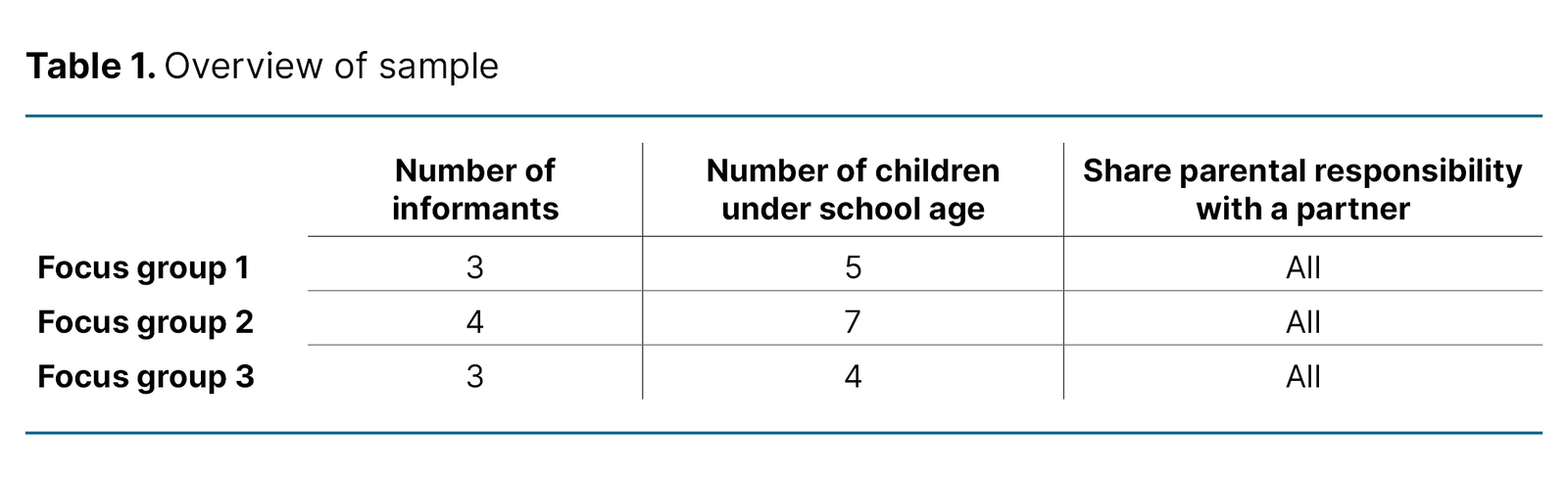
The inclusion criteria were having at least one child under school age and the ability to participate in a group discussion in Norwegian. A total of ten informants were recruited, distributed across three focus groups. Seven women and three men participated in the study. They all had a partner with whom they shared parental responsibility, and the majority had two children under school age in the family (Table 1). The sample was homogenous in terms of socioeconomic background and ethnicity.
Data collection
Three focus group interviews were conducted using a semi-structured interview guide. Two of the groups had three participants and the third had four. Some of the participants came from small municipalities where they may have already known each other.
We carried out the interviews, which lasted from 50 to 60 minutes, in autumn 2023. The first and second authors took it turns to be moderator and co-moderator. We audiotaped the interviews, which were transcribed verbatim afterwards.
Analysis
The data were coded and analysed using Aksel Tjoras’ stepwise deductive-inductive method (SDI) (25). This is a structured analysis method that precludes reaching hasty conclusions. Both authors carried out the empirical coding individually, and this was then converted into a joint set of codes that were refined to code groups. Subsequently, we worked in partnership to generate themes and subthemes in light of the theoretical framework on changes in the parental role and the child’s role in the family (Table 2)

Ethical considerations
The study was reported to the Norwegian Agency for Shared Services in Education and Research (Sikt) (reference number 615343). In line with national research ethics guidelines, all informants received information about the study and gave their written consent to participating (26). The interviews were audiotaped and stored in Nettskjema. The data material was anonymised during transcription. During the analysis, we kept in mind our own bias regarding the subject.
Results
The parents’ thoughts about screen use were generally emotional. The findings were divided into two main themes: 1) ‘The screen as something positive’, and 2) ‘The screen as something negative’.
The screen as something positive
The screen was described as a positive and necessary contributor to the family, with screen time together with the child providing an opportunity for shared time. The parents highlighted their pleasure in observing the child’s enthusiasm or finding out what games the child mastered:
‘It’s great fun seeing how involved he is in it. I think it’s an enjoyable activity we do together’ (Informant 10).
The parents found the quiet time together with their children enjoyable in their otherwise busy daily life. They believed that the children noticed that their parents were also having a good time relaxing in front of the television, so that it was a positive experience for the child.
However, the parents made it clear that they were not willing to watch just any programme. They wanted to have a say in deciding what the child should watch, as the quality of different children’s programmes vary.
If both adults and children were watching something in which they were both interested, the informants felt that shared screen time could allow them to talk about what was happening in the programme. One of the informants said the following:
‘It’s easy to join in, talk to them, there’s something in that. You can learn something about some feelings, reactions, that kind of thing’ (Informant 6).
In addition to shared time, the parents used the screen to cope with a hectic workday. They could make a meal without being disturbed, or do other tasks without having the children in tow. The child’s screen time was described as ‘sacred’, and the parents said that it gave them a break from the parental role without the child feeling they were being excluded.
When the parents did not have the capacity to play with the child, they regarded the screen as an opportunity to have personal time. Several informants believed that personal time was essential for them to be the best version of themselves. Some described it as a break they could use to reset and find new energy for better interaction with the child.
The screen was also described as a useful diversion, for example when the family had to drive long distances, or when brushing teeth or when there was general unrest. Meanwhile, several parents emphasised that using the screen as a diversion during meals or as a consolation or reward was not good for the child.
The screen as something negative
The screen was described as a necessary evil, and the parents worried about how screen use affected their children. The parents often had a bad conscience when reflecting on how they regulated their children’s screen time and how the screen made their children passive. One informant described how their daughter said nothing about her basic needs:
‘If she has a wet nappy, the TV can make her ignore it’ (Informant 2).
The parents found that their children were engrossed by the screen and that it was difficult to achieve contact with them. They described some programmes as particularly provocative, and a few described such programmes as ‘toxic TV’.
They pointed out that it was particularly challenging to end screen use and it resulted in an emotional explosion. One parent said that if their child got angry when they turned off the TV, they often had to allow the child to use their mobile for a while to calm down. Many of the parents had found that switching off led to conflict with the child even when another fun activity was planned:
‘It’s often negative, trying to do something else that might have been fun to start off with. The screen wins every time’ (Informant 6).
Concerns about screen use were also linked to possible long-term consequences. Parents vacillated between thinking that ‘everyone knows too much screen time is not recommended’, and ‘is it really that bad?’. They wanted to limit screen time so that their children were not sitting inside and ‘missing out on the world outside’.
The findings depict parents who deal with their children’s screen time with uncertainty and ambivalence. Doubt and feelings of guilt dominate. The recommendation of no screen time for children under two years of age appears impossible to achieve. Parents spend a lot of energy thinking about their children’s screen use:
‘I sort of notice that I’m really stressed by it and actually think a lot about it in my daily life’ (Informant 3).
Another informant said, ‘Just today, an alert popped up saying, ‟When children under the age of five watch TV more than two hours a day,” – that’s quite a lot actually – ‟they have eight times more chance of getting ADHD and becoming overweight and having anxiety and depression.” So I just thought, ‟Oh my goodness, yes, that’s true”’ (Participant 10).
Our findings indicate that parents regard themselves as the ones to blame for the child’s screen use. They use expressions like ‘resort to’ the screen, or that it is difficult to refrain from using the screen ‘in a pinch’:
‘And it’s kind of like, when everything is hopeless, and everything is kind of wrong, and they don’t want to take part in baby gym, don’t want to do anything, you know that the screen will work. So it’s kind of sad, really’ (Informant 10). ‘It’s really sad. But it’s also great’ (Informant 9).
Several parents felt guilty because they allowed more screen time than they had planned. Even though they had clear opinions on regulating screen time before they had children, several acknowledged that they had had to compromise in the child’s very first year.
The conversations between the parents about their children’s screen use are affected by the media. Several asked whether what is published is research-based, or if it is fearmongering without scientific evidence. One informant reflected:
‘So I think it’s important to give guidance on what’s good enough, what are the consequences of failing to follow the advice, how bad is it, what can you compare it with, kind of. Like, how bad can it be? Say that you, you’re falling apart, and you just … there isn’t a minute of the day you don’t stick a screen in the kid’s face. What happens then? But I think it’s important to minimize the danger, as long as there’s evidence. Minimize the danger and reduce the shame’. (Informant 8)
Discussion
This study sheds light on parents’ experiences of screen use in young children. The findings are discussed in light of parental role theory and views of the child’s role in the family. Parents’ experiences alternate between enthusiasm for the opportunities offered by screen use and difficult emotions linked to how it affects the child.
Digital parenting is a struggle between good and evil
The screen is well integrated into family life (27). Our study and previous studies find that parents are concerned about their children’s screen use (9). Nevertheless, they frequently do not live up to their own ideals regarding how much screen time children should be allowed (16).
To legitimise screen use, they highlight the positive aspects, for example the child’s enjoyment and learning opportunities. Meanwhile, as other studies confirm, parents spend considerable energy worrying about the possible consequences of the screen use that they themselves permit (6, 28).
Studies show that the screen can have a positive impact on parent-child interaction when used as an educational tool and shared experience (15–17). The findings in our study confirm this, but the parents emphasised that what they watch together with the child must have some educational quality.
The parents’ discussion of screen use is morally charged. The clash between what the parents describe as ideal screen use regulation and the child’s actual practice creates considerable stress. They acknowledge that they are unable to stay plugged into the parental role the whole time as the ideology of intensive parenting requires (2, 3), but that they allow their children to use the screen in order to get a longed-for break.
They appear to be paying for this through a bad conscience and greater stress, a finding supported by other research (29). In contrast to other studies, our findings indicate that parents are aware of strategies for screen use regulation but lack the energy to apply them.
When the children attend kindergarten and the parents are at work, this limits interaction between them to afternoons and weekends. We found that afternoons are particularly hectic for families with young children. Making dinner and doing housework are among the activities the parents must cover. Meanwhile they want quality time with the children to promote physical, mental and emotional development in line with ‘intensive parenting’. They are often exhausted and struggle to find personal time. It is well documented that children are often placed in front of the screen at this time (28, 30).
Some studies point out that the screen solves the stress and time squeeze parents experience in their daily lives (11, 31), while others show that the child’s screen use can lead to greater stress for the parents (32).
We found that the parents are keen to be good parents. They want to take part in interaction with the child, and the limited amount of time they spend together should be positive. The screen is an effective tool for distracting their children when it comes to brushing teeth, long drives or using a baby changing unit, and enables them to manage everything. The screen is both a childminder and pacifier – it is used as a reward, a distraction and a comfort. In a society where demands on the parents of young children seem almost unmanageable, it allows them to cope.
The public debate on screen use is a heavy burden on parents
Our study reveals that it is a common perception that screens are bad for children. The public debate in the media is the source of this perception. The discourse affects parents by making them uncertain of their own choices as regards regulating the child’s screen use. They believe that society’s discussion of screen use is one-sided and focuses only on concerns. Navigating a society where access to screens is so widespread becomes more difficult when there is a lack of nuance in the debate.
Previous research indicates that parents’ knowledge of screen recommendations is relevant for the amount of screen time they allow their child (8, 19, 20). However, parents think it is difficult to know what to believe, and find current screen recommendations difficult to uphold (30).
Our findings suggest that parents may know about the recommendations but nevertheless permit their children to use the screen at an earlier age than recommended or planned. We find the same phenomenon in other studies (21, 22, 30).
We may wonder why regulating screen use turns out to be much more difficult than the parents envisaged. Could the fact that they knowingly end up compromising with their ambitions for digital parenting be attributed to the demands that are placed on them?
Our findings indicate that the parents do not really want to change their own practice but dream of finding evidence that screen use is not so harmful so that they can continue with less guilt and shame.
Strengths and limitations of the study
As public health nurses, we are interested in the wellbeing of parents and children. When we talk about screen use in one-to-one consultations at the child health centre, we find that parents are fairly unwilling to share their thoughts about this. Therefore we wanted to explore how parents would talk to each other in a group and share their experiences.
A weakness of focus groups can be that participants have limited time to speak and group dynamics may affect their opportunity to speak freely (23). However, the choice of focus groups proved to be a strength as parents discussed freely, identified with what was being said and were glad to share their experiences with others.
It is recommended to have a minimum of four participants in a focus group. Nevertheless we chose to have three participants in two of the groups due to last-minute absence. Despite our efforts to recruit broadly, the sample consisted only of ethnic Norwegians because two participants with a different ethnic background chose to withdraw at short notice.
In addition, most of the participants had higher education and they had a partner with whom they shared parental responsibility. Studies suggest that the children of parents without higher education use the screen more (27).
The study would undoubtedly have benefitted from the recruitment of informants with a more varied social background. Consequently, our sample is not representative of the parent population in Norway today, which affects the transferability of the findings. However, the study provides valuable knowledge of how the informants in this study deal with children’s screen use in everyday life. The problems we elucidate presumably apply to other parent groups as well.
Our bias and involvement as public health nurses have influenced the choice of topic and our approach. As mothers, we have something in common with the informants and can recognise ourselves in the parents’ description, while also noting that the screen is used more than before in the interaction between parents and children at the child health centre.
We have attempted to be aware of our bias. The interview guide was based on open questions that were neither positive nor negative, and we did not guide the informants’ conversation to any degree.
Conclusion
The study shows that the screen is well integrated in family life, and is used in many situations, both by the child and the parents. The parents find that both they and the child gain benefit from the opportunities it offers. Meanwhile the constant evaluation of how to use the screen is taxing. The parents think a lot about how the screen affects the child, in both the short-term and long-term.
The screen recommendations issued by the health authorities aim to reduce the child’s screen time. The parents find the recommendations impossible to follow and know little about the grounds on which they are based. They cannot imagine daily life without screens and would all like screen use as they currently practice it to be legitimised. Moreover, they would like guidance on how best to use the screen.
Recommendations that seek to limit children’s screen time should differentiate between interactive activities together with others and passive activities where the child is left on its own.
The authors declare no conflicts of interest.
Open access CC BY 4.0
The Study's Contribution of New Knowledge

Comments