Are group-based self-management programmes suitable for all patients with type 2 diabetes?
Group-based self-management programmes make it easier to cope with the disease. However, half of all patients decline to participate in such programmes.
Group-based self-management programmes make it easier to cope with the disease. However, half of all patients decline to participate in such programmes.
When public health nurses use the EPDS screening tool in addition to their gut feeling and clinical judgment, they identify more mothers who need help.
Nurses with Norwegian as their mother tongue use a larger, and more nuanced repertoire in handover reports than those with Norwegian as a second language. However, they document numerical information in almost the same way.
They should be on the lookout for risk factors such as functional impairment, loneliness, changing roles and the feeling of being a burden.
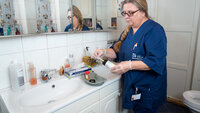
Differences in the level of knowledge and unreliable equipment make it difficult for health personnel in the home health care services to discover and diagnose urinary tract infection. We need national guidelines for the collection of urine samples and the use of urine dipsticks in the home care services.
They observe eye contact, comforting and other behaviours based on experience rather than by making use of recognised instruments. Their assessments are influenced by professional development opportunities, a heavy workload and interdisciplinary collaboration.
Involving a user and a professional translator may be appropriate when an instrument is translated and adapted to another culture.
Belonging to a team, flexibility and good systems for next-of-kin involvement create motivation.
Collaborative interdisciplinary meetings may increase the mutual respect between health professionals and provide more knowledge about the patient.
Different perspectives on what to prioritise, characterise the cooperation.